
Southeast Asia Program
Southeast Asian Summer Studies Institute (SEASSI)
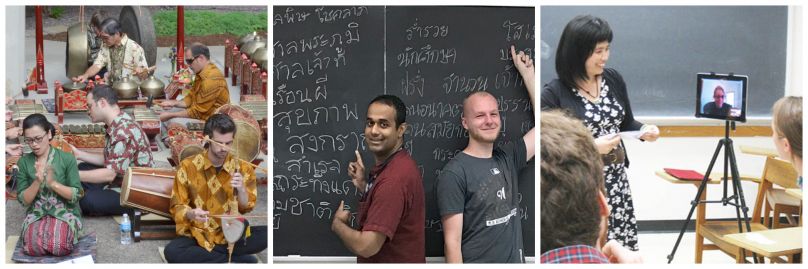
Earn two semesters of language credit at SEASSI this summer!
The Southeast Asian Studies Summer Institute (SEASSI) is an eight-week intensive summer language training program for undergraduates, graduate students, and professionals. It has been held since 1983, and hosted by the University of Wisconsin-Madison in 1994-1995 and then since 2000. The eight-week program is equivalent to two semesters of language study.
For SEASSI 2025, course instruction is offered in the following languages at the first, second and third year levels (i.e. Elementary, Intermediate, Advanced levels).
- Burmese (Online Only)
- Hmong (Online Only)
- Indonesian (Online & Limited In-Person Options)
- Khmer (Online Only)
- Lao (Online Only)
- Filipino (Tagalog) (Online Only)
- Thai (Online & Limited In-Person Options)
- Vietnamese (Online & Limited In-Person Options)
- In previous years, we have also offered Javanese language classes. (Online Only)
Instruction is given in small individualized groups taught by a team consisting of a coordinator (usually a linguist specializing in Southeast Asian language pedagogy) and teachers who are native speakers of that language. Instruction is intensive. Classes are held from 8:00 am to 1:30 pm, Mondays through Fridays (CDT). Most students find that they spend an additional three to four hours per day on homework.
SEAP offers funding for undergraduates students to attend SEASSI via SEASSI Language Scholarships. Further scholarships are available on the SEASSI website.
Application Deadline
Priority deadline March 1, 2026.
Stay Connected for Updates
More details about the program are available on the SEASSI website, and make sure you have subscribed to the SEAP listserv to receive the latest updates on deadlines for SEASSI applications and funding deadlines.
Additional Information
Indonesian Night 2024
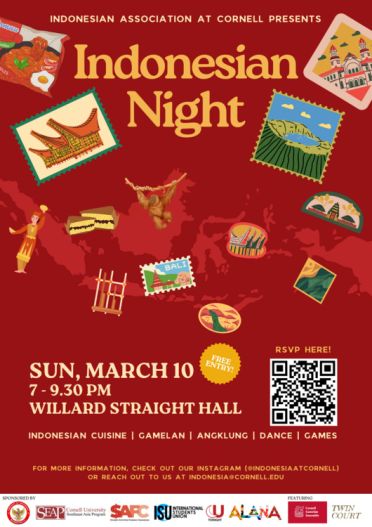
March 10, 2024
7:00 pm
Willard Straight Hall, Memorial Room
RSVP HERE: https://cglink.me/2ee/r2262810
Indonesian Night 2024, brought to you by the Indonesian Association at Cornell (IAC), is an annual celebration aimed at showcasing the vibrant cultural heritage of Indonesia to the Cornell community. This event is a unique opportunity to dive into Indonesia's diverse traditions and arts, completely free of charge. Attendees will be treated to an evening filled with performances that highlight traditional Indonesian musical instruments, including a special performance by the Cornell Gamelan Ensemble, dance by our very own student members, cultural exhibits, and a vast selection of Indonesian cuisine including coffee, offering an authentic taste of the country's rich cultural tapestry.
In anticipation of this cultural gala, the Cornell Chimes will enchant the campus with a medley of Indonesian songs on the Friday before the main event.
Additional Information
Program
Southeast Asia Program
Full Scholarships for SEASSI!

Apply by March 15
The Southeast Asian Studies Summer Institute (SEASSI) is an eight-week intensive summer language training program for undergraduates, graduate students, and professionals. It has been held since 1983, and hosted by the University of Wisconsin-Madison in 1994-1995 and then since 2000. The eight week program is equivalent to two semesters of language study.
Additional Information
How to Navigate AAS
March 6, 2024
8:00 pm
Are you a first-time attendee of the Association for Asian Studies annual meeting? A PhD student or early career researcher with questions about how AAS works, how to navigate such a large event, and how to build community with people who share your interests?
Join the GETSEA consortium for an informal discussion with Tom Pepinsky (Cornell), Trude Jacobsen Gidaszewski (NIU), and Nida Sanglimsuwan (UCLA) about the ins-and-outs of the AAS for students and scholars of Southeast Asia.
Additional Information
Program
Einaudi Center for International Studies
Southeast Asia Program
Cigarette Girl and Commodity Nationalism

March 1, 2024
4:00 pm
Kahin Center
Keynote address of the 26th SEAP Graduate Student Conference.
With its recent hit series Cigarette Girl, Netflix is shoring up its market position in Indonesia, the world’s fourth most populous country. Based on a novel by Ratih Kumala, Cigarette Girl weaves a tale of romantic family and business intrigue against a historical backdrop of postcolonial nationalism, political violence, and tobacco industry growth. Examining what Cigarette Girl reveals and conceals about the past, I argue that the series reproduces commodity nationalist aesthetics, fantasies, and ideologies that frame the clove cigarette (kretek) as indigenous cultural heritage. By centering the hand-rolled kretek and Javanese business rivalries, Cigarette Girl obscures how machine-rolled kretek and Chinese Indonesian families actually dominate the market. As the series grapples with other unresolved historical issues, including class and gender inequalities, the 1965/6 massacres, the military occupation of West Papua, and Indonesia’s tobacco-related disease epidemic, it also arrives at politically conservative conclusions.
Marina Welker is an associate professor in the Department of Anthropology at Cornell University. She is the author of Enacting the Corporation: An American Mining Firm in Postauthoritarian Indonesia (University of California Press, 2014) and Kretek Capitalism: Making, Marketing, and Consuming Clove Cigarettes in Indonesia (University of California Press, 2024).
Additional Information
Program
Einaudi Center for International Studies
Southeast Asia Program
Once Banned From the U.S., This Fiery Ex-army General is Poised to Lead Indonesia. What to Expect

Tom Pepinsky, SEAP
“Prabowo had a reputation in the military for fighting and for his short temper. While he might not have the same crassness or brashness of politicians like Rodrigo Duterte, Javier Milei or Trump, his politics replace concern for law and order with a preference for order over the law,” says Tom Pepinsky, professor of government and director of the Southeast Asia Program.
Additional Information
GETSEA Spring Mini-Course Applications Due Feb 26
Sea Nomads of Southeast Asia and Citizenship
Taught by Benny Baskara (Halu Oleo University) and Kumiko Kato (Sophia University)
Offered virtually from March to April, 2024 – see syllabus below for a full list of dates/times.
Apply here.Application deadline EXTENDED TO: February 26, 2024
Additional Information
Indonesian Markets Cheer as Prabowo's Likely Victory Removes Uncertainty
Thomas Pepinsky, SEAP
Tom Pepinsky, professor of government and director of the Southeast Asia Program, says “But as always with Prabowo, one must be wary of how he would respond to disappointing or negative economic news, and his dominating performance will mean that he will assume office with a relatively free hand.”
Additional Information
One Health: Understanding Threats to Wildlife and Human Health in Asia

March 7, 2024
1:00 pm
eCornell Keynote
From the river valleys and grasslands of Nepal to the high mountains of Central Asia, from tigers to leopards to vultures to Asiatic wild dogs (or dholes) — and from canine distemper to wildlife poisonings to the infectious diseases impacting wild sheep and goats as well as their domestic cousins — there is no shortage of threats to the health of these magnificent species and ecosystems, with some of these very same threats being of importance to agriculture and public health.
Join us as Dr. Martin Gilbert from the Cornell K. Lisa Yang Center for Wildlife Health and some of its students and team members share their fieldwork experiences and help illustrate how the health of wildlife and our own health and well-being are inextricably linked.
The Cornell K. Lisa Yang Center for Wildlife Health, with programs around the globe, strives to sustain a healthier world by developing and implementing proactive, science-based solutions to challenges at the interface of wildlife health, domestic animal health, human health and livelihoods, and the environment that supports us all. With its focus on Asia, the Cornell Wild Carnivore Health Program promotes the health and long-term sustainability of wildlife populations by advancing scientific tools and sharing knowledge to protect and improve the health of wild carnivores and their prey, all while seeking to mitigate human-wildlife conflict.
Register for the event here.
WHAT YOU'LL LEARN
How securing the health of our wildlife is key to conservationThe ways in which our health and the health of wildlife are inextricably linkedHow the field of wildlife health often yields surprisesHow wildlife resources are incredibly important to rural livelihoods and national economies
Additional Information
Program
Southeast Asia Program
South Asia Program
Einaudi Center for International Studies
Indonesia Wants EV Battery Makers. Nickel Is Its Big Draw.
Thomas Pepinsky, SEAP
Thomas Pepinsky, director of the Southeast Asia Program, comments on President of Indonesia Joko Widodo's economic performance.