
Development, Law, and Economics
Hot Air

Global Labor Institute conference recap
22 January 2026 Cornell Southeast Asia Program, Global Labor Institute and Thammasat Business School Bangkok Conference 'Hot Air: What works to combat extreme heat in apparel production in Asia?' Recap.
Additional Information
Institute for African Development Spring Symposium: Artificial Intelligence and the Global South: Perils, Pitfalls and Potential

April 23, 2026
9:00 am
401 Warren hall
April 23, 2026 401 Warren Hall Register Artificial intelligence (AI) is viewed by some as having great promise, while others view the arrival of this novel technology with skepticism or concern. AI is certainly having a significant impact in many arenas of life. What are the specific implications of AI for people living in the Global South? This conference will examine the specific social, political, environmental and economic impacts of AI in and for the Global South, taking a holistic, perspective that considers the historical, socio-cultural, environmental and political-economic context in which AI is embedded in and entangles with across the Global South. Keynote speakers from a range of disciplines will focus on specific themes.
Conference Schedule
8:00am - 8:30am Breakfast
8:30am Welcome Rachel Bezner Kerr Professor, Global Development Section Director, Institute for African Development, Global Cornell
8:45am - 9:00am Opening Remarks: Wendy Wolford Vice Provost for International Affairs, Office of the Provost Robert A. and Ruth E. Polson Professor, Global Development Section
9:00am - 10:00am Keynote Address: AI and Development Impacts Arthur Mutambara Director and Professor, Institute for the Future of Knowledge (IFK) University of Johannesburg (UJ) Q & A
10:00am - 10:15am Networking and Coffee Break
10:15am - 11:15pm Session I: Culture and Representation Rethinking AI Equity: Collaborative Perspectives from Ghana and the U.S
Hua Wang PhD, Associate Teaching Professor, Duffield College of Engineering, Cornell
Nancy Henaku PhD, Lecturer, Department of English, University of Ghana
Kwaku Owusu Afriyie Osei-Tutu PhD, Senior Lecturer, Dept of English, University of Ghana
11:15am-12:15pm Session II: Political Economy and Governance of AI in the Global South Clapperton Chakanetsa Mavhungaha Professor, Program in Science, Technology, and Society, Massachusetts Institute of Technology
Youssif Hassan Assistant Professor, Gerald R. Ford School of Public Policy and School of Information University of Michigan
12:15pm - 1:30pm Lunch and Poster Viewing 1:30pm-2:45pm Session III: Safety and Ethics with AI
Aditya Vashistha Assistant Professor, Cornell Ann. S. Bowers College of Computing and Information Science Cornell Ethics of AI in, for, and by the Global South
Trystan Sterling Goetze, Director, Sue G. and Harry E. Bovay Program in the History and Ethics of Professional Engineering, Cornell Duffield Engineering
Technology-facilitated gender-based violence against women in Sudan as a threat to the Women Peace and Security (WPS) Agenda
Lucie George PhD, University of Witwatersrand (Wits) Johannesburg
2:45pm - 3:00pm Tea break and Networking
3:00pm - 3:45pm Session IV: Creativity, Visual Arts, Healthcare and AI
The Problem in Pandamatenga’: Precarity, Power and AI as Actors in Southern African Border Communities
Rebecca Upton Professor of Global Public and Environmental Health; Director, Global Public and Environmental Health Program, Colgate University
Kelly Van Busum Assistant Professor of Computer Science & Software Engineering, Butler University
Artists, Creativity, and the Challenges of AI
Pedro Molina Political Cartoonist
3:45pm - 4:00pm Closing Discussion
cosponsors: STS, Cornell Global AI Initiative, Global Development.
Additional Information
Program
Einaudi Center for International Studies
Reppy Institute for Peace and Conflict Studies
Institute for African Development
The Enduring Business Case for Sustainability
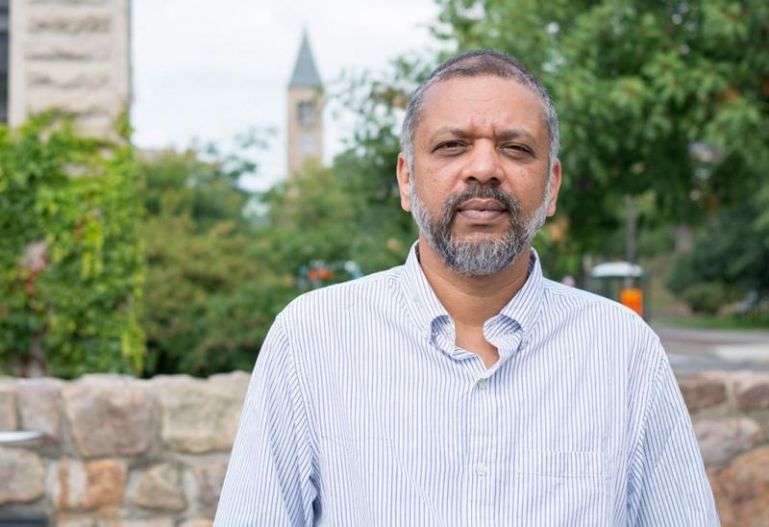
Sarosh Kuruvilla, SEAP
Sarosh Kuruvilla on sustainability in the textile industry.
Additional Information
The High Cost of Our GDP Obsession

Economic Inequality, Threats to Democracy, and Climate Crisis
Kaushik Basu (IES/SAP) writes about the limitations of GDP as an indicator of economic well-being.
Additional Information
Topic
- Development, Law, and Economics
Program
CRADLE Director Kaushik Basu Named Co-chair of UN Panel

Experts to Think Beyond GDP, Toward Sustainability
Gross Domestic Product (GDP) is heavily relied upon as a gauge of prosperity, but does not measure sustainable practices that consider the planet.
Additional Information
Temporary Labor Migration in Southeast Asia
GETSEA Mini-Course deadline extended to May 17
Taught by Kurt W. Kuehne, New York University Abu Dhabi
Offered virtually from June 24 to July 30, 2025, Tuesdays, 8:00pm-10:00pm Eastern Time. (Check this against your local time zone using a tool like this one)
Additional Information
Social Media and Playing at Democracy

Kaushik Basu, IES/SAP/CRADLE
In this op-ed, CRADLE director Kaushik Basu argues that social media has given the super-rich new tools to manipulate public opinion.
Additional Information
Topic
- Development, Law, and Economics
- World in Focus
Program
How scientists are using behavioral studies to help solve elephant-human conflict in Thailand

Joshua Plotnik featured on CBS 60 Minutes
CBS’s “60 Minutes” Profiles Work of Elephant Researcher Joshua Plotnik, who gave a Gatty several years ago and studied with our own Thak Chaloemtiarana!
View the full segment here: https://www.cbsnews.com/news/scientists-using-behavioral-studies-to-help-solve-thailand-elephant-human-conflict-60-minutes-transcript/
Additional Information
World at a Turning Point Interview

Human Development Report Director, Lead Author
UNDP's Dr. Pedro Conceição speaks with us during the Oct. 3–5 CRADLE conference on the state of the global economy.
This year's CRADLE conference, The World at a Turning Point: Cornell Conference on Development Economics and Law, takes stock of the global economy, with a special focus on the changing nature of labor markets, technological progress, inequality, climate change, and related laws and regulations. The three-day event is cosponsored by the Einaudi Center and the Department of Economics in the College of Arts and Sciences (A&S).
"Even if a country implements all the right policies, … it is still vulnerable to shocks that may emanate not from shortcomings of what it does within borders, but from the fact that countries are not coming together to address challenges."
On this page: Pedro Conceição, director of the United Nations Development Programme's Human Development Report Office, speaks with Arpit Chaturvedi, Cornell MPA ’18 and research manager to CRADLE cofounder and Carl Marks Professor of International Studies Kaushik Basu (A&S).
“Under Pedro Conceicao’s leadership, the Human Development Report has become one of the most important documents coming out of a multilateral institution,” Basu said. "It has widened the meaning of ‘human development’ and does not hesitate to wade into controversial themes and ideas."
Attend the Conference: The World at a Turning Point
A Conversation with Pedro Conceição
The UNDP Human Development Reports rarely focus on political issues, but the 2023–24 report released on Sept. 30 dedicates a chapter to political polarization. Why is addressing polarization crucial for providing global public goods?
For the most part, we know the kind of policies that would help countries and the international community to address shared challenges, from climate change to migration. The barriers to implementing these very rational—even obvious—policies seem to encounter difficulties that, it seems to us, lie beyond the realm of smart, technical policy advice.
For instance, shifting incentives toward decarbonized economies would benefit from increasing the cost of carbon, but that has been incredibly difficult to implement, both within many countries and internationally. Also, many high-income countries face declining fertility rates, shrinking populations, and challenges such as labor shortages and pension sustainability. Yet, immigration, which would help quite a bit, is incredibly difficult to manage.
In both cases, the difficulties lie more in the patterns of political polarization than in the technical details of what the solutions might be. So we felt that we needed to look into that a little bit to understand the meta-interventions that would make implementing the solutions to some of these challenges more likely to succeed.

The new report highlights how mismanaged interdependence, as seen in COVID-19, worsened inequalities. What lessons can be learned? How should institutions evolve to empower individuals in areas like climate change and digital governance?
One of the big takeaways is that even if a country implements all the right policies, makes all the right investments, and has “perfect” institutions, it is still vulnerable to shocks that may emanate not from shortcomings of what it does within borders, but from the fact that countries are not coming together to address challenges.
One of my big worries is that we look at the COVID-19 pandemic, and we think that we have gotten over the bump and fail to draw the most important implications about the failures of collective action of countries in the international community. Or that we look at it as a sectoral challenge—a health problem—to be addressed by, say, a pandemic treaty.
That is needed, of course, but our report invites us to reflect on a broader set of challenges in which countries are interdependent: pandemics are an example, but so is climate change. The global public goods framework helps us understand what is common to these challenges.
That analytical framework also enables us to understand what works and what works less well. For instance, because sovereign countries can always choose to leave an international treaty at will, we have to figure out ways they find it in their interest to remain in treaties. The trick is to have them realize that when it comes to global public goods, there are no zero-sum (competitive) dynamics, and structure incentives so that countries come on board.
You've had a unique career path, transitioning from physics to economics and public policy and now working in political economy at UNDP. What inspired these shifts?
I may have been guided by two things. One, curiosity. As a teenager, I wanted to understand the world through physics, particularly relativity, and quantum mechanics, which led me to study the math behind those theories throughout college. That took me through my college years and to my first professional experience, working on nuclear fusion in a European research project close to Oxford.
Over time, my curiosity was less about the science as such, and more about what kind of difference science could make in improving people’s lives. I became interested in science, technology, and innovation policy, and my curiosity broadened to other aspects that could improve standards of living, culminating with my ongoing interest in economic development.
I guess the other thing that drove me was trying to figure out where I could contribute the most. I was an average physicist, but it became clear to me that I would have to try to make more of a difference in other fields, so I studied economics and public policy and sought opportunities to learn and work in places where I could engage analytics to support decision-making.
Learn more about CRADLE and find out how to submit a paper to the open-access paper series.
Additional Information
Economics, Empathy, and the U.S. Election

Kaushik Basu, IES/SAP/CRADLE
“The current debate about outsourcing is often framed as a battle between workers…. But this overlooks the fact that outsourcing is fundamentally a labor-versus-capital issue,” writes CRADLE's Kaushik Basu.