
East Asia Program
2021 Korean Noraebang Contest
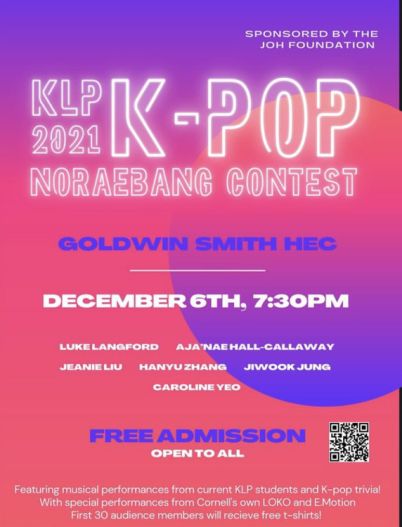
December 7, 2021
7:30 pm
Goldwin Smith Hall, HEC auditorium
The Korean Language Program will be hosting its 12th annual K-Pop Noraebang Contest on 12/6 (Mon) at 7:30pm in Goldwin Smith HEC auditorium. Korean language students who passed the audition will compete for awards and the audience will vote. Free Korean t-shirts will be given to the first 30 audience members and through trivia during the event. Enjoy the special performances by LOKO and E.Motion at the opening and closing. This event is sponsored by the Joh Foundation and is open to the public.
Additional Information
Program
East Asia Program
Future Directions in the Study of Migration and Racial Justice: A Postdoctoral Symposium

December 8, 2021
4:00 pm
Uris Hall, G-08
The Mario Einaudi Center for International Studies, in partnership with the Society for the Humanities, presents this symposium featuring five cutting-edge researchers whose work crosses disciplinary lines to tackle some of the world’s most pressing problems.
Join postdoctoral fellows Mohamed Abdou, Eman Ghanayem, Bamba Ndiaye, Eleanor Paynter, and Grace Tran for a discussion of their work in the fields of migration studies and global racial justice. Topics will include identity, colonialism and decolonization, indigeneity and dispossession, refugee studies and mobility, economic and social justice, and critical race theory. Learn how new approaches and developments are changing scholarship in these critical fields.
Einaudi Center director Rachel Beatty Riedl will introduce the event, and Viranjini Munasinghe (Department of Anthropology) will moderate.
Speakers
Mohamed Abdou, Global Racial Justice Postdoctoral Fellow, Einaudi Center"Non-statist Indigenous and Muslim Conceptualizations of Sovereignty: The Decolonial Inseparability of Race from Religion"
Eman Ghanayem, Mellon Postdoctoral Fellow, Department of Comparative Literature and Society for the Humanities"Being Native, Being Refugee"
Bamba Ndiaye, Mellon Postdoctoral Fellow, Department of Music and Society for the Humanities"From Mbas Mi to Mbëkk Mi: Covid-Induced Migration and Social Movement Advocacy in Senegal"
Eleanor Paynter, Migrations Postdoctoral Fellow, Einaudi Center"Witnessing Migration 'Crises': Race, Coloniality, and Asylum in Italy"
Grace Tran, Migrations Postdoctoral Fellow, Migrations Initiative"What’s Love Got to Do With It?: Transformative Effects of Vietnamese-American Engagement in 'Marriage Fraud' Arrangements"
Additional Information
Program
Einaudi Center for International Studies
Reppy Institute for Peace and Conflict Studies
East Asia Program
Southeast Asia Program
Latin American and Caribbean Studies
Institute for African Development
Institute for European Studies
South Asia Program
Laidlaw Scholars Info Session: support for first- and second-year research projects

November 30, 2021
5:00 pm
Tatkon Center, 105 RPCC
Learn about the Laidlaw Undergraduate Leadership and Research Program. Open to first- and second-year students, this 2-year program provides generous support to carry out internationally-focused research, develop leadership skills, engage with community projects overseas, and join a global network of like-minded scholars from more than a dozen universities.
Join us to learn more about the program, its benefits, and the application process, as well as tips for approaching potential faculty research mentors and writing a successful application. Sponsored by the Tatkon Center for First-Year Students and the Mario Einaudi Center for International Studies.
Additional Information
Program
Einaudi Center for International Studies
Reppy Institute for Peace and Conflict Studies
East Asia Program
Southeast Asia Program
Institute for African Development
Institute for European Studies
South Asia Program
Latin American and Caribbean Studies
"Strange Parallels: Consecrated Chinese Buddhist Images in Context"
December 3, 2021
12:00 pm
Please join us for a talk by James Robson 羅柏松 (James C. Kralik and Yunli Lou Professor of East Asian Languages and Civilizations, Harvard University).
It has become increasingly well-known that religious statues throughout Asia have hidden cavities that are filled with various objects inserted during a consecration ritual. This talk explores the hidden world of these statues through a discussion of a large collection of statues from throughout East Asia (China, Korea, Japan, and Vietnam), including some intriguing European examples. The history of such images has been the object of much research in Japan and Korea that this talk will also use to contextualize the Chinese Buddhist images. These statues provide a valuable glimpse of local religion, ritual practice, lay devotion, and sutra fragments. These statues also raise a host of significant interpretive questions for historians of religion, including issues such as the place of icon animation, idolatry, and iconoclasm in Chinese Buddhism and Chinese Religious history generally. The images discussed in this talk contain a niche carved into their back (or sometimes in the uṣṇīṣa, base, or pedestal) that is filled with a variety of objects, including relics, religious manuscripts and printed texts, medicinal herbs, desiccated insects, talismans with magical writing, and a “consecration certificate” or “vow text.” These statues are ubiquitous but have had a particularly intriguing history of visibility and concealment in East Asia and in Western scholarship. This talk will raise questions about why sacred images and icons such as these have been objects of extreme devotion for some, but also presented problems for priests, politicians, missionaries, philosophers, and academics who for various reasons have found them distasteful, attacked their validity and power, and have tried to hide them away or destroy them. Why, even in the face of ideological critique and iconoclastic destruction, have they persisted and proliferated?
The Cornell Buddhist Studies Seminar Series is co-sponsored by the GPSA-FC, the Departments of Anthropology, Asian Studies and Philosophy, by the South Asia Program, and by the Society for the Humanities. The talk is open to all interested; for accessibility queries please contact buddhiststudies@cornell.edu
Additional Information
Program
East Asia Program
Southeast Asia Program
South Asia Program
Paul Robeson, "The Black King of Songs, " and China
December 1 at 12:00 p.m.
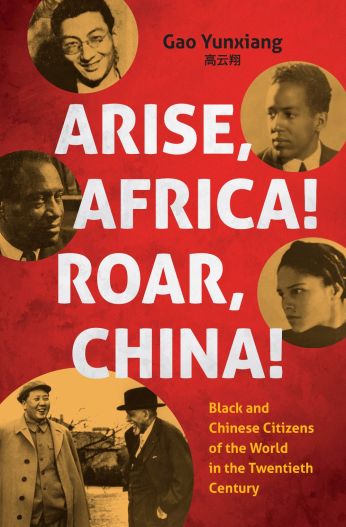
Professor Gao Yunxiang, History, Ryerson University, explores a chapter from her new book Arise, Africa! Roar, China! Black and Chinese Citizens of the World in the Twentieth Century (UNC Press, December 2021).
In this lecture, Gao unpacks the dynamic yet scarcely noted relations between Paul Robeson (1898-1976), the world famous African American singer, actor, athlete, lawyer, and political activist, and China throughout most of the twentieth century.
Please register in advance for this meeting.
Sponsored by the East Asia Program, EAP Graduate Student Steering Committee, The Mario Einaudi Center for International Studies, and the Global Racial Justice initiative.
Additional Information
Program
Mako Komuro Isn't The First Female Scion of Japan's Royal Family To Have Suffered From Mental Stress
Kristin Roebuck, EAP
“If you add up that legal disability that’s unique to the imperial family’s women, with the intense media scrutiny, and the incredible degree of control that they’re subjected to from a very conservative, elderly, masculine government, I think those women are exposed to pressures that would actually be unfathomable to most people in Japan, or outside Japan,” says Kristin Roebuck, assistant professor of history.
Additional Information
Is China a Part of Taiwan? - Shelley Rigger

The last of the Contemporary China Initiative series for Fall '21
The CCCI welcomes Shelley Rigger of Davidson University to address this question.
There is a long-standing debate over whether Taiwan is part of China. Beijing insists that not only is Taiwan part of China, it is part of the People’s Republic of China. Watch the lecture video here.
Most Taiwanese reject the idea that the island they live on is part of the PRC, and they would prefer to remain outside the PRC state’s jurisdiction. But when it comes to China – the abstract, cultural, historical idea of China – the situation is more interesting. While some Taiwanese embrace an identity that relegates Chineseness to a minor role (or even dismiss it altogether), most of Taiwan’s 24 million people recognize a cultural and historical attachment to China. Where the two sides differ is over the meaning of that attachment for contemporary political arrangements. Few Taiwanese are swayed by the historical determinism and cultural essentialism that underlie the PRC’s case for “unification.” Rather, they believe that political identity and citizenship should follow the will of the people, not the dictates of history.
Additional Information
The Lifespans of Lamas: Mining Biographical Data to Examine Tibetan Longevity
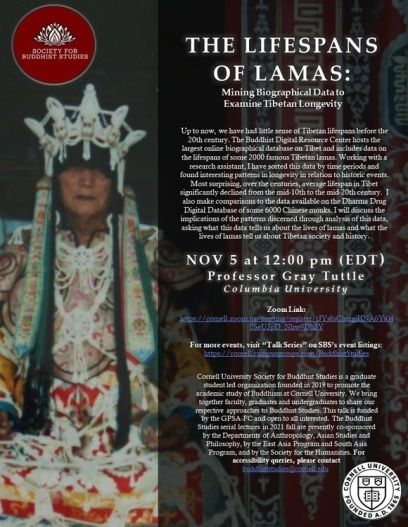
November 5, 2021
12:00 pm
Up to now, we have had little sense of Tibetan lifespans before the 20th century. The Buddhist Digital Resource Center hosts the largest online biographical database on Tibet and includes data on the lifespans of some 2000 famous Tibetan lamas. Working with a research assistant, I have sorted this data by time periods and found interesting patterns in longevity in relation to historic events. Most surprising, over the centuries, average lifespan in Tibet significantly declined from the mid-10th to the mid-20th century. I also make comparisons to the data available on the Dharma Drug Digital Database of some 6000 Chinese monks. I will discuss the implications of the patterns discerned through analysis of this data, asking what this data tells us about the lives of lamas and what the lives of lamas tell us about Tibetan society and history.
Additional Information
Program
East Asia Program
South Asia Program
Walley's Eight Dogs translation wins Japan-U.S. Friendship Commission Prize

Glynne Walley, translator of Kyokutei Bakin’s Eight Dogs, or “Hakkenden”: Part One—An Ill-Considered Jest, is co-winner of the Japan-U.S. Friendship Commission Prize for the Translation of Japanese Literature given by the Donald Keene Center for Japanese Culture.
The Japan-United States Friendship Commission Prize for the Translation of Japanese Literature was established in 1979, and the award has been administered by the Donald Keene Center of Japanese Culture at Columbia University since the Center was founded in 1986. The Prize is awarded annually to outstanding works of translation into English from the Japanese language.
Eight Dogs is the fourth in the Cornell East Asia Series to win this prize, following Stephen D. Miller and Patrick Donnelly’s The Wind from Vulture Peak (2015-2016), Matthew Fraleigh’s New Chronicles of Yanagibashi and Diary of a Journey to the West (2011-2012), and Mae J. Smethurst’s Dramatic Representations of Filial Piety (2001).
Eight Dogs was awarded the 2018-19 William F. Sibley Memorial Subvention Award for Japanese Translation by the Center for East Asian Studies at the University of Chicago. In 2020, Glynne Walley received a Presidential Fellowship in Humanistic Study from the University of Oregon to further his translation of Eight Dogs.
Professor Walley discussed his translation at the first CEAS author talk, hosted by the East Asia Program, on October 20. For more information on Eight Dogs, visit the Cornell University Press website or read the review in the Wall Street Journal.
Additional Information
Program
"Reconsidering Renunciation: Models of Practice and Devotion in the Biography of a Buddhist Woman."

November 12, 2021
12:00 pm
Asian Studies Faculty Lounge, Rockefeller level 3
Please join us for a talk by MK Long (PhD Candidate, Department of Asian Studies).
This paper opens the historical study of initiated female Buddhist devotees (thilashin) in Myanmar through analysis of the 1982 biography of Daw Medawadi (1862-1932), founder of a Buddhist nunnery (chaung) at the turn of the twentieth century. Attending to rhetorical models of practice that reveal the stakes of the historically specific and local social worlds in which thilashin have sought to establish and maintain institutional footholds, I reconsider the assumed predominance of tropes of renunciatory asceticism in the self-presentation of thilashin and propose a more closely calibrated understanding of thilashin as non-ordained but initiated women unevenly empowered by relationships and practices that enable their advancement on a Buddhist path to liberation. In particular, I focus on the biography’s emplacement of its subject, Daw Medawadi, within a family system and within a patronage network as evidence of the meaningful persistence of highly intimate and localized networks of belonging and affiliation amidst the state-driven reorganization of Myanmar Buddhist institutions of the 1980s. Read intertextually with other contemporary, vernacular Burmese literature written by and about thilashin, Medawadi’s life narrative and other thilashin biographies offer a vital and largely untapped source that can contribute to our understanding of the social and historical underpinnings of understudied institutional forms of female Buddhist devotion in Myanmar.
The Cornell Buddhist Studies Seminar Series is co-sponsored by the GPSA-FC, the Departments of Anthropology, Asian Studies and Philosophy, by the South Asia Program, and by the Society for the Humanities. The paper can be read in advance, by those with a Cornell NetID at this link; interested parties without a NetID may contact MK directly at ml2458@cornell.edu.
The talk is in-person and open to the graduate and professional student community; for accessibility queries please contact buddhiststudies@cornell.edu
Additional Information
Program
East Asia Program
Southeast Asia Program
South Asia Program