
East Asia Program
From Country to Nation: Ethnographic Studies, Kokugaku, and Spirits in Nineteenth-Century Japan

From Country to Nation tracks the emergence of the modern Japanese nation in the nineteenth century through the history of some of its local aspirants. It explores how kokugaku (Japan studies) scholars envisioned their place within Japan and the globe, while living in a castle town and domain far north of the political capital.
Book
55.00
Additional Information
Program
Type
- Book
- Cornell East Asia Series
Publication Details
Publication Year: 2021
ISBN: 9781501753930
Spring and Autumn Annals of Wu and Yue: An Annotated Translation of Wu Yue Chunqiu

Spring and Autumn Annals of Wu and Yue is the first complete English translation of Wu Yue Chunqiu, a chronicle of two neighboring states during China's Spring and Autumn period. This collection of political history, philosophy, and fictional accounts depicts the rise and fall of Wu and Yue and the rivalry between them, the inspiration for centuries of poetry, vernacular fiction, and drama.
Book
55.00
Additional Information
Program
Type
- Book
- Cornell East Asia Series
Publication Details
Publication Year: 2021
ISBN: 9781501754340
Perspectives 360 Film Festival: Virus Has No Nationality

June 11, 2021
7:00 pm
The Ithaca Asian American Association invites you to share your story through your lens, as you interpret and express your meaning of "Virus Has No Nationality."
You are encouraged to be bold in challenging issues of racism, sexism, xenophobia, ableism, heterosexism, classism, and all -isms. Through a five-minute film, we hope your creative expressions will inspire hope and possibilities for a better tomorrow.
The film festival is open to everyone regardless of age, experience, and status. All you need is a video recording device such as your phone. Films can be completed as an individual or group and must be submitted through FilmFreeway by Monday, May 31 to be screened on Friday, June 11, 2021, at 7:00 p.m. An award presentation will follow.
Filmmaking Criteria
Must be less than 5 minutes longCan be of any genreCan be created on mobile devices or digital camerasMust align with the “Virus Has No Nationality” campaign and feature a mask as a special propMust be submitted on FilmFreeway no later than May 31, 2021Awards
Six $500 Scholarship Prize awarded to best high school and college studentsTen $100 Gift Certificates to local businesses and eateries for best general submissionsSponsors
The film festival is made possible by the Park Foundation, and it is supported by:
Building BridgesCAN Cooperative Media/Sustainability SentinelCommunity Leaders of Colors (CLOC)Cornell Asian and Asian American Center (A3C)Dorothy Cotton InstituteGlobal CornellGreater Ithaca Activities Center (GIAC)Ithaca Mural AssociationKhuba InternationalLearning FarmsTompkins County's Office of the Human Rights.Please contact Ithaca Asian American Association at iaaa607@yahoo.com for more information and with any questions.
Additional Information
Program
Einaudi Center for International Studies
East Asia Program
Southeast Asia Program
South Asia Program
Eun A Jo, PACS/EAP: Einaudi Student Path (video)
Eun A Jo is a PhD student in government and a Peace and Conflict Studies Fellow with the Einaudi Center's Judith A. Reppy Institute for Peace and Conflict Studies. Through support from the Reppy Institute, East Asia Program, and Einaudi Center more broadly, she has been able to travel for research to explore comparative questions of peace and conflict.
Additional Information
EastAsia+ Joshua Neves

“Southern Effects: Kaiju, Cultural Intimacy, and the Production of Distribution”
Joshua Neves, Associate Professor and Director of the Global Emergent Media (GEM) Lab at Concordia University (Montréal) spoke on “Southern Effects: Kaiju, Cultural Intimacy, and the Production of Distribution." His talk traces a particular genealogy of special effects in Asia, the talk moving from King Kong (1933) and Godzilla (1954) to the 2013 Chinese-Korean blockbuster Mr. Go (Kim Yong-hwa, 2013) and the 2021 release of King Kong vs. Godzilla, among others. This talk was recorded on April 29, 2021.
Presented by the Cornell EastAsia+ Initiative, a collective of scholars, publishing professionals, curators, and graduate students dedicated to exploring new possibilities for academic publishing, networking, and collaboration in East Asia media studies and digital humanities research.
EastAsia+ is generously supported this spring by funding from Cornell University’s Society for the Humanities.
Additional Information
CCCI: Gerald Roche

Tibet, China, and Settler Colonialism
CCCI welcomed Gerald Roche, Senior Research Fellow, LaTrobe University to speak on "Tibet, China, and Settler Colonialism." The term settler colonialism is increasingly being used to describe the relationship between the People’s Republic of China and its so-called ethnic minorities, such as Tibetans and Uyghurs. Roche provides a brief overview of settler colonialism as both a framework for scholarly analysis and real-world practice of domination. He also discusses urbanization in Tibet as a technique of settler colonialism, particularly the relationship between urbanization and migration. This talk was recorded on April 12, 2021.
Additional Information
CCCI: International reproduction migration with Biao Xiang
The Case of China
Biao Xiang, of Oxford/Max Planck Institute spoke on "International Reproduction Migration: the Case of China." Reproduction migration from China has increased much faster than labor or settlement migrations since the 1990s. Those who have benefited from China’s development the most leave the rising center of the world economy. They do so to internationalize their reproduction arrangements, and to pursue capital conversation (e.g. from money to status) at the cost of capital accumulation. This talk was recorded on May 10, 2021.
Additional Information
Virtual Research Seminar on The COVID-19 Crisis: Policies, Outcomes, and Lesson Drawing
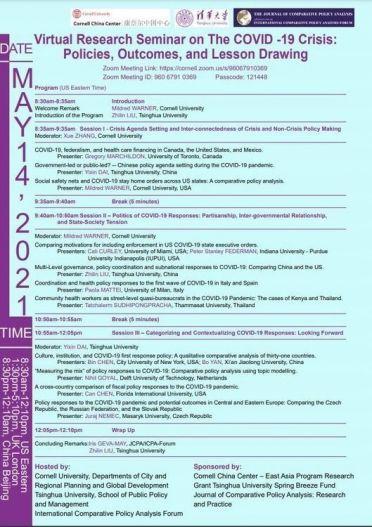
May 14, 2021
8:30 am
Cornell University and Tsinghua University are cohosting this international seminar with papers exploring policy responses to COVID-19 from across the world. The papers are featured in a special issue of the Journal of Comparative Policy Analysis, just published.
Special Issue on The COVID -19 Crisis: Policies, Outcomes, and Lesson Drawing, Journal of Comparative Policy Analysis: Research and Practice, 2021, 23 (2) https://www.tandfonline.com/toc/fcpa20/current
Dr. Xue Zhang (Global Dev) and Dr. Mildred Warner (City and Reg Planning and Global Dev) have a paper in this collection based on work supported by the Cornell Center for Social Sciences and Cornell Center for Inequality.
This seminar is funded in part by a Cornell China Center-East Asia Program grant.
Program (US Eastern Time)
8:30am-8:35am Introduction Welcome Remark Mildred Warner, Cornell University Introduction of the Program Zhilin LIU, Tsinghua University
8:35am-9:35am Session I - Crisis Agenda Setting and Inter-connectedness of Crisis and Non-Crisis Policy Making Moderator: Xue ZHANG, Cornell University COVID-19, federalism, and health care financing in Canada, the United States, and Mexico. Presenter: Gregory MARCHILDON, University of Toronto, Canada Government-led or public-led? -- Chinese policy agenda setting during the COVID-19 pandemic. Presenter: Yixin DAI, Tsinghua University, China Social safety nets and COVID-19 stay home orders across US states: A comparative policy analysis. Presenter: Mildred WARNER, Cornell University, USA
9:35am-9:40am Break (5 minutes)
9:40am-10:50am Session II – Politics of COVID-19 Responses: Partisanship, Inter-governmental Relationship, and State-Society Tension Moderator: Mildred WARNER, Cornell University Comparing motivations for including enforcement in US COVID-19 state executive orders. Presenters: Cali CURLEY, University of Miami, USA; Peter Stanley Federman, Indiana University - Purdue University Indianapolis (IUPUI), USA Multi-Level governance, policy coordination and subnational responses to COVID-19: Comparing China and the US. Presenter: Zhilin LIU, Tsinghua University, China Coordination and health policy responses to the first wave of COVID-19 in Italy and Spain Presenter: Paola MATTEI, University of Milan, Italy Community health workers as street-level quasi-bureaucrats in the COVID-19 Pandemic: The cases of Kenya and Thailand. Presenter: Tatchalerm SUDHIPONGPRACHA, Thammasat University, Thailand
10:50am-10:55am Break (5 minutes)
10:55am-12:05pm Session III – Categorizing and Contextualizing COVID-19 Responses: Looking Forward Moderator: Yixin DAI, Tsinghua University Culture, institution, and COVID-19 first response policy: A qualitative comparative analysis of thirty-one countries. Presenters: Bin CHEN, City University of New York, USA; Bo YAN, Xi’an Jiaotong University, China “Measuring the mix” of policy responses to COVID-19: Comparative policy analysis using topic modelling. Presenter: Nihit GOYAL, Delft University of Technology, Netherlands A cross-country comparison of fiscal policy responses to the COVID-19 pandemic. Presenter: Can CHEN, Florida International University, USA Policy responses to the COVID-19 pandemic and potential outcomes in Central and Eastern Europe: Comparing the Czech Republic, the Russian Federation, and the Slovak Republic Presenter: Juraj NEMEC, Masaryk University, Czech Republic
12:05pm-12:10pm Wrap Up Concluding Remarks:Iris GEVA-MAY, JCPA/ICPA-Forum Zhilin LIU, Tsinghua University
Additional Information
Program
Einaudi Center for International Studies
East Asia Program
China: In Search of a Green Economy

May 20, 2021
8:00 am
Climate change and environmental degradation is a threat for economic prosperity. In relation to its commitment to achieve the Paris Agreement goals, China is aiming to reach carbon neutrality by 2060. China is leading in renewable energy production figures. It is currently the world's largest producer of wind and solar energy and the largest domestic and outbound investor in renewable energy. At the same time, Greenhouse gas emissions by China are the largest of any country in the world both in production and consumption terms. This stems mainly from coal electricity generation, which represents 60 percent of power and mining.
Carbon neutrality refers to the elimination of carbon dioxide. China’s government supports R&D efforts for green technology innovation. A major challenge is the greening of China’s manufacturing system to create a more sustainable economy. International cooperation for the greater good of mitigating global warming is urgently needed and China’s green trajectory comes with both opportunities and challenges for the rest of the world.
What You’ll Learn:
China’s goals to reduce greenhouse gas emissionsChallenges and opportunities of green technologyInternational cooperation regarding Paris Agreement GoalsSpeakers:
Lourdes Casanova, Senior Lecturer, Director Emerging Markets InstituteHenri Li and Gari Xiao, Yingke Law FirmYan Chen, China International Capital Corporation (CICC)Crystal GENG, Ping An Insurance (Group) Company of China, Ltd.Moderator: Ying Hua, Director, Cornell China CenterQ&A moderator: David (Wei) Wu, Executive Project Manager and AttorneyThis event is cosponsored by the Emerging Markets Institute, the Cornell China Center, and eCornell.
Event time:
8:00-9:30 am New York time
8:00-9:30 pm Beijing time
Registration link: https://ecornell.cornell.edu/keynotes/overview/K052021/
Registration link for attendees in China: https://cornell.zoom.us/webinar/register/WN_VZn0gi57Q3WQl_5J680zTA
(Attendees in China should register and attend through the Zoom link, as the eCornell platform may not work in China.)
Additional Information
Program
Einaudi Center for International Studies
East Asia Program
Race Matters: Research Questions in International Relations

May 20, 2021
11:00 am
The Einaudi Center’s global racial justice research team presents the inaugural session of Race Matters, a new webinar series that fosters in-depth conversations on colonial questions and racial justice across international relations.
This panel brings together global experts for a candid appraisal of disciplinary instruments (methods, archives, concepts, ontologies, and epistemologies) and institutions (practices of knowledge production and incorporation as policy). The debate centers the question: How effectively do our tools for producing and shaping knowledge and policy serve the cause of advancing racial equality and justice globally?
Some of the panelists critique methods and lines of inquiries in scholarship on race and racism. Others presume an insurgency by self-determining political communities—including in the academy—against colonizing institutional practices and in favor of the expansion of archives and imaginaries.
This conversation represents an initial framing of questions and critiques that will continue in four additional Race Matters panels through the fall 2021 semester. Read more about the series below.
Moderator: Siba Grovogui, Africana Studies, Cornell University
Panelists:
Daniel Bendix, Franziska Müller, and Aram Ziai, coeditors of Beyond the Master’s Tools? Decolonizing Knowledge Orders, Research Methods, and Teaching (2020)Mustapha K. Pasha, Meera Sabaratnam, and Robbie Shilliam, series editors of Kilombo: International Relations and Colonial QuestionsDiscussants: Oumar Ba, Political Science, Morehouse College; Sarah Then Bergh, Africana Studies PhD candidate, Cornell University
***
Race Matters: A webinar series sponsored by Cornell’s Mario Einaudi Center for International Studies, Africana Studies and Research Center, and Department of Government
Race Matters brings together international relations experts for critical conversations on colonial questions and racial justice across international relations. Join us to explore scholarship on race and racism and the policies, institutions, and systems that perpetuate racial inequality and violence worldwide. Continuing throughout 2021, Race Matters will identify opportunities for transformative change and highlight collective and individual actions toward a more just world.
Learn about the Einaudi Center’s work on racial justice and all of our global research priorities.
Register now: https://cornell.zoom.us/webinar/register/WN_hYI75wwITDOvrOW_ZTHY6Q
Additional Information
Program
Einaudi Center for International Studies
Reppy Institute for Peace and Conflict Studies
East Asia Program
Southeast Asia Program
Latin American and Caribbean Studies
Institute for African Development
Institute for European Studies
South Asia Program