
Einaudi Center for International Studies
Mass Detention and Forced Assimilation of Uyghur Children in China

Magnus Fiskesjö, EAP/PACS/SEAP
"One of history’s largest operations to confiscate children to force-assimilate them is currently under way in China’s colonized territories," writes Magnus Fiskesjö in a CETNI report published July 19.
"One of history’s largest operations to confiscate children to force-assimilate them is currently under way in China’s colonized territories," write Magnus Fiskesjö and Rukiye Turdush. "Organized by the Chinese government, this massive campaign forms part of a set of measures targeting twelve to fifteen million ethnic Uyghurs, Kazakhs, and other Turkic ethnicities who live in East Turkistan."
Fiskesjö and Turdush's report on the events in China's territories is written in conjunction with the symposium on "Uyghur Children in China’s Genocide," held at Cornell University in October 2023.
Additional Information
Topic
- World in Focus
Program
Influence and Counter-Influence in Networks
Paper
Additional Information
Type
- Paper
- CRADLE Law and Economics Papers
Publication Details
Publication Year: 2024
Chuan Liao

Assistant Professor, Global Development
Chuan Liao is an interdisciplinary sustainability and environmental social scientist. Chuan’s research interest lies at the intersection of environment, development, and justice. He develops and applies integrated approaches to study human-environment interactions by linking statistical, spatial, and other quantitative methods. He has worked on topics that include land tenure and land use change, dryland system sustainability, sustainable energy transition, and circular bionutrient economy.
Additional Information
Andrew Reid Bell

Schleifer Family Associate Professor of Sustainability, Global Development
Andrew Reid Bell is the inaugural Schleifer Family Professor of Sustainability in the Department of Global Development at Cornell University. His work draws on agent-based modeling tools, informed by field and behavioral experiments.
Additional Information
Basil Safi

Executive Director, Einhorn Center for Community Engagement
Basil is responsible for providing senior leadership, planning and strategy development in support of the Einhorn Center to shape a wide range of projects and initiatives in community engagement. He advises senior university leaders on key issues, provides recommendations for strategic planning and oversees coordination, analysis and reporting for the center’s activities.
Additional Information
Kieran Donaghy

Professor Emeritus, City and Regional Planning
Kieran Donaghy's research and teaching focus on issues of globalization, development ethics, climate change and environmental policy, macroeconomic modeling, regional planning, infrastructure systems, and international conflict resolution. He is the departing faculty director of economic development at Cornell's Atkinson Center for a Sustainable Future and has served as a consultant to the World Bank, the European Commission, research departments of several European central banks, and other international, state, and federal agencies.
Additional Information
Kurt Jordan

Professor, Anthropology, American Indian and Indigenous Studies Program
Kurt Jordan's research centers on the archaeology of Haudenosaunee (Iroquois) peoples, emphasizing the settlement patterns, housing, and political economy of seventeenth- and eighteenth-century Senecas. The empirical evidence provided by archaeology can do much to combat inaccurate narratives of Indian decline and powerlessness that pervade scholarly and popular writing about Native Americans.
Additional Information
Exhibition Highlights Overlooked Colonial Latin American Art
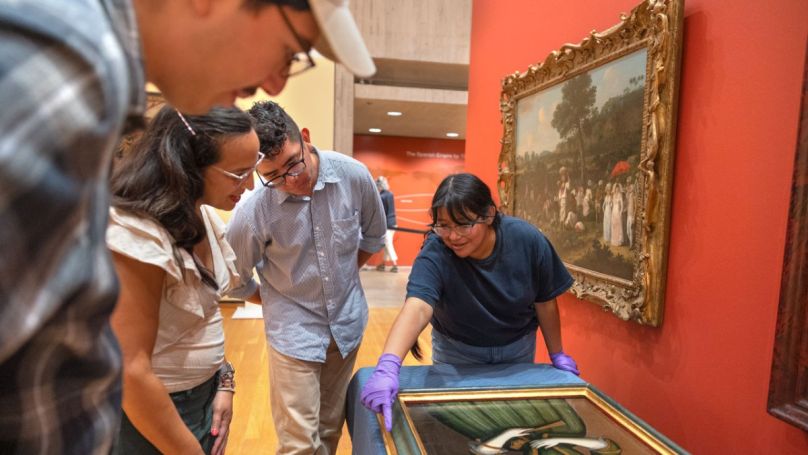
Cocurated by Ananda Cohen-Aponte, LACS
"Colonial Crossings," the first exhibition of colonial Latin American art at Cornell, is now on view at the Herbert F. Johnson Museum of Art.
Additional Information
Netanyahu vs. The Generals
September 12, 2024
12:00 pm
Uris Hall, G08
The Civil-Military Rift in Contemporary Israel
The era of Benjamin Netanyahu, Israel’s longest-serving prime minister, has been characterized by unprecedented civil-military tensions. Netanyahu’s carefully cultivated self-image as Israel’s “Mr. Security” has long been rejected by the Israeli national security community, which has opposed both his leadership and his policies, particularly with respect to the Palestinians. In recent years, populist-nationalist politicians allied with Netanyahu have stepped up their attacks on the heads of the Israeli army, the Mossad intelligence agency, and the Shin Bet domestic security service in what has become part of a broader pattern of assaults on state institutions. This development has major implications for Israel’s future as a democracy, its relations with the Palestinians, and its relationship with the United States, Israel’s most important ally.
About the Speaker
Dr. Guy Ziv is an associate professor in the Department of Foreign Policy and Global Security at American University’s School of International Service (SIS). He also serves as the associate director of AU’s Meltzer Schwartzberg Center for Israel Studies. He teaches courses on U.S. foreign policy, international negotiations, U.S.-Israel relations, and Israeli-Palestinian peacemaking. Professor Ziv is the recipient of the SIS Outstanding Teaching Award in 2014, the William Cromwell Award for Outstanding Teaching in 2019, and the SIS Outstanding Scholarship Award in 2024.
His latest book is titled Netanyahu vs The Generals: The Battle for Israel’s Future, published by Cambridge University Press (2024). His first book, Why Hawks Become Doves: Shimon Peres and Foreign Policy Change in Israel, was published by SUNY Press in 2014.
Dr. Ziv has a background in policy, having worked on Capitol Hill and for not-for-profit organizations that promote Israeli-Palestinian peacemaking. His articles have been published in peer-reviewed academic journals, as well as leading newspapers and news sites, including CNN.com, Haaretz, The Jerusalem Post, The New York Daily News, The Philadelphia Inquirer, and USA Today. He also appears regularly as a commentator in major media outlets including BBC, Bloomberg TV, CNN, MSNBC, NPR, Sky News, and Voice of America.
Host
Reppy Institute for Peace and Conflict Studies
Co-Sponser
Jewish Studies Program
Additional Information
Program
Einaudi Center for International Studies
Reppy Institute for Peace and Conflict Studies
The State of Indonesian Democracy

August 2, 2024
9:00 am
Johnson Museum of Art
This workshop brings together scholars from around the world who specialize in contemporary Indonesian politics to discuss the state of Indonesian democracy, with a particular emphasis on events and dynamics associated with the 2024 elections.
This workshop is organized in collaboration with the Southeast Asia Program, the Modern Indonesian Project, and Cornell’s Einaudi Center for International Studies, with additional support from the Department of Government and the Brooks School of Public Policy.
A full schedule for the workshop is available here.
Additional Information
Program
Einaudi Center for International Studies
Southeast Asia Program