Einaudi Center for International Studies
Election Alert
Polarization in Ecuador Highlights Risks for U.S. Democracy
"The basic rules of the electoral process are no longer mutually recognized,” says Kenneth Roberts, based on research at the Ecuador Global Hub.
Additional Information
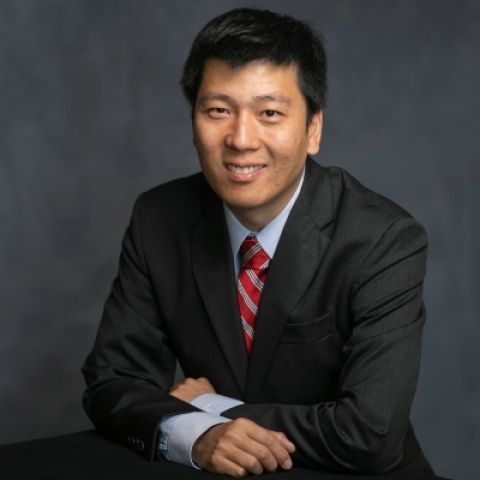
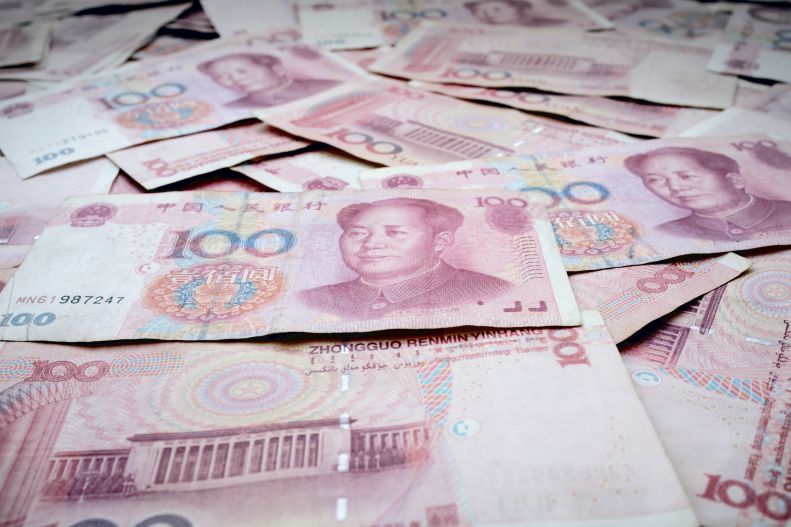
America and China Don’t Need to Knock Each Other Out to Win
Jessica Chen Weiss, EAP
Competition and conflict between the United States and China have continued to intensify, writes Jessica Chen Weiss, professor of government and public policy, in New York Times commentary.
Additional Information
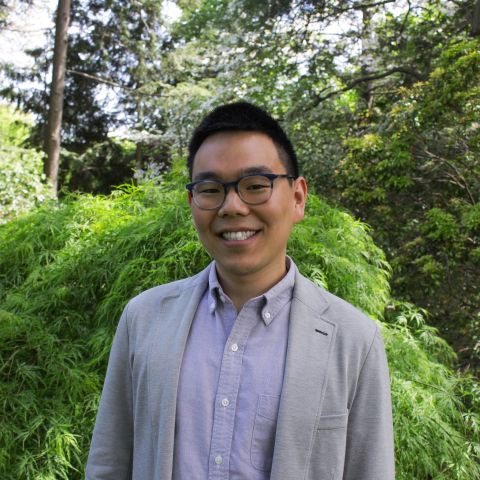
Role of African Union Scrutinized in Ethiopia, Tigray Peace Talks
Oumar Ba, Global Public Voices and IAD
Oumar Ba, assistant professor of government, says "the war in the AU’s host state of Ethiopia shows that, despite its broad mandate and the African Peace and Security Architecture, it is still struggling to become an effective organization with a meaningful imprint on conflict resolutions in the continent."
Additional Information
Food Shock: Crop-battering Disasters Highlight Climate Threat
Rachel Bezner Kerr, Einaudi
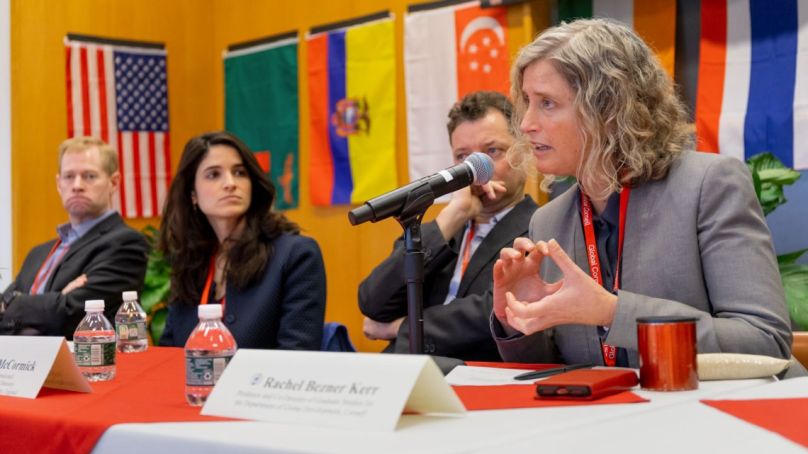
Rachel Bezner Kerr, professor of global development and a lead author of the UN's landmark IPCC report, says, “It does feel like our report is being lived out in real time.”
Additional Information
Ukraine ‘Increasingly Successful’ at Destroying Shahed-136 Drones: U.K.
Sarah Kreps, PACS
“I think these are operating on a different model, which is kind of the law of large numbers,” says Sarah Kreps, professor of government and public policy. “If we deploy 30 of these, if five get through, they could do some damage to the Ukrainian energy infrastructure.”
Additional Information
Xi Jinping’s Power Play Augurs Little Scope for Improvement in US-China Relations
Jessica Chen Weiss, EAP
This piece references an analysis written by Jessica Chen Weiss, professor of government and public policy, for Foreign Affairs Magazine.
Additional Information
Across the Archives: Colonial Photography on the Philippines
November 19, 2022
7:00 pm
Join us for an online discussion on Cornell University's Gerow D. Brill Collection and Michigan University's Dean C. Worcester Photographic Collection, hosted by the Committee on Research Materials on Southeast Asia (CORMOSEA), the Southeast Asia Program (SEAP), and the Southeast Asia Digital Library (SEADL).
Speakers:
Claire Cororaton, PhD Candidate, Cornell University
Claire Cororaton is a 6th year Ph.D. Candidate in History at Cornell University. Her dissertation, tentatively titled “Emplotments of Freedom: Agricultural Development and ‘The Philippine Question’, 1898 – 1941” examines the relationship between ideas of agricultural development and state capitalism in the Philippines. She explores how imperial and racial understandings of land and property suffuse American and Filipino discourses of “national development” through the first half of the 20th century. The Janus-faced nature of American and Philippine exceptionalist rhetoric prior to the era of decolonization —that the Philippines was a great “democratic experiment” in Southeast Asia, amidst other colonized regions—belied the development of an authoritarian postcolonial imaginary, one that remains alive in the modern Philippine Republic. Her work draws on the fields of Southeast Asian History, US Imperialism, and European Intellectual History, working at the intersection of legal history, development studies, and settler-colonial studies.
Abstract: The Gerow D. Brill Collection, housed in Cornell University Library’s Division of Rare and Manuscript Collections, includes glass plate negatives taken by Brill during the early years of the US Occupation of the Philippines. The photographs are part of a current digitization project that explores how discourses of agricultural productivity informed the American imperial project in the Philippines. Brill’s photos from his relatively short trip in the Philippines (March 1902 - December 1902) provide a unique lens into an important moment in Philippine history, when many were still reeling from war. While most scholarship on Philippine colonial photography deal with discourses of race and savagery, these photos focus on subjects that might interest an engineer or a scientist: soil science, pests, topography, agricultural implements, infrastructure, home industries, and markets. Overall, the collection reveals the intersection between science, violence, and empire underpinning the United States' supposedly "benevolent empire" in the Philippines.
Dr. Mary Dorothy Jose, Associate Professor, University of the Philippines Manila
Mary Dorothy dL. Jose is an Associate Professor at the Department of Social Sciences and Associate Dean for Academic Affairs at the College of Arts and Sciences, University of the Philippines Manila, where she also served as the Convenor of the Manila Studies Program and Coordinator of the Office of the Gender Program. She finished her BA History, MA in Asian Studies, and PhD in Philippine Studies at the University of the Philippines Diliman. Her research interests help further the feminist perspective. In January 2018, she was awarded the University Library Fellowship by the Center for Southeast Asian Studies at the University of Michigan for her research entitled “Race, Gender, and Photography: Images of Filipino Women at the 1904 St. Louis Exposition” which was also awarded 1st Prize in the 1st Virginia B. Licuanan History Writing Contest sponsored by the Ateneo de Manila University Library of Women’s Writings in 2018. The U-M research fellowship also helped her finish her dissertation entitled “Women, Photography, and History: An Analysis of the Images of Women in American Colonial Photography” where she used photographs from the 1904 St. Louis Exposition, the Dean Worcester Collection, and American travelogues from the U-M archives as primary sources.
Abstract: In the early years of American imperialism in the Philippines, photography was extensively used to document the colony. Most of these photographs were taken by Dean Worcester while serving as the Secretary of Interior in the US colonial government from 1901 to 1913. By the end of his term, he was able to take and archive more than 15,000 photographs of the Philippines and the Filipino people. While significant studies have delved into how Worcester used these photographs to promote his imperial interests, I have decided to focus on his images of Filipino women to interrogate if they were also utilized to propagate gender ideology since gender continues to be an unexplored topic in colonial photography. After all, it has been noted that of the 5,000 images of women in his collection, many were nudes from the so-called “non-Christian tribes.” In analyzing the portrayal of women in the Worcester collection, the images become commentaries on social roles, status, and civilization (or lack of it) not only in the context of race but also gender. Looking at these photographs will show how photography has been used as an instrument to create gendered images of Filipino women.
Additional Information
Program
Einaudi Center for International Studies
Southeast Asia Program
Tacet(i), "Global Sound": CU Music
November 3, 2022
8:00 pm
Barnes Hall
Tacet(i) performs “Global Sound,” a music curation of diverse composers: Daniel Sabzghabaei (Iran/US), Thanakarn Schofield (Thailand), Jia Yi Lee (Singapore), Miles Jefferson Friday (US), Travis Christopher Johns (US), Laura Cetilia (US), and John Eagle (US). Featuring Ariana Kim on violin.
Part of Extended instruments and global sounds: This series of events will be a collaboration between Cornell composers, and Tacet(i) Ensemble from Thailand, curated by Piyawat Louilarpprasert. The project offers a series of performances and workshops centered on extended instruments and global sounds concerning the idea of sonic identities, instrumental connotation in global cultures as well as to hybridize Southeast Asian musical tradition and to transgress boundaries of sounds and instruments.
Discussion: Contemporary Music from Southeast Asia
Wednesday, Nov. 2, Lincoln Hall B20, 11:25am - 12:40pm
Concert: Global Sounds and Extended Instruments
Wednesday, Nov. 2, Barnes Hall, 8:00pm - 9:30pm
Midday Music Concert: Human and Machine
Thursday, Nov. 3, Lincoln Hall B20, 12:30pm - 1:15 pm
Performance: Transcending Tradition and Collective of Resonation
Saturday, Nov. 5, Lincoln Hall B20, 8:00pm - 9:00pm
Additional Information
Program
Einaudi Center for International Studies
Southeast Asia Program
Annual Celebration of Gratitude Dinner on Thanksgiving Day
November 24, 2022
11:30 am
Morrison Dining
The Office of Global Learning and Cornell Dining are teaming up to welcome Cornell's international community, all Cornellians, and friends in the local community for the 35th Annual Celebration of Gratitude Dinner on Thanksgiving Day at Morrison Dining.
There are two seatings, at 11:30am and 1pm, so please pick the time you'd like to attend. All tickets must be purchased in advance; none will be available at the door!
Reserve for 11:30am seatingReserve for 1:00pm seatingTickets are on sale for Cornell students as of November 9th, and go on sale to the general public on November 16th. Reservations are required by noon on Wednesday, November 23.
Sign up to volunteer and eat for free
Additional Information
Program
Einaudi Center for International Studies
Expedition Tribuga (Expedición Tribugá) film screening and discussion with filmmaker Felipe Mesa
November 8, 2022
6:30 pm
Uris Hall, G08
Co-sponsored by: Landscape Architecture, Department of Natural Resources
The balance that the Gulf of Tribugá is due to the cosmovision of the peoples that inhabit it, as well as the struggle that the same inhabitants undertake in defense of their territory. The documentary Tribugá Expedition leaves a clear message: if the place is intervened with megaprojects, not only would the ecosystem be put at risk, which is currently one of the few in the world that is preserved in good condition, but it would also attack the beliefs and ways of life of the Afro and Embera peoples.
El equilibrio que tiene el Golfo de Tribugá se debe a la cosmovisión de los pueblos que lo habitan, así como a la lucha que los mismos habitantes emprenden en defensa de su territorio. El documental Expedición Tribugá deja un mensaje claro: si se interviene el lugar con megaproyectos, no solo se pondría en riesgo el ecosistema, que actualmente es de los pocos en el mundo que se conserva en buen estado, sino que también se atentaría contra las creencias y formas de vida de los pueblos afro y Embera.
Additional Information
Program
Einaudi Center for International Studies
Latin American and Caribbean Studies