
Einaudi Center for International Studies
What Poland Tells America about Abortion Politics
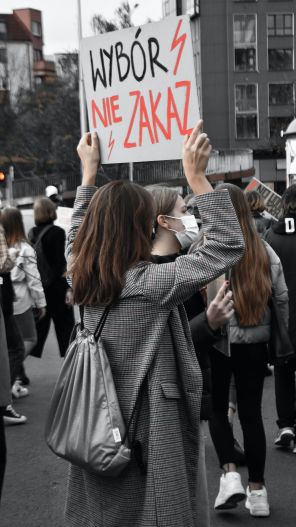
David Ost, IES
David Ost, visiting scholar with the Institute of European Studies, says, “American women need to understand that they’re facing not just a Republican Party, but part of a global movement that’s been very strong in Europe.”
Additional Information
A Climate Reckoning for U.S. Housing: Too Many Homes in Harm’s Way

Linda Shi, Global Public Voices
“The reasons that people move are always multifaceted. They rarely ever point to an environmental reason, even after a disaster happens,” says Linda Shi, assistant professor of city and regional planning.
Additional Information
Institute for African Development Film Series

November 9, 2022
5:30 pm
109 Tower Rd., G-08 Uris Hall
Amandla!: A Revolution in Four-Part Harmony is a 2002 documentary film depicting the struggles of black South Africans against the injustices of Apartheid through the use of music.
Additional Information
Program
Einaudi Center for International Studies
Reppy Institute for Peace and Conflict Studies
Institute for African Development
Man with a Movie Camera

November 19, 2022
7:30 pm
Willard Straight Theatre
Featuring a live score incorporating traditional Ukrainian folk melodies by Austin’s Montopolis
1929 > USSR > Directed by Dziga Vertov
This film is not only Vertov's masterpiece and final film of the silent era, it is a work which notably exemplifies the montage aesthetic of the Soviet avant-garde of the twenties. A city symphony filmed in Moscow and Odessa, the film is a continually shifting kaleidoscope of breathtaking imagery that captures the spirit of Russian life at that time. Featuring a. live original score by Austin, TX band Montopolis. Cosponsored with the Wharton Studio Museum. More at www.montopolismusic.com/man-with-a-movie-camera
1 hr 7 min
Additional Information
Program
Institute for European Studies
Einaudi Center for International Studies
Nov. 16–17: Frontiers and the Future

Global Grand Challenges Symposium
Register now to join the conversation on the world’s most urgent challenges and how Cornell and Global Hubs can work together to meet them.
Additional Information
Regina Bateson: Vigilantism as Contentious Politics

February 9, 2023
11:25 am
Martha Van Rensselaer Hall, G155
Why do people engage in vigilantism? Vigilantism is commonly understood as a functional solution to a security problem, or as "popular justice," an expression of the people's will. However, both these approaches overlook the power dynamics that are at the heart of vigilantism—and as a result, they are unable to fully explain when, how, and why vigilantism occurs.
Regina Bateson will discuss the logic and processes of vigilantism as a form of contentious political behavior. Indeed, a contentious politics framework helps to resolve several puzzles of vigilantism: Why do vigilantes intentionally seek engagement with the state? Why are vigilante punishments excessively violent? Why is vigilantism sometimes unrelated to public opinion, crime rates, and state presence? And why does vigilantism happen even in societies with strong rule of law? These apparent contradictions all make sense if we view vigilantism as a way of seeking influence, reinforcing hierarchies, and making claims. After all, vigilantism is not just about security or justice; it is also about power.
About the Speaker
Regina Bateson is a comparative political scientist who studies violence, politics, the rule of law, and threats to democracy. Regina is currently an assistant professor at the Graduate School of Public and International Affairs at the University of Ottawa. Her academic work is informed by her prior experiences as a Foreign Service Officer for the US Department of State, a Spanish-English legal interpreter, and a congressional candidate.
Presented by the Reppy Institute for Peace and Conflict Studies. Co-sponsored by the Gender and Security Sector Lab.
Additional Information
Program
Einaudi Center for International Studies
Reppy Institute for Peace and Conflict Studies
U.S. Military Deployments and Public Opinion

April 20, 2023
11:25 am
Uris Hall, G08
The United States stands at a crossroads in international security. The backbone of its international position for the last 70 years has been the massive network of overseas military deployments. However, the U.S. now faces pressures to limit its overseas presence and spending.
Carla Martinez Machain argues that the U.S. has entered into a "domain of competitive consent," where the longevity of overseas deployments relies on the buy-in from host-state populations and what other major powers offer in security guarantees.
Drawing from three years of surveys and interviews across fourteen countries, her current project demonstrates that a key component of building support for the U.S. mission is the service members themselves as they interact with local community members. Highlighting both the positive contact and economic benefits that flow from military deployments and the negative interactions like crime and anti-base protests, her work shows how U.S. policy on the ground shapes its ability to advance its foreign policy goals.
About the Speaker
Carla Martínez Machain is a professor of political science at the State University of New York at Buffalo. Her research (funded by the Department of Defense’s Minerva Initiative and the Army Research Office, among others) focuses on foreign policy analysis, with a focus on military policy and international conflict.
Presented by the Reppy Institute for Peace and Conflict Studies. Co-sponsored by the American Studies Program and the Gender and Security Sector Lab.
Additional Information
Program
Einaudi Center for International Studies
Reppy Institute for Peace and Conflict Studies
Border Fortification and Legibility: Evidence from Afghanistan

April 13, 2023
11:25 am
Uris Hall, G02
States often fortify their borders against militant threats. How do these efforts shape civilian welfare and perceptions in borderland communities? Professor Christopher Blair conceptualizes border fortification as a legibility-building endeavor. By bolstering state reach in areas of weak historical penetration, fortification enhances the government's capacity for monitoring, administration, and control. Yet, expanding state authority also disrupts traditional cross-border markets. A trade-off between security and corruption emerges in consequence. He provides evidence for this theory in a difference-in-differences framework, combining administrative records on violence and representative data from a NATO-commissioned survey fielded across Afghanistan. Fortification facilitates government information-collection, improving security provision and fostering national identification. Enhanced state capacity is countervailed by negative economic impacts. By disturbing the informal borderland economy, fortification fuels criminalization and local opposition. Civilians rely on illicit economic entrepreneurs to sustain traditional market access. Higher smuggling rents fuel official corruption and bribe-taking. The findings point to a key dilemma inherent in border fortification strategies.
About the Speaker
Christopher Blair is an incoming Assistant Professor in the Department of Politics at Princeton University. His work spans across international relations and comparative politics, with a substantive focus on the political economy of conflict and migration. The main questions motivating his research are: (1) how counterinsurgency policies impact rebel and civilian behavior; and (2) how prospective hosts respond to forcibly displaced people.
Presented by the Reppy Institute for Peace and Conflict Studies. Co-sponsored by the South Asia Program, and the Gender and Security Sector Lab.
Additional Information
Program
Einaudi Center for International Studies
Reppy Institute for Peace and Conflict Studies
South Asia Program
The 1968 Tet Offensive and South Vietnam’s Second Republic

March 30, 2023
11:25 am
In many accounts of the Vietnam War, the 1968 Tet Offensive – a sweeping series of communist attacks against military bases, provincial capitals and even the United States Embassy in Saigon – is recalled as a defining moment when American public opinion turned against the war. Long overlooked, however, is the equally significant political impact of Tet in South Vietnam itself.
Far from evincing public sympathy as Communist strategists had intended, the attacks saw a wave of anti-Communist solidarity sweep through South Vietnam’s cities and provincial towns. Partisan rivals set aside their differences, while the South Vietnamese military seized the opportunity to expand into Communist-dominated rural areas.
The post-Tet period arguably marked the zenith of anti-Communist cohesion in Vietnam. For a time, it appeared plausible that the balance might be tipping in Saigon’s favour. But the military government squandered this uniquely poised opportunity by monopolizing political power at the expense of civilian parties and institutions. This betrayed the constitutional order on which the state’s legitimacy was based, deflating post-Tet resolve, accelerating American funding cuts, and precipitating the state’s abrupt collapse from within in 1975.
Drawing on American and Vietnamese-language sources, Sean Fear explores the aftermath of the 1968 Tet Offensive in South Vietnam. Challenging conventional views of the Vietnam War as a clash between Cold War superpowers and their proxies, it also asserts the centrality of overlooked Vietnamese political actors in determining the outcome of the war.
Please join us for this virtual conversation. Register here.
About the Speaker
Sean Fear is a lecturer in international history at the University of Leeds. His research focuses on South Vietnamese domestic politics and diplomacy during the Second Republic (1967-1975). He is a 2022-23 Visiting Professor of History and Vietnam Studies at Fulbright University in Ho Chi Minh City, Vietnam.
Presented by the Reppy Institute for Peace and Conflict Studies. Co-sponsored by the Southeast Asia Program and the Gender and Security Sector Lab.
Additional Information
Program
Einaudi Center for International Studies
Reppy Institute for Peace and Conflict Studies
Southeast Asia Program
Counterterrorism Between the Wars: An International History, 1919-1937

March 9, 2023
11:25 am
What happened to the tens of millions of guns left over from World War I? Mary Barton discusses how the Great Powers’ failure to secure these weapons contributed to the rise of state-sponsored terrorism during the 1920s and 1930s. Barton tells a global story of the demise of empires, the rise of communism, and the cooperation between the United Kingdom and United States that would evolve into the Five Eyes intelligence alliance.
The Five Eyes remains a vital intelligence alliance today. The Five Eyes justice chiefs recently strongly supported Ukraine's efforts to prosecute war crimes arising from Russia's invasion.
Please join us for this virtual conversation. Register here.
About the Speaker
Mary Barton is an analyst with the U.S. government. She received her Ph.D. from the University of Virginia in 2016. She completed postdoctoral fellowships at the Henry A. Kissinger Center for Global Affairs, SAIS, and Dartmouth College, and previously served as a historian and wargaming analyst supporting the Office of the Secretary of Defense, Department of Defense.
Presented by the Reppy Institute for Peace and Conflict Studies. Co-sponsored by the Institute for European Studies and the Gender and Security Sector Lab.
Additional Information
Program
Einaudi Center for International Studies
Reppy Institute for Peace and Conflict Studies
Institute for European Studies