
Einaudi Center for International Studies
From David's Harp to Tum Balalayka: Jewish Strings in Russian Song

November 3, 2022
4:30 pm
Anabel Taylor Hall, 203, Auditorium
On November 3 scholar and singer-songwriter Psoy Korolenko will present a lecture-concert that combines discussion of Jewish musical tradition in cross-cultural context of the 19-21st centuries and artistic performance.
Pavel Lion, PhD in Philology, MSU, more known by his art name Psoy Korolenko, is a singer-songwriter, translator, scholar, and journalist, often referred to as a ''wandering scholar'' and an ''avant-bard''. His multilingual one-person cabaret balances various genres and traditions, among which East European music, Klezmer, and Yiddish play a significant role. On stage since 2000, he released several books of essays, poetry, and song lyrics, and more than 20 CDs, solo or in collaboration with active Jewish and Klezmer musicians ("Opa!", Daniel Kahn, Igor Krutogolov, "Oy Division", Michael Alpert, Bob Cohen, Jake Shulmann-Ment). Featured in movies "Soul Exodus" (Hungary), "The Wandering Muse" (Canada), several Russian films (sometimes in cameo episodes). He has been a part of various international music projects, such as “Brothers Nazaroff'' (Smithsonian Folkways Records, 2015), ''Defesa'' (2015, tribute to Brazilian Tropicalists) and other. In 2020, ''Psoetry'' was published, a bilingual selection of Psoy's original Russian songs in English translations by other authors, and songs by Bob Dylan, Tom Waits, Daniel Kahn and other artists, translated into Russian by Psoy.
One of his most recent achievements is his participation in ''Yiddish Glory'', a long-term collaborative project with the historian Anna Shternshis, professor of Toronto University. Yiddish Glory is an academic and artistic exploration of long-lost and recently discovered trove of Yiddish songs in Yiddish created and performed by a group of amateur singers and musicians from Ukraine evacuated to Middle Asia at the time of WWII. The album "Yiddish Glory" (2019) won “The Fiddler on the Roof” award from the Federation of Jewish Communities of Russia and had been nominated for a Grammy award. Psoy is a voting member of the American Recording Academy, one of the organizers or the Russian American open-air music festival JetLAG, and participant of multiple klezmer music festivals. He had been artist/scholar-in-residence at the Trinity College (Hartford), University of Michigan (Ann Arbor), Dickinson College (Carlisle, PA), and he currently is a visiting lecturer at Dartmouth College.
Event sponsored by Jewish Studies Program, Department of Comparative Literature/Russian Program, Institute for European Studies, and Department of Music
Additional Information
Program
Institute for European Studies
Einaudi Center for International Studies
Institute for African Development Seminar Series: Learning in the Digital Age in Africa: Experiences from Cornell and University of Ghana students
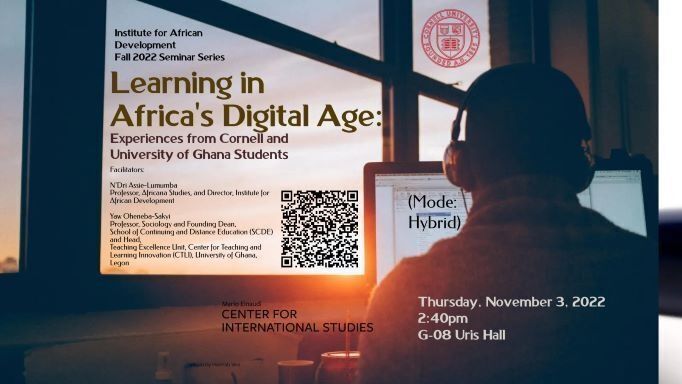
November 3, 2022
2:40 pm
Uris Hall, G-08
The Issues in African Development Seminar Series examines critical concerns in contemporary Africa using a different theme each semester. The seminars provide a forum for participants to explore alternative perspectives and exchange ideas. They are also a focal activity for students and faculty interested in African development. In addition, this seminar series prepares students for higher level courses on African economic, social, and political development. The presentations are designed for students who are interested in development as well as Africa’s place in global studies, want to know about the peoples, cultures, and societies that call Africa home, and wish to explore development theories and alternate viewpoints on development practice.
Additional Information
Program
Einaudi Center for International Studies
Institute for African Development
Emilio Rojas: GO BACK TO WHERE YOU CAME FROM!

October 3, 2022
5:15 pm
Abby and Howard Milstein Auditorium
Bio:
Emilio Rojas is a multidisciplinary artist working primarily with the body in performance, using video, photography, installation, public interventions, and sculpture. He holds an M.F.A. in Performance from The School of the Art Institute of Chicago and a B.F.A. in Film from Emily Carr University in Vancouver, Canada. As a queer, Latinx immigrant with Indigenous heritage, it is essential to his practice to engage in the postcolonial ethical imperative to uncover, investigate, and make visible and audible undervalued or disparaged sites of knowledge, narratives, and individuals. He utilizes his body in a political and critical way, as an instrument to unearth removed traumas, embodied forms of decolonization, migration, and poetics of space. His research-based practice is heavily influenced by queer and feminist archives, border politics, botanical colonialism, and defaced monuments. Besides his artistic practice, he is also a translator, community activist, yoga teacher, and anti-oppression facilitator with queer, migrant, and refugee youth.
His work has been exhibited in exhibitions and festivals in the U.S., Mexico, Canada, Japan, Austria, England, Greece, France, Germany, Italy, Spain, Holland, Colombia, and Australia, as well as institutions such as The Art Institute and the Museum of Contemporary Art in Chicago, Ex-Teresa Arte Actual Museum and Museo Tamayo in Mexico City, The Vancouver Art Gallery, The Surrey Art Gallery, The DePaul Art Museum, and The Botin Foundation. From 2019-2022 Rojas was a Visiting Artist in Residency in the Theater and Performance Department at Bard College in New York. He is also currently visiting faculty in the M.F.A. programs at Parsons the New School and the low-res M.F.A. programs at PNCA in Portland, Oregon, and University of the Arts, in Philadelphia.
Abstract:
GO BACK TO WHERE YOU CAME FROM! is a lecture/performance by artist Emilio Rojas, departing from this xenophobic phrase to trace histories of colonialism, the open wounds of borders, and the emptiness of monuments. This embodied lecture considers his practice in relation to decolonization, de-linking, archives, queerness, and contaminations into public space. It is not an attempt to re-write history but rather to view it from a different orientation, in a non-linear way which opens spaces of liminality and possibility, remembrance and healing. It urges us to ask ourselves: How are we complicit with the past we inherited? How are we accomplices of the history of what we consume in the present?
Emilio Rojas is the fall 2022 Teiger Mentor in the Arts.
Additional Information
Program
Einaudi Center for International Studies
Latin American and Caribbean Studies
Berger International Speaker Series with Tawab Danish – Circling Back to Zero after 20 years of Achievements: How the Legal System of Afghanistan has Been Affected More than Any Other Institution under the Taliban Regime

October 25, 2022
12:15 pm
Myron Taylor Hall, Cornell Law School, 277
Please join us for a lunchtime seminar given by our guest Tawab Danish, a Visiting Scholar here at Cornell Law School.
SEMINAR: Circling Back to Zero after 20 years of Achievements: How the Legal System of Afghanistan has Been Affected More than Any Other Institution under the Taliban Regime
DATE: Tuesday, October 25th, 2022
TIME: 12:15 p.m. to 1:15 p.m. ET
LOCATION: Room 277 – Myron Taylor Hall, Cornell Law School
***Lunch will be provided during the event, so don’t forget to RSVP!
RSVP here
Please fill out the following short form: https://cornell.ca1.qualtrics.com/jfe/form/SV_5A8vFJEaEmFjiQu
The Seminar – Circling Back to Zero after 20 years of Achievements: How the Legal System of Afghanistan has Been Affected More than Any Other Institution under the Taliban Regime
After 2001, the international community, the United States of America, and the leader of Afghanistan spent billions of dollars and put much effort into rebuilding the legal system in Afghanistan. However, since the Taliban received power on August 15, 2021, the legal system has gone backwards to where it was 20 years ago. The Taliban abolished the Constitution ratified in 2004, and dissolved the National Assembly and some independent legal institutions such as the Afghanistan Independent Bar Association and Afghanistan Independent Human Right Commission. Simultaneously, the criminal code, civil code, criminal procedure, human rights law, and women and children's rights are unclear. The Taliban leads the country most dominantly by decrees of the Ministry for the Propagation of Virtue and the Prevention of Vice. Their administration believes that the 2004 Constitution does not hold up to sharia law, although the First, Second, and Third Articles of the Constitution were mainly about Islamic values and accepted Islam as the official state religion.
Continuation of the current situation in Afghanistan will have extreme effects on the whole legal system and will lead the country to absolute tyranny. So, the international community – especially the United Nations, United States of America, and regional and Islamic countries – should take proper measures to pressurize the Taliban to keep alive and promote the legal system.
About our Distinguished Guest: Tawab Danish
Tawab Danish, a visiting scholar at the Cornell School of Law, was born in the Bagram district of Parwan, Afghanistan in 1985. He graduated from the Law & Political Science School of Albironi University in Kapisa, Afghanistan in 2006 and holds an LLM degree from the University of Washington School of Law.
Tawab Danish was appointed as a lecturer at Parwan University in 2013 and taught Constitutional Law, Public International Law, Human Rights, and International Organizations. He also has worked as a senior advisor of the Speaker of the House of the National Assembly of Afghanistan from 2019 to 2021.
Mr. Danish founded a private school in 2013, which is one of the most well-known schools in Parwan Province. More than 700 students are enrolled in his school, 28% of which are girls.
Can’t make it to our event in-person? You can attend virtually!
We are also livestreaming the event, so you can sign up to attend the Zoom Webinar at this link: https://cornell.zoom.us/webinar/register/WN_hazaK_ekTnCSPKB2lVO8mQ
Please feel free to distribute the link to anyone you feel would be interested in the seminar. All are welcome!
Additional Information
Program
Einaudi Center for International Studies
South Asia Program
Reppy Institute for Peace and Conflict Studies
China Says Biden's Taiwan Remarks 'Severely Violate' US Policy Over Island

Jessica Chen Weiss, EAP
Biden's new comments are "dangerous, even if not an official change in policy", wrote Jessica Chen Weiss, professor of government, on Twitter. "More explicit here than in previous gaffes is the suggestion that the US would send troops to fight for Taiwan, regardless of what Taiwan does," she wrote, adding that it will "strengthen perceptions that the US is issuing Taiwan a blank check".
Additional Information
Cornell China Center Fall Field Trip: Cornell Botanic Gardens Tour of Chinese and Asian Plants

October 14, 2022
12:15 pm
Join this guided outdoor stroll exploring different areas of the garden to highlight several plants endemic to China and eastern Asia. Discover the importance of trees and garden plants in East Asian culture, and learn about plans to develop an Asian Summer Garden to showcase tree and herbaceous peonies and other plants native to China, Japan, and Korea. Led by garden staff and volunteer guides. The walk will take place rain or shine. It will be postponed to the next day, Fri 10/14, in the event of severe or hazardous weather, and registrants will emailed at least 45 minutes in advance if postponed. Limited to 20 participants.
***THIS TRIP IS NOW FULLY ENROLLED. Register here to add yourself to the wait list.***
DATE CHANGED to Fri 10/14 due to heavy rains on Thursday.
Additional Information
Program
Einaudi Center for International Studies
East Asia Program
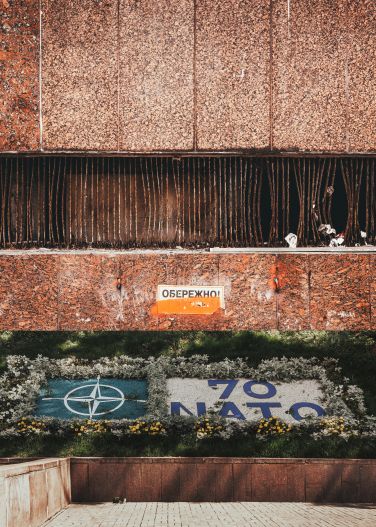
Russia’s Mobilization Won’t Fix Its Military Problems
Bryn Rosenfeld, IES
Though Russian Defense Minister Sergei Shoigu has said that the mobilization will be limited and gradual, “already there appears to be a disconnect between how it was described by Putin and Shoigu in their announcements of the policy and how it is being carried out,” Bryn Rosenfeld, a professor of government at Cornell University, told Vox via email.
Additional Information
Congratulations, Eleanor Paynter!
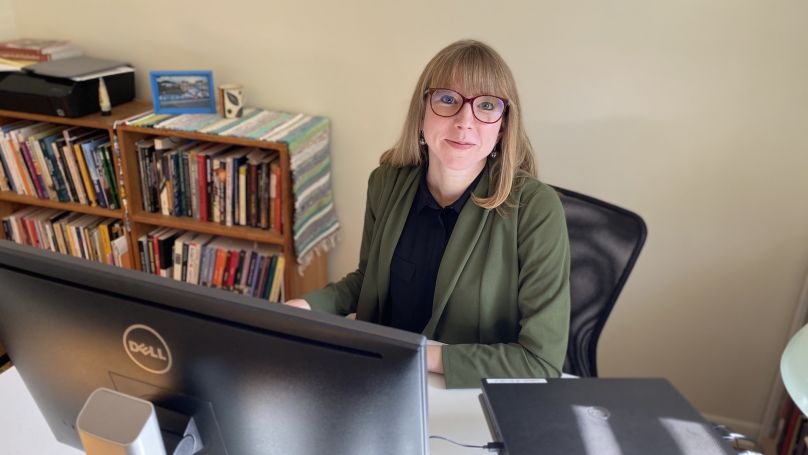
Einaudi Migrations Postdoc Receives Postdoc Achievement Award
"Supporting students has been a highlight of my time at Cornell," says Paynter, winner of the Postdoc Achievement Award for Excellence in Mentoring.
Additional Information
For Asylum Seekers, Manhattan Is Only Part of a Harrowing Journey
Stephen Yale-Loehr, Migrations
"It is too soon to tell what percentage of Venezuelans will qualify for asylum," said Stephen Yale-Loehr, an immigration professor at Cornell Law School. "Because of backlogs in the asylum process, it could be years before we will know."
Additional Information
Fears For Rights Under Italy's "Christian Mother" Meloni
Mabel Berezin, IES
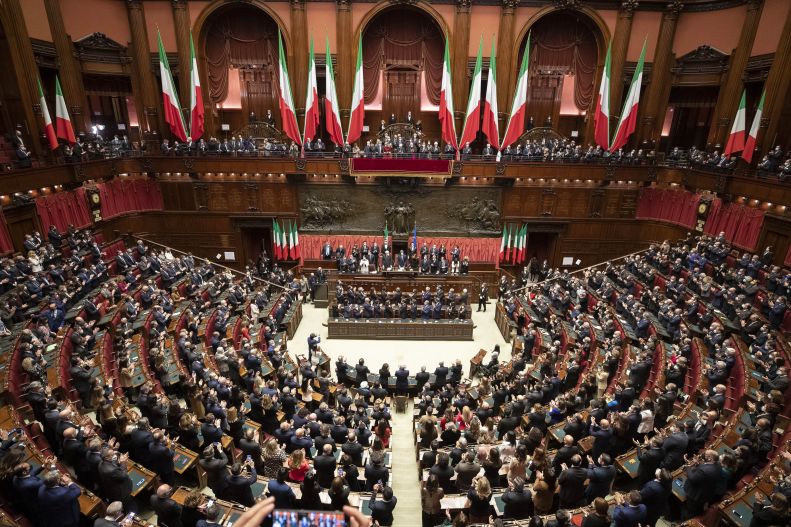
“Some of the old guard remain, but Meloni is attempting to construe herself instead as a "nationalist conservative," said Mabel Berezin, an expert on fascist, nationalist and populist movements at Cornell.