
Einaudi Center for International Studies
Institute for African Development Seminar: Africa in 2040: transformative change for people, food and nature
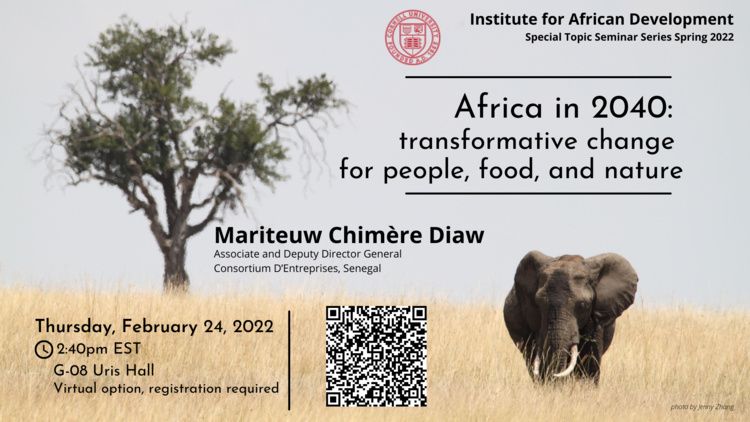
February 24, 2022
2:40 pm
Uris Hall, G-08
Mariteuw Chimère Diaw is an associate and Deputy Director General of the Consortium D’Entreprises in Senegal, and a member of the Multistakeholder Expert Panel of IPBES, the Intergovernmental Platform on Biodiversity and Ecosytem Services. He was until recently the Director General of the African Model Forest Network (AMFN) and a member of the Board of EcoAgricultural Partners and of the International Networking Committee of the International Model Forest Network (IMFN). He holds a PhD in Economic anthropology from Laval University, an MA in Rural Sociology from Michigan State University and a Master in Philosophy and Sociology from the University of Dakar. He has worked 40 years as a researcher and international scientist with the CGIAR and other organisations and has led or contributed to several international programs on Adaptive Collaborative Management, Governance, Verification, Environmental Services and Rural Livelihoods, Alternative to Slash and Burn, Environmental Decentralizations and Criteria and Indicators of sustainable forest management. He was the convener in Cameroon of the Forest Governance Learning Group (FGLG), a network active in 11 countries. His research interests and publications include African history, migrations, and modeling of the share system in fisheries; tenure regimes and property rights, climate change mitigation and adaptation, biodiversity governance and multistakeholder landscapes, Model Forests, participatory action research and interactive social methodologies. Chimère has lived and worked in the Congo Basin, West Africa, Southeast Asia, and North America.
Register
Additional Information
Program
Einaudi Center for International Studies
Institute for African Development
Institute for African Development Seminar Series: Inclusive Development in East African Cities? The Challenge of Generative Urbanization
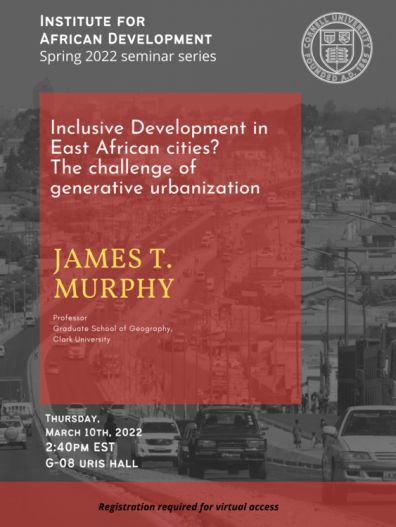
March 10, 2022
2:40 pm
G-08 Uris Hall
Issues in African Development Seminar Series examines critical concerns in contemporary Africa using a different theme each semester. The seminars provide a forum for participants to explore alternative perspectives and exchange ideas. They are also a focal activity for students and faculty interested in African development. In addition, prepares students for higher level courses on African economic, social and political development. The presentations are designed for students who are interested in development, Africa’s place in global studies, want to know about the peoples, cultures and societies that call Africa home, and explore development theories and alternate viewpoints on development.
Speaker's details here
Registration here
Additional Information
Program
Einaudi Center for International Studies
Institute for African Development
Natalie Koch | How to green a petrostate: Resource nationalism and post-oil futures in the Arabian Peninsula

February 25, 2022
3:00 pm
Stimson Hall, G01
How to green a petrostate: Resource nationalism and post-oil futures in the Arabian Peninsula
Resource nationalism has taken many shapes in the Arabian Peninsula since the discovery of large oil and gas reserves in the early- and mid-20th century. As the region assumed its place in hegemonic global imaginaries as the world’s epicenter of hydrocarbon extraction, governments and ordinary citizens alike celebrated the role of oil and gas in their national independence movements and rapid development trajectories upon achieving statehood. Hydrocarbons are still locally perceived as a force for good and essential to securing the past, present, and future development of the nation. Yet these discourses do not exist in a vacuum: today they increasingly interact with global sustainability discourses and a now-dominant idea that “to be green is to be modern.”
New “post-oil” nationalist storylines have become prominent in the Arabian Peninsula the past 10 years, where diverse government-backed greening projects have been promoted with a large dose of spectacle – leading them to be frequently dismissed in the West as mere PR and “greenwashing.” Moving past this simplistic critique, I instead show how recent sustainability initiatives are themselves targeted at challenging prevailing geopolitical identity narratives in the West, which stigmatize them as petrostates and climate pariahs. But post-oil future narratives in the Arabian Peninsula are not just a reaction to these Western critiques: they are part of a well-established Western tradition of using spectacle in promoting environmental sustainability and promoting a positive narrative about the “modern” national self.
Based on ethnographic research on major sustainability events and sites in the UAE, Qatar, and Saudi Arabia from 2014-2022, I demonstrate how Gulf governments, national oil and gas companies, and sovereign wealth funds have been adapting sustainability discourses and working to define “post-oil” futures – and what this means for the increasing incorporation of sustainability in resource nationalisms around the world.
About the speaker
Natalie Koch is a political geographer focusing on authoritarianism, geopolitics, nationalism and identity politics, and resource governance. Koch also work on sports geography, and is broadly interested in understanding how the territorial state system is maintained, and how individuals become subjects in different political systems and spaces. She has conducted extensive research on Central Asia in the past, but her work is currently focused on the Arabian Peninsula. Empirically, her research examines alternative sites of geopolitical analysis such as science and higher education, sport, spectacle, nationalist rituals and landscapes, environmental policy and sustainability initiatives, and urban development
This event is organized by Cornell’s Nationalism Working Group with support from the Qualitative & Interpretive Research Institute
Additional Information
Program
Einaudi Center for International Studies
La Ciénaga, Latin American & Caribbean Studies Program Film Series

March 24, 2022
6:00 pm
G64 Goldwin Smith Hall, Kaufmann Auditorium
LACS Film Series Spring 2022
Mecha, a woman in her 50s with several teenage children and a husband, Gregorio, wants to remain looking young. In order to avoid the hot and humid weather of the city, the family spends the summers in their decaying country estate named La Mandrágora. After Mecha falls and injures herself, she is confined to her bed, and takes to drinking. She resents her gloomy Amerindian servants, whom she accuses of theft and laziness. Mecha's cousin Tali, who lives in a modest house in town with her husband Rafael, makes repeated visits with her brood of young, noisy children to escape from her claustrophobic home. Before long, the crowded domestic situation in both homes strains the families' nerves, exposing repressed family mysteries and tensions that threaten to erupt into violence.
Additional Information
Program
Einaudi Center for International Studies
Latin American and Caribbean Studies
Lingua Mater Student Competition Deadline

November 6, 2022
12:00 am
The Lingua Mater competition invites students to translate Cornell's Alma Mater into a different language and submit a video of the performed translation. The inaugural Lingua Mater student competition took place in 2018 as part of Cornell's Global Grand Challenges Symposium. The top three videos received cash prizes.
2022 competition details
Can you translate Cornell’s Alma Mater into your mother tongue (or a language you are learning/have learned at Cornell) and sing it? We invite you to translate “Far Above Cayuga’s Waters” and submit a video of you (and your friends!) performing it somewhere on any of Cornell’s campuses.
Translations do not need to be exact or perfectly in meter but should capture the feel and tune of our university’s Alma Mater. As is customary, include the first verse, refrain, second verse, and refrain in your video submission (for guidance, listen to a performance and read the lyrics).
Video submissions need to be MP4 files at 1920 x 1080 (1080p), in landscape mode with an aspect ratio of 16:9. Please ensure that you have copyright permission for any images/videos you use.
Entries will be reviewed by a panel of judges. Submissions will be judged equally on the translation, the musical quality, and the creativity in visual presentation.
The top three entries will win cash prizes.
Winners will be announced during International Education Week (November 14-18, 2022) and the top three videos will be posted online that week.
Entries may be submitted by any registered Cornell student or group of students.
Submission deadline: Sunday, November 6, 2022
SUBMIT YOUR VIDEO AND LYRICS HERE
Please contact Angelika Kraemer, Director of the Language Resource Center, if you have any questions.
The Lingua Mater competition is co-sponsored by the Language Resource Center and the Office of the Vice Provost for International Affairs.
Additional Information
Program
Einaudi Center for International Studies
East Asia Program
Southeast Asia Program
Latin American and Caribbean Studies
South Asia Program
Institute for European Studies
Lingua Mater Alumni Competition Deadline

October 30, 2022
12:00 am
The Lingua Mater competition invites alumni to translate Cornell's Alma Mater into a different language and submit a video of the performed translation. The inaugural Lingua Mater alumni competition took place in 2018 as part of Cornell's Global Grand Challenges Symposium. Winners included the Cornell Club of Thailand in 2018, Cornell Club of Gaeta, Italy in 2019, and alumni in Argentina in 2021. They received financial support for a local alumni event.
2022 competition details
Can you translate Cornell’s Alma Mater into your mother tongue (or a language you learned at Cornell) and sing it? We invite you to translate “Far Above Cayuga’s Waters” and submit a video of you (and your friends!) performing it, wherever you may be!
Translations do not need to be exact or perfectly in meter but should capture the feel and tune of our university’s Alma Mater. As is customary, include the first verse, refrain, second verse, and refrain in your video submission (for guidance, listen to a performance and read the lyrics).
Video submissions need to be MP4 files at 1920 x 1080 (1080p), in landscape mode with an aspect ratio of 16:9. Please ensure that you have copyright permission for any images/videos you use.
Entries will be reviewed by a panel of judges. Submissions will be judged equally on the translation, the musical quality, and the creativity in visual presentation.
The top entry will receive financial support and Cornell swag for a local alumni event.
Winners will be announced during International Education Week (November 14-18, 2022) via Noteworthy, and the top video will be posted online that week. Be sure to subscribe to our weekly newsletter to stay in the know of this competition and international alumni activities.
Entries may be submitted by any Cornell alumni groups outside of the United States and Canada.
Submission deadline: Sunday, October 30, 2022
SUBMIT YOUR VIDEO AND LYRICS HERE
Please contact the International Alumni Relations team if you have any questions.
The Lingua Mater competition is co-sponsored by the Office of International Alumni Relations, the Language Resource Center, and the Office of the Vice Provost for International Affairs.
Additional Information
Program
Einaudi Center for International Studies
East Asia Program
Southeast Asia Program
Latin American and Caribbean Studies
South Asia Program
Robo-Sexism: Gendering AI and Robots

April 22, 2022
4:45 pm
Goldwin Smith Hall, 64
Robo-Sexism: Gendering AI and Robots in Japan and the United States (and Elsewhere) HYBRID event. The in-person location is Goldwin Smith Hall GS64.
Jennifer Robertson, Professor Emerita, Anthropology and History of Art, University of Michigan
In humans, gender constitutes an array of learned behaviors that are cosmetically enabled and enhanced. Gender(ed) behaviors are both socially and historically shaped and are also contingent upon many situational influences, including individual choices. How is gender assigned in actual (as opposed to fictional) robots? Robertson will explore the sex/gender stereotypes and operational functions informing the design and embodiment of artificial intelligence (AI) and robots, especially humanoids and androids.
Robots have been imagined, designed, and deployed in rhetorical and tangible forms alike to reinforce conservative models of sex/gender roles, ethnic nationalism, and "traditional" family structures. Robertson considers the ramifications of "retro-tech" and also nascent efforts to redress robo-sexism.
This is a University Lecture sponsored by the Cornell Department of History and the University Lectures Committee, co-sponsored by the East Asia Program at Cornell.
Additional Information
Program
Einaudi Center for International Studies
East Asia Program
Japanese Videogames as Cultural Artifacts

April 18, 2022
4:45 pm
What are we learning when we play video games from Japan? Rachael Hutchinson (University of Delaware) examines the cultural content of Japanese videogames through character design, background setting and environment, aesthetic style, thematic content, and game dynamics. We will consider how mid-1990s games converged around ideas of nuclear power and bioethics, making works like Final Fantasy VII and Metal Gear Solid valuable windows into social anxieties expressed in the Japanese arts.
Hosted by faculty member, Andrew Campana (Asian Studies) and the EastAsia+ collaborative. EastAsia+ is a new initiative at Cornell University that combines programming, mentorship, and digital publishing around East Asian media studies and digital humanities.
Additional Information
Program
Einaudi Center for International Studies
East Asia Program
Nuclear Freeze Archive Digitized
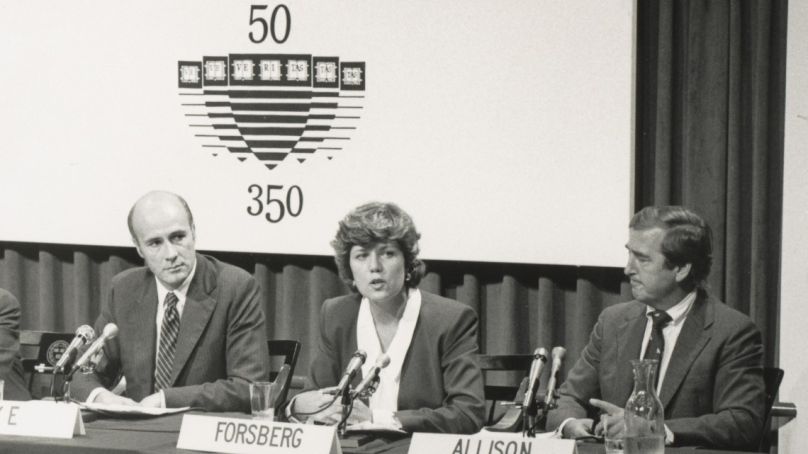
Randall Forsberg Project Led by Reppy Institute
Judith Reppy, Matt Evangelista, and Agnes Nimark (PACS) led work to preserve papers of international Nuclear Freeze movement leader.
Additional Information
Armed Drones: Limited War in Strategic and Global Contexts
March 14, 2022
1:00 pm
Since 9/11, the U.S. has used armed drones to combat terrorists. Bush initiated the use of strikes; Obama accelerated the practice, especially in Pakistan; and, Trump institutionalized it further. Biden’s “over-the-horizon” counterterrorism strategy suggests he will also continue to rely on strikes. At the same time, other states and stateless actors, including France and the Islamic State, have acquired drones indicating the emergence of a “second drone age.”
What are the implications of the evolving proliferation of drones for international security and global order? How do these consequences, in turn, shape policies to manage the emergence of automated and autonomous remote-warfare technologies? This panel discussion draws on the insights of three experts to answer these and related questions, including:
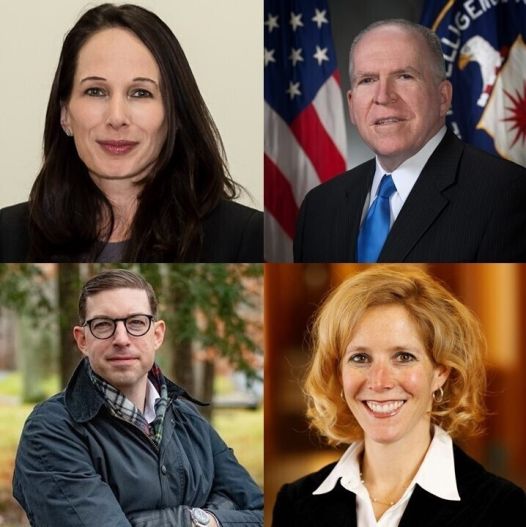
Mr. John Brennan, former Director of the Central Intelligence Agency;Professor Amy Zegart from the Hoover Institute at Stanford University; and,U.S. Army Lieutenant Colonel Paul Lushenko, a General Andrew Jackson Goodpaster Scholar at Cornell University.This discussion will be moderated by Professor Sarah E. Kreps, the John L. Wetherill Professor at the Department of Government, and hosted by Congressman Steve Israel, Director of the Institute of Politics and Global Affairs at the Brooks School of Public Policy.
This event is a collaboration between the Brooks School of Public Policy, Cornell Tech Policy Lab, the Institute of Politics and Global Affairs, and the Judith Reppy Institute for Peace and Conflict Studies.
Additional Information
Program
Reppy Institute for Peace and Conflict Studies
Einaudi Center for International Studies