
Einaudi Center for International Studies
Language Resource Center Speaker Series - Karen Lichtman

October 4, 2021
4:00 pm
Stimson Hall, G25
"Acquisition vs. Learning in 2021"
Karen Lichtman
Associate Professor of Spanish Linguistics and Director of Educator Licensure in the Department of World Languages & Cultures, Northern Illinois University
In the late 1970s and early 1980s, Stephen Krashen put forward a model of language learning distinguishing between language acquisition (acquiring a language by listening or reading and understanding) and language learning (conscious, effortful study and practice of language). Today, many people look at Krashen’s monitor model as just a "method from the past." However, most of these ideas are still very much present in contemporary research — just under different names, such as implicit vs. explicit language teaching and learning.
This talk will share three of my studies using the acquisition/learning, or implicit/explicit, framework: one on elementary students learning Spanish, another with children and adults who were taught an artificial mini-language in the laboratory, and finally, a study currently in progress comparing two different teaching methods in beginning classes. Each study has different implications for teaching: (1) grammar instruction can be delayed to the end of years of input-based language study, (2) grammar instruction may have a negative effect on learners' speaking fluency, and (3) a "narrow and deep" curriculum using high-frequency structures in context could be more effective than a traditional grammar-based curriculum... but since this last study is still in progress, attend the talk to find out if this is really the case!
Bio: Dr. Lichtman is Associate Professor of Spanish Linguistics and Director of Educator Licensure in the Department of World Languages & Cultures at Northern Illinois University. Her research focuses on instructed second language acquisition. Specifically, she studies implicit and explicit language learning in children and adults, questioning the conventional wisdom that children learn languages implicitly whereas adults need explicit grammar instruction. She recently wrote Teaching Proficiency through Reading and Storytelling (TPRS): An Input-Based Approach to Second Language Instruction. Dr. Lichtman teaches methods courses for pre-service teachers and upper-level Spanish Linguistics courses.
This event will be held in person in G25 Stimson and will also be streamed live over Zoom. Join us at the LRC or on Zoom.
The event is free and open to the public. Campus visitors and members of the public must adhere to Cornell's public health requirements for events, which include wearing masks while indoors and providing proof of vaccination or a recent negative COVID-19 test.
Additional Information
Program
Einaudi Center for International Studies
Latin American and Caribbean Studies
Naomi Egel, PACS/IES: Einaudi Student Path (video)
"One of the strengths of the Einaudi Center and Reppy Institute is how they bring together scholars working on related issues, but from a variety of perspectives," says Naomi Egel, a PhD student in government at Cornell. She participated in the Einaudi Dissertation Proposal Development Program and received Einaudi Center, Reppy, and IES financial support for research travel to Geneva, Switzerland.
Additional Information
Eun A Jo, PACS/EAP: Einaudi Student Path (video)
Eun A Jo is a PhD student in government and a Peace and Conflict Studies Fellow with the Einaudi Center's Judith A. Reppy Institute for Peace and Conflict Studies. Through support from the Reppy Institute, East Asia Program, and Einaudi Center more broadly, she has been able to travel for research to explore comparative questions of peace and conflict.
Additional Information
Einaudi Student Path Video: FLAS Recipient Nisa Burns '21

Nisa Burns '21 received a Foreign Language and Area Studies Fellowship to learn Burmese.
Due February 16: Apply for FLAS support to study a language of South Asia or Southeast Asia.
Nisa studied linguistics at Cornell and minored in Southeast Asian Studies. Her connection to the Southeast Asia Program is personal to her as a Thai American. The program has fostered her love for the region and language learning generally, and she's been able to study Burmese, Thai, and even Hungarian at Cornell.
Nisa says, "I really appreciate that SEAP is here and has this volume of knowledge and expertise to allow me to learn more about the world."
Additional Information
Virtual Research Seminar on The COVID-19 Crisis: Policies, Outcomes, and Lesson Drawing
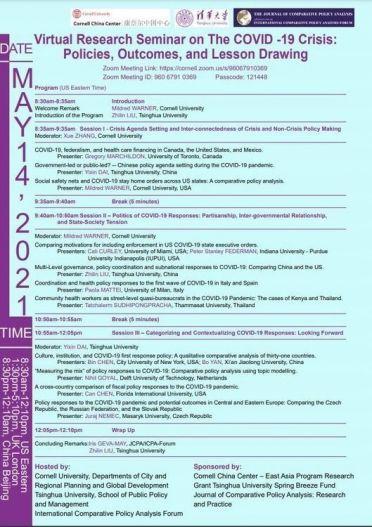
May 14, 2021
8:30 am
Cornell University and Tsinghua University are cohosting this international seminar with papers exploring policy responses to COVID-19 from across the world. The papers are featured in a special issue of the Journal of Comparative Policy Analysis, just published.
Special Issue on The COVID -19 Crisis: Policies, Outcomes, and Lesson Drawing, Journal of Comparative Policy Analysis: Research and Practice, 2021, 23 (2) https://www.tandfonline.com/toc/fcpa20/current
Dr. Xue Zhang (Global Dev) and Dr. Mildred Warner (City and Reg Planning and Global Dev) have a paper in this collection based on work supported by the Cornell Center for Social Sciences and Cornell Center for Inequality.
This seminar is funded in part by a Cornell China Center-East Asia Program grant.
Program (US Eastern Time)
8:30am-8:35am Introduction Welcome Remark Mildred Warner, Cornell University Introduction of the Program Zhilin LIU, Tsinghua University
8:35am-9:35am Session I - Crisis Agenda Setting and Inter-connectedness of Crisis and Non-Crisis Policy Making Moderator: Xue ZHANG, Cornell University COVID-19, federalism, and health care financing in Canada, the United States, and Mexico. Presenter: Gregory MARCHILDON, University of Toronto, Canada Government-led or public-led? -- Chinese policy agenda setting during the COVID-19 pandemic. Presenter: Yixin DAI, Tsinghua University, China Social safety nets and COVID-19 stay home orders across US states: A comparative policy analysis. Presenter: Mildred WARNER, Cornell University, USA
9:35am-9:40am Break (5 minutes)
9:40am-10:50am Session II – Politics of COVID-19 Responses: Partisanship, Inter-governmental Relationship, and State-Society Tension Moderator: Mildred WARNER, Cornell University Comparing motivations for including enforcement in US COVID-19 state executive orders. Presenters: Cali CURLEY, University of Miami, USA; Peter Stanley Federman, Indiana University - Purdue University Indianapolis (IUPUI), USA Multi-Level governance, policy coordination and subnational responses to COVID-19: Comparing China and the US. Presenter: Zhilin LIU, Tsinghua University, China Coordination and health policy responses to the first wave of COVID-19 in Italy and Spain Presenter: Paola MATTEI, University of Milan, Italy Community health workers as street-level quasi-bureaucrats in the COVID-19 Pandemic: The cases of Kenya and Thailand. Presenter: Tatchalerm SUDHIPONGPRACHA, Thammasat University, Thailand
10:50am-10:55am Break (5 minutes)
10:55am-12:05pm Session III – Categorizing and Contextualizing COVID-19 Responses: Looking Forward Moderator: Yixin DAI, Tsinghua University Culture, institution, and COVID-19 first response policy: A qualitative comparative analysis of thirty-one countries. Presenters: Bin CHEN, City University of New York, USA; Bo YAN, Xi’an Jiaotong University, China “Measuring the mix” of policy responses to COVID-19: Comparative policy analysis using topic modelling. Presenter: Nihit GOYAL, Delft University of Technology, Netherlands A cross-country comparison of fiscal policy responses to the COVID-19 pandemic. Presenter: Can CHEN, Florida International University, USA Policy responses to the COVID-19 pandemic and potential outcomes in Central and Eastern Europe: Comparing the Czech Republic, the Russian Federation, and the Slovak Republic Presenter: Juraj NEMEC, Masaryk University, Czech Republic
12:05pm-12:10pm Wrap Up Concluding Remarks:Iris GEVA-MAY, JCPA/ICPA-Forum Zhilin LIU, Tsinghua University
Additional Information
Program
Einaudi Center for International Studies
East Asia Program
China: In Search of a Green Economy

May 20, 2021
8:00 am
Climate change and environmental degradation is a threat for economic prosperity. In relation to its commitment to achieve the Paris Agreement goals, China is aiming to reach carbon neutrality by 2060. China is leading in renewable energy production figures. It is currently the world's largest producer of wind and solar energy and the largest domestic and outbound investor in renewable energy. At the same time, Greenhouse gas emissions by China are the largest of any country in the world both in production and consumption terms. This stems mainly from coal electricity generation, which represents 60 percent of power and mining.
Carbon neutrality refers to the elimination of carbon dioxide. China’s government supports R&D efforts for green technology innovation. A major challenge is the greening of China’s manufacturing system to create a more sustainable economy. International cooperation for the greater good of mitigating global warming is urgently needed and China’s green trajectory comes with both opportunities and challenges for the rest of the world.
What You’ll Learn:
China’s goals to reduce greenhouse gas emissionsChallenges and opportunities of green technologyInternational cooperation regarding Paris Agreement GoalsSpeakers:
Lourdes Casanova, Senior Lecturer, Director Emerging Markets InstituteHenri Li and Gari Xiao, Yingke Law FirmYan Chen, China International Capital Corporation (CICC)Crystal GENG, Ping An Insurance (Group) Company of China, Ltd.Moderator: Ying Hua, Director, Cornell China CenterQ&A moderator: David (Wei) Wu, Executive Project Manager and AttorneyThis event is cosponsored by the Emerging Markets Institute, the Cornell China Center, and eCornell.
Event time:
8:00-9:30 am New York time
8:00-9:30 pm Beijing time
Registration link: https://ecornell.cornell.edu/keynotes/overview/K052021/
Registration link for attendees in China: https://cornell.zoom.us/webinar/register/WN_VZn0gi57Q3WQl_5J680zTA
(Attendees in China should register and attend through the Zoom link, as the eCornell platform may not work in China.)
Additional Information
Program
Einaudi Center for International Studies
East Asia Program
Race Matters: Research Questions in International Relations

May 20, 2021
11:00 am
The Einaudi Center’s global racial justice research team presents the inaugural session of Race Matters, a new webinar series that fosters in-depth conversations on colonial questions and racial justice across international relations.
This panel brings together global experts for a candid appraisal of disciplinary instruments (methods, archives, concepts, ontologies, and epistemologies) and institutions (practices of knowledge production and incorporation as policy). The debate centers the question: How effectively do our tools for producing and shaping knowledge and policy serve the cause of advancing racial equality and justice globally?
Some of the panelists critique methods and lines of inquiries in scholarship on race and racism. Others presume an insurgency by self-determining political communities—including in the academy—against colonizing institutional practices and in favor of the expansion of archives and imaginaries.
This conversation represents an initial framing of questions and critiques that will continue in four additional Race Matters panels through the fall 2021 semester. Read more about the series below.
Moderator: Siba Grovogui, Africana Studies, Cornell University
Panelists:
Daniel Bendix, Franziska Müller, and Aram Ziai, coeditors of Beyond the Master’s Tools? Decolonizing Knowledge Orders, Research Methods, and Teaching (2020)Mustapha K. Pasha, Meera Sabaratnam, and Robbie Shilliam, series editors of Kilombo: International Relations and Colonial QuestionsDiscussants: Oumar Ba, Political Science, Morehouse College; Sarah Then Bergh, Africana Studies PhD candidate, Cornell University
***
Race Matters: A webinar series sponsored by Cornell’s Mario Einaudi Center for International Studies, Africana Studies and Research Center, and Department of Government
Race Matters brings together international relations experts for critical conversations on colonial questions and racial justice across international relations. Join us to explore scholarship on race and racism and the policies, institutions, and systems that perpetuate racial inequality and violence worldwide. Continuing throughout 2021, Race Matters will identify opportunities for transformative change and highlight collective and individual actions toward a more just world.
Learn about the Einaudi Center’s work on racial justice and all of our global research priorities.
Register now: https://cornell.zoom.us/webinar/register/WN_hYI75wwITDOvrOW_ZTHY6Q
Additional Information
Program
Einaudi Center for International Studies
Reppy Institute for Peace and Conflict Studies
East Asia Program
Southeast Asia Program
Latin American and Caribbean Studies
Institute for African Development
Institute for European Studies
South Asia Program
Institute for African Development Seminar: Students' Presentations

May 13, 2021
2:40 pm
Title: Transportation Policy Development in Africa , Paine Gronemeyer
Cornell AAP '24, Urban and Regional Studies
Title: African Healthcare Real Estate Outlook:
The resilience of the medical system across African Cities
Eugene Nana Kyere Afranie, MPS – Real Estate Candidate '22
Baker Program in Real Estate | The Hotel School
SC Johnson College of Business | Cornell University
Title: The Impact of COVID-19 on Africa's Development and Economic Growth
and its Impact on the Housing Market
Justina Bethune, Graduate Student, City & Regional Planning
TBA
Diane Okong'o, College of Arts and Sciences
Register https://cornell.zoom.us/meeting/register/tJ0vd-mvqzovG9D71gp7fZrfjY8zap…
Additional Information
Program
Einaudi Center for International Studies
Institute for African Development
Sen: Attacks on Democracy

Bartels Lecturer Describes Rising Internal Threats
"Home may have become a dangerous place for democracy to flourish now," said Nobel prize–winning economist Amartya Sen on May 5.
Additional Information
Can Incentives Sway the Vaccine-Hesitant?

Sarah Kreps, PACS
The article cites research from Sarah Kreps, professor of government, showing that the prospect of being paid $100 had no statistically significant impact on whether people wanted the COVID-19 vaccine, but that having to pay a $20 copay did make people less enthusiastic.