
Einaudi Center for International Studies
Unity Across Language/Unidad en Lenguaje
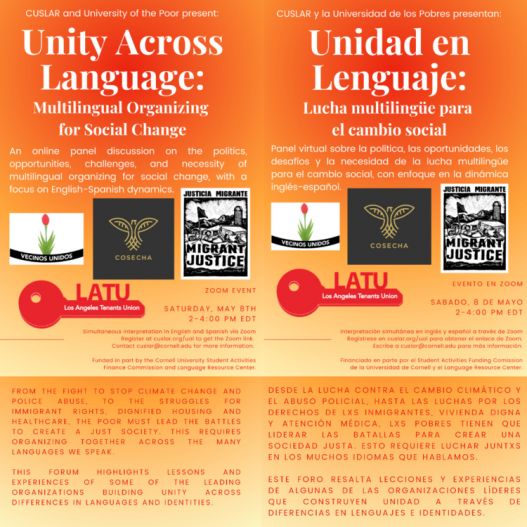
May 8, 2021
2:00 pm
Unity Across Language: Multilingual organizing for social change
Unidad en Lenguaje: Lucha multilingüe para el cambio social
An online panel discussion on the politics, opportunities, challenges, and necessity of multilingual organizing for social change, with a focus on English-Spanish dynamics.
Panel virtual sobre la política, las oportunidades, desafíos y necesidad de la lucha multilingüe para el cambio social, con enfoque en la dinámica inglés-español.
From the fight to stop climate change and police abuse, to the struggles for immigrant rights, dignified housing and healthcare, the poor must lead the battles to create a just society. This requires organizing together across the many languages we speak.
Desde la lucha contra el cambio climático y el abuso policial, hasta las luchas por los derechos de lxs inmigrantes, vivienda digna y atención médica, lxs pobres tienen que liderar las batallas para crear una sociedad justa. Esto requiere luchar juntxs en los muchos lenguajes que hablamos.
This forum highlights lessons and experiences of some of the leading organizations building unity across differences in languages and identities.
Este foro resalta lecciones y experiencias de algunas de las organizaciones líderes que construyen unidad a través de diferencias en lenguajes e identidades.
Featuring leaders from/Con líderes de:
Los Angeles Tenants Union (California)/Sindicato de inquilinos de Los Ángeles (California)
Migrant Justice (Vermont)/Justicia Migrante (Vermont)
Movimiento Cosecha
Vecinos Unidos (Wisconsin)
Simultaneous interpretation in English and Spanish via Zoom.
Interpretación simultánea en inglés y español a través de Zoom.
Register at/Regístrese en cuslar.org/ual
Contact cuslar@cornell.edu for more information.
Escribe a cuslar@cornell.edu para más información.
Organized by CUSLAR and University of the Poor.
Organizado por CUSLAR y Universidad de los Pobres.
Funded in part by the Cornell University Student Activities Funding Commission and Language Resource Center.
Financiado en parte por Cornell University Student Activities Funding Commission y Language Resource Center.
Additional Information
Program
Einaudi Center for International Studies
Latin American and Caribbean Studies
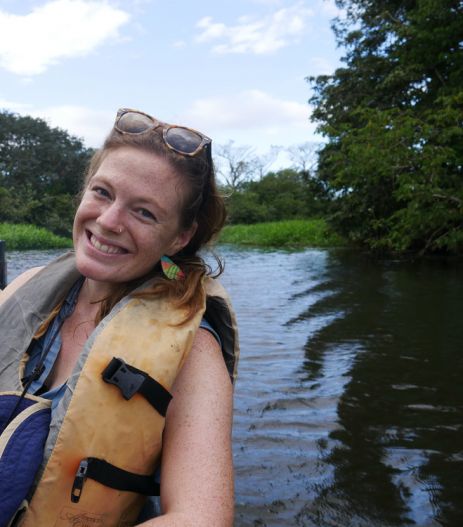
Anthropology Colloquium: Rachel Odhner
May 7, 2021
3:00 pm
"la frontera piñera: pineapple and water in the making and unmaking of the Nicaragua/Costa Rica border"
Rachel’s research explores how rivers, lakes, wetlands, and different people’s relationships with these bodies of water have made, remade, and unmade the Nicaragua/Costa Rica border through time. Her project looks at how despite state border-making projects, local residents’ crossborder mobilizations over water, as well as the flows and stops of water, disrupt and destabilize the border, challenging the notion of a fixed or fixable boundary.
Rachel received her bachelor’s degree in cultural anthropology from the University of Rochester in 2010. Prior to beginning graduate school, she spent two years traveling and working in rural South America, and then volunteered as a Peace Corps Volunteer in northern Nicaragua. There she became interested in water issues amid seasonal cycles of food availability and the everyday realities of farmers in a drought-prone community in a country abundant with water.
Her research is supported by the National Science Foundation Graduate Research Fellowship, the US Student Fulbright program, and the National Geographic Society.
Additional Information
Program
Einaudi Center for International Studies
Latin American and Caribbean Studies
Support COVID Relief in South Asia

Please consider supporting these organizations working on the ground in South Asia to provide relief from COVID-19. They accept donations in US$.
India
Cornell India Association GiveIndia fundraiser
Pakistan
Bangladesh
Nepal
America Nepal Medical Foundation
Sri Lanka
Additional Information
Program
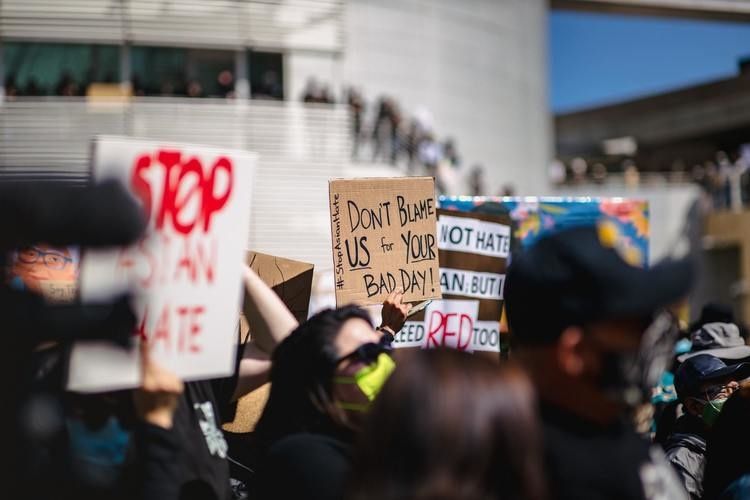
Teach-in on Confronting Anti-Asian Racism
May 7, 2021
12:00 pm
Join us for an interactive teach-in and listen-in on the history and experience of anti-Asian racism in the United States and at Cornell University. Register here.
In the first hour, perspectives and presentations from Cornell students, staff, and faculty will highlight the long history of anti-Asian racism in the United States as well as the diversity of experiences at Cornell. Participants will hear about the connections and divisions under the very broad labels of “Asian” and “Asian American” and explore ways to speak across these differences.
Speakers:
Christine Bacareza Balance, Associate Professor of Performing and Media ArtsDerek Chang, Associate Professor of HistoryAvery August, Vice Provost for Academic Affairs, Professor of Immunology Nancy Martinsen, Associate Dean of Students and Director of the Asian and Asian American CenterPanelists:
Huili Grace Xing, William L Quackenbush Professor of Electrical and Computer Engineering and Materials Science and Engineering, Associate Dean for Research and Graduate Studies in the College of EngineeringReanna Esmail, Outreach and Engagement Librarian at Olin Library and the library liaison to the Latinx Studies Program and the Asian American Studies ProgramJeannie Yamazaki, undergraduate student in Environment and Sustainability and EducationAnthony Chen, undergraduate student in Information Science and Sociology, minor in Asian American StudiesChristopher Berardino, dual MFA/Ph.D. candidate in EnglishRazima Chowdhury, Senior Lecturer, Asian StudiesThe panel moderated by Wendy Wolford, Vice Provost for International Affairs, Professor of Global Development
In the second hour, participants will meet in small breakout groups to freely express their views and generate concrete ideas in an anonymous setting (zoom profiles will be anonymized). These breakout rooms are an opportunity to set the agenda for further related programming on campus during the next academic year and beyond. Facilitated by the Intergroup Dialogue Project and Durba Ghosh, Professor of History.
This event has been co-organized with faculty and staff from the Asian and Asian American Center (A3C), Asian American Studies Program, Asian Studies, Global Cornell, Mario Einaudi Center for International Studies (including EAP, SAP, and SEAP), Graduate School, and Office of Faculty Development and Diversity.
Additional Information
Program
Einaudi Center for International Studies
East Asia Program
Southeast Asia Program
South Asia Program
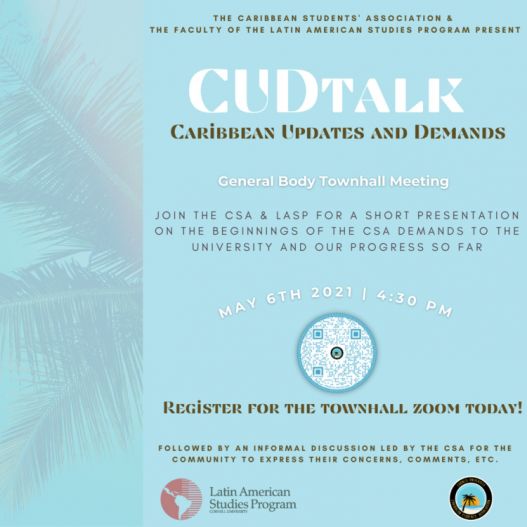
CUD Talk, CSA & LASP Townhall Meeting, Caribbean Updates and Demands
May 6, 2021
4:30 pm
CUD Talk, Caribbean Updates and Demands, CSA & LASP Townhall Meeting:
Join the Caribbean Students' Association & the Faculty of the Latin American Studies Program for a short presentation on the beginning of the CSA demands to the University and our progress so far.
To be followed by an informal discussion led by the CSA for the community to express their concerns, comments, etc.
Additional Information
Program
Einaudi Center for International Studies
Latin American and Caribbean Studies
Sahana Natesan ’19, SAP/IAD: Einaudi Student Path (video)
Sahana Natesan ’19 worked with the South Asia Program to bring her passion for traditional Indian dance to others, performing at the Johnson Museum and later sharing dance and Hindi language through Einaudi's Afterschool Language and Culture Program. She also found opportunities through the Institute for African Development, which facilitated her trip abroad to study healthcare in Ghana.
Additional Information
Democracy: Global Challenges
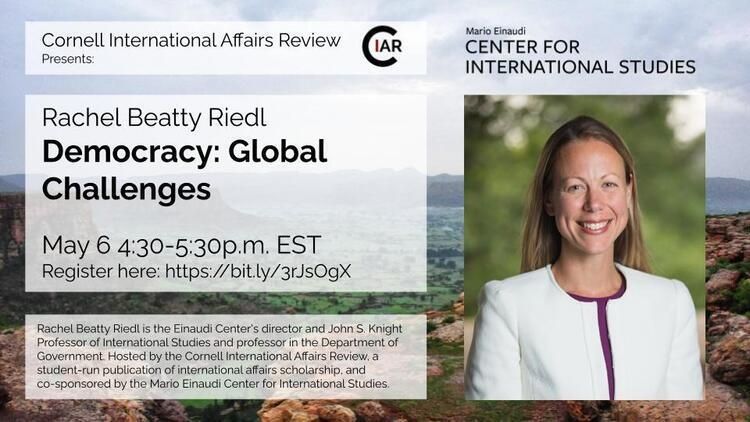
May 6, 2021
4:30 pm
Join the Cornell International Affairs Review and Prof. Rachel Beatty Riedl for her talk on "Democracy: Global Challenges."
Rachel Beatty Riedl will discuss the global challenges confronting democracy today. Prof. Riedl is the Mario Einaudi Center for International Studies' director and John S. Knight Professor of International Studies and professor in the Department of Government. The event is hosted by the Cornell International Affairs Review and cosponsored by the Einaudi Center. It is open to all.
Please email editor.ciar@gmail.com or LRD72@cornell.edu with any questions!
Additional Information
Program
Einaudi Center for International Studies
EastAsia+ Workshop with Thomas Lamarre: "Infrastructure and Sensibility: A Physiology of Power"

May 20, 2021
3:30 pm
The EastAsia+ Initiative presents a talk by Thomas Lamarre on television, anime infrastructures, and new formations of media power. Across these two lines of inquiry, Lamarre aims to delineate both an ecological approach to media and a physiology of power, which might open a transformation in our media sensibility.
Abstract: One of the current trends in media studies is to make visible the massive built environments and intendant ecological destruction that subtend telecommunications infrastructures, which remain invisible or “thin” for users. Another trend concerns the symbolic function of infrastructure, a symbol of modernity, or state power, or both. I propose to complement these approaches with a more micropolitical perspective on infrastructure that brings questions of subjectivity and sensibility to the fore. On the one hand, I will explore what the 1997 Pokemon incident tells us about television infrastructures and new formations of media power. On the other hand, I wish to show how this formation of power presents a profound challenge to the received wisdom about environments and media (and the associated legacy of cybernetic thinking). Across these two lines of inquiry, I aim to delineate both an ecological approach to media and a physiology of power, which might open a transformation in our media sensibility.
Bio: Thomas Lamarre (he/him/his) teaches in Cinema and Media Studies and East Asian Languages and Civilizations at the University of Chicago. Publications on media, thought, and material history include work on communication networks in 9th century Japan (Uncovering Heian Japan, 2000); silent cinema and the global imaginary (Shadows on the Screen, 2005); animation technologies (The Anime Machine, 2009) and infrastructure ecologies (The Anime Ecology, 2018). Major translations include Kawamata Chiaki’s Death Sentences (2012), Muriel Combes’s Gilbert Simondon and the Philosophy of the Transindividual (2012), and David Lapoujade’s William James, Empiricism, and Pragmatism (2019).
Presented by EastAsia+, a new initiative at Cornell that combines programming, mentorship, and (digital) publishing around East Asian media studies. EastAsia+ is a collective of scholars, publishing professionals, librarians, curators, and graduate students dedicated to exploring new possibilities for academic publishing, networking, and collaboration in East Asia media studies and digital humanities research.
EastAsia+ is generously supported by funding from Cornell University’s Society for the Humanities.
Additional Information
Program
Einaudi Center for International Studies
East Asia Program
Renelle Mensah '21, IAD: Einaudi Student Path (video)
Renelle Mensah is a government major with minors in Arabic and French. After she graduates, she will use her Pickering fellowship to complete a master's degree and prepare for a career in the foreign service.
Additional Information
Plantationocene

Conference Videos Now Available
On April 15–16, 40 panelists from around the world explored plantations' legacies. Watch the videos.