
Einaudi Center for International Studies
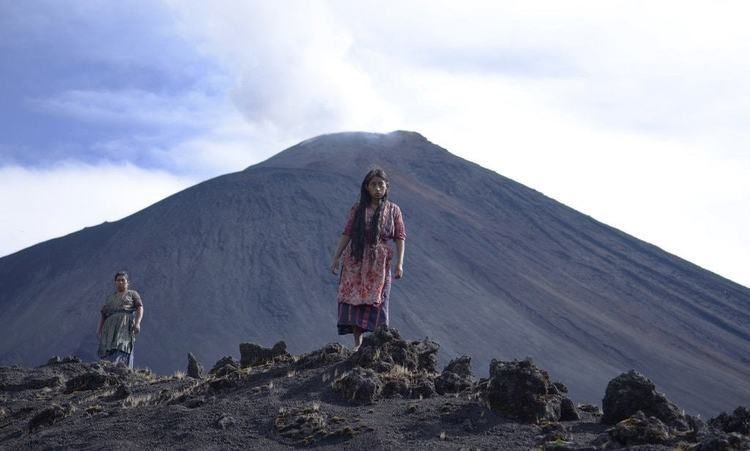
LACS Film Series presents "IXCANUL (volcano)," 6-8pm, G08 Uris Hall
September 23, 2021
6:00 pm
Uris Hall, G08
IXCANUL (“volcano” in the Kaqchikel language, English Subtitles)
Time: 6-8 PM | Place: G08 Uris Hall
This year’s LACS Film Series will screen movies from all over the region, highlighting the program’s recent focus on the Caribbean. During the Fall semester we’ll watch and discuss movies from North America (Mexico), Central America (Guatemala), and the Caribbean (Haiti & Dominican Republic). In the Spring semester, the series will “go South” with films from South American countries, and once again from the Caribbean.
Feel free to join any of the screening sessions + discussions without previous RSVP. Upcoming dates are October 21 and November 18 (always at 6pm). Further details will be shared before each session.
Looking forward to seeing you all!
The LACS Film Committee
Ixcanul Description: Maria, a 17 year old Mayan woman, lives on the slopes of an active volcano in Guatemala. An arranged marriage awaits her. Although Maria dreams of seeing 'the city', her status as an indigenous woman does not allow her to go out into that 'modern world'. Later, during a pregnancy complication, this modern world will save her life, but at what price. The brilliant debut by Guatemalan filmmaker Jayro Bustamante is a mesmerizing fusion of fact and fable, a dreamlike depiction of the daily lives of Kaqchikel speaking Mayans on a coffee plantation at the base of an active volcano. Immersing us in its characters' customs and beliefs, IXCANUL chronicles with unblinking realism, a disappearing tradition and a disappearing people.
Additional Information
Program
Einaudi Center for International Studies
Latin American and Caribbean Studies
CEAS Book talk: Eight Dogs, or Hakkenden: Part One—An Ill-Considered Jest.

October 20, 2021
1:30 pm
CEAS welcomes author Glynne Walley to talk about his book Eight Dogs, or Hakkenden: Part One—An Ill-Considered Jest, a translation of Kyokutei Bakin's Nansō Satomi hakkenden. This multigenerational samurai saga was one of the most popular and influential Japanese books of the nineteenth century and has been adapted many times into film, television, fiction, and comics. Part One tells the story of Princess Fuse of the Satomi clan, whose tragic and heroic sacrifice leads to the creation of the Eight Dog Warriors.
Glynne Walley is an Associate Professor of Japanese Literature at the University of Oregon. His research interests involve popular literature and how it negotiates the requirements of industry and genre, the demands of a mass audience, and the aspirational pull of “serious” literature. His main focus is popular fiction of the late Tokugawa period, particularly Hakkenden. He is also the author of Good Dogs: Edification, Entertainment and Kyokutei Bakin's Nansō Satomi hakkenden (CEAS, 2017).
Housed in the East Asia Program, CEAS is an internationally known, award-winning scholarly press. CEAS publishes on subjects relative to the cultures of East Asia, covering topics in history, culture, and society, and translations of literary works.
Since its inception in 1973 as a venue for publishing papers that were submitted to the East Asia Program, the Series has grown into its current status as a publisher with a reputation for quality and specialized academic titles. More than 200 volumes have been published to date, with hundreds of titles in print and dozens of titles available digitally for free through the Cornell University Library.
Contact
For all publication matters, please contact the managing editor at ceas@cornell.edu.
Additional Information
Program
Einaudi Center for International Studies
East Asia Program
"The Economic Motivations Behind U.S. Interventions & Foreign Policy in Haiti," by Jean Eddy Saint Paul, Virtual LACS Public Issues Forum
November 29, 2021
4:30 pm
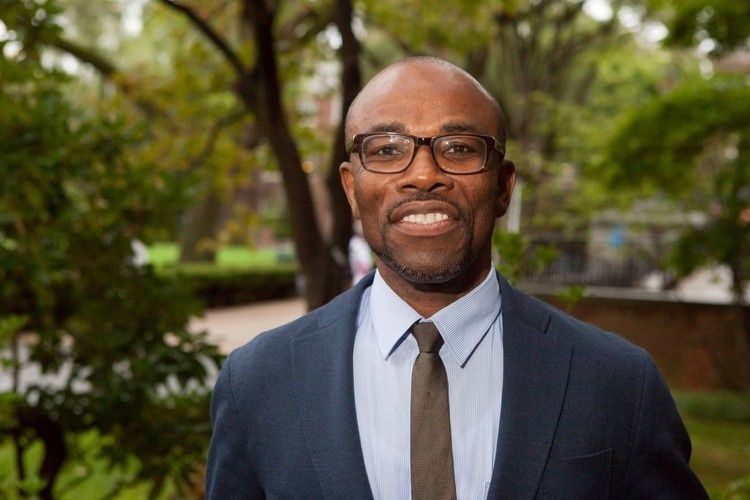
Many scholars and practitioners do not necessarily know that the United States occupied Haiti for nineteen years, between 1915 and 1934. It is also not common knowledge that the monies taken from the National Bank of Haiti helped to boost the U.S. economy in the context of the great depression. With the recent assassination of Haitian President Jovenel Moïse followed by the powerful earthquake of August 14, 2021, Haiti has yet again been in the spotlight of mainstream media, and is recurrently labelled as the “poorest country of the Western Hemisphere,” a label that not only ignores the root causes of Haiti’s contemporary issues, but also completely ignores the country’s rich history and resources. Contrary to the general scholarship that has reaffirmed neocolonial tropes about Haiti, Professor Saint Paul will unpack the myth that Haiti is the poorest country, and will explain how U.S. economic interests have driven U.S. political interventions in Haiti, from 1915 to now. The overall goal of the lecture is to raise awareness about the fact that the Caribbean country has been impoverished by powerful transnational social forces, highly influenced by the United States of America. The discussion will also explore the question of whether or not the United States has a moral responsibility in Haiti’s current state of affairs.
Virtual Event via Zoom, please register through the following link: https://cornell.zoom.us/webinar/register/WN_Py9gTMsFSta3oHkkmEQqyQ
Additional Information
Program
Einaudi Center for International Studies
Latin American and Caribbean Studies
Becoming Organic: Nature and Agriculture in the Indian Himalaya, Shaila Seshia Galvin

October 4, 2021
11:00 am
Just after the turn of the new millennium, in 2003, the newly created state of Uttarakhand in India’s central Himalayas declared its ambition to become fully organic in all aspects of agricultural production. But what does it mean to become organic in a region where many people claim agriculture has always been “organic by default”? Tracing the social and bureaucratic life of organic quality as it is produced in Uttarakhand, this talk decenters commonly held understandings that hold up organic as a property of land and its produce. I show instead how organic may be more fully understood as a quality that is historically and socially produced and assembled within relationships forged between farmers, state authorities, private corporations, and new agrarian intermediaries, and that affirms, even as it seeks to rework, enduring distinctions between nature and agriculture in India.
Shaila Seshia Galvin is an Associate Professor in the Department of Anthropology and Sociology at the Graduate Institute of International Development Studies in Geneva, Switzerland. She conducts research at the intersection of environmental, political, and economic anthropology. Her recently published book, Becoming Organic: Nature and Agriculture in the Indian Himalaya (Yale University Press, 2021), emerges from long-term research interests in processes of agrarian change. Her upcoming research will examine intersections of agriculture and bioeconomies, as well as the proliferation of audit technologies and accounting methodologies as tools of environmental management and governance through a new project funded by the Swiss National Science Foundation, “Accounting for Nature: Agriculture and Mitigation in the Era of Global Climate Change.” Her work has been published in American Ethnologist, Annual Review of Anthropology, Journal of Asian Studies, and World Development, among others.
This event is co-sponsored by the Departments of Anthropology and Global Development.
Additional Information
Program
Einaudi Center for International Studies
South Asia Program
Establishing Africa Free Trade Agreement (AFCFTA)
September 16, 2021
2:40 pm
Uris Hall, G-08
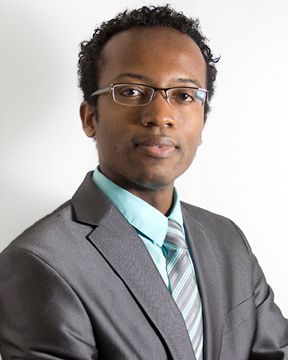
Issues in African Development Seminar Series examines critical concerns in contemporary Africa using a different theme each semester. The seminars provide a forum for participants to explore alternative perspectives and exchange ideas. They are also a focal activity for students and faculty interested in African development. In addition, prepares students for higher level courses on African economic, social and political development. The presentations are designed for students who are interested in development, Africa’s place in global studies, want to know about the peoples, cultures and societies that call Africa home, and explore development theories and alternate viewpoints on development.
Additional Information
Program
Einaudi Center for International Studies
Institute for African Development
Amr Leheta

Graduate Student, Near Eastern Studies
Amr Leheta is a PhD student in Cornell University's Department of Near Eastern Studies.
He was a research associate for Middle Eastern studies at the Council on Foreign Relations in Washington, DC, from 2014 to 2018. There, he worked on numerous research projects related to U.S.-Middle East foreign policy, with a particular focus on Egypt and Turkey, as well as Middle Eastern history, politics, and society.
Additional Information
Ecem Sarıçayır

Graduate Student, Architecture
Ecem Sarıçayır is pursuing a PhD in history of architecture and urban development at Cornell University. Her dissertation analyzes the history of art, architecture, and urbanism in the South Caucasus with a particular focus on the displacements and resettlements of the peoples in the region, as well as the alternative solidarities existing among them.
Additional Information
"Bootstrap Justice: The Search for Mexico's Disappeared," by Janice Gallagher, LACS Weekly Seminar Series

November 22, 2021
1:00 pm
G-01 Stimson Hall
What does it take to challenge entrenched judicial dysfunction? In this talk, Janice Gallagher previews the central argument from her forthcoming book, "Bootstrap Justice: The Search for Mexico's Disappeared." She shows how the sustained mobilization of families of the disappeared widens cracks in impunity produced by shifting state-criminal alliances, and highlights the key role of state allies. Speaker is in-person.
Cornell Community may attend in-person at 1pm G01 Stimson Hall
Event is free and open to the public via Zoom--Please register through the following link:
https://cornell.zoom.us/webinar/register/WN_5VxY9YHDS5yCp1N-FwG2Lw
Additional Information
Program
Einaudi Center for International Studies
Latin American and Caribbean Studies
Theranos Judge Requires Covid Shots for Jurors, But Will That Skew the Jury Pool?

Valerie Hans, Law
"I think it's a reasonable decision in the midst of the pandemic, but yes, the elimination of unvaccinated people is likely to affect the makeup of the jury pool,” says Valerie Hans, professor of law.
Additional Information
Best! Letters from Asian Americans in the arts
September 15, 2021
12:00 pm
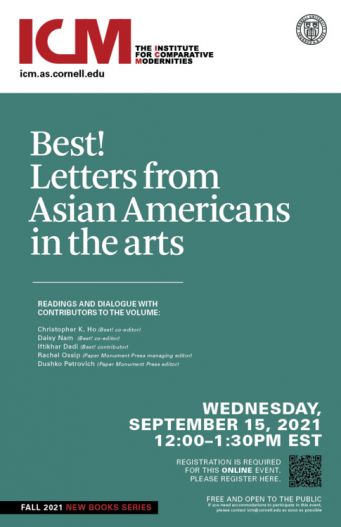
A panel discussion and series of readings from the 2021 anthology Best! Letters from Asian Americans in the arts. Readings, annotations, and dialogue with editors and contributors Christopher K. Ho, Daisy Nam, Iftikhar Dadi, Rachel Ossip, and Dushko Petrovich.
This collection of seventy-three letters written in 2020 captures an unprecedented moment in politics and society through the experiences of Asian-American artists, curators, educators, art historians, editors, writers, and designers. The form of the letter offers readers intimate insights into the complexities of Asian American experiences, moving beyond the model-minority myth. Chronicling everyday lives, dreams, rage, family histories, and cultural politics, these letters ignite new ways of being, and modes of creating, at a moment of racial reckoning.
Registation is required to attend this online event. The registration link is:
https://cornell.zoom.us/webinar/register/WN_09xS16fkTcmiiQc3Kvge2g
Additional Information
Program
East Asia Program
Einaudi Center for International Studies