
Einaudi Center for International Studies
How To Make 'Immunity Passports' More Ethical

Nicole Hassoun, Einaudi
Nicole Hassoun, visiting scholar at the Mario Einaudi Center for International Studies, writes this opinion piece about how to make requiring proof for vaccination against COVID-19 more ethical.
Additional Information
Odysseys: Minfong Ho & Kenneth McClane

May 18, 2021
7:00 pm
Odysseys: Ithaca Writers on Exile, Wandering, and Searching for Home is a reading series presented by Ithaca City of Asylum and co-sponsored by Global Cornell and Cornell's Migrations initiative.
Homer’s Odyssey recounts the adventures of Odysseus, king of Ithaca, as he seeks to return home after the Trojan War. In four monthly readings, pairs of Ithaca-based writers provide their takes on the theme of odysseys, from the physical to the intellectual to the emotional.
Authors:
Minfong Ho (author of The Clay Marble and Hush!, journalist, educator)
Kenneth McClane (professor of literature emeritus at Cornell, author, poet)
Moderator:
Edward Hower (novelist, Ithaca City of Asylum board member)
Additional Information
Program
Einaudi Center for International Studies
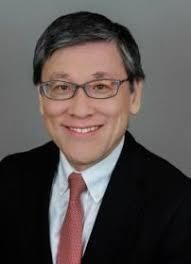
Emerging Markets Theme Research Seminar—TJ Wong
May 7, 2021
12:00 pm
The research seminar series is an initiative of the Emerging Markets Theme of the Cornell S.C. Johnson College of Business, which focuses on engaging students and faculty in discourse over the role of emerging markets in an increasingly connected world.
Every month, we will host a speaker to expand our understanding of emerging economies through research and diverse perspectives. Join us in welcoming TJ Wong on May 7 at 12pm ET.
TJ Wong is the Joseph A. DeBell Professor of Business Administration and Professor of Accounting at USC Marshall Business School. He co-organizes the China Research Group at USC. Prior to joining USC, he served as the Dean of the business school and the Director of the Center for Institutions and Governance of the Chinese University of Hong Kong. His research primarily focuses on the institutions and corporate governance of emerging market firms.
Additional Information
Program
Einaudi Center for International Studies
Latin American and Caribbean Studies
Rough Work: Melodramatic Afterlives with Simon Posner
April 28, 2021
11:30 am
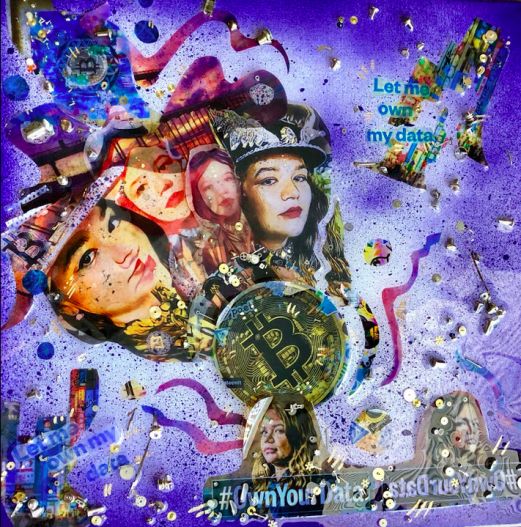
Melodramatic Afterlives: Visions in Seoul’s Blockchain Space
Simon Posner, Ph.D. student, Department of Anthropology, Cornell University
Posner writes: This chapter looks at blockchain-inspired visions of the future crafted by members of Seoul's largest community of blockchain enthusiasts. I look at the ways in which these visions are less visual and more felt. In particular, I argue that these visions are intended to conjure and re-animate melodramatic structures of feeling that arose during South Korea's period of rapid industrialization to make sense of profound change. This method of envisioning is distinct from ocular-centric visions often described in Western contexts and adds to the repertoire by which we might engage the future.
ROUGH WORK: Discussing research in progress, hence the term, rough work. This rough work session is hosted by the East Asia Program's Graduate Student Steering Committee (GSSC).
Additional Information
Program
Einaudi Center for International Studies
East Asia Program
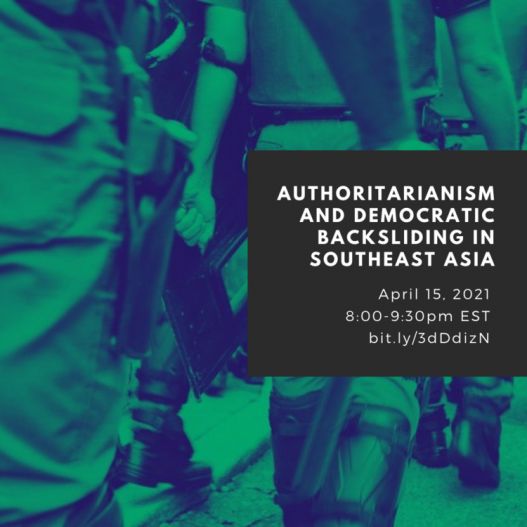
Authoritarianism and Democratic Backsliding in Southeast Asia: A Virtual Roundtable
April 16, 2021
8:00 pm
The global trend of democratic backsliding has reshaped politics around the world, from the United States to Indonesia. Throughout Southeast Asia, a region long marked by contestation between authoritarian and democratic politics, contemporary authoritarian practices interact with local histories to generate distinctly new forms of politics—from penal populism in the Philippines to Burma’s most recent military coup. This virtual roundtable on authoritarianism brings together four experts on the politics of Myanmar, Indonesia, Thailand, and the Philippines to understand contemporary authoritarianism and democratic backsliding in the Southeast Asian context.
Introduction: Rebecca Slayton, Director of the Judith Reppy Institute for Peace and Conflict Studies (Associate Professor, Dept of Science and Technology Studies, Cornell)
Moderator: Tom Pepinsky (Tisch University Professor, Dept of Government, Cornell)
Panelists:
Pavin Chachavalpongpun (Associate Professor, Center for Southeast Asian Studies, Kyoto University)Mark R. Thompson (Professor of Politics and Head, Department of Asian & International Studies; Director of Southeast Asia Research Centre, City University of Hong Kong)Ardeth Thawnghmung (Chair of Political Science, Professor, Interim Director, Peace and Conflict Studies, University of Massachusetts Lowell)Eve Warburton (Postdoctoral Fellow, Asia Research Institute, National University of Singapore)
Co-organized by the Southeast Asia Program and the Judith Reppy Institute for Peace and Conflict Studies
Additional Information
Program
Einaudi Center for International Studies
Reppy Institute for Peace and Conflict Studies
Southeast Asia Program
A Conversation on the Plantationocene

April 15, 2021
11:00 am
This virtual conference, sponsored by the Mario Einaudi Center for International Studies and Migrations: A Global Grand Challenge, brings together a diverse group of scholars, activists, and practitioners to discuss the role that plantations and plantation agriculture have played in shaping the nature, structure, and dynamics of the modern era.
Although plantations have long been the subject of study, the Plantationocene as a concept emerged only in the past few years to describe the role of racialized, large-scale plantation agriculture in establishing a world system that to this day lives with the legacy and continuation of slavery, forced migration, dispossession, and mono-crop extractive agriculture intended for export production.
This article serves as a frame for the conversation: Wolford, Wendy, 2021 “The Plantationocene: A Lusotropical Contribution to the Theory,” Annals of the American Association of Geographers, early view online.
Over two days of roundtable discussions (April 15-16), scholars and activists from a variety of disciplines of critical social theory and practice, including agrarian studies, political ecology, development studies, black geographies and feminist theory, will discuss the Plantationocene and to what extent this conceptional framework may be useful—not just for analytical purposes, but also for activism and practice.
Explore the schedule and presentersRegister nowThe conference is available in Portuguese through simultaneous interpretation on the same Zoom channel. All sessions will be recorded.
Moderator:
Wendy Wolford, Robert A. and Ruth E. Polson Professor, Department of Global Development, Cornell University
Panelists:
Gerard Aching, Professor of Africana and Romance Studies, Cornell UniversityYasmine Ahmed, Postdoctoral teaching fellow, The American University in CairoSarah Besky, Associate Professor of Industrial and Labor Relations, Cornell UniversityRachel Bezner-Kerr, Professor of Global Development, Cornell UniversityJun Borras, Professor of Agrarian Studies, Institute of Social Studies, Erasmus University, the HagueNatacha Bruna, PhD candidate, International Institute of Social Studies (ISS), Erasmus University, the Hague Judith Carney, Professor of Geography, University of California, Los AngelesSophie Chao, Postdoctoral Research Associate, University of SydneySharad Chari, Associate Professor of Geography, University of California, BerkeleyYoujin Chung, Assistant Professor of Energy and Resources Group and Environmental Science, Policy, and Management, University of California, BerkeleyAndrew Curley, Assistant Professor of Geography, University of ArizonaMary Jo Dudley, Director of the Cornell Farmworker Program, Cornell UniversityChristopher Dunn, Elizabeth Newman Wilds Executive Director of Cornell Botanic Gardens, Cornell UniversityDivya Dutta, Researcher, Oxfam America and Oxfam Great BritainJennifer Franco, Activist and Researcher at the Transnational Institute (TNI), the HagueShannon Gleeson, Professor of Labor Relations, Law, and History, Cornell UniversityJenny Goldstein, Assistant Professor of Global Development, Cornell UniversityEuclides Gonçalves, Director and Researcher, Kaleidoscopio, Research in Public Policy, MozambiqueCarla Gras, Researcher and Professor of Sociology, University of Buenos AiresJulie Guthman, Professor of Social Sciences, University of California, Santa CruzShalmali Guttal, Executive Director, Focus on the Global South, BangkokTania Murray Li, Professor of Anthropology, University of TorontoJuliet Lu, Postdoctoral Research Fellow, Cornell Atkinson Center for SustainabilityFouad Makki, Associate Professor of Global Development, Cornell UniversityPriscilla McCutcheon, Assistant Professor of Geography, University of KentuckyPhilip McMichael, Professor of Global Development, Cornell UniversityGregg Mitman, Vilas Research and William Coleman Professor of History of Science, Medical History, and Environmental Studies, University of Wisconsin, MadisonSharlene Mollett, Distinguished Professor in Feminist Cultural Geography, Nature and Society and Associate Professor of Geography, University of TorontoJoão Mosca, Director, Observatório do Meio Rural, Maputo Andrew Ofstehage, Postdoctoral Associate, Cornell UniversityKasia Paprocki, Assistant Professor of Geography and Environment, London School of Economics and Political ScienceDeniz Pelek, Postdoctoral Researcher in the MIGRADEMO Project, Universitat Autònoma de BarcelonaNancy Peluso, Professor of Society and Environment and Chair of the Center for Southeast Asian Studies, University of California, BerkeleyPrabhu Pingali, Professor of Applied Economics and Policy, Cornell UniversityRachel Beatty Riedl, John S. Knight Professor of International Studies and Director of the Einaudi Center, Cornell UniversityCaitlin Rosenthal, Associate Professor, History, University of California, BerkeleySergio Sauer, Professor in the Center for Sustainable Development, University of BrasíliaJudite Stronzake, Activist in the Movement of Landless Workers (MST), Brazil and Professor of Education, Universidade Federal da Grande DouradosEric Tagliacozzo, John Stamburgh Professor, Department of History, Cornell UniversityAnna Tsing, Professor of Anthropology, University of California, Santa CruzMichael Watts, Chancellor’s Professor of Geography Emeritus, and Co-Director of Development Studies, University of California, BerkeleyWendy Wolford, Robert A. and Ruth E. Polson Professor of Global Development, Cornell UniversityYunan Xu, Post-doctoral researcher, International Institute of Social Studies (ISS), Erasmus University RotterdamJohn Aloysius Zinda, Assistant Professor, Global Development, Cornell University
Additional Information
Program
Einaudi Center for International Studies
Latin American and Caribbean Studies
Institute for African Development
Institute for European Studies
South Asia Program
Southeast Asia Program
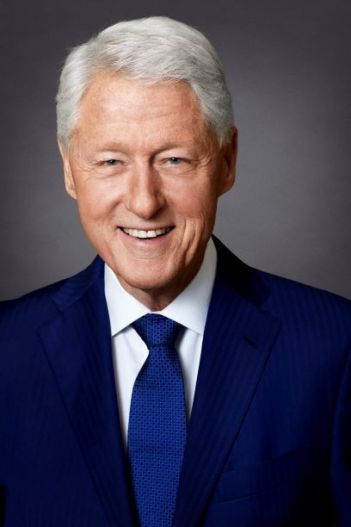
A Conversation on the Future of Democracy with Bill Clinton
March 18, 2021
5:00 pm
Join the Institute of Politics and Global Affairs and eCornell for a conversation with President Bill Clinton on the state of democracy in America. This program will delve into the challenges faced by our democracy today and what can be done to strengthen our democratic norms for future generations. Following the conversation with President Clinton, please stay tuned for a panel reaction from Cornell experts and to learn how to get involved with the Campaign for the Future of Democracy, an exciting new project through the Institute of Politics and Global Affairs.
This event is sponsored by the Howard and Abby Milstein Foundation and marks the first event in the Milstein State of Democracy Address series. The event is also supported by The Larry and Judy Tanenbaum Distinguished Speakers Fellowship of Sigma Phi.
Biography of our esteemed guest, the 42nd President of the United States
William Jefferson Clinton, the first Democratic president in six decades to be elected twice, led the United States to the longest economic expansion in American history, including the creation of more than 22 million jobs.
After leaving the White House, President Clinton established the Clinton Foundation in order to continue working on the causes he cared about. Since its founding, the Foundation has endeavored to help build more resilient communities by developing and implementing programs that improve people’s health, strengthen local economies, and protect the environment.
In addition to his Foundation work, President Clinton served as the top United Nations envoy for the Indian Ocean tsunami recovery effort, the UN Special Envoy to Haiti—and has partnered numerous times with Presidents George H.W. Bush and George W. Bush to support relief efforts for communities devastated by natural disasters.
President Clinton was born on August 19, 1946, in Hope, Arkansas. He and his wife Secretary Hillary Rodham Clinton have one daughter, Chelsea, and three grandchildren, Charlotte, Aidan and Jasper. They live in Chappaqua, New York.
Introduction by special guest, Chairman of Cornell's Board of Trustees
Bob Harrison is Chairman of the Board of Trustees of Cornell University. He served as Chief Executive Officer of the Clinton Global Initiative from 2007 to 2017 and worked for the Clinton Foundation since 2005 in two prior roles — Executive Director of the Foundation’s childhood obesity initiative and chairing a task force on access to water and sanitation in the developing world. Before joining the Clinton Foundation, Harrison spent over 20 years on Wall Street as an investment banker and attorney. He joined Goldman Sachs in 1987, where he became a partner in the firm’s Investment Banking Division and Global Co-Head of its Communications, Media, and Entertainment group. From 1981 to 1987, Harrison practiced corporate law in the New York and Paris offices of Davis, Polk and Wardwell. In addition to serving on the Cornell Board of Trustees, Harrison is a Director of the Clinton Foundation and the Association of American Rhodes Scholars, a Director and Chairman Emeritus of the Board of the Henry Street Settlement, and a member of the Council on Foreign Relations. He received a B.A. in Government from Cornell University, an M.A. in Politics, Philosophy, and Economics from Oxford University, where he was a Rhodes Scholar, and a J.D. from Yale Law School.
The Institute of Politics and Global Affairs is a non-partisan institute dedicated to elevating public discourse and stimulating civic engagement.
Additional Information
Program
Einaudi Center for International Studies
Basement Bhangra Redux: An Artist Conversation & Dance Party with DJ Rekha

March 19, 2021
7:00 pm
This event is part of the ongoing Critical Moves: Performance in Theory Movement series co-organized by Prof. Balance and Prof. Karen Jaime and co-sponsored by Cornell Asian American Studies Program (AASP), Latina/o Studies Program (LSP), and the department of Performing Media Arts. Basement Bhangra Redux is also co-sponsored by the South Asia Program (SAP) at Cornell.
DJ Rekha/Rekha Malhotra is a DJ, producer, curator, and educator. They have been credited with pioneering Bhangra music in North America via Basement Bhangra club night (1997-2017). They are a proud resident of Jackson Heights, Queens. Rekha was the sound designer for the TONY award-winning Broadway Show, Bridge and Tunnel and received a Drama Desk Award nomination for their work on the play Rafta Rafta. Rekha has done remixes for artists that range from Meredith Monk to Major Lazer, and has performed at the Obama White House and internationally. They are on the board of Queens-based Chhaya Community Development Corp., serving to economically empower New Yorkers of South Asian origin. They have produced events for Central Park SummerStage and the South Asian Block Party for the Biden Harris Campaign. They have a BA in Urban Studies from Queens College, a Masters in Comparative Media Studies from MIT, and produce the weekly podcast Bhangra and Beyond.
Additional Information
Program
South Asia Program
Einaudi Center for International Studies
Institute for African Development Global Africa Monthly Webinar Series: Africans in Science and Technology:
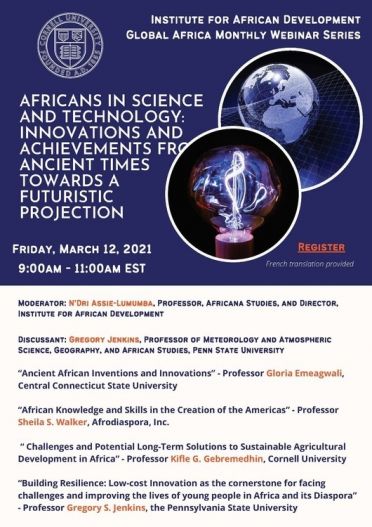
March 12, 2021
9:00 am
In contrast to the objective conditions and the current images of Africa in the global geo-politics measured by indicators of socio-economic performance, as the cradle of humankind, for tens of thousands of years the people of the continent exhibited what Basil Davidson referred to as the African genius. From the onset and throughout the different historical moments, ingenuity was crucial in all aspects of their livelihood. The tragic centuries of the transatlantic enslavement did not halt the creative capacities of the Africans who survived, amidst extreme hostile contexts.
Moderator: N'Dri Assie-Lumumba, Professor, Africana Studies, and Director, Institute for African Development, Cornell
Discussant: Professor Gregory Jenkins,Professor of Meteorology and Atmospheric Science, Geography, and African Studies, Penn State University
Ancient African Inventions and Innovations - Professor Gloria Emeagwali, Central Connecticut State University
African Knowledge and Skills in the Creation of the Americas - Professor Sheila S. Walker, Afrodiaspora, Inc.
Challenges and Potential Long-Term Solutions to Sustainable Agricultural Development in Africa - Professor Kifle G. Gebremedhin, Cornell University
Building Resilience: Low-cost Innovation as the cornerstone for facing challenges and improving the lives of young people in Africa and its Diaspora - Professor Gregory S. Jenkins, the Pennsylvania State University
Additional Information
Program
Einaudi Center for International Studies
Institute for African Development
Institute for African Development Seminar: Cultural Logic & Health Promotion Practices in the Age of COVID-19: Engaging Communities in Public Health Agenda
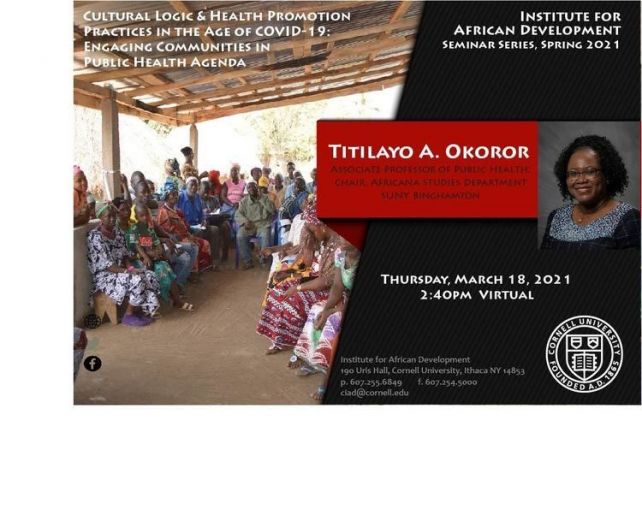
March 18, 2021
2:40 pm
Issues in African Development Seminar Series examines critical concerns in contemporary Africa using a different theme each semester. The seminars provide a forum for participants to explore alternative perspectives and exchange ideas. They are also a focal activity for students and faculty interested in African development. In addition, prepares students for higher level courses on African economic, social and political development. The presentations are designed for students who are interested in development, Africa’s place in global studies, want to know about the peoples, cultures and societies that call Africa home, and explore development theories and alternate viewpoints on development.
Register:
Additional Information
Program
Einaudi Center for International Studies
Institute for African Development