
Einaudi Center for International Studies
Leaders of Sarayaku: Connecting Indigenous Roots, Session II, a LASP-CUSLAR Public Issues Forum
February 24, 2021
12:15 pm
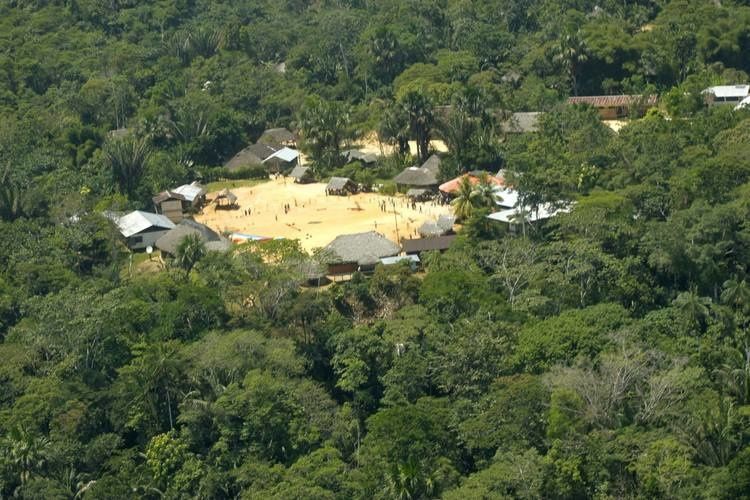
This is a second time during 24 February to meet the leaders if you couldn't make the 11am session. Sarayaku’s Kichwa communities were central to Ecuador’s first National Indigenous Uprising in 1990 and are at the forefront of indigenous rights mobilization. Come listen to four leaders from Sarayaku's indigenous communities (Abigail Gualinga, Mario Santi, Yaku Viteri, and Fausto Santi) and learn more about indigenous cosmologies & human rights frameworks.
This event is co-sponsored by Cornell University Latin American Studies Program with funding from a Undergraduate International Studies and Foreign Language (UISFL) grant from the U.S. Department of Education, the Committee on US Latin American Relations (CUSLAR) at Cornell, the Cornell Law School, the American Indian and Indigenous Studies (AIIS) program at Cornell, and with a partial funding from the Cornell Student Activities Funding Committee (SAFC)
For Session II, register here: https://bit.ly/3qpj6kg
Additional Information
Program
Einaudi Center for International Studies
Latin American and Caribbean Studies
'I am the Constitution!' On the superpowers of the Brazilian Supreme Court, by Daniel Hachem, LASP Seminar Series
March 1, 2021
4:00 pm
In the last three decades, the Brazilian constitutional experience has moved towards the adoption of a model of judicial supremacy, in which the Supreme Court has the prerogative to give the last word on the attribution of meaning to constitutional norms. With the rise of a government of judges, the Supreme Court began to directly interfere in the political decision-making of the Legislative and Executive Powers. This talk intends to expose the process of development of the superpowers of the Brazilian Supreme Court, the rise and fall of its democratic legitimacy and the reactions adopted by the Legislative Power in order to rebalance the relationship between the branches.
Daniel Hachem is Professor of Public Law at the Pontifical Catholic University of Paraná (PUCPR) and at the Federal University of Paraná (UFPR) – Brazil. Visiting Professor at the Sorbonne Law School (2018-2020). Doctor of Law – Federal University of Paraná. Postdoctoral Fellowship at Université Paris 1 Panthéon-Sorbonne (2017). Director General of NUPED – Center for Research on Public Policy and Human Development at PUCPR. Member of the Ibero-American Forum of Administrative Law and the Public Law Association of Mercosur. Website: www.danielhachem.com
Registration link: https://bit.ly/2Ml5IPi
Additional Information
Program
Einaudi Center for International Studies
Latin American and Caribbean Studies
Institute for African Development Seminar: The Need for Climate Justice in Africa and its Diaspora: Lessons from the COVID-19 Pandemic
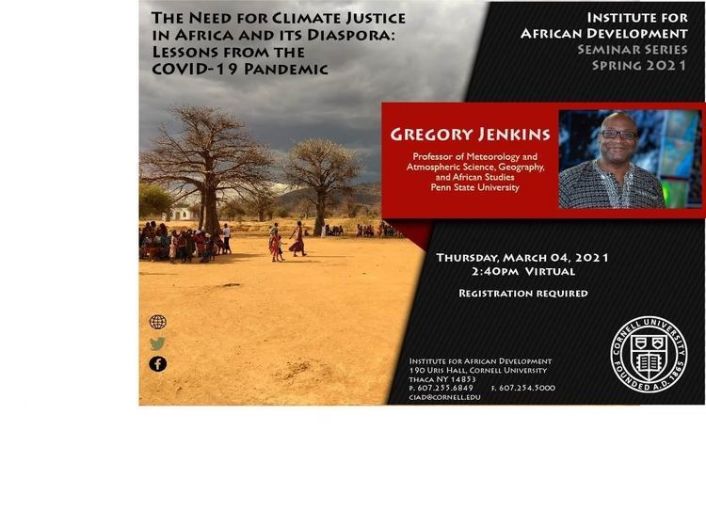
March 4, 2021
2:40 pm
Issues in African Development Seminar Series examines critical concerns in contemporary Africa using a different theme each semester. The seminars provide a forum for participants to explore alternative perspectives and exchange ideas. They are also a focal activity for students and faculty interested in African development. In addition, prepares students for higher level courses on African economic, social and political development. The presentations are designed for students who are interested in development, Africa’s place in global studies, want to know about the peoples, cultures and societies that call Africa home, and explore development theories and alternate viewpoints on development.
Additional Information
Program
Einaudi Center for International Studies
Institute for African Development
Institute for African Development Seminar: The Importance of Clean Water and the Role of African Woman in Situation of Health Crises / Importance de l’eau potable et la place de la femme Africaine en situation de crise sanitaire: cas de la COVID-19
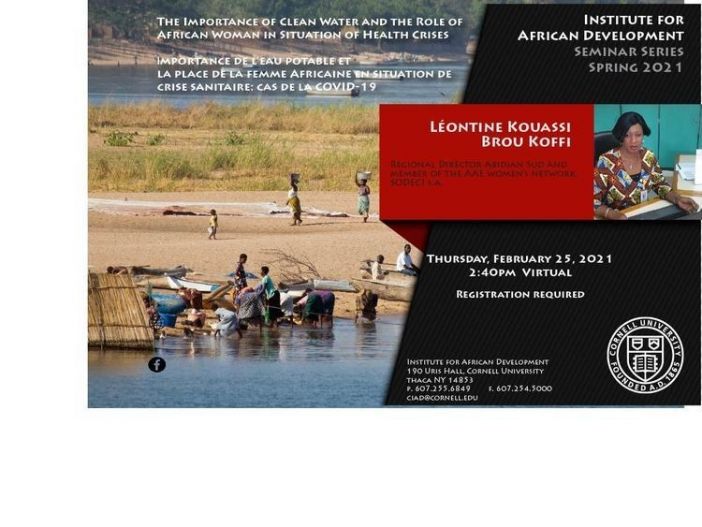
February 25, 2021
2:40 pm
Issues in African Development Seminar Series examines critical concerns in contemporary Africa using a different theme each semester. The seminars provide a forum for participants to explore alternative perspectives and exchange ideas. They are also a focal activity for students and faculty interested in African development. In addition, prepares students for higher level courses on African economic, social and political development. The presentations are designed for students who are interested in development, Africa’s place in global studies, want to know about the peoples, cultures and societies that call Africa home, and explore development theories and alternate viewpoints on development.
Additional Information
Program
Einaudi Center for International Studies
Institute for African Development
From Upstate New York to Foggy Bottom: Lessons from a Career in the U.S. Foreign Service, by Laura Stone

March 10, 2021
4:30 pm
Laura Stone '90 is Deputy Assistant Secretary for South Asia, overseeing U.S. policy towards and relations with India, Nepal, Sri Lanka, Bangladesh, Maldives, and Bhutan. She will discuss her wide-ranging career in the U.S. Foreign Service, as well as her perspective on diplomatic statecraft in the 21st century.
Previously, Ms. Stone served as Director of the India, Nepal, Sri Lanka, Bangladesh, Maldives, and Bhutan Affairs Office, Special Advisor to the Undersecretary of State for Economic Growth, and was Acting Deputy Assistant Secretary for China and Mongolia from 2017 to 2019. She has worked as the Director of the Office of Chinese and Mongolian Affairs; Director of the Economic Policy Office in the Bureau of East Asia and Pacific Affairs; and Economic Counselor in Hanoi, Vietnam. She served three tours in Beijing as well as tours in Bangkok, Tokyo, the Public Affairs Bureau, the Pentagon Office of the Secretary of Defense, and the Bureau of Intelligence and Research. Ms. Stone joined the Department of State in 1991 and is a career member of the Senior Foreign Service with the rank of Minister Counselor.
Ms. Stone has an M.Phil. in International Relations from Oxford University, and a B.A. from Cornell University.
This event is co-sponsored by the South Asia Center at Syracuse University.
Additional Information
Program
Einaudi Center for International Studies
South Asia Program
East Asia Program
Southeast Asia Program
Odysseys: Sorayya Khan & Raza Ahmad Rumi

March 16, 2021
7:00 pm
Odysseys: Ithaca Writers on Exile, Wandering, and Searching for Home is a reading series presented by Ithaca City of Asylum and co-sponsored by Global Cornell and Cornell's Migrations initiative.
Homer’s Odyssey recounts the adventures of Odysseus, king of Ithaca, as he seeks to return home after the Trojan War. In four monthly readings, pairs of Ithaca-based writers provide their takes on the theme of odysseys, from the physical to the intellectual to the emotional.
Authors:
Sorayya Khan (author of the novels Noor, Five Queen's Road, and City of Spies)
Raza Ahmad Rumi (director of the Park Center for Independent Media at Ithaca College, visiting faculty at the Cornell Institute for Public Affairs)
Moderator:
Barbara Adams (associate professor of writing at Ithaca College, Ithaca City of Asylum board member)
Additional Information
Program
Einaudi Center for International Studies
South Asia Program
Language Instruction Grants Application Deadline

March 15, 2021
5:00 pm
The Language Resource Center offers grants for effective and innovative projects that enhance language instruction at Cornell. We welcome proposals from all languages and all levels of instruction. Lecturers, senior lecturers, and professors who are involved with language teaching and do not have visiting status are eligible to apply. Graduate students are also eligible to apply, working under the supervision of a faculty member.
Details at https://lrc.cornell.edu/funding-research
Additional Information
Program
Einaudi Center for International Studies
Southeast Asia Program
Latin American and Caribbean Studies
South Asia Program
How Humans Reshape the World
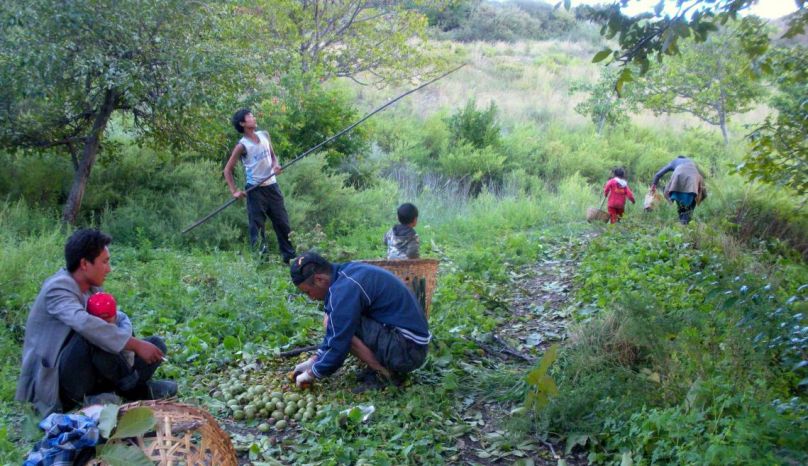
EAP's Jack Zinda Works with Communities
Environmental sociologist examines how human decisions influence environmental outcomes in communities—from China to New York State.
Additional Information
LATIN AMERICA STUDIES PROGRAM--VIRTUAL RESEARCH SYMPOSIUM, SAT 20 FEB, 9am-2pm
February 20, 2021
9:00 am
The Latin American Studies Program (LASP) invites Cornell Faculty, Staff, Graduate and Undergraduate Students, to attend in its Annual Research Symposium on February 20, 2021. The event is a great opportunity to hear about research related to Latin America in a number of varied disciplines and in different stages of development. We also will have one panel of Undergraduates who did Digital Internships with Brazil and Ecuador, come hear and apply yourself to do a digital internship this Summer’21 (rising sophomores, juniors and seniors). All members of the greater Latin American and Caribbean community at Cornell are encouraged to attend, including undergraduates, graduate students, and faculty. Register here. Click here for Full Symposium Program
Additional Information
Program
Einaudi Center for International Studies
Latin American and Caribbean Studies
Emerging Trends in African Economies
February 19, 2021
5:00 pm
Hosted by Cornell’s Emerging Markets Institute, the Emerging Markets Webinar Series is a monthly initiative that highlights key concepts and ideas occurring in emerging markets. The theme for 2021 is “Building Bridges and Encouraging Dialogue,” with online sessions profiling four emerging markets: Africa, Latin America, India, and China. The goal of the webinar series is to engage and educate the community about emerging trends worldwide, aided by a panel of economic development experts on each region.
The first session in the series showcases Africa, as four panelists discuss the challenges and opportunities presented by this exciting emerging market.
Additional Information
Program
Einaudi Center for International Studies
Latin American and Caribbean Studies