
Einaudi Center for International Studies
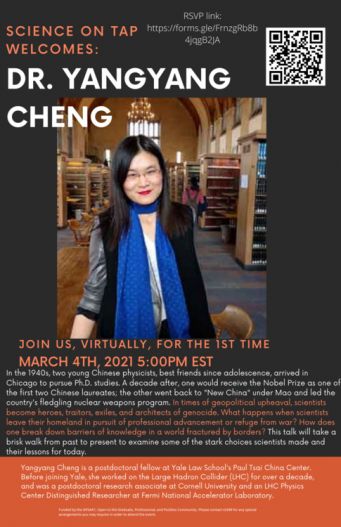
Virtual Science on Tap presents: Dr. Yangyang Chen
March 4, 2021
5:00 pm
Please join us March 4, 2021 at 5 pm EST for the first virtual Science on Tap! This month, we welcome Dr. Yangyang Cheng and her talk, "When Scientists Cross Water," about the ethics and governance of science, focusing on China and China-US relations.
RSVP at https://docs.google.com/forms/d/e/1FAIpQLSdYb_Cw8-bGQ_JLH3FkK58tlRFCa0M…
Additional Information
Program
Einaudi Center for International Studies
East Asia Program
Cornell Policy Review Speaker Series
March 3, 2021
12:00 pm
Speaker: Dr. Yangyang Cheng (Postdoctoral Fellow, Yale Law School's Paul Tsai China Center).
Topic: Pushing the Frontier: When Science Becomes Transnational.
Description:
Scientific collaboration has become one of the most contentious issues in U.S. - China relations. In a world fractured by nations, races, and governing systems, can science transcend political borders?
Particle physicist and postdoctoral fellow at Yale Law School, Dr. Yangyang Cheng, will discuss this urgent and complex subject.
Additional Information
Program
Einaudi Center for International Studies
East Asia Program
Migrations Forum
March 25, 2021
4:00 pm
The Migrations Forum is an interdisciplinary works-in-progress series for Cornell migrations scholars, bringing together graduate students and faculty across disciplines to share ongoing research.
At this session, Natasha Raheja (Anthropology) will share a rough cut of the new ethnographic film A Gregarious Species: What do bugs and borders have to do with each other? In 2019, thousands of gregarious desert locust swarms flew across the India-Pakistan border and ravaged the fields of farmers. In the same year, Indian government officials described migrants as termites and infiltrators at right-wing political rallies across the country. Farmers started to wonder if locusts were bioweapons from hostile countries to destroy crops. Scientists met at the India-Pakistan border to discuss how to manage this "transboundary pest". This experimental, found-footage video, "A Gregarious Species", contemplates borders, migration, and human-animal relations through a dizzying assembly of mobile phone videos of locusts, scientific webinars, and nationalist political rallies.
Additional Information
Program
Einaudi Center for International Studies
South Asia Program
Rough Work: The Floating World, Chris Bush, Northwestern University
March 24, 2021
11:30 am
The Floating World: History, Haiku, Global Modernism
The East Asia Program invites you to join our guest, Chris Bush, (Ph.D. in Comparative Literature, UCLA) Associate Professor of French and Comparative Literary Studies in this Rough Work session.
This “rough work” session shares an account of the genesis and current state of my current book project, The Floating World, along with a narrative outline of the book as a whole and some suggested points of departure for our discussion.
The first half of the book analyzes the impact of Japanese modernization on theories of history and universal civilization in a variety of places around the world. Its three chapters cover triumphalist end-of-history discourses; hopes for anti-Western and anti-colonial solidarity; and yellow-peril apocalypticism. The second half of the book explores, in this context, the rapid spread of the haiku as a literary form in the early part of the twentieth century. Its three chapters focus on World War One-era French-language haiku as a form of anti-epic historical writing; the tensions between cosmopolitanism and nationalism in the Mexican haiku movement of the 1920s; and the place of Japan in Ezra Pound’s cosmopolitan fascism.
Participants will receive a link to access texts by Chris Bush for prereading upon registration.
Bio
Christopher Bush is Associate Professor of French at Northwestern University, where he codirects the Global Avant-garde and Modernist Studies graduate cluster and coedits Modernism/modernity and its Print Plus platform His first book, Ideographic Modernism: China, Writing, Media, was published by Oxford University Press in 2010 and he is currently completing The Floating World for Columbia University Press.
These sessions are small allowing for informal discussion and exploration as well as feedback.
ROUGH WORK: Discussing research in progress, hence the term, rough work.
Additional Information
Program
Einaudi Center for International Studies
East Asia Program
Democracy is Weakening Right in Front of Us
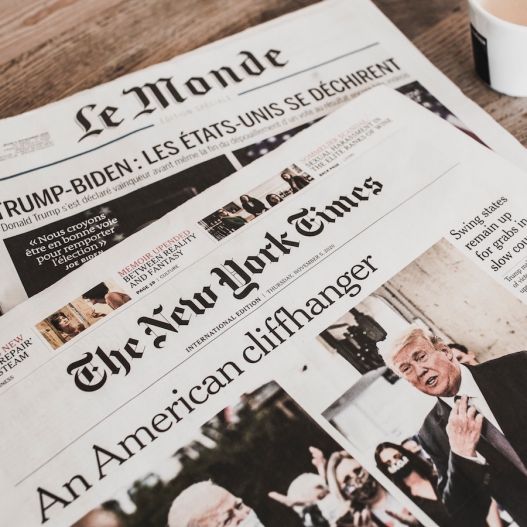
Robert H. Frank, Einaudi
This opinion piece references an op-ed written by Robert Frank, emeritus professor of economics, in The New York Times in which Frank argues that many social media companies’ business models contribute to political and social dysfunction.
Additional Information
High Food Prices are Part of a 'One-Two Punch' for Struggling Americans

Chris Barrett, IAD and SEAP
“The risk of food price spikes is driving people into diets or undernutrition who don't need to be there. We've got to find ways to both temper demand growth and to accelerate supply growth,” says Chris Barrett, professor of applied economics.
Additional Information
Innovation in Emerging Markets: Asia and LATAM

March 5, 2021
12:00 pm
In the past 15 years, emerging markets (EM) have come to represent the largest share of global Gross Domestic Product (GDP) and made gains in economic development and political influence; in turn, their companies have taken on a new level of importance in driving innovation, local development and global competition. We want to invite a conversation about diverse types of innovation in emerging markets and present some findings of the book From Copycat to Leaders: Innovation from Emerging Markets.
Additional Information
Program
Einaudi Center for International Studies
Latin American and Caribbean Studies
Rough Work: Why is English the Lingua Franca in Chinese Academia?

March 22, 2021
11:30 am
Rough Work session with Xuewen Yan, Ph.D. student, sociology
The popularity and prestige of the English language in Chinese academia: A missing link in the hegemony of English as lingua franca?
Xuewen Yan writes: With the rise of English as the global language, scholars across the social sciences have long queried the hegemonic power of the English language in the academic world. Most often, sociologists and critical linguists have examined the active dominance or relative privileges of native speakers of English, vis-à-vis the subordination and disadvantage of those from non-English speaking countries. In this study, I theorize a potentially different mechanism in the maintenance of the hegemony of English: actors in non-English speaking countries attach prestige and value to the use of English within their own country, whereby the dominance of English over their native language is perpetuated. I plan to test my theory with the empirical example of China's sociological academia. Currently working on data from a flagship Chinese-language sociology journal, shehuixue yanjiu, I expect to find higher valence associated with English as opposed to Chinese-related indicators. At the level of individual papers, my preliminary analysis shows that publications with more English-language references receive more citations themselves, an effect that one does not observe for Chinese-language references. At the author level, I hypothesize that having professional connections to English will be a strong predictor of higher influence within China's sociology community.
ROUGH WORK: Discussing research in progress, hence the term, rough work. This rough work session is hosted by the East Asia Program's Graduate Student Steering Committee (GSSC).
Additional Information
Program
Einaudi Center for International Studies
East Asia Program
Rahul Gandhi on Democracy

South Asia Program Hosted Indian MP Mar. 2
Tens of thousands in U.S. and India viewed Gandhi's conversation with Kaushik Basu. Watch video on Einaudi Facebook.
Additional Information
A Conversation with Rahul Gandhi

March 2, 2021
9:30 am
Rahul Gandhi, member of India’s Parliament and former president of the Indian National Congress, will join Kaushik Basu, Carl Marks Professor of International Studies at Cornell University, for an open conversation on democracy, development, and life in politics, India, and the world. Q&A with Cornell students and faculty will follow.
Rahul Gandhi has been a member of the Lok Sabha (India’s lower house of Parliament) since 2004. He currently represents the constituency of Wayanad, Kerala. In 2007, he was named general secretary of the Indian National Congress in charge of the party's youth and student organizations. In January 2013, he assumed office as vice president of the Indian National Congress. He was the president of the Indian National Congress from December 2017 to July 2019.
Rahul Gandhi is the great-grandson of Jawaharlal Nehru, India’s first prime minister. He attended St. Stephen’s College, Delhi; Harvard University; and Rollins College. He has an M. Phil. in development studies from Trinity College, Cambridge University.
Kaushik Basu is professor of economics and the Carl Marks Professor of International Studies. From 2012 to 2016 he was chief economist and senior vice president of the World Bank. Educated at St. Stephen’s College, Delhi, and the London School of Economics, Basu has published extensively in development economics, game theory, and industrial organization. His most recent book The Republic of Beliefs: A New Approach to Law and Economics was published by Princeton University Press in 2018.
Additional Information
Program
Einaudi Center for International Studies
South Asia Program