
Einaudi Center for International Studies
GOP Senator Pat Toomey's Last-Minute Add to the Stimulus Bill Helps His Wall Street Donors

Robert Hockett, CRADLE
Robert Hockett, professor of law, says that actions by Sen. Pat Toomey and other Senate Republicans amid relief bill negotiations “send a signal to bankers that we're in your corner, we're fighting for you.”
Additional Information
Farm Laws 3 Experts 2 Opinions

Kaushik Basu, SAP
Kaushik Basu, professor of applied economics, co-writes this opinion piece about the agriculture reform that needs to take place in India.
Additional Information
Which Countries’ Economies are Doing Best? Those that Beat the Virus.

Eswar Prasad, SAP
“China’s recovery seems to be well-entrenched, and it’s now in the position of being by far the leading contributor to what little global growth there is likely to be this year,” says Eswar Prasad, professor of economics and trade policy.
Additional Information
Bioethicist: Why the UK is Getting Vaccine Distribution Right and the US is Not

Nicole Hassoun, Einaudi
Nicole Hassoun, a visiting scholar at the Mario Einaudi Center for International Studies, writes this opinion piece arguing that the United States’ approach in prioritizing “essential workers” is chaotic compared to the UK’s approach. Hassoun also writes an opinion piece for Albany Times Union about how the focus on COVID risks resurgence of other diseases.
Additional Information
Cornell Classical Chinese Colloquium: Leigh Jenco Phonology and Human Difference in the Late Ming
May 8, 2021
10:00 am
Phonology and Human Difference in the Late Ming:
Chen Di's "Mao shi guyin kao zixu (Author's Preface to Investigation of the Ancient Pronunciations in the Mao Odes)" (1606)
Presenter: Leigh Jenco, London School of Economics and Political Science
Professor Jenco writes: My current research examines the overlooked connections between Wang Yangming learning (i.e., xinxue Confucianism) and empirical scholarship in the late Ming and early Qing. The philosophical agendas of Wang Yangming—notable for their reliance on the subjective and inward-looking sources of moral knowledge, rather than on empirical investigation of the external world that earlier neo-Confucians held to be the primary means for learning moral truth—are typically seen as discouraging scholars from engaging in the kind of text-critical historical analysis that would flourish a century later under the banner of kaozheng (evidential research). To the contrary, I try to show that Wang’s doctrines motivated empirical research in a specific way, that lends new insight into how and why empirical investigation was undertaken in late imperial China. Chen's groundbreaking investigation of the Mao Odes (published around 1606) was built on the pioneering insight that ancient pronunciations of words in the Odes classic differed from contemporary pronunciation, a thesis which Chen meticulously defended through a systematic reconstruction of rhyme patterns. This text was heralded by later Qing kaozheng scholars and modern commentators as a paragon of proto-scientific empiricism in early modern China. Yet Chen's own preface to this work shows that it was in fact his commitment to an ideal of virtue as embodied and responsive to context, upheld by the Taizhou school associated with Wang Yangming, that inspired him to recognize the possibility of historical and phonological difference.
All are welcome, with any level of experience with classical Chinese.
At each session, a participant presents a classical Chinese text. Attendees discuss historical, literary, linguistic, and other aspects of the text, working together to resolve difficulties in comprehension and translation.
No preparation is required, all texts will be distributed at the meeting.Contact eap-guwen@cornell.edu for more information.Or subscribe to CCCC news for updates about events. Please make sure to send your subscription request from the email address at which you wish to receive CCCC updates.
Additional Information
Program
Einaudi Center for International Studies
East Asia Program
Cornell Classical Chinese Colloquium: Beverly Bossler
March 5, 2021
3:30 pm
Presenter: Beverly Bossler, Brown University
The Dao of soliciting a patron: Zheng Xia 鄭 俠 (1041-1119)'s "Letter presented to [the] Transport Intendant" 上漕車書 (Anon, Guo chao er bai jia ming xian wen cui 國朝二百家名賢文粹)
The Cornell Classical Chinese Colloquium (CCCC) 古文品讀 is a reading group for scholars interested in premodern Sinographic (古文) text. The group typically meets monthly during the semester to explore a variety of classical Chinese texts and styles. Other premodern texts linked to classical Chinese in Japanese, Korean, and Vietnamese have been explored. Presentations include works from the earliest times to the 20th century. Workshop sessions are lead by local, national, and international scholars. No prior experience or preparation is necessary.
Additional Information
Program
Einaudi Center for International Studies
East Asia Program
Antiracist Pedagogy Workshop for Asian Studies
January 27, 2021
3:30 pm
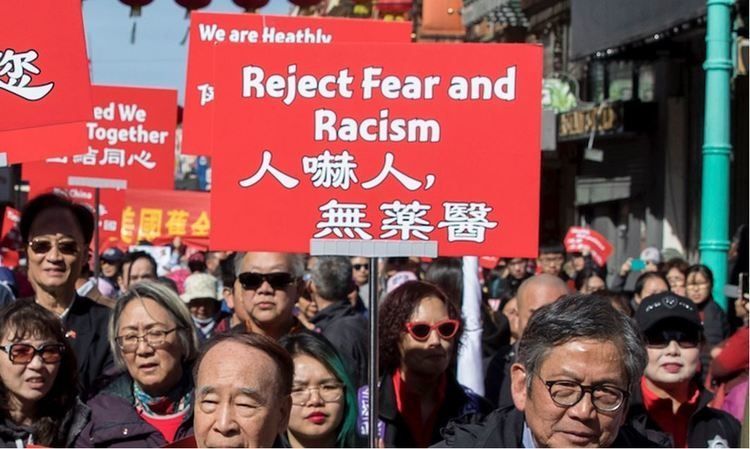
The workshop aims to offer an understanding of race, racism, and the particular racial formations embedded in the classroom and a discussion on ways to apply anti-racist pedagogy to courses in Asian studies. With scholars of Asian culture, history, and language participating, this workshop opens discussions on the challenges of incorporating anti-racist pedagogy into our classrooms to overcome both perceived personal and institutional barriers and on practical strategies and models of intentional anti-racist curriculum. The topics of discussion include teaching models of anti-racist and social justice, syllabus-making, selection of teaching materials, challenges and problems in the classroom, etc.
EAP Faculty host: Suyoung Son (Asian Studies)
Panelists include: Naoki Sakai (Asian Studies), TJ Hinrichs (History), Christine Balance (Performing & Media Arts), Ivanna Yi (Asian Studies), Stephanie Divo (Asian Studies), and Razima Chowdhury (Asian Studies)
Image by Getty Images
Additional Information
Program
Einaudi Center for International Studies
East Asia Program
Southeast Asia Program
South Asia Program
Institute for African Development Seminar: Students' Presentations
December 16, 2020
4:00 pm
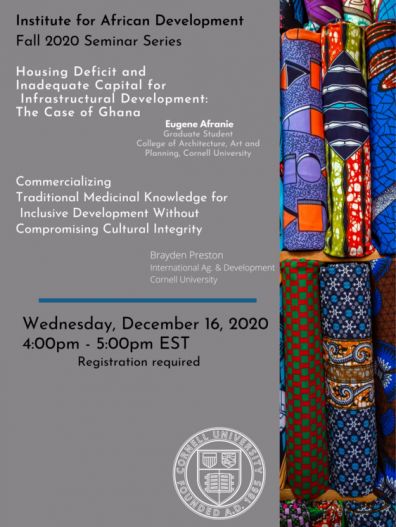
Issues in African Development Special Topic Seminar Series (CRP 4770/6770) - Fall 2020 Theme: Environment, Sustainability and Health Challenges in Africa: Managing Human-Nature Interactions. Issues in African Development Seminar Series examines critical concerns in contemporary Africa using a different theme each semester. The seminars provide a forum for participants to explore alternative perspectives and exchange ideas. They are also a focal activity for students and faculty interested in African development. In addition, prepares students for higher level courses on African economic, social and political development. The presentations are designed for students who are interested in development, Africa’s place in global studies, want to know about the peoples, cultures and societies that call Africa home, and explore development theories and alternate viewpoints on development.
Additional Information
Program
Einaudi Center for International Studies
Institute for African Development
Cornell Modern Indonesia Project
Video introduction to the Cornell Modern Indonesia Project (2016), featuring Eric Tagliacozzo and Tom Pepinsky.
Additional Information
Program
Seed Grants

Details
The Einaudi Center's faculty seed grants launch international studies research and activities that show promise to grow and secure external follow-on funding.
Tenured and tenure-track Cornell faculty are eligible to apply. All disciplines and topics are welcome. Read about recent research Einaudi seeded.
Building International Studies Capacity
Einaudi Center seed grants support international studies research and collaborations that reach across world regions and bring together researchers who have deep knowledge in different regions and disciplines. The awards launch early-stage interdisciplinary research projects with clear plans for scaling up and securing external funding support.
The Einaudi Center is dedicated to international studies. Our seed grants focus on complex global and regional issues and community-engaged methodologies across the social sciences, hard sciences, and humanities. Some research conducted abroad and international collaborations—while valuable—do not qualify for the awards.
Proposals must align with the mission and interests of at least one of our international studies programs. The application requires only your own thoughtful assessment of how your project might contribute to the work of one or more programs.
Proposals that engage with two or more geographical regions are eligible for larger awards of up to $25,000.
Eligibility
Tenured and tenure-track Cornell faculty in all colleges and schools are eligible to apply as individuals or teams. The Einaudi Center will not accept proposals from past awardees who failed to submit the required final report by the deadline stated in the award letter.
- Funding-eligible activities: Data collection, research assistance, travel, meetings
- Not eligible for funding: Salary offset, summer salary, computers and equipment, student stipends/tuition
Requirements
- All funds must be used within one year of the award date.
- You must submit a final report to the Einaudi Center director within one year of the award date. The report must include:
- A summary and assessment of the research and activities you accomplished.
- An update on your external follow-on funding proposal.
- A promotional paragraph written for nonspecialists (100 words maximum) describing the outcome and value of your project.
- The Einaudi Center must be acknowledged in all publications, promotion, and media coverage related to your funded research and activities. Please inform the Einaudi Center in advance of publications and other project outcomes.
How to Apply
Complete the seed grant funding application and submit a proposal including the following:
- Curricula vitae (CVs) for principal faculty
- Statement including objectives, activities, work plan, expected outputs, beneficiaries, and impact
- Human subjects approval, if relevant
- Detailed budget with justification of expenses
- Plans for pursuing future research and external funding support
Evaluation
All successful proposals will meet these criteria. The proposal:
- Shows a high likelihood of generating new knowledge of key economic, environmental, social, cultural, or political problems in the world.
- Includes clearly articulated deliverables.
- Includes a budget appropriate for planned activities.
- Includes a plan for obtaining full project funding to sustain and expand the research.
Questions?
Please email our academic programming staff if you have questions about the seed grant program or your application.
Additional Information
Funding Type
- Award
Role
- Faculty