
Einaudi Center for International Studies
The Battle for the Sabarimala Temple

October 28, 2020
12:00 pm
The Cornell India Law Center presents:
The Battle for the Sabarimala Temple: Should women of menstruating age be prohibited from entering a Hindu temple?
In some societies, girls and women who are menstruating are considered polluted and untouchable. Should a Hindu temple in India be able to prohibit women of menstruating age from entering? That was the central question in a recent Indian Supreme Court case. The Court said that the Sabarimala temple must allow all women to enter, even those who could menstruate, in the decision IYLA v. State of Kerala. But now the Court is reconsidering that judgement. Please join the Cornell India Law Center in a conversation with University of Alabama Law Professor and legal anthropologist Deepa Das Acevedo about her new forthcoming book with Oxford University Press called The Battle for Sabarimala. Drawing on her longstanding ethnographic and legal research, Professor Das Acevedo will contextualize the dispute and explain its significance for religion-state relations and democratic governance in India. For more background information, you can read a summary of IYLA v. State of Kerala here and listen to an episode on religious freedom in India and the United States from the A Law in Common podcast.
Wednesday, October 28, 2020
12:00 PM ET
Virtual Event: Please register for the event here.
Additional Information
Program
South Asia Program
Einaudi Center for International Studies
Hindu Belonging and Minority Recognition in Pakistan

October 26, 2020
11:15 am
This roundtable brings academics and activists together to discuss contemporary issues of Hindu belonging and minority recognition in Pakistan. Speakers will draw on their ethnographic research and activism with Hindus in Sindh, Pakistan to engage questions of devotional life, religious difference, caste, class, and gender hierarchy, and the possibilities and limits of state recognition.
Participants:
Ghazal Asif (John Hopkins University): The 2017 Hindu Marriage and Family Act: caste, gender, and the law in Pakistan
Kapil Dev Human Rights Activist
Chander Kolhi (Progressive Human Foundation): Inequality and Injustice to Scheduled Castes in Pakistan
Juergen Schaflechner (Freie Universität Berlin): 'Wary and Aware': Self-representation and public performances of Hindus in Pakistan's public spheres
A discussion session, moderated by Natasha Raheja, Assistant Professor of Anthropology, will follow the speakers' short talks. The audience is encouraged to submit questions via the Q&A window in the webinar.
Additional Information
Program
Einaudi Center for International Studies
South Asia Program
You Always Step into the Same River, by Atul Bhalla

October 22, 2020
12:10 pm
My sustained preoccupation with the water in Delhi, India resulting in ‘Yamuna Walk’ and ‘I was not waving but drowning’ both executed on or around the same site on the western Yamuna bank, which forms the basis of my diverse practice leading to questions of distribution, regulation, commodification and pollution of the River. I have over the years attempted to explore its physical, mythical, historical, spiritual and political significance in relation to the population it sustains. Attempting the political through the poetical. My attempt is to understand water as a repository of history, meaning and myth; the way I perceive it, feel it, drink it, swim in it and sink in it or will drown in it.
Atul Bhalla has explored the physical, historical, and political significance of water in the urban environment of New Delhi through artworks that incorporate sculpture, painting, installation, video, photography, and performance. He is SAP’s Virtual Artist-in-Residence in Fall 2020.
His recent solo shows include “Anhedonic Dehiscence” (Vadehra Art Gallery, New Delhi, 2018), “You always step into the same river” (SepiaEYE, New York, 2015) and “Ya Ki Kuch aur …” (Vadehra Art Gallery, New Delhi, 2014). He was also the Mellon Artist Research Africa fellow at WITS University 2018, Johannesburg with the project “The Excavated distance of gold,” examining acid mine drainage at the gold mines. Recent group exhibitions have brought his work to FotoFest Biennale Houston in 2016 and 2108, The Pompidou Center, Paris, the IVAM Institute of Modern Art in Valencia, and the Devi Art Foundation in New Delhi. Important books on his works are Yamuna Walk and monograph 'You always step into the same river'.
Additional Information
Program
Einaudi Center for International Studies
South Asia Program
Repatriation of Museum Objects
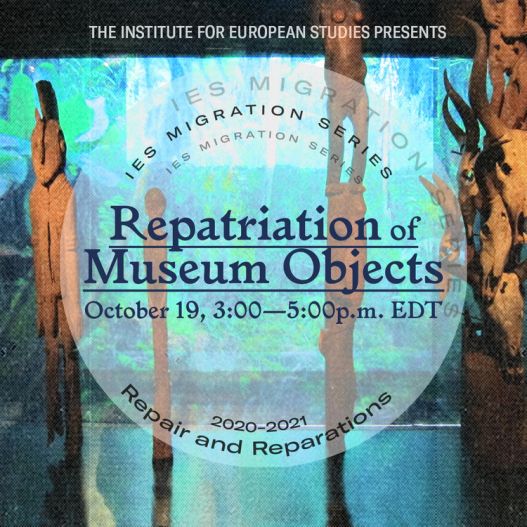
October 19, 2020
3:00 pm
This panel is organized to bring together museum directors, curators, architects, and scholars to comment on the recent discussions on repatriation and restitution as a form of reparation to colonized and looted lands.
While museums in Europe and North America have occasionally returned objects to their native communities or lands of arrival, the issue of repatriation gained an accelerated epistemological and ethical momentum at the end of 2018. What is the responsibility of museums to objects taken into their collections by violence or deceit during the colonial times or wars? What is the role of museum-object-repatriation in the recognition of colonial and military violence? What are the procedural and ethical differences between repatriation, restitution, and other possible forms of reparations? What are the legal structures that prohibit or allow deaccession in the museums of different countries? Once the objects are parted from their communities and no longer serve their original sacred functions, where are they returned back to? What determines how far back museums consider repatriation claims legitimate and why? What is the future of “universal museums” around the world?
Speakers will each make a 15-minute presentation, commenting on the contemporary debates from the perspectives of their own work and study area. A question and answer session will follow the presentations.
Speakers:
Souleymane Bachir Diagne | Columbia University | New York
Jonathan Fine | Humboldt Forum | Berlin
Cecile Fromont | Yale University | New Haven
Moderator:
Esra Akcan | Cornell University | Ithaca
Additional Information
Program
Einaudi Center for International Studies
Institute for European Studies
Between the Polls: How Voters Decide
October 19, 2020
7:00 pm
Excitement – and anxiety – about the 2020 election ratchets higher with the release of each new poll and prediction. But polls don’t tell the whole story and many forecasts in 2016 were proved wrong: what can we expect this year?
In “Between the Polls: How Voters Decide,” experts will examine how we learn about voters and their decisions and how those data drive election forecasts; they’ll also explore how polling is covered in the media and methods journalists use to gauge voter interest. The webinar, organized through the Distinguished Visiting Journalist Program in the College of Arts and Sciences (A&S), will be held on Mon., Oct. 19 at 7 pm. The event is free and the public is invited; registration is required.
Panelists include:
Marc Lacey '87, national editor for The New York Times and Arts & Sciences' 2020 Distinguished Visiting Journalist.Alexandra Cirone, assistant professor of government, is a faculty fellow with the Institute of Politics and Global Affairs (IOPGA). She studies historical political economy, democratization and party systems in new democracies, and fake news and misinformation campaigns. Peter Enns, associate professor of government, executive director of the Roper Center for Public Opinion Research, co-director of the Cornell Center for Social Sciences, and co-founder of Reality Check Insights. His research focuses on public opinion and political representation, as well as mass incarceration and the legal system.Sergio Garcia Rios, assistant professor of government and Latina/o studies, is director of polling of Latino voters for Univision News. He studies voter turnout, political participation and public opinion, especially among Latino immigrants.Jamila Michener, associate professor of government, is co-director of the Cornell Center for Health Equity. She is an expert on the politics of race, poverty and public policy in the United States.The panel will be moderated by Doug Kriner, Clinton Rossiter Professor in American Institutions in the Department of Government (A&S) and faculty director of IOPGA.
Co-hosted by the College of Arts & Sciences and the Institute of Politics and Global Affairs, the webinar is supported by Alumni Affairs and Development and powered by eCornell.
Additional Information
Program
Einaudi Center for International Studies
Global Studies Gateway Series: The Myth of Economic Development

October 13, 2020
12:00 pm
Ndongo Samba Sylla, Research and Programme Manager for the Rosa Luxemburg Foundation
Dr. Ndongo Samba Sylla will present a lecture articulated on what Celso Furtado, the late Brazilian economist, called the ‘myth of economic development ’. He is a Senegalese development economist, interested in Fair Trade, labour markets, social movements, democratic theory, and monetary sovereignty. Coauthor of the forthcoming "Africa's Last Colonial Currency: the CFA franc story", Dr. Sylla will defend the view that the Covid-19 pandemic could be seized as an opportunity to break from the dominant economic paradigm in Africa in favor of alternative models more equalitarian and more sustainable in their outcomes.
This lecture will be integrated into the "Global Studies Gateway" (GOVT 2274), which takes a thematic and interdisciplinary approach to major questions of our time, including health, development, migrations, security, technology, inequality, and innovation.
Additional Information
Program
Einaudi Center for International Studies
Institute for African Development
Ballots and Borders: Election 2020 and What’s at Stake for International Students and Scholars
October 19, 2020
12:00 pm
Immigration and border security are signature policy areas for the Trump administration and central to the upcoming U.S. election. From immigration enforcement, to the public charge rule, to F-1 duration of status—find out where the candidates stand and what may be at stake for you.
Professor Stephen Yale-Loehr of Cornell Law School will discuss the presidential candidates’ immigration platforms and the implications for international students and other immigrants, both in the short term and over the next four years.
Registration is required for this event.
Additional Information
Program
Einaudi Center for International Studies
US States Roll Out Apps Alerting People to COVID-19 Exposure

Sarah Kreps, PACS
“In order for these apps to be effective, you need to have enough of a critical mass of people who are willing to download and use the app,” says Sarah Kreps, professor of government and faculty with the Reppy Institute. “And short of mandating that, as was done in China, then you need a kind of public trust.”
Additional Information
Fueling US-China Clash, Years of Disconnects

“Nationalism is really at the root of the rhetorical spiral which is driving the tit for tat in policies that are accelerating the confrontation,” says Professor Jessica Chen Weiss of the East Asia Program. “Both governments have calculated it is politically advantageous to sound and act tough, which makes it difficult to walk back.”
Additional Information
Outright Bans can Sometimes Be a Good Way to Fight Climate Change
Shanjun Li is noted to have been among those who “estimate that a 10% rise in the availability of charging stations boosts sales of electric vehicles by 8%, and a 10% increase in the number of electric cars on the roads raises the construction of new charging points by 6%.”