
Einaudi Center for International Studies
"Chao Yuen-Ren’s Art of Songs": Concert
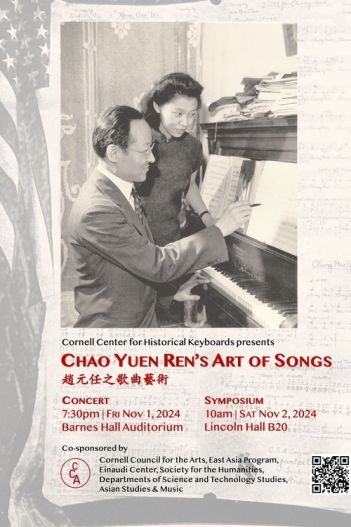
November 1, 2024
7:30 pm
Barnes Hall
The Cornell Center for Historical Keyboards presents “Chao Yuen-Ren’s Art of Songs,” a concert-symposium-exhibit that explores the musical legacy of the pioneering Chinese-American polymath and Cornell alumnus (class of 1914). Through performances, scholarly discussions, and an online exhibition, this two-day event celebrates Chao’s groundbreaking contributions to modern Chinese art music.
Central to the event is Chao’s innovative “Chinese lieder” (1922-1927), a song collection that represents a bold experiment in merging Chinese and Western musical traditions and a creative use of music as a vehicle for reforming the Chinese language.
Friday evening’s concert will bring Chao’s experimental compositions to life, alongside works by his compatriot contemporaries—Chinese composers who were also studying in the U.S. at the time—and select European lieder that inspired him. The concert will feature guest artist Stephen Ng alongside Cornell students and faculty, including Rachel Cheang, Vera Hsu, Roger Moseley, Yen-Hsiang Nieh, Morton Wan, and Cici Zhou.
A Saturday morning symposium will assemble an interdisciplinary panel to examine Chao’s music within the broader contexts of early 20th-century Chinese-American intellectual life, East-West musical exchange, and the keyboard’s role in the global transmission of musical knowledge and creativity. The panelists include Corey Earle (History, Cornell), Addi Liu (Music, Cornell), Morton Wan (Music, Cornell), Ding Xiang Warner (Chinese Literature, Cornell), Chen-Pang Yeang (History of Science and Technology, University of Toronto), and Sarah Yu (History, DeSales University).
An accompanying online exhibition, launching at the event, will invite visitors to explore a curated selection of photographs, letters, and musical works from Chao Yuen-Ren’s extensive archives at both Cornell University and UC Berkeley. These archival materials will illuminate Chao’s lifelong commitment to and fascination with music—as a scholar and musician, and as an influential Chinese-American intellectual on both sides of the Pacific.
The event, led by the Cornell Center for Historical Keyboards, is co-sponsored by the Cornell Council for the Arts, East Asia Program, Einaudi Center, Society for the Humanities, and the Departments of Asian Studies, Music, and Science and Technology Studies, with additional support from the Cornell Office of Alumni Affairs.
Additional Information
Program
Einaudi Center for International Studies
East Asia Program
Institute for African Development Seminar: Acoustic Monitoring as an Effective Conservation Tool: examples from the African Forest Elephant

October 24, 2024
11:15 am
Ives Hall, 109
Basic research, and applying what we learn directly to enhance conservation efforts, is a primary focus of the Elephant Listening Project. About equal effort is targeted at gathering new data from the forests of Central Africa, pushing the boundaries of how we can use acoustic monitoring to achieve conservation goals, and building capacity in Central Africa to ensure sustainable conservation into the future.
While the use of innovative technology is a key part of what we do, good old basic observational studies also play a key role. Linking specific calls to interactions requires careful (and long) observation. At the same time, we strive to teach local assistants and researchers how to use the technology, building capacity in the next generation of conservationists.
Additional Information
Program
Einaudi Center for International Studies
Institute for African Development
Experts Look Abroad for Lessons in Super Election Year

"Democracy is on the ballot"
Ten area studies and government experts weigh in on worldwide elections.
Additional Information
Information Session: East Asia Program Funding Opportunities

October 30, 2024
2:00 pm
Uris Hall, G08
The East Asia Program (EAP) offers several categories of fellowships and grants to support student and faculty research and study related to East Asia:
EAP Graduate Area Studies Fellowships East Asian Language Study Grants EAP Research Travel GrantsCan’t attend? Contact eap@cornell.edu.
Additional Information
Program
Einaudi Center for International Studies
Reppy Institute for Peace and Conflict Studies
East Asia Program
Southeast Asia Program
Latin American and Caribbean Studies
Institute for African Development
Institute for European Studies
IAD Seminar: Behaviorally Targeted SMS Reminders Improve Smallholder Adoption of Sustainable Agricultural Practices

October 17, 2024
11:15 am
Ives hall, 109
The speaker, Jordan Blekking (Postdctoral Associate, Department of Global Development, Cornell) is investigating how smallholder farmers’ perceptions of environmental conditions vary across locations and how these perceptions inform their cropping decisions in areas experiencing high rainfall variability. Second, he uses publicly available, high resolution (<250m) remotely sensed products to investigate how urban food retail environments change as African urban areas grow. He has conducted research in Kenya, Zambia, and South Africa.
Declining soil health is a major challenge for smallholder farmers in Africa. Smallholders often struggle to align their intentions to improve soil health with on-farm behaviors. Using a longitudinal dataset collected by an NGO from 170 smallholders in Western Kenya, we examine the extent to which short message service (SMS) messages that are targeted toward specific behaviors can enhance the adoption of sustainable gardening practices following a six-month farmer field school training. We find that, on average, farmers that received timely SMS messages targeted to specific practices adopted 0.44 more practices during a one-year period (p <0.05), even when controlling for socioeconomic factors. We also tested whether framing related to community social norms were effective, but we did not find evidence that social norm framing improved adoption rates. These findings suggest that behaviorally targeted and temporally relevant SMS messaging can significantly increase the adoption of sustainable agricultural practices. In-person messaging remains the most important avenue for information dissemination, but our findings illustrate how NGOs and other agricultural extension service providers can use SMS messages to maintain farmer engagement and adoption of sustainable practices following a training period.
Public Registration
Additional Information
Program
Einaudi Center for International Studies
Institute for African Development
IAD Seminar: Cornell Botanic Gardens' Seeds of Survival and Celebration: Plants and the Black Experience
October 10, 2024
11:15 am
Ives hall, 109
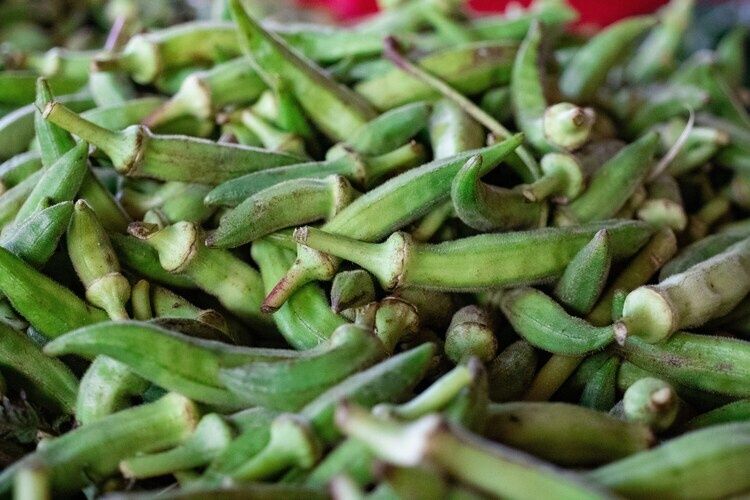
"Seeds of Survival is an exhibition at Cornell Botanical Gardens that honors the Black experience in the Americas dating back to the transatlantic slave trade1. The exhibition includes an outdoor plant display, audio tour and an indoor exhibit1. It focuses on food plants native to West Africa, such as black-eyed peas, okra and millet, that were used as provisions on the slave ships and became embedded in American cuisine21. The exhibition also highlights the cash crops, like sugarcane, cotton and tobacco, that fueled the transatlantic slave trade2."- Cornell Botanic Gardens
Public Registration
Additional Information
Program
Einaudi Center for International Studies
Institute for African Development
World at a Turning Point Interview

Human Development Report Director, Lead Author
UNDP's Dr. Pedro Conceição speaks with us during the Oct. 3–5 CRADLE conference on the state of the global economy.
This year's CRADLE conference, The World at a Turning Point: Cornell Conference on Development Economics and Law, takes stock of the global economy, with a special focus on the changing nature of labor markets, technological progress, inequality, climate change, and related laws and regulations. The three-day event is cosponsored by the Einaudi Center and the Department of Economics in the College of Arts and Sciences (A&S).
"Even if a country implements all the right policies, … it is still vulnerable to shocks that may emanate not from shortcomings of what it does within borders, but from the fact that countries are not coming together to address challenges."
On this page: Pedro Conceição, director of the United Nations Development Programme's Human Development Report Office, speaks with Arpit Chaturvedi, Cornell MPA ’18 and research manager to CRADLE cofounder and Carl Marks Professor of International Studies Kaushik Basu (A&S).
“Under Pedro Conceicao’s leadership, the Human Development Report has become one of the most important documents coming out of a multilateral institution,” Basu said. "It has widened the meaning of ‘human development’ and does not hesitate to wade into controversial themes and ideas."
Attend the Conference: The World at a Turning Point
A Conversation with Pedro Conceição
The UNDP Human Development Reports rarely focus on political issues, but the 2023–24 report released on Sept. 30 dedicates a chapter to political polarization. Why is addressing polarization crucial for providing global public goods?
For the most part, we know the kind of policies that would help countries and the international community to address shared challenges, from climate change to migration. The barriers to implementing these very rational—even obvious—policies seem to encounter difficulties that, it seems to us, lie beyond the realm of smart, technical policy advice.
For instance, shifting incentives toward decarbonized economies would benefit from increasing the cost of carbon, but that has been incredibly difficult to implement, both within many countries and internationally. Also, many high-income countries face declining fertility rates, shrinking populations, and challenges such as labor shortages and pension sustainability. Yet, immigration, which would help quite a bit, is incredibly difficult to manage.
In both cases, the difficulties lie more in the patterns of political polarization than in the technical details of what the solutions might be. So we felt that we needed to look into that a little bit to understand the meta-interventions that would make implementing the solutions to some of these challenges more likely to succeed.

The new report highlights how mismanaged interdependence, as seen in COVID-19, worsened inequalities. What lessons can be learned? How should institutions evolve to empower individuals in areas like climate change and digital governance?
One of the big takeaways is that even if a country implements all the right policies, makes all the right investments, and has “perfect” institutions, it is still vulnerable to shocks that may emanate not from shortcomings of what it does within borders, but from the fact that countries are not coming together to address challenges.
One of my big worries is that we look at the COVID-19 pandemic, and we think that we have gotten over the bump and fail to draw the most important implications about the failures of collective action of countries in the international community. Or that we look at it as a sectoral challenge—a health problem—to be addressed by, say, a pandemic treaty.
That is needed, of course, but our report invites us to reflect on a broader set of challenges in which countries are interdependent: pandemics are an example, but so is climate change. The global public goods framework helps us understand what is common to these challenges.
That analytical framework also enables us to understand what works and what works less well. For instance, because sovereign countries can always choose to leave an international treaty at will, we have to figure out ways they find it in their interest to remain in treaties. The trick is to have them realize that when it comes to global public goods, there are no zero-sum (competitive) dynamics, and structure incentives so that countries come on board.
You've had a unique career path, transitioning from physics to economics and public policy and now working in political economy at UNDP. What inspired these shifts?
I may have been guided by two things. One, curiosity. As a teenager, I wanted to understand the world through physics, particularly relativity, and quantum mechanics, which led me to study the math behind those theories throughout college. That took me through my college years and to my first professional experience, working on nuclear fusion in a European research project close to Oxford.
Over time, my curiosity was less about the science as such, and more about what kind of difference science could make in improving people’s lives. I became interested in science, technology, and innovation policy, and my curiosity broadened to other aspects that could improve standards of living, culminating with my ongoing interest in economic development.
I guess the other thing that drove me was trying to figure out where I could contribute the most. I was an average physicist, but it became clear to me that I would have to try to make more of a difference in other fields, so I studied economics and public policy and sought opportunities to learn and work in places where I could engage analytics to support decision-making.
Learn more about CRADLE and find out how to submit a paper to the open-access paper series.
Additional Information
Climate Change is Destroying American Homes. Who Should Have to Move?

Linda Shi, GPV
“You can’t read the fairness of [a retreat] only in the one action. It’s always relative to what is being done in another community,” says Linda Shi, professor of urban planning.
Additional Information
Economics, Empathy, and the U.S. Election

Kaushik Basu, IES/SAP/CRADLE
“The current debate about outsourcing is often framed as a battle between workers…. But this overlooks the fact that outsourcing is fundamentally a labor-versus-capital issue,” writes CRADLE's Kaushik Basu.
Additional Information
U.S. Sees Biggest Yearly Surge In Immigrant Population For 20 years

Stephen Yale-Loehr, Migrations
“People here on parole or temporary protected status have a status, so they shouldn't be put into deportation proceedings unless a separate ground of deportability (e.g., a criminal conviction) applies to them,” says Stephen Yale-Loehr, professor of immigration law.