
Einaudi Center for International Studies
Information Session: Laidlaw Research and Leadership Program

November 13, 2024
12:00 pm
The Laidlaw Undergraduate Leadership and Research Program promotes ethical leadership and international research around the world—starting with the passionate leaders and learners found on campuses like Cornell. Open to first- and second-year students, the two-year Laidlaw program provides generous support to carry out internationally focused research, develop leadership skills, engage with community projects overseas, and become part of a global network of like-minded scholars from more than a dozen universities. We’ll also share tips for approaching potential faculty research mentors and writing a successful application.
Register for the virtual session.
Can’t attend? Contact laidlaw.scholars@cornell.edu.
***
The Mario Einaudi Center for International Studies hosts info sessions for graduate and for undergraduate students to learn more about funding opportunities, international travel, research, and internships. View the full calendar of fall semester sessions.
Additional Information
Program
Einaudi Center for International Studies
Reppy Institute for Peace and Conflict Studies
East Asia Program
Southeast Asia Program
Latin American and Caribbean Studies
Institute for African Development
Institute for European Studies
South Asia Program
Migrations Program
Rethinking Migration: The Shared Journeys of People and Birds

The Migrations Program's Amanda Rodewald (Lab of Ornithology) explains why people and birds migrate—and what communities and policymakers can do to develop sustainable solutions (podcast).
Additional Information
Deadline Extended for Select Global Internships
Apply by Jan. 15
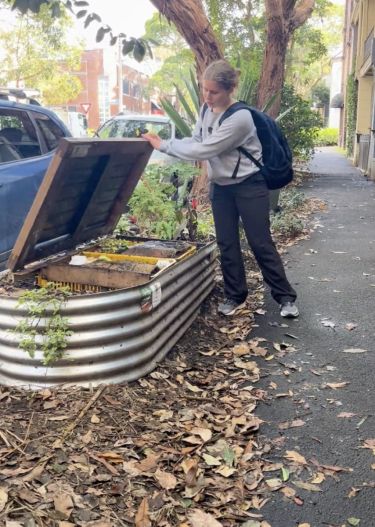
Our Global Internships span the globe with placements at Global Hubs and beyond. Explore available positions and apply over winter break!
Additional Information
IAD Seminar: Urban-based Domestic Land Investors Are Transforming Rural Land Use and Ownership in East Africa: specific implications for research and policy in the region.

October 31, 2024
11:15 am
Ives Hall, 109
Niwaeli Kimambo will share her ongoing work in Eastern Africa that links rural land use change to domestic urban actors. The work uses remote sensing analysis to track the emergence of tree crops (e.g., pine, eucalyptus, and avocado). Remote sensing analysis is paired with spatially explicit fieldwork from Uganda and Tanzania to argue that the rural tree crop boom is linked to new, urban-based land users. Direct involvement of urban-based citizens in rural land use signals a profound regional shift in rural land ownership and land markets. Dr. Kimambo will discuss the implications of this shift for environmental policy like tree-based landscape restoration, local ‘land grabs’, as well as geographic study of cross-scale phenomena.
Additional Information
Program
Einaudi Center for International Studies
Institute for African Development
Gift Helps Rescue Scholars from Gaza, Other Warzones and Disasters

Wendy Wolford, Acting Director
“To me, the ability to host scholars under threat and to work with IIE is really core to the entire mission of higher education and the mission of the university,” says Wendy Wolford, vice provost for international affairs.”
Additional Information
What SpaceX Will Need to Prove to Win its Lawsuit Against a California Commission

Sarah Kreps, PACS
Sarah Kreps, director of the Tech Policy Institute, says “It is possible that the lawsuit could be dismissed as lacking grounds for a constitutional claim.
Additional Information
Here’s Why the Gap Between Americans’ Perception of U.S. Economic performance and Reality has Doubled Since 2019, According to Economists

Kaushik Basu, IES/SAP/CRADLE
In this opinion essay, Kaushik Basu, professor of economics, discusses the U.S. economic performance under the Biden-Harris administration.
Additional Information
Fact Check: Are Haitian Immigrants in Springfield in the U.S. Illegally?

Stephen Yale-Loehr, Migrations
Stephen Yale-Loehr, professor of immigration law, explains the process of deportation.
Additional Information
Why OpenAI is Becoming a For-profit Business
Sarah Kreps, PACS
Restructuring around a core for-profit entity formalizes what outsiders have known for some time: that OpenAI is seeking to profit in an industry that has received an enormous influx of investment in the last few years,” says Sarah Kreps, director of the Tech Policy Institute.
Additional Information
"Chao Yuen-Ren’s Art of Songs": Symposium
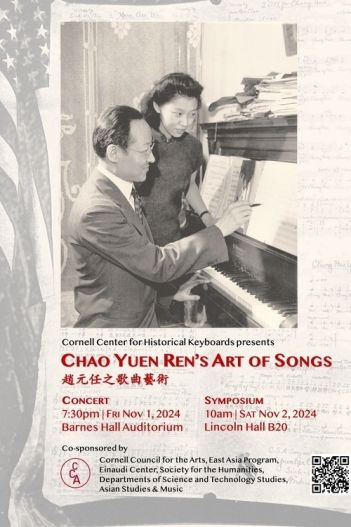
November 2, 2024
10:00 am
LIncoln Hall B20
The Cornell Center for Historical Keyboards presents “Chao Yuen-Ren’s Art of Songs,” a concert-symposium-exhibit that explores the musical legacy of the pioneering Chinese-American polymath and Cornell alumnus (class of 1914). Through performances, scholarly discussions, and an online exhibition, this two-day event celebrates Chao’s groundbreaking contributions to modern Chinese art music.
Central to the event is Chao’s innovative “Chinese lieder” (1922-1927), a song collection that represents a bold experiment in merging Chinese and Western musical traditions and a creative use of music as a vehicle for reforming the Chinese language.
Friday evening’s concert will bring Chao’s experimental compositions to life, alongside works by his compatriot contemporaries—Chinese composers who were also studying in the U.S. at the time—and select European lieder that inspired him. The concert will feature guest artist Stephen Ng alongside Cornell students and faculty, including Rachel Cheang, Vera Hsu, Roger Moseley, Yen-Hsiang Nieh, Morton Wan, and Cici Zhou.
A Saturday morning symposium will assemble an interdisciplinary panel to examine Chao’s music within the broader contexts of early 20th-century Chinese-American intellectual life, East-West musical exchange, and the keyboard’s role in the global transmission of musical knowledge and creativity. The panelists include Corey Earle (History, Cornell), Addi Liu (Music, Cornell), Morton Wan (Music, Cornell), Ding Xiang Warner (Chinese Literature, Cornell), Chen-Pang Yeang (History of Science and Technology, University of Toronto), and Sarah Yu (History, DeSales University).
An accompanying online exhibition, launching at the event, will invite visitors to explore a curated selection of photographs, letters, and musical works from Chao Yuen-Ren’s extensive archives at both Cornell University and UC Berkeley. These archival materials will illuminate Chao’s lifelong commitment to and fascination with music—as a scholar and musician, and as an influential Chinese-American intellectual on both sides of the Pacific.
The event, led by the Cornell Center for Historical Keyboards, is co-sponsored by the Cornell Council for the Arts, East Asia Program, Einaudi Center, Society for the Humanities, and the Departments of Asian Studies, Music, and Science and Technology Studies, with additional support from the Cornell Office of Alumni Affairs.
Additional Information
Program
Einaudi Center for International Studies
East Asia Program