
Institute for African Development
IAD Distinguished Africanist Scholar Lecture
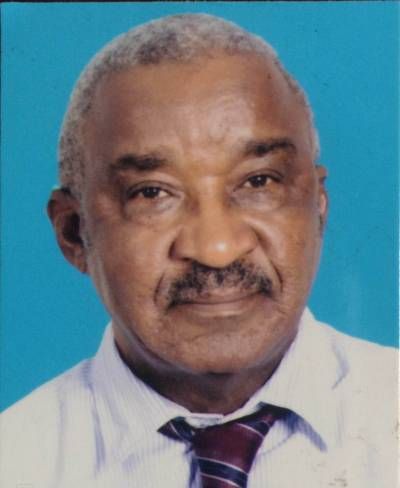
Wilbard Kombe, Professor, Urban Land Management, and Director, Institute of Human Settlements
Understanding the Make-up of Community in Basic Service Delivery Projects: Retrospective Analysis of a Co-production in Dar es Salaam
Thursday, September 8 2:40pm G-08 Uris Hall
Wilbard Kombe is a Professor of Urban Land Management and Director of the Institute of Human Settlements Studies at Ardhi University, Dar es Salaam, Tanzania. He holds a PhD from the Technical University of Dortmund. His area of expertise is in land management, the governance of informal urbanization as well as water and sanitation in peri-urban areas.
He has published extensively in the fields of urban governance in poverty; enhancing service delivery and partnerships and land management. He has been extensive involved in applied and basic research activities in several countries in the Sub-Sahara Africa including in Tanzania, South Africa, Zimbabwe, Kenya, Uganda, Mozambique, Zambia, Namibia, Botswana and Ethiopia.
Prof. Kombe has also been a consultant for international agencies including the he UN-Habitat, the World Bank, DANIDA, and Sida. He is also member of Boards of Parastatal Organizations and Registration Boards.
Additional Information
Institute for African Development Seminar Series: Integrating Digitalization Technologies into African Development: Can a Sociotechnical Systems Perspective Add Value?

October 13, 2022
2:40 pm
Uris Hall, G-08
The Issues in African Development Seminar Series examines critical concerns in contemporary Africa using a different theme each semester. The seminars provide a forum for participants to explore alternative perspectives and exchange ideas. They are also a focal activity for students and faculty interested in African development. In addition, this seminar series prepares students for higher level courses on African economic, social, and political development. The presentations are designed for students who are interested in development as well as Africa’s place in global studies, want to know about the peoples, cultures, and societies that call Africa home, and wish to explore development theories and alternate viewpoints on development practice.
Additional Information
Program
Einaudi Center for International Studies
Institute for African Development
Institute for African Development Seminar Series: Technology and Internet Inequities in African Universities
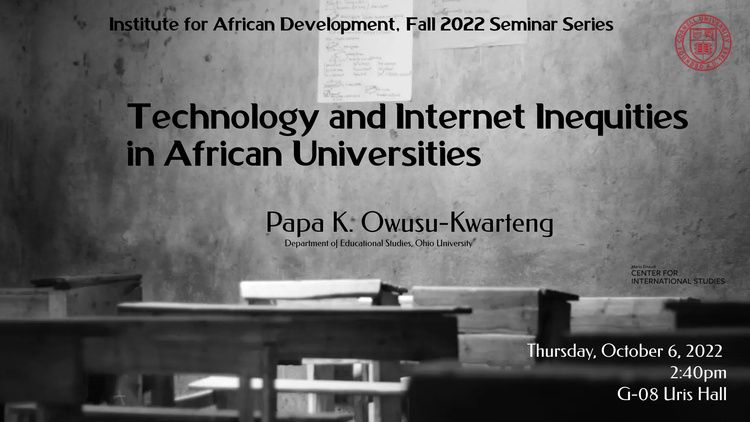
October 6, 2022
2:40 pm
Uris Hall, G-08
The seminar will be live. Virtual viewers may register here
The Issues in African Development Seminar Series examines critical concerns in contemporary Africa using a different theme each semester. The seminars provide a forum for participants to explore alternative perspectives and exchange ideas. They are also a focal activity for students and faculty interested in African development. In addition, this seminar series prepares students for higher level courses on African economic, social, and political development. The presentations are designed for students who are interested in development as well as Africa’s place in global studies, want to know about the peoples, cultures, and societies that call Africa home, and wish to explore development theories and alternate viewpoints on development practice.
Additional Information
Program
Einaudi Center for International Studies
Institute for African Development
Institute for African Development Seminar Series: "We Will Not Follow You Like Sheep:" Language,Officialdom, and Generational Politics in the Digital Age
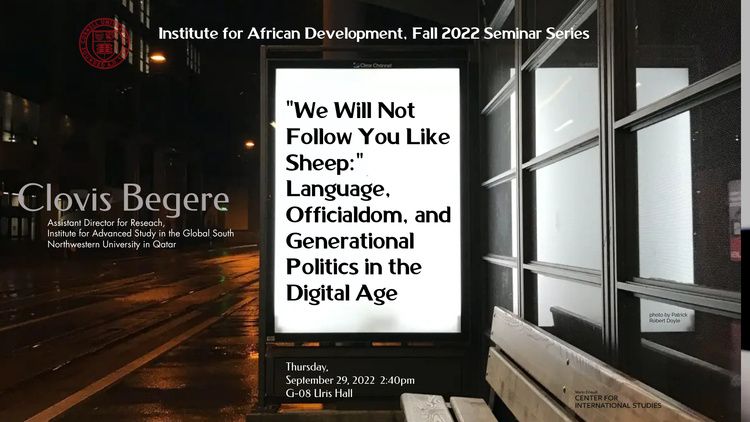
September 29, 2022
2:40 pm
Uris Hall, G-08
The Issues in African Development Seminar Series examines critical concerns in contemporary Africa using a different theme each semester. The seminars provide a forum for participants to explore alternative perspectives and exchange ideas. They are also a focal activity for students and faculty interested in African development. In addition, this seminar series prepares students for higher level courses on African economic, social, and political development. The presentations are designed for students who are interested in development as well as Africa’s place in global studies, want to know about the peoples, cultures, and societies that call Africa home, and wish to explore development theories and alternate viewpoints on development practice.
Additional Information
Program
Institute for African Development
Einaudi Center for International Studies
Institute for African Development Seminar Series: Role of Digital Technologies in Transforming Agri-Food Systems in Africa
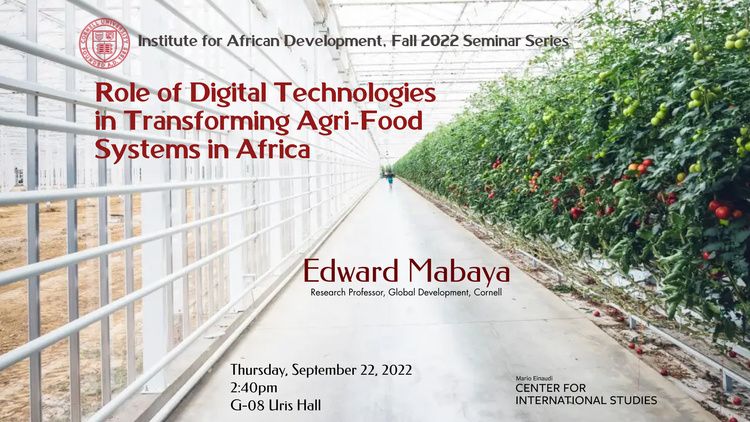
September 22, 2022
2:40 pm
Uris Hall, G-08
The Issues in African Development Seminar Series examines critical concerns in contemporary Africa using a different theme each semester. The seminars provide a forum for participants to explore alternative perspectives and exchange ideas. They are also a focal activity for students and faculty interested in African development. In addition, this seminar series prepares students for higher level courses on African economic, social, and political development. The presentations are designed for students who are interested in development as well as Africa’s place in global studies, want to know about the peoples, cultures, and societies that call Africa home, and wish to explore development theories and alternate viewpoints on development practice.
Additional Information
Program
Einaudi Center for International Studies
Institute for African Development
Institute for African Development Seminar Series: Social Media Aesthetics and the Digital Afterlives of Old Nollywood
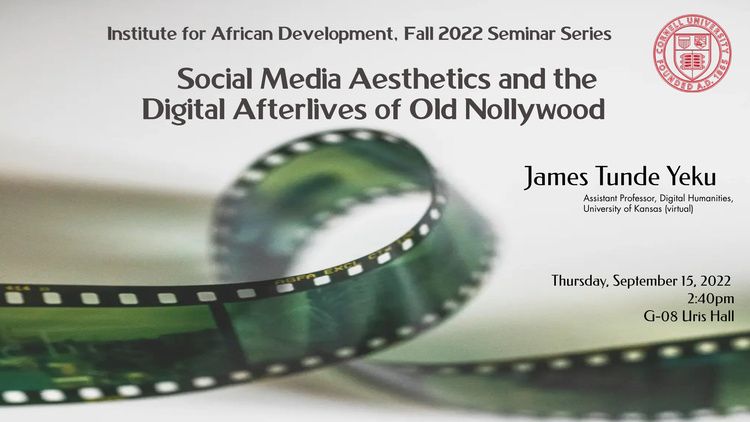
September 15, 2022
2:40 pm
Uris Hall, G-08
The Issues in African Development Seminar Series examines critical concerns in contemporary Africa using a different theme each semester. The seminars provide a forum for participants to explore alternative perspectives and exchange ideas. They are also a focal activity for students and faculty interested in African development. In addition, this seminar series prepares students for higher level courses on African economic, social, and political development. The presentations are designed for students who are interested in development as well as Africa’s place in global studies, want to know about the peoples, cultures, and societies that call Africa home, and wish to explore development theories and alternate viewpoints on development practice.
James Yékú is an Assistant Professor of African and African American studies at the University of Kansas, where he leads the African digital humanities program. He is the author of Cultural Netizenship: Social Media, Popular Culture, and Performance in Nigeria (Indiana University Press), and a book of poetry, Where the Baedeker Leads (Mawenzi House, Toronto). His current digital projects include Digital Nollywood, an Omeka-based collection of vintage film posters from Nigeria. Yékú is a 2022 fellow at the Center for Advanced Internet Studies (CAIS) in Bochum, Germany.
Additional Information
Program
Einaudi Center for International Studies
Institute for African Development
"Understanding the make-up of community in basic service delivery projects: Retrospective analysis of a coproduction in Dar es Salaam," Professor Wilbard Kombe, IAD Distinguished Africanist Scholar
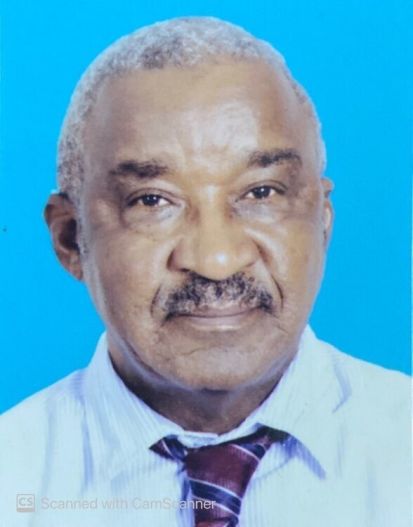
September 8, 2022
2:40 pm
G08-Uris Hall
Community involvement in public services delivery is widely acknowledged in the literature and practice as being pivotal to local development initiatives especially in cities of the global south. However, the nature and role of social composition of communities is rarely explored. This presentation applies a case study research approach to retrospectively analyse how the social make-up of local communities and their organizations influenced coproduction of public services in a low income informal settlement in Dar es Salaam city. It is argued that unpacking community level contextual factors including local resources, socio-cultural and institutional structures, partnerships and networks is key to addressing the challenges that produce and sustain poverty, inequalities and exclusion in low income settlements. The paper also calls for search for more knowledge on how partnerships and community engagement can be sustained in low income settlements.
Wilbard Kombe is a Professor at Ardhi University, the Institute of Human Settlements Studies, Tanzania. He received his PhD from the Technical University of Dortmund, (TUD). His research works have focused on governance of informal urbanization, land management and administration; disasters management and livelihoods of the poor; urban inequality and coproduction of basic infrastructure services; and climate change and urban vulnerability. He has also been extensively involved in research activities in several countries in the Sub-Sahara Africa.
Kombe has also implemented several real-life projects undertaken in Tanzania covering a wide range of subjects. This includes large projects on coproduction of basic infrastructure services and livelihoods in low income settlements funded by UNDP, Ford Foundation and local government authorities LGAs in Tanzania.
Additional Information
Program
Einaudi Center for International Studies
Institute for African Development
Does Dual Citizenship Reproduce Inequalities?
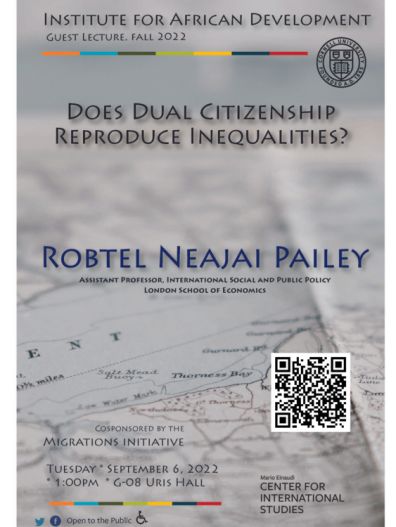
September 6, 2022
1:00 pm
G-08 Uris Hall
Robtel Neajai Pailey is an IAD guest speaker who will speak to this question and more at a lecture based around her work in Development, (Dual) Citizenship and Its Discontents in Africa: The Political Economy of Belonging to Liberia.
Pailey is an assistant professor in international social and public policy at the London School of Economics and Political Science (LSE). A Liberian scholar-activist working at the intersection of Critical Development Studies, Critical African Studies and Critical Race Studies, she centers her research on how structural transformation is conceived and contested by local, national and transnational actors from ‘crisis’-affected regions of the so-called Global South.(Cambridge University Press, 2021). Hers is the first book to evaluate domestic and diasporic constructions and practices of Liberian citizenship across space and time and their myriad implications for development. In this seminar drawing on rich life histories from over two hundred in-depth interviews in West Africa, Europe, and North America, Pailey uses a contested dual citizenship bill, introduced in Liberia in 2008 but never passed, as an entry point to ask broader questions about how citizenship is differentiated by class, gender, race, ethnicity, etc, and whether dual citizenship actually reproduces inequalities. She develops a new model for conceptualizing citizenship within the context of ‘crisis’-affected states while offering a compelling critique of the neoliberal framing of diasporas and donors as the panacea to post-war reconstruction.
Cosponsored by the Migrations initiative.
Additional Information
Program
Einaudi Center for International Studies
Institute for African Development
IAD Guest Lecture: Robtel Neajai Pailey

Does Dual Citizenship Reproduce Inequalities?
cosponsored by the Migrations Initiative.
Tuesday, September 6, 2022 * 1:00pm * G-08 Uris Hall
'Does dual citizenship reproduce inequalities?' Robtel Neajai Pailey grapples with this question and more in her engaging monograph Development, (Dual) Citizenship and Its Discontents in Africa: The Political Economy of Belonging to Liberia (Cambridge University Press, 2021). Hers is the first book to evaluate domestic and diasporic constructions and practices of Liberian citizenship across space and time and their myriad implications for development. In this seminar drawing on rich life histories from over two hundred in-depth interviews in West Africa, Europe, and North America, Pailey uses a contested dual citizenship bill, introduced in Liberia in 2008 but never passed, as an entry point to ask broader questions about how citizenship is differentiated by class, gender, race, ethnicity, etc, and whether dual citizenship actually reproduces inequalities. She develops a new model for conceptualizing citizenship within the context of ‘crisis’-affected states while offering a compelling critique of the neoliberal framing of diasporas and donors as the panacea to post-war reconstruction.
Robtel Neajai Pailey is an Assistant Professor in International Social and Public Policy at the London School of Economics and Political Science (LSE). A Liberian scholar-activist working at the intersection of Critical Development Studies, Critical African Studies and Critical Race Studies, she centers her research on how structural transformation is conceived and contested by local, national and transnational actors from ‘crisis’-affected regions of the so-called Global South.
Additional Information
Institute for African Development Seminar Series: Digital Humanities as Platform for Reconfiguring and Retooling Humanities Research and Scholarship in Africa
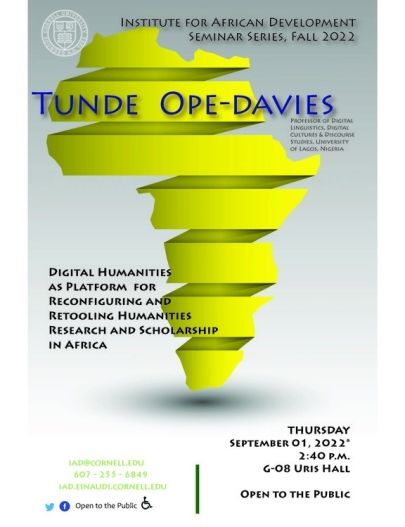
September 1, 2022
2:40 pm
Uris Hall, G-08
The Issues in African Development Seminar Series examines critical concerns in contemporary Africa using a different theme each semester. The seminars provide a forum for participants to explore alternative perspectives and exchange ideas. They are also a focal activity for students and faculty interested in African development. In addition, this seminar series prepares students for higher level courses on African economic, social, and political development. The presentations are designed for students who are interested in development as well as Africa’s place in global studies, want to know about the peoples, cultures, and societies that call Africa home, and wish to explore development theories and alternate viewpoints on development practice.
Additional Information
Program
Einaudi Center for International Studies
Institute for African Development