
Institute for European Studies
The Italian Far Right’s Beef with Vegans and Immigrants

Gray Fuller, IES
Authored by Gray Fuller, a sophomore in Public Policy and recipient of the Susan Tarrow Fellowship for Research in Europe.
Additional Information
Information Session: Fulbright Opportunities for Undergraduate Students

November 11, 2024
4:45 pm
The Fulbright U.S. Student Program supports U.S. citizens to study, conduct research in any field, or teach English in more than 150 countries. Students who wish to begin the program immediately after graduation are encouraged to start the process in their junior year. Recent graduates are welcome to apply through Cornell.
The Fulbright program at Cornell is administered by the Mario Einaudi Center for International studies. Applicants are supported through all stages of the application and are encouraged to start early by contacting fulbright@einaudi.cornell.edu.
Register for the virtual session.
Can’t attend? Contact fulbright@einaudi.cornell.edu.
Additional Information
Program
Einaudi Center for International Studies
Reppy Institute for Peace and Conflict Studies
East Asia Program
Southeast Asia Program
Latin American and Caribbean Studies
Institute for African Development
Institute for European Studies
South Asia Program
Migrations Program

Information Session: Fulbright Opportunities for Graduate Students

November 6, 2024
4:45 pm
The Fulbright U.S. Student Program provides full funding for graduate and professional students conducting research in any field or teaching in more than 150 countries. Open to U.S. citizens only. The Fulbright-Hays Doctoral Dissertation Research Abroad program supports doctoral students conducting research in modern languages or area studies for six to 12 months.
Open to U.S. citizens and permanent residents of the United States. Travel to Western European countries is not eligible.
Register for the virtual session.
Can’t attend? Contact fulbright@einaudi.cornell.edu.
Additional Information
Program
Einaudi Center for International Studies
Reppy Institute for Peace and Conflict Studies
East Asia Program
Southeast Asia Program
Latin American and Caribbean Studies
Institute for African Development
Institute for European Studies
South Asia Program
Migrations Program
Green Border

September 19, 2024
7:00 pm
Willard Straight Hall Theatre
In the treacherous and swampy forests that make up the so-called "green border" between Belarus and Poland, refugees from the Middle East and Africa are lured by government propaganda promising easy passage to the European Union. Unable to cross into Europe and unable to turn back, they find themselves trapped in a rapidly escalating geopolitical stand-off. An unflinching depiction of the migrant crisis captured in stark black-and-white, this riveting film explores the intractable issue from multiple perspectives: a Syrian family fleeing ISIS caught between cruel border guards in both countries; young guards instructed to brutalize and reject the migrants; and activists who aid the refugees at great personal risk.
Thirty years after Europa Europa, three-time Oscar¨ nominee Agnieszka Holland brings a masterful eye for realism and deep compassion to this blistering critique of a humanitarian calamity that continues to unfold. Winner of the Special Jury Prize at the 2023 Venice Film Festival, Green Border is a poignant and essential work of cinema that opens our eyes and speaks to the heart, challenging viewers to reflect on the moral choices that fall to ordinary people every day.
Filmmaker Agnieszka Holland will join for a Zoom Q&A with Professor Ewa Bachminska, Senior Lecturer of Polish Language in the Department of Romance Studies at Cornell, following the screening on Sunday, September 15, 2024 at noon.
Green Border screens as part of our "Doc Spots" series. Courtesy of Kino Lorber.
Additional Information
Program
Reppy Institute for Peace and Conflict Studies
Institute for European Studies
Einaudi Center for International Studies
Far-Right: The Crisis Itself or the Result?

Mabel Berezin in World in Focus
Institute for European Studies director Mabel Berezin joined Dora Mengüç (Dora Reports) before France's high-stakes parliamentary elections to discuss Europe's shift to the right.
“Not everyone in every country has the same problem, but they all talk about the same thing. Many people talk about identity issues or other concerns, but they talk about immigrants. They worry that they do not share the same culture. This was a big deal for France.”
In the interview, Berezin reflected on the success of conservatives, right-wing populists, and far-right candidates in early June European Parliament elections and weighed in on French President Emmanuel Macron’s decision to call for snap elections to shore up his support.
She correctly questioned the wisdom of Macron's move. “I don’t want to downplay the uncertainty of the problem, but it’s hard to see a good outcome,” she said. “Macron has not been very good at understanding and connecting with the emotions of the French people.”
After this interview, France held legislative elections to elect all 577 members of the 17th National Assembly. No party reached a majority. With his centrist party now in third place, Macron has so far refused to appoint a prime minister.
Berezin also looked ahead to the U.S. election. She downplayed the value of comparing young voters in the U.S. and Europe. “What is happening in the United States today is exceptional, and I feel terrified,” she said, stressing the impact of local communities and unique contexts of right-wing thinking.
Nevertheless, the left and right share ownership of certain vital issues, she observed—which can lead to some surprising convergences. “Economic problems reflect the conditions of many people in all these countries,” Berezin said. “The dissolution of traditional parties opens space, especially for right-wing people in left-wing parties.”
Mabel Berezin is director of Einaudi's Institute for European Studies and interim chair of the Department of Sociology in the College of Arts and Sciences. She is a frequent commentator on fascism and right-wing populist politics.
Featured in World in Focus Briefs
Additional Information
Democracy at Risk: The Radical Right’s Interaction with Mainstream Parties and Its Effects in Eastern Europe

September 12, 2024
4:30 pm
Uris Hall, G08
The lecture offers an overview of the radical right's interactions with mainstream parties and the effect they have on setting political agendas in the region. The focus is on sensitive policy areas such as minority policies and asylum regulations. Based on a study of shifts in major parties’ policy positions and in minority-related policies, the lecture addresses the question to what extent the radical right has changed the quality of democracy in Eastern Europe. This question shall be answered by comparing three groups of countries that are distinct in terms of the relevance of radical right parties: Bulgaria and Slovakia; Hungary, Poland, and Romania; and the Czech Republic and Estonia.
About the speaker
Michael Minkenberg is professor of Comparative Politics at the European University Viadrina in Frankfurt (Oder). He studied Political Science, History, and Economics at the universities of Heidelberg, Freiburg/Br., Bonn and Cologne and at Georgetown University where he received his M.A. in American Government in 1984. He obtained his Ph.D. at the university of Heidelberg in 1989 and his Habilitation (venia legendi) in Political Science at the university of Göttingen in 1997.
Since 1989, he has taught comparative politics at Georgetown University, the universities of Göttingen and Heidelberg, at Cornell University and Columbia University. From 2007-10 he held the Max Weber Chair for German and European Studies at NYU.
Minkenberg's research interests include the radical right in liberal democracies; the relationship between religion and politics in Western societies; and, more recently, the role of state architecture in capital cities. He published widely on these topics in journals such as the European Journal of Political Science, Comparative Politics, Government and Opposition, West European Politics, Comparative Political Studies, East European Politics and Societies, the International Political Science Review.
His most recent publications are, with Zsuzsanna Végh, Depleting democracies: Radical right impact on parties, policies, and polities in Eastern Europe (Manchester University Press 2023), and Religion und Politik in westlichen Demokratien (Religion and politics in Western democracies) (Wiesbaden: Springer VS 2024).
Additional Information
Program
Einaudi Center for International Studies
Institute for European Studies
Dario Melossi - Migration, Imprisonment and "Race": Toward a Comparative Study between the US and Europe

September 10, 2024
4:00 pm
Uris Hall, G08
Migration, Imprisonment and "Race": Toward a Comparative Study between the US and Europe
By Dario Melossi
(University of Bologna)
The number of migrants in prison is very high in most European penal systems today whereas it is quite low in the United States, and it has been that way for a long time. Criminological and historical reconstructions in the United States have advanced the thesis that the initial hostility toward migrants, expressed also in processes of criminalization, slowly turned into a process of assimilation and “whitening” of Southern and Eastern European migrants (however, things did not change that much when, more recently, non-European migrants became prevalent). At the same time, between the period of Reconstruction and the Great Migration, Americans of African origins became increasingly the target of processes of criminalization. Consequently, the number of migrants in prison became negligible, while the “overrepresentation” of African Americans became commonplace. Is there something to be learned today in Europe from such a story? Is there the danger that also in Europe there may be a possible shift from xenophobia to racism in processes of criminalization and prisonization? In this first, tentative, and for now descriptive, analysis, I present data taken from the recent Italian migration context in the last 30 years, connecting imprisonment rates and migrants’ nationalities, in order to start thinking some of these issues through.
Additional Information
Program
Institute for European Studies
Migrations Program
Global Hubs Grant Launches AI Collaboration

Call for Proposals Open Now
Isabel Perera (IES) and international partners are investigating AI's impact on workplaces. Apply now for the next round of Hubs seed grants.
Additional Information
Announcing 2024-25 IES Graduate Fellows!
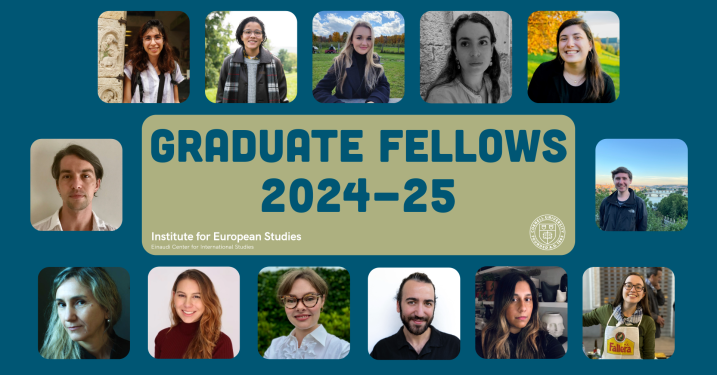
Thirteen graduate students from various disciplines have been accepted as fellows for 2024-25.