
Institute for European Studies
Of Plants, Place, and Politics
New IES Faculty Research Pod
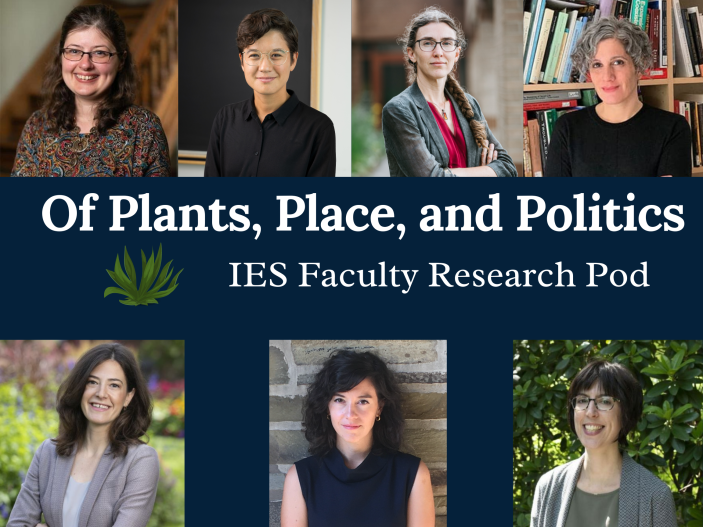
IES is pleased to announce the awarding of our second faculty research pod: “Of Plants, Place, and Politics” [Eastern Europe and the former Soviet Union]”.
The pod brings together several faculty from across Cornell departments and colleges whose work focuses on the region(s) covered by the Association of Slavic, East European and Eurasian Studies (ASEEES). The pod team will be meeting monthly to workshop draft research papers in an interdisciplinary setting. They will also organize a symposium of faculty research related to Soviet/post-Soviet history and politics and the environment/landscape.
More broadly, under the rubric “Of Plants, Place, and Politics,” the pod will focus on the intersection of environmental, cultural and political themes, discussing how the changing climate (in all senses of the word) relates to their research, teaching, collegial networks and collaborations, public scholarship and advocacy, and the institutional support available to international and interdisciplinary studies of this region.
Participating Faculty:
Maria C. Taylor, Department of Landscape Architecture, Assistant Professor
Cristina Florea, History, Assistant Professor
Mari F. Jarris, German Studies, Provost New Faculty Fellow and incoming Assistant Professor
Lori Khatchadourian, Department of Near Eastern Studies & Anthropology, Associate Professor
Sophie Pinkham, Comparative Literature, Professor of Practice
Bryn McCammon Rosenfeld, Government, Assistant Professor
Leila Wilmers, Sociology, Postdoctoral Associate
Additional Information
Program
Mari Jarris
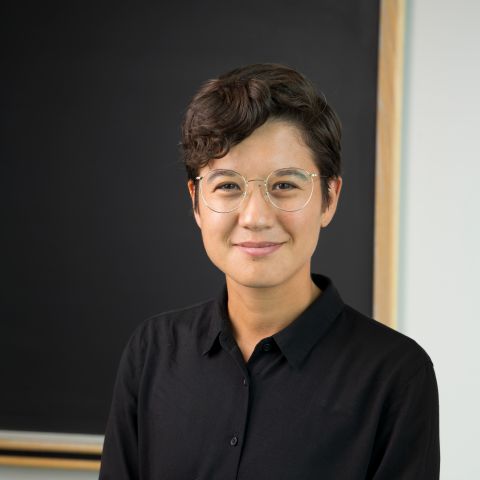
Assistant Professor, German Studies
Mari Jarris works across German- and Russian-language literature and theory, primarily in the nineteenth and twentieth centuries. Their research areas include feminist and queer theory, transnational socialisms, and Critical Theory. They are currently completing a book manuscript, Utopia as Revolution: Marxism’s Queer Pasts and Futures.
Additional Information
Maria Taylor

Assistant Professor, Landscape Architecture
Maria C. Taylor is a historian and theorist of landscape design, environmental relations and international urban planning. Taylor was awarded her PhD at University of Michigan (Ann Arbor), where she received the Distinguished Dissertation in Architecture Award for her 2019 dissertation on Soviet urban environmental design. Taylor also earned a Master of Landscape Architecture at the University of Washington and a MA in Russian, East European and Eurasian Studies at Stanford University.
Additional Information
Sophie Pinkham

Professor of the Practice, Comparative Literature
Sophie Pinkham’s research focuses on post-Soviet and post-socialist literature, culture, and politics, primarily in Russia and Ukraine. Her current project is a history of the forest in the Russian imagination.
Additional Information
Epidemic Extraterritoriality and Border Prophylaxis in Western Europe 1780-1850
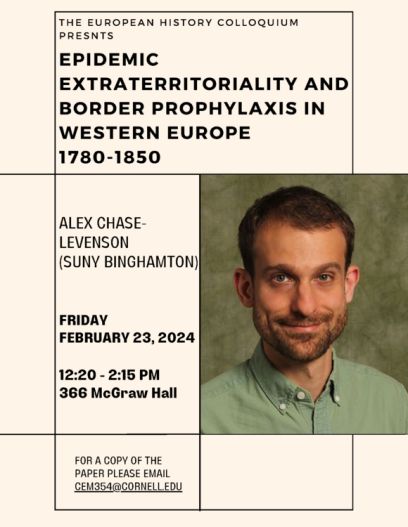
February 23, 2024
12:20 pm
McGraw Hall, 366
First meeting of the Spring 2024 European History Colloquium will be with Alex Chase-Levenson of SUNY Binghamton. For a copy of the paper please email cem354@cornell.edu.
This semester's colloquium will include discussions with-
Giuliana Chamedes on March 15
Aimee Genell on April 19
Additional Information
Program
Institute for European Studies
Information Session: Global PhD Research Awards

February 28, 2024
4:45 pm
The Amit Bhatia ’01 Global PhD Research Awards fund international fieldwork to help Cornell students complete their dissertations. Through a generous gift from Amit Bhatia, this funding opportunity annually supports at least six PhD students who have passed the A exam. Recipients hold the title of Amit Bhatia ’01 Global PhD Research Scholars. All disciplines and research topics are welcome. The award provides $10,000 to be used by the end of the sixth PhD year for international travel, living expenses, and research expenses.
Register for the information session. Can’t attend? Contact programs@einaudi.cornell.edu.
***
The Mario Einaudi Center for International Studies hosts info sessions for graduate and for undergraduate students. To learn more about funding opportunities, international travel, research, and internships, view the full calendar for spring semester sessions.
Additional Information
Program
Einaudi Center for International Studies
Reppy Institute for Peace and Conflict Studies
East Asia Program
Southeast Asia Program
Latin American and Caribbean Studies
Institute for African Development
Institute for European Studies
South Asia Program
Luigi Einaudi Distinguished Lecture
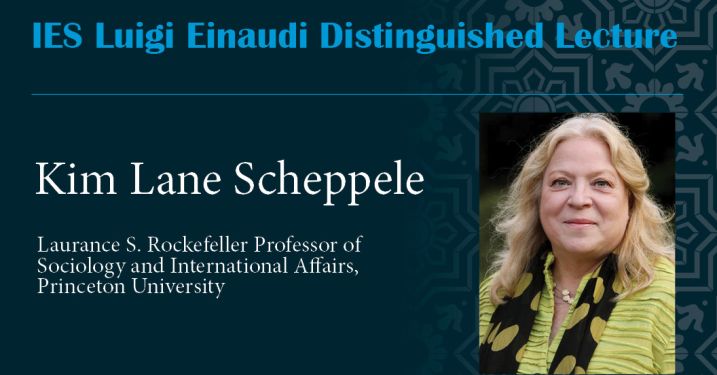
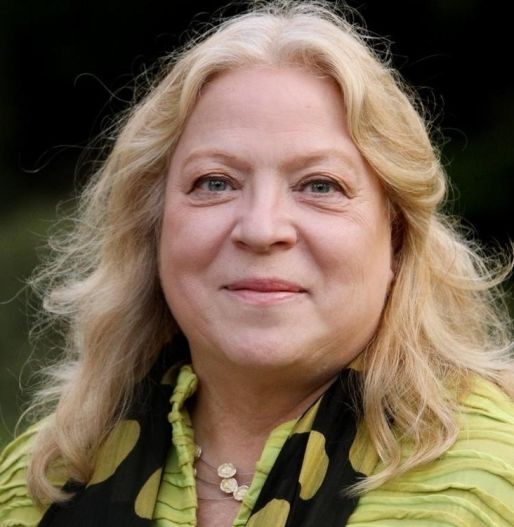
On May 2, renowned Princeton University professor Kim Lane Scheppele will deliver the Luigi Einaudi Distinguished Lecture on "Destroying Democracy by Law."
Destroying Democracy by Law
May 2, 2024
5:00 pm
Physical Sciences Building, 120
Institute for European Studies Luigi Einaudi Distinguished Lecture
Until 2005, the number of democracies in the world kept increasing, but after that date, the number has declined. Even robust democracies are now showing signs of weakness and some have turned into hybrid regimes suspended between democracy and autocracy. What is killing off the world’s democracies - and what can be done about it?
In her forthcoming book Destroying Democracy by Law, Kim Lane Scheppele explores the countries in which aspirational autocrats have undermined democracies. With examples from Hungary, Poland, Venezuela, Ecuador, Turkey, Russia, the United Kingdom, the United States and beyond, Scheppele shows how democracies no longer die with tanks in the streets. Instead, democracies die when aspirational autocrats come to power through elections and then use legal methods to undermine constraints on their power. With law as their weapon, aspirational autocrats damage the institutions that provide checks and balances, compromise the independence of the judiciary, stifle civil society, muzzle the press and use the power of the state against those who might challenge their monopoly on power. Scheppele explains how the new legal tools work, how they circulate from one budding autocracy to another and why international observers have been slow to recognize the problem. She also provides some ideas for reversing these processes through law wielded by new democratic movements.
Kim Lane Scheppele is the Laurance S. Rockefeller Professor of Sociology and International Affairs at the Princeton School of Public and International Affairs and the University Center for Human Values at Princeton University. She is also a faculty fellow at the University of Pennsylvania Law School. Her primary field is the sociology of law, and she specializes in ethnographic and archival research on courts and public institutions. She also works in sociological theory, comparative/historical sociology, political sociology, sociology of knowledge, and human rights.
Additional Information
Program
Einaudi Center for International Studies
Institute for European Studies
Global Grand Challenge: The Future

Call for Proposals to Imagine Better Future
Faculty, find out how you can join Cornell's newest challenge. The call for research and curricular proposals is now open. LOI due Feb. 26.
Assembling the Illegality Regime: Vagrancy Laws, Indentured Labor, and the Making of Migration Control in Germany

March 15, 2024
11:30 am
White Hall, 106
Today, illegality is the major frame through which societies discuss migration. While the existing literature has situated the emergence of the figure of the illegal migrant in the post-1945 era, I show that people were already criminalized as illegal in 1920s Germany. To target Jewish migrants fleeing the pogroms in present-day Poland and Ukraine, the German government built its first immigration detention camps and attempted to control its external borders and deport those that had been categorized as ‘nuisance foreigners’ – the poor, those without a job or a permanent abode, and those who had been found guilty of a crime. Through a historical case study of Germany, this paper therefore asks how states first came to render people on the move as illegal. Drawing on one year of archival research, I show how the making of migrant illegality is as much rooted in the domestic control of vagrants and Roma people as it was influenced by the transnational efforts to manage colonized labor. I argue that the entanglements of these local-subnational and global-colonial histories of mobility controls equipped the German state with the legal, bureaucratic, and enforcement capacities to define and categorize who can be excluded as an illegal migrant and to detain and deport those targeted.
About the Speaker
Sabrina Axster is a postdoctoral fellow at Cornell University’s Migration Initiative and hold a PhD in Political Science from Johns Hopkins University.
This event is part of the Department of Government's Politics, Sandwiches, and Comments workshop series.
Additional Information
Program
Einaudi Center for International Studies
Institute for European Studies