
Institute for European Studies
Russia’s War on Ukraine: A New Attack on Peace, Rights, and Sovereignty

March 4, 2022
4:30 pm
The Russian invasion of Ukraine constitutes the first major land war in Europe in decades. It threatens lives across the region, the post–Cold War international order—and the stability of the global economy, as the United States, European allies, and countries around the world have imposed severe sanctions on Russia and supplied varying levels of aid to Ukraine.
In cooperation with the Cornell Jeb E. Brooks School of Public Policy and College of Arts and Sciences, the Mario Einaudi Center for International Studies has convened this expert panel to respond to the injustice and massive violation of sovereignty, human rights, and peace.
Join us for a wide-ranging discussion of Russian domestic and foreign policy, Ukrainian nationhood and security response, human rights and migration, economic sanctions’ impact, and international and European consequences of Russia’s invasion of Ukraine. The panel includes Dmitry Bykov, a Russian dissident and Open Society University Network threatened scholar sponsored by Global Cornell and hosted by the Einaudi Center's Institute for European Studies (IES), in partnership with Ithaca City of Asylum.
***
Panelists:
Mabel Berezin (IES Director; Professor, Department of Sociology/A&S)Dmitry Bykov (Russian writer and dissident; scholar at risk hosted by IES)Cristina Florea (Assistant Professor, Department of History/A&S)Nicholas Mulder (Assistant Professor, Department of History/A&S)Bryn Rosenfeld (Assistant Professor, Department of Government/A&S)Stephen Yale-Loehr (Migrations faculty fellow; Professor of Immigration Law Practice, Cornell Law School)Moderator:
Rachel Beatty Riedl (Einaudi Center Director; Professor, Department of Government/A&S and Cornell Brooks School)
Introduction:
Wendy Wolford (Vice Provost of International Affairs; Professor, Department of Global Development, College of Agriculture and Life Sciences)
***
Live Screening: Statler 196
Students: Join the campus community in Statler 196 at 4:30 to watch the panel live. Sponsored by the Einaudi Center, A&S, and Cornell Brooks School.
***
About the Series
The new Einaudi Center Critical Conversations Series brings together world-class regional, historical, and comparative experts to promote deeper understanding of global current events and emerging crises on the world stage. The stakes for our shared future have never been higher—so please join us for these critical conversations.
Additional Information
Program
Einaudi Center for International Studies
Reppy Institute for Peace and Conflict Studies
Institute for European Studies
The US Keeps Turning to Sanctions Despite Their Mixed Record

Nicholas Mulder, IES
“The record of sanctions at deterring war is pretty mixed, and one of the reasons for that is that it’s quite difficult to calibrate, to sort of… really arrange the pressure exactly right,” says Nicholas Mulder, assistant professor of history. “If you make a threat that is too weak, then it doesn’t deter. But if you make a threat that is very strong, then you might not be actually able to deliver on that threat, and it might not be credible.”
Additional Information
Weighing Russia Sanctions Success Tough in Ukraine Conflict

Nicholas Mulder, IES
Nicholas Mulder discusses the difficulties of implementing successful sanctions on a country with a large economy like Russia.
Additional Information
Cristina Florea
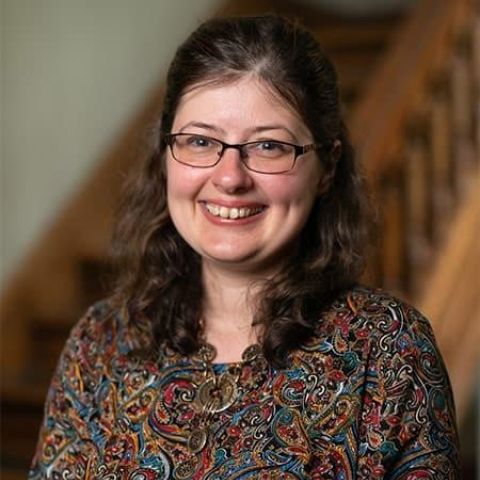
Associate Professor, History
Additional Information
Program
Role
- Faculty
- IES Core Faculty
- IES Steering Committee
- PACS Steering Committee
- Global Public Voices Fellow 2022-23
Contact
Email: cf476@cornell.edu
Ukrainian Cornellians Look Homeward

Ukrainian students and researchers at Cornell share their thoughts as they absorb the ongoing news of Russia’s invasion of Ukraine.
Additional Information
"No Sign of Backing Down"

Former Ambassador Speaks on Ukraine Conflict at Feb. 22 Event
Former U.S. Ambassador to Ukraine Bill Taylor said Russian President Vladimir Putin appears intent on provoking a “horrific conflict.”
Additional Information
From Populism to Fascism?
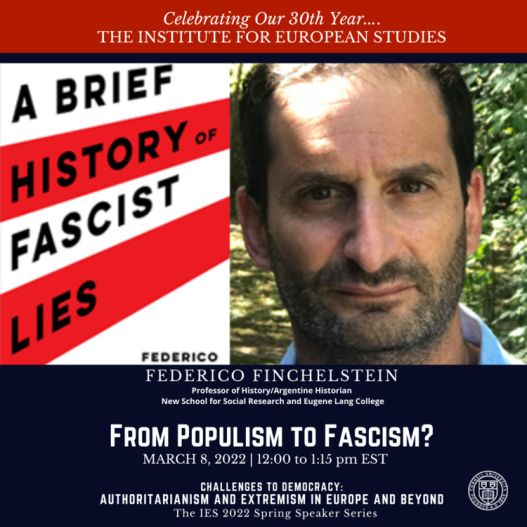
March 8, 2022
12:00 pm
REGISTER HERE.
Fascism denied the very nature of democracy, the legitimacy of democratic procedures and their electoral outcomes. Its proponents claimed that votes were only legitimate when they confirmed by referendum the autocratic will of their leader.
Populists, in contrast, have used elections to stress their own democratic nature even when they advanced other authoritarian trends. These differences matter today as wannabe fascist populist like Donald Trump, Jair Bolsonaro and others, deny the electoral legitimacy of their opponents.
The more we know about the past fascist attempts to deny the workings of democracy, the more worried we should be about present post-fascist and populist forms.
Federico Finchelstein is Professor of History at the New School for Social Research at the Eugene Lang College in New York City. He is the author of several books, including Fascist Mythologies, A Brief History of Fascist Lies, From Fascism to Populism in History, Transatlantic Fascism, and The Ideological Origins of the Dirty War. He contributes to major American, European, and Latin American media, including the New York Times, the Washington Post, the Guardian, CNN, Foreign Policy, Clarín, Corriere della Sera, Nexos, and Folha de S.Paulo.
After his undergraduate education at the University of Buenos Aires, he received his Ph.D. from Cornell University. He has previously taught at Brown University.
Additional Information
Program
Institute for European Studies
Dispatch from Ukraine: Human Rights and Conflict in the Eastern Regions
March 2, 2022
4:00 pm
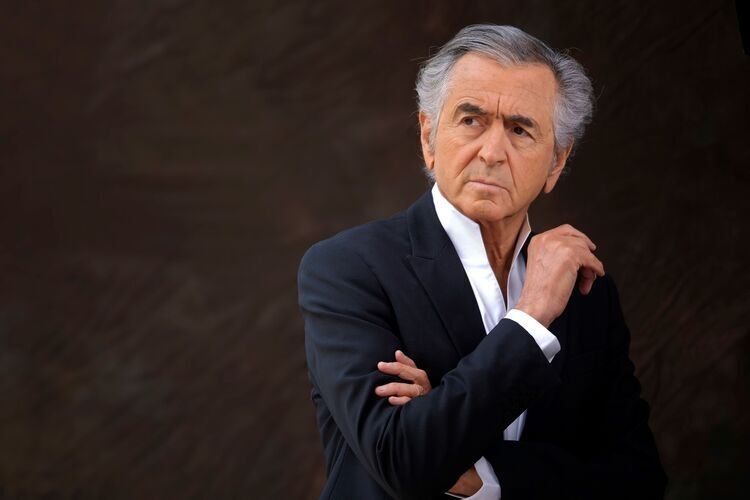
Just before the coronavirus pandemic, Bernard-Henri Lévy’s reporting took him to eastern Ukraine, as part of an eight-part journey to cast light upon human rights abuses in global hotspots that have escaped international attention or active response.
Now, with the Ukraine crisis making global news headlines, Lévy recounts his experience in a dispatch from eastern Ukraine, as reported in his new book The Will To See: Dispatches from a World of Misery and Hope (Yale University Press, 2021). In a chapter he calls, “Donbass: Trench Warfare Lives on in Europe,” Lévy shares what he witnessed in 2020. And he will connect how that period foreshadowed what the world is paying close attention to today.
Bernard-Henri Lévy will be in conversation with Representative Chris Smith (R-NJ), co-chair of the bipartisan Tom Lantos Human Rights Commission (formerly known as the Congressional Human Rights Caucus) and former Representative Steve Israel, director of the Institute of Politics and Global Affairs at the Cornell Jeb E. Brooks School of Public Policy.
Speaker
Bernard-Henri Lévy, French philosopher, filmmaker, activist, and author
Moderators
Rep. Chris Smith, Senior Member on the Foreign Affairs Committee and Ranking Member of its Africa, Global Health, Global Human Rights, and International Organizations Subcommittee (R-NJ)
Steve Israel, Director, Institute of Politics and Global Affairs at Cornell University and former U.S. Representative (D-NY)
About the book
The Will To See: Dispatches from a World of Misery and Hope
Blurb: An unflinching look at the most urgent humanitarian crises around the globe, from one of the world’s most daring philosopher-reporters. Over the past fifty years, renowned public intellectual Bernard-Henri Lévy has reported extensively on human rights abuses around the world. This new book follows the intrepid Lévy into eight international hotspots—in Nigeria; Syrian and Iraqi Kurdistan; Ukraine; Somalia; Bangladesh; Lesbos, Greece; Libya; and Afghanistan—that have escaped global attention or active response.
In a deeply personal introduction, Lévy recounts the intellectual journey that led him to advocacy, arguing that a truly humanist philosophy must necessarily lead to action in defense of the most vulnerable. In the second section, he reports on the eight investigative trips he undertook just before or during the coronavirus pandemic, from the massacred Christian villages in Nigeria to a dangerously fragile Afghanistan on the eve of the Taliban talks, from an anti-Semitic ambush in Libya to the overrun refugee camp on the island of Lesbos. Part manifesto, part missives from the field, this new book is a stirring rebuke to indifference and an exhortation to level our gaze at those most hidden from us.
Additional Information
Program
Institute for European Studies
Reppy Institute for Peace and Conflict Studies
Laurent Dubreuil

Distinguished Professor of Arts and Sciences; Professor of French, Francophone & Comparative Literature
Laurent Dubreuil is the Director of the French Studies Program at Cornell. In his research, he aims to explore the powers of literary and artistic thinking at the interface of social thought, the humanities and the sciences. Dubreuil's scholarship is broadly comparative and makes use of his reading knowledge in some ten languages.
Additional Information
The Egyptian Labor Corps: Race, Space, and Place in the First World War

March 23, 2022
5:00 pm
White Hall, 106
Kyle Anderson, assistant professor at SUNY Old Westbury, will give a talk on his recently published book "The Egyptian Labor Corps: Race, Space, and Place in the First World War" (University of Texas Press, 2021).
In-person attendance is open to current Cornell students, faculty and staff. The public is invited to attend via Zoom.
Book synopsis:
This history sheds new light on Egypt’s involvement in World War I by telling the story of the Egyptian Labor Corps and how the treatment of these primarily rural workers influenced the 1919 Egyptian Revolution.
During World War I, the British Empire enlisted half a million young men, predominantly from the countryside of Egypt, in the Egyptian Labor Corps (ELC) and put them to work handling military logistics in Europe and the Middle East. British authorities reneged on their promise not to draw Egyptians into the war, and, as Kyle Anderson shows, the ELC was seen by many in Egypt as a form of slavery. The Egyptian Labor Corps tells the forgotten story of these young men, culminating in the essential part they came to play in the 1919 Egyptian Revolution.
Combining sources from archives in four countries, Anderson explores Britain’s role in Egypt during this period and how the ELC came to be, as well as the experiences and hardships these men endured. As he examines the ways they coped—through music, theater, drugs, religion, strikes, and mutiny—he illustrates how Egyptian nationalists, seeing their countrymen in a state akin to slavery, began to grasp that they had been racialized as “people of color.” Documenting the history of the ELC and its work during the First World War, The Egyptian Labor Corps also provides a fascinating reinterpretation of the 1919 revolution through the lens of critical race theory.
Sponsored by the Department of Near Eastern Studies with support from Critical Ottoman & Post-Ottoman Studies, Comparative Muslim Societies Program, Institute for European Studies, Department of History
Additional Information
Program
Institute for European Studies