
Latin American and Caribbean Studies
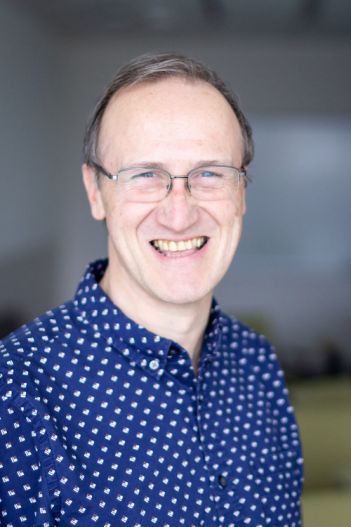
Language Resource Center Speaker Series - Koen Van Gorp
April 12, 2023
4:00 pm
Stimson Hall, G25
"Real-World Tasks in the Classroom: Myth or Reality? Exploring Task-Based Language Teaching"
Koen Van Gorp
Assistant Professor and Less Commonly Taught Languages Coordinator, Michigan State University
Tasks are everywhere. They are the things we do in daily life. Long (2016) argues that task-based language teaching (TBLT) is the strongest empirically supported teaching approach around. However, for many instructors of commonly and less commonly languages, TBLT is still an innovative approach that deviates from more familiar structure-based or form-focused teaching methods. They find it difficult to incorporate real-world tasks in their classrooms. Are real-world tasks the only option or can instructors integrate more pedagogical tasks? What do they look like and how do they incorporate (or not) grammar and vocabulary?
This talk will focus on what makes a task different from a traditional language classroom activity or exercise, and how real-world and pedagogical tasks can drive classroom (and beyond) learning. This talk aims to provide you with the foundational principles of TBLT so you can make tasks work for students and classrooms.
Bio: Dr. Koen Van Gorp is an Assistant Professor in the Applied Linguistics program and Less Commonly Taught Languages (LCTL) Coordinator in the Department of Linguistics, Languages, and Cultures at Michigan State University. He is also Co-Principal Investigator and Head of Research for the National LCTL Resource Center (NLRC) and serves as a Research Fellow at the Centre for Language and Education (KU Leuven, Belgium). His main research interests are task-based language teaching and assessment, and multilingualism in education. He is founding Co-Editor (together with Kris Van den Branden) of TASK. Journal on task-based language teaching and learning and Treasurer of the International Association for Task-Based Language Teaching (IATBLT).
This event will be held in person in G25 Stimson and will also be streamed live over Zoom. Join us at the LRC or on Zoom.
The event is free and open to the public. Campus visitors and members of the public must adhere to Cornell's public health requirements for events.
Additional Information
Program
Einaudi Center for International Studies
Latin American and Caribbean Studies
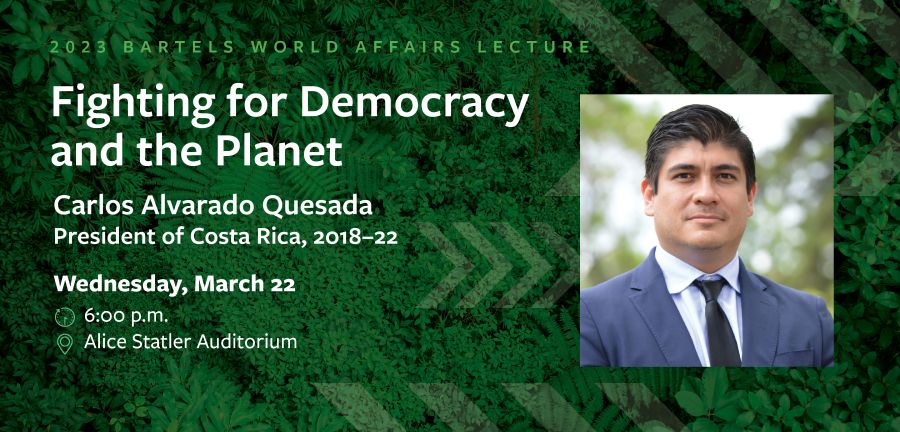
March 22: Bartels Lecture

Former Costa Rican President to Speak on Democracy, Sustainability
Carlos Alvarado Quesada will explore how conservation can preserve democracy around the world. Learn more and get your free ticket!
Additional Information
Global Hubs Provide Benefits

Einaudi Directors Defend Hubs, Academic Freedom
Rachel Beatty Riedl and program directors: "Global Hubs seek to build partnerships and create spaces that advance knowledge and understanding.”
Additional Information
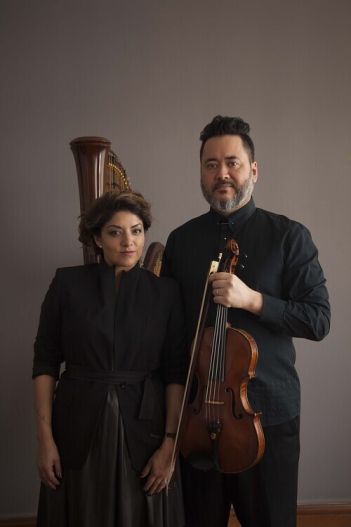
Duo Portinari: An Evening of Latin American Music
April 12, 2023
5:00 pm
Alice Cook House, Common Room
The program will feature music from Latin America, including the works of Brazilian composers Heitor Villa-Lobos, Claudio Santoro, Cesar Guerra-Peixe, and Argentinian composers Esteban Benzecry, Astor Piazzolla, and Luis Gianneo. Violinist and PhD Candidate in Music and Sound Studies, Rafael Torralvo joins Duo Portinari for a set featuring Armorial music from northeastern Brazil.
This event is funded in part by the Cornell Council for the Arts (CCA) and by a USIFL grant to LACS from the U.S. Department of Education.
Formed by Peter Pas, Viola Soloist of the São Paulo Symphony Orchestra, and Soledad Yaya Principal Harpist of the Goiânia Philharmonic Orchestra, Duo Portinari performed throughout the Americas, Europe, and Australia. Duo Portinari’s recording of Michael Kurek's Sonata for Viola and Harp reached #1 on the Billboard Classical chart in 2017. Duo Portinari’s current project includes a new CD featuring music of Latin American composers. The name of the duo pays homage to the Brazilian painter Cândido Portinari.
Soledad Yaya attended the Cordoba Conservatory of Music, continuing her studies in Buenos Aires with Oscar do Campo, and later in Paris under the tutelage of Marielle Nordmann. She formerly held a position with the São Paulo Experimental Orchestra of the Municipal Theater of São Paulo and currently serves as a Professor of Harp at the Baccarelli Institute in São Paulo.
Peter Pas attended Indiana University, where he studied with Atar Arad. He later received the prestigious Performer's Certificate for his Senior Recital from that institution. He concluded his studies at Yale University with Jesse Levine. In addition to his position as Viola Soloist of the São Paulo Symphony Orchestra, Peter Pas also serves as violist of the OSESP Quartet, a chamber ensemble formed by the principal players of the São Paulo Symphony Orchestra, and Professor of Viola and Chamber Music at the São Paulo Symphony Orchestra Academy. Peter Pas is sponsored by Thomastik-Infeld and Bam Cases.
Born in Brazil and educated in the United States, Rafael Torralvo holds a BM and a MM degree in violin performance from James Madison University and West Chester University of Pennsylvania, respectively. He is an alumnus from the Frost School of Music, at the University of Miami, where he received a MM degree in musicology. Rafael also holds a MA in Arts from Cornell University where he currently is a PhD Candidate in Music and Sound Studies. Rafael has an active career as a violinist and chamber musician, appearing in concert engagements throughout Europe, the United States, and South America. He is the founder and Artistic Director of the "Encontro Internacional de Cordas." In recognition of his efforts to enhance the cultural life of his community, Rafael received the Fumagalli Trophy, the most prestigious award bequeathed by the city of Limeira, his hometown.
The concert will take place on Wednesday, April 12 at 5 pm in the Common Room of Alice Cook House, on West Campus. The event is free and open to the public.
Additional Information
Program
Einaudi Center for International Studies
Latin American and Caribbean Studies
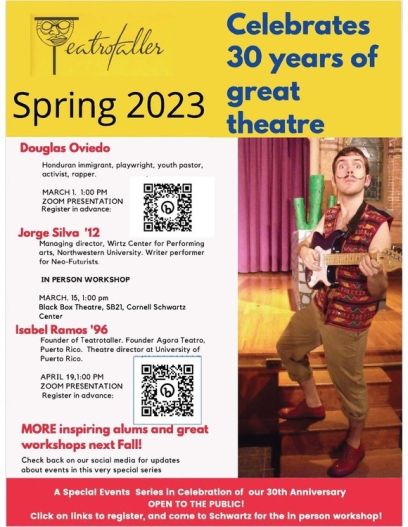
Conversation with Cornell alum, Isabel Ramos '96 and founder of Teatrotaller
April 19, 2023
1:00 pm
Celebrating Teatrotaller’s 30th Anniversary!
Cornell alum, Isabel Ramos ’96 and founder of Teatrotaller, and theater director at the University of Puerto Rico will be joining us via zoom zoom after the performance run of her new post Hurricane Maria meditation, “Antigona frente al mar” .
Join us by zoom on April 19 at 1:00 pm. Register in advance here.
Additional Information
Program
Latin American and Caribbean Studies
Bartels Explainer
How did President Alvarado’s policies protect Costa Rica’s environment?
Viviana Ruiz-Gutierrez talks about her recent biodiversity assessment and how Alvarado’s policies engaged citizens in climate action.
This year’s Bartels lecturer, President Carlos Alvarado Quesada (2018–22), started Costa Rica on track to net-zero carbon emissions by 2050 with an ambitious climate action plan to meet the objectives of the United Nations’ 2015 Paris Agreement. His administration’s climate and conservation policies earned Costa Rica the 2019 Champion of the Earth Award, the UN’s highest environmental honor.
"We found significant biodiversity losses in regions with high-impact agriculture."
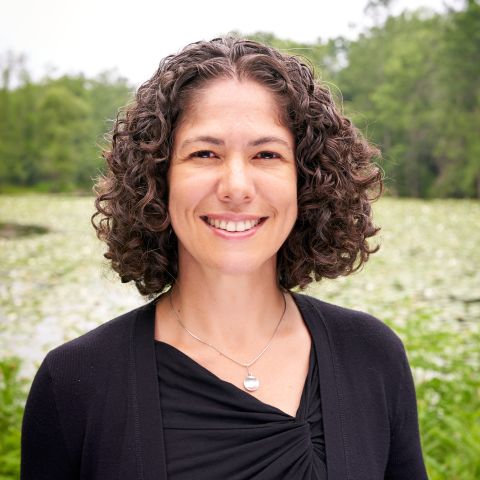
On this page: Viviana Ruiz-Gutierrez describes Costa Rica's unique standing as a global biodiversity hotspot with a long history of environmental regulations—not always effectively enforced—and explains how Alvarado’s policies enlisted Costa Ricans in climate action. A native of Costa Rica, Ruiz-Gutierrez is co-director of the Cornell Lab of Ornithology’s Center for Avian Population Studies, conservation science program leader, and a fellow at Cornell Atkinson Center for Sustainability.
Coming March 22: Reserve Your Free Ticket Today!
A Conversation with Viviana Ruiz-Gutierrez
Did Alvarado reverse any damaging environmental policy trends in his time in office?
President Alvarado sought to balance the pressures to increase growth and development in Costa Rica while protecting our natural capital. A notable example was when he vetoed a project that would have authorized shrimp trawl fishing in Costa Rican waters—an activity that would negatively impact small-scale fishermen and destroy marine life.
Another success of the Alvarado administration was the Escazu Agreement, which was signed in Costa Rica in 2018 and took effect in 2021. The agreement provided a sweeping framework to promote inclusive, informed, and participatory climate action in Latin America and imposed requirements to protect the rights of environmental defenders in the region.
Unfortunately, current president Rodrigo Chaves has taken steps to potentially reactivate shrimp trawling in the country and, in February, pulled back Costa Rica from the UN-backed climate agreement.
What kinds of changes to wildlife habitats have you observed in Costa Rica?
In my own research with the Lab of O’s conservation science program, we recently completed a biodiversity assessment for the country using birds as indicators. Our results support current knowledge—and my own observations that Costa Rica has successfully preserved much of its biodiversity through the National System of Conservation Areas.
However, we found significant biodiversity losses in regions with high-impact agriculture and where unregulated urban development has degraded and impacted forest remnants.
How did Costa Rica start to make conservation a priority?
Costa Rica’s achievements in conservation and environmental issues can be traced back to the country’s most politically relevant decision—abolishing the army in 1949. This decision is what has allowed Costa Rica to spend social capital on environmental issues for the past 74 years.
A few key laws in the 1990s have served as the backbone for biodiversity conservation. In 1994 the constitution was amended to state that “every person has the right to a healthy and ecologically balanced environment.” The 1996 Forest Law mandates the rational use of all natural resources, prohibits land-cover change in forests, and includes incentives like the Payment for Ecosystem Services Program. Unfortunately, enforcement of these laws has varied widely among different governments.
What’s one practical step Alvarado’s administration took to encourage citizens’ participation in conservation?
The participation of citizens in conservation action at local levels is a critical driver for different initiatives. One example is the decarbonization plan launched by Alvarado’s administration in 2019, which aims for a decarbonized economy with net-zero emissions by 2050.
A big component of Alvarado’s plan was to renew the transport system, which is the country’s major source of greenhouse emissions. This included the goal of full electrification of all buses and taxis and incentives to move 100 percent of light-duty vehicle sales to zero emissions by 2050. Any changes to the transport system require significant buy-in and participation from citizens.
As a result of tax exemptions, many people purchased new or used electric vehicles. Charging stations became more common across the main central valley. These changes were starting to gain momentum when the pandemic hit, and the economic impacts and controversies surrounding the pandemic diverted public attention and support.
Has Alvarado’s successor continued the 2050 plan?
Rodrigo Chaves’ administration has not made the plan a priority. Alvarado’s plan included significant measures in basic infrastructure and economic sectors, such as public and private transport, energy, industry, agriculture, waste management, and soil and forest management. Many of these measures have fallen by the wayside.
Chaves has allowed the public bus sector to retain fleets of older buses, for example—compromising not just the goals of the plan, but the health of the people and ecosystems of Costa Rica.
Don't miss the Bartels World Affairs Lecture with Carlos Alvarado Quesada on March 22: Reserve your free ticket today!
Additional Information
Private Sovereignties: ZEDEs, Puertopias, and Seasteads in Central America and the Caribbean: A Panel

May 8, 2023
4:30 pm
Uris Hall, G-08
A Latin American and Caribbean Studies Program Public Issues Forum Panel.
About the Panelists and the Moderator:
Beth Geglia is a public anthropologist focused on processes of privatization in urban and rural settings, tech capitalism, and social movements. Her research examines the development of Economic Development and Employment Zones (ZEDEs) in Honduras and how global visions for private "startup cities" and ideologies of the decentralized finance movement interact with different political projects, land disputes, and territorial realities in Honduras. Beth holds a PhD in Anthropology from American University, and is currently working on a book manuscript as a Hunt Postdoctoral Fellow with the Wenner-Gren Foundation.
Atossa Araxia Abrahamian is a journalist who writes about the unexpected aspects of globalization. Her first book, The Cosmopolites, investigated the global market for citizenship, revealing how the sale of second and third passports to the ultrarich intersects with growing wealth inequality and a crisis of statelessness. She is working on The Hidden Globe, a non-fiction book about unusual and extraterritorial jurisdictions from art freeports to outer space. Atossa is a recipient of the 2022 Whiting Creative Nonfiction grant and a 2021 Silvers grant for works-in-progress. She lives in Brooklyn with her family.
Rafael Cox Alomar is a professor of law at the David A. Clarke School of Law of the University of the District of Columbia in Washington, D.C., and has been a Visiting Professor of Law at Harvard Law School (Winter 2022). He is the author of The Puerto Rico Constitution (Oxford University Press 2022) and Revisiting the Transatlantic Triangle: The Constitutional Decolonization of the Eastern Caribbean (Ian Randle 2009). Professor Cox Alomar received a BA magna cum laude from Cornell University; a DPhil in history from the University of Oxford (Trinity College), where he was a Marshall Scholar; and a JD from Harvard Law School.
Moderator: Ray Craib is Marie Underhill Noll Professor of History at Cornell and the author, most recently, of Adventure Capitalism: A history of libertarian exit, from the era of decolonization to the digital age (PM Press/Spectre, 2022).
Additional Information
Program
Einaudi Center for International Studies
Latin American and Caribbean Studies
Democracy and Its Opposites: Challenges in a Global World

April 24, 2023
5:00 pm
Alice Statler Auditorium
Lund Critical Debate
Democracies worldwide—even many wealthy democracies long considered safely consolidated—are at risk today. Governments, policymakers, and voters face new conflicts over democratic institutions, checks and balances, which citizens can compete for office or deserve representation, and what rules of accountability apply.
This year's Lund debate from the Mario Einaudi Center for International Studies examines the threats democracies around the world are confronting, both from external forces and from within—and what governments and citizens can do to fight back.
Join Thomas Garrett of the Community of Democracies and Damon Wilson of the National Endowment for Democracy for a conversation on democratic backsliding, strategies for resilience, and the conditions and practices that undermine democracy: democracy ... and its opposites.
A reception with refreshments will follow the conversation.
Lund Debate: 5:00–6:30 p.m. | Alice Statler AuditoriumFree ticket required for in-person attendance. Reserve your ticket today! Join the lecture virtually by registering at Cornell.
Reception to follow.
***
Panelists
Thomas E. Garrett is secretary general of the Community of Democracies, a global intergovernmental coalition comprised of the Governing Council member states that support adherence to the Warsaw Declaration's common democratic values and standards. Garrett previously worked for the International Republican Institute for 12 years overseas in Ukraine, Mongolia, and Indonesia, returning to Washington, DC, in 2005 as director of Middle East programs and then as vice president for global programs.
Damon Wilson is president and CEO of the National Endowment for Democracy (NED), a nonprofit grant-making foundation supporting freedom around the world. Prior to joining NED, he helped transform the Atlantic Council into a leading global think tank as its executive vice president. He previously served as special assistant to the president and senior director for European affairs at the National Security Council. Wilson also served at the U.S. Embassy in Baghdad as the executive secretary and chief of staff, where he helped manage one of the largest U.S. embassies during a time of conflict.
Moderator
Rachel Beatty Riedl has served as the Einaudi Center's director since 2019. She is the Einaudi Center's John S. Knight Professor of International Studies and professor in the Department of Government and Cornell Jeb E. Brooks School of Public Policy. Her research interests include institutional development in new democracies, local governance and decentralization, and authoritarian regime legacies in Africa.
***
About the Debate
The Lund Critical Debate is a signature event of the Mario Einaudi Center for International Studies. This year's dialogue is part of Einaudi's work on democratic threats and resilience. Established in 2008, Einaudi's Lund Critical Debate series is made possible by the generosity of Judith Lund Biggs '57.
Additional Information
Program
Einaudi Center for International Studies
Reppy Institute for Peace and Conflict Studies
East Asia Program
Southeast Asia Program
Latin American and Caribbean Studies
Institute for African Development
Institute for European Studies
South Asia Program
"Black Women Writers: voices from Brazil" by Dr. Tassiana Oliveira
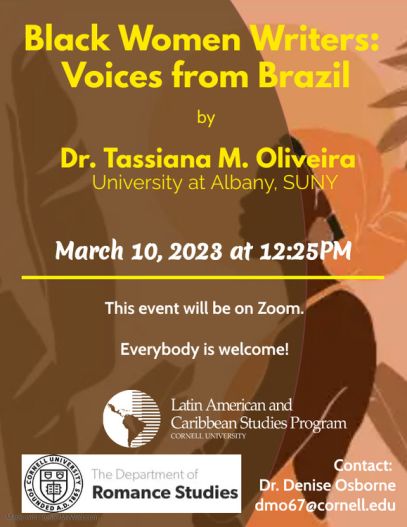
March 10, 2023
12:25 pm
Dr. Tassiana Oliveira is a professor at the University at Albany, State University of New York (SUNY).
This event will be in English. Everybody is welcome!
Additional Information
Program
Latin American and Caribbean Studies
ILRLR/ICL Workshop Series Paul Ortiz
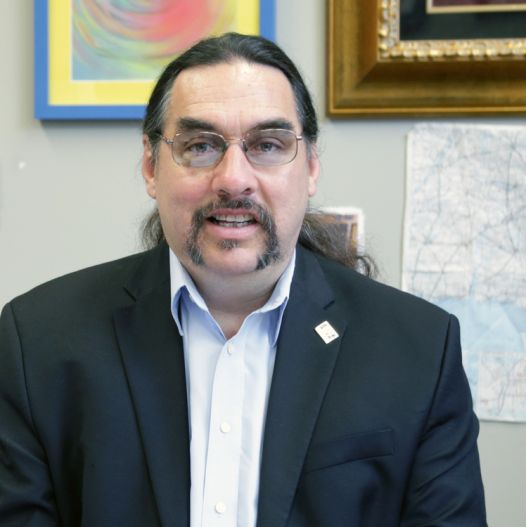
March 3, 2023
11:30 am
ILR Conference Center, 423
Social Movements as a Way of Life: How African American and Latinx Experiences Change the Ways We Think About US History
Additional Information
Program
Latin American and Caribbean Studies