
Latin American and Caribbean Studies
Global Hubs Town Hall

March 13, 2023
11:30 am
G10 Biotech
Faculty and staff are invited to join for an overview and open discussion of the Global Hubs initiative.
Vice Provost Wendy Wolford will explain the purpose of the Global Hubs, and faculty leads for several of the Hubs locations will discuss their experiences with institutional partners and ways for faculty and staff to be involved.
Please bring your questions about the Hubs and join us in person on March 13 at 11:30 a.m. in G10 Biotech.
Moderator:
Wendy Wolford, Vice Provost for International Affairs
Faculty Presenters:
Gustavo Flores-Macias, faculty lead for Tecnológico de Monterrey, MexicoNate Foster, faculty lead for University of Edinburgh, United KingdomYing Hua, director of Cornell China Center, BeijingLee Humphreys, faculty lead for DenmarkTom Pepinsky, faculty lead for National University of Singapore, SingaporeMark Milstein, representative for the Faculty Senate CAPP on the faculty advisory committeeRachel Beatty Riedl, director of the Mario Einaudi Center for International StudiesKen Roberts, faculty lead for Universidad San Francisco de Quito, Ecuador
Additional Information
Program
Einaudi Center for International Studies
East Asia Program
Southeast Asia Program
South Asia Program
Reppy Institute for Peace and Conflict Studies
Latin American and Caribbean Studies
Institute for African Development
Institute for European Studies
“Education for Ethnic-Racial Inclusion in Brazil”
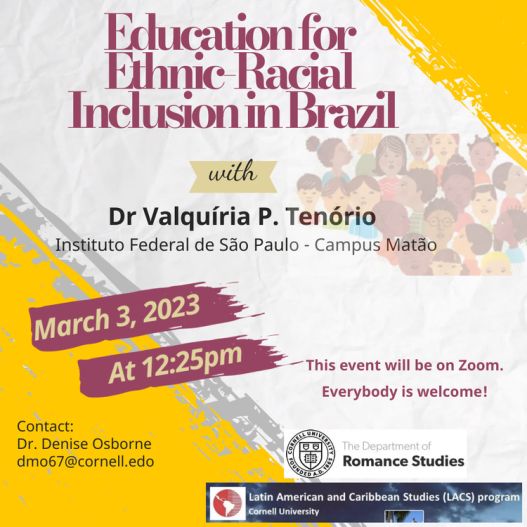
March 3, 2023
12:25 pm
Dr. Valquíria P. Tenório is a professor at the Instituto Federal de São Paulo, campus Matão.
This event will be in English. Q/A in English and Portuguese. Everybody is welcome!
WHEN: March 3, 2023 at 12:25PM
WHER: Zoom. Registration in advance is require.
Additional Information
Program
Latin American and Caribbean Studies
Conversation with Cornell alum, Jorge Silva '12 as part of Teatrotaller's 30 years of theater
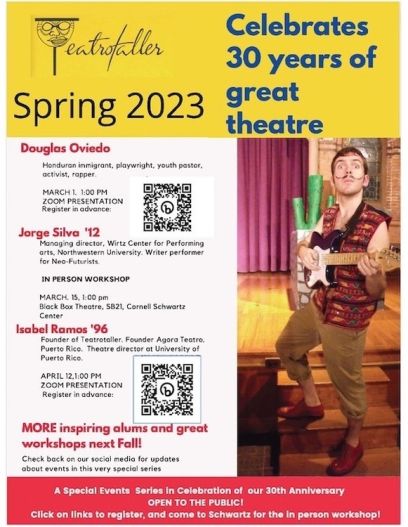
March 15, 2023
1:00 pm
Schwartz Center for Performing Arts, Black Box Theatre
Celebrating Teatrotaller’s 30th Anniversary!
Jorge Silva ’12 a Cornell alum and managing director of the Wirtz Center for Performing Arts at Northwestern University will be joining us in person to lead a neo-futurist workshop.
Additional Information
Program
Latin American and Caribbean Studies
Conversation with Douglas Oviedo, Honduran born activist, youth pastor, rapper, writer
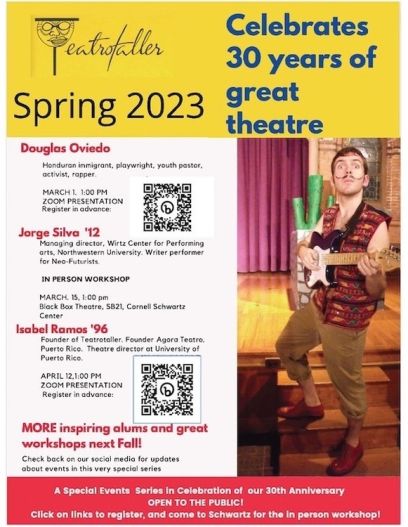
March 1, 2023
1:00 pm
Celebrating Teatrotaller’s 30th Anniversary!
Douglas Oviedo, Honduran born activist, youth pastor, rapper, and writer came to the United States with one of the 2018 caravans. Join us via zoom for a conversation about his migrant trajectory and his play, “Caravaneros” on March 1 at 1:00 pm.
Register in advance for this zoom meeting here
Additional Information
Program
Latin American and Caribbean Studies
Global PhD Research Awards
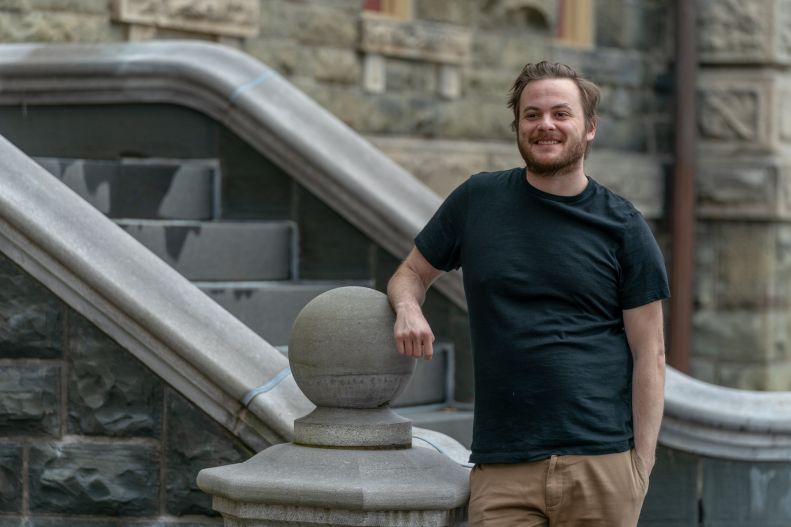
Open now! Apply by March 10
PhD students: Conduct your international field research with a $10,000 award. Read about Vincent Mauro’s 2021–22 award and find out how to apply.
Additional Information
Emerging Markets Theme Research Seminar: Ruth Aguilera

May 9, 2023
12:30 pm
Sage Hall, 134
Registration Link: https://cglink.me/2cm/r2042285
The Cornell S.C. Johnson College of Business Emerging Markets Theme, in collaboration with China Institute for Economic Research (CICER), the Cornell China Center, and the Emerging Markets Institute, brings together scholars to provide thought leadership on the role of emerging markets – and emerging market multinationals – in the global economy.
On 5/9, Ruth Aguilera, Northeastern University
Additional Information
Program
Einaudi Center for International Studies
Latin American and Caribbean Studies
Fires and Forest Loss in the Colombian Amazon

May 9, 2023
12:25 pm
Uris Hall, G08
Dr. Dolors Armenteras will present her analysis of the patterns and impacts of forest degradation in the Colombian Amazon for more than 20 years. Her presentation will share insights and updates from the remote sensing of forest dynamics and land use patterns following the 2016 peace process in Colombia.
About the Speaker
Dr. Dolors Armenteras is a geographer and biodiversity conservation expert. She is a biologist from the Universitat de Barcelona, holds an MSc in Environmental Forestry from the University of Wales, and a PhD in Geography from King’s College London, UK. Most of her scientific and research work has been developed over the last 20 years in Colombia.
She is currently a Professor of Landscape Ecology at the Universidad Nacional de Colombia. Before that, she worked in the environmental sector, where she developed the first integrated spatial geographic information system for monitoring Colombian ecosystems and biodiversity in the early 2000s and coordinated the first ecosystem services assessment undertaken in Colombia in 2005. Her experience and knowledge of tropical ecology include work on fire ecology, biodiversity conservation, deforestation, land use changes, and sustainability scenarios.
Co-Sponsors: Reppy Institute for Peace and Conflict Studies, Department of Natural Resources, Einaudi Center
Additional Information
Program
Einaudi Center for International Studies
Latin American and Caribbean Studies
Reppy Institute for Peace and Conflict Studies
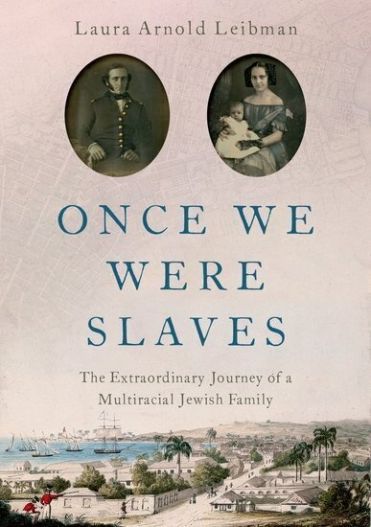
Zoom Webinar: A Multiracial Jewish Family in Early America
March 14, 2023
5:00 pm
An obsessive genealogist and descendent of one of the most prominent Jewish families since the American Revolution, Blanche Moses firmly believed her maternal ancestors were Sephardic grandees. Yet she found herself at a dead end when it came to her grandmother’s maternal line. In this talk, Professor Leibman overturns the reclusive heiress’s assumptions about her family history to reveal that her grandmother and great-uncle, Sarah and Isaac Brandon, actually began their lives as poor, Christian, and enslaved in Barbados. Leibman traces the siblings’ extraordinary journey around the Atlantic world, using artifacts they left behind in Barbados, Suriname, London, Philadelphia, and, finally, New York. While their affluence made them unusual, their story mirrors that of the largely forgotten people of mixed African and Jewish ancestry that constituted as much as ten percent of the Jewish communities in which the siblings lived.
Bio:
Laura Arnold Leibman is Professor of English and Humanities at Reed College, VP of Program (AJS), and the author of "The Art of the Jewish Family: A History of Women in Early New York in Five Objects" (Bard Graduate Center, 2020) which won three National Jewish Book Awards. Her latest book" Once We Were Slaves" (Oxford UP, 2021) is about an early multiracial Jewish family who began their lives enslaved in the Caribbean and became some of the wealthiest Jews in New York.
Lecture sponsored by the Jewish Studies Program, Latin American and Caribbean Studies Program, and Department of History
Additional Information
Program
Latin American and Caribbean Studies
It’s Official: US Residents Can Now Sponsor Refugees. Here’s How.

Maria Cristina Garcia, LACS
After WWII, the U.S. “often prioritized for admission those who had family or friends in the United States, or a faith community willing to support them, because that made them less likely to become a public charge and more likely to assimilate quickly,” says Maria Cristina Garcia, professor of history.
Additional Information
Einaudi Graduate Fellow Studies Women’s Political Participation
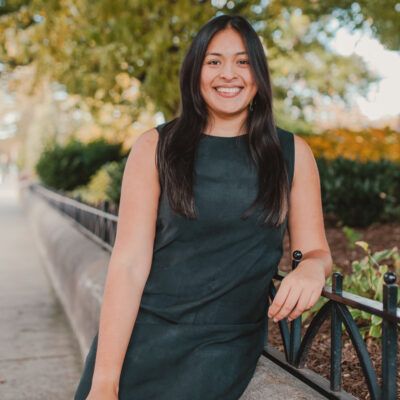
Angie Torres-Beltran
Einaudi graduate fellow Angie Torres-Beltran studies how women’s political participation is influenced by gender-based violence and interactions with state institutions under the guidance of Sabrina Karim and Gustavo Flores-Macías.