
Latin American and Caribbean Studies
Book Talk: Contemporary State Building in Latin America, by Gustavo Flores-Macias
April 18, 2023
4:30 pm
Uris Hall, G08
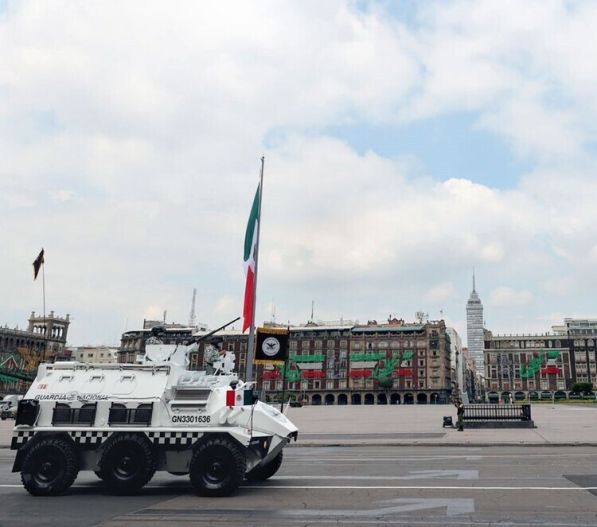
In his new book “Contemporary State Building: Elite Taxation and Public Safety in Latin America” (Cambridge University Press 2022) Professor Flores-Macías discusses experiences of elite taxation in Latin America, in the context of the public-safety crises facing several countries in the region.
Contrary to prominent explanations in the literature on the fiscal strengthening of the state – including the role of resource dependence and inequality – the book advances a theory of elite taxation that focuses on public-safety crises as windows of opportunity and highlights the importance of business–government linkages to overcome mistrust toward government from corruption and lack of accountability. Based on the evidence from across Latin America and rich case studies from experiences in Colombia, Costa Rica, El Salvador, and Mexico, the book provides scholars and policymakers with a blueprint for contemporary state-building efforts in the developing world.
Government professor Kenneth Roberts will interview Gustavo about his book.
About the Author
Gustavo Flores-Macías is Associate Vice Provost for International Affairs and Professor of Government and Public Policy at Cornell University. His research and teaching interests include a variety of topics related to political and economic development, such as taxation, state capacity, and militarization of law enforcement. He is the author of After Neoliberalism? The Left and Economic Reforms in Latin America (Oxford 2012), and the editor of The Political Economy of Taxation in Latin America (Cambridge 2019).
About the Interviewer -- Kenneth Roberts is the Richard J Schwartz Professor of Government at Cornell. He leads the Einaudi Center's democratic threats and resilience global research priority in academic years 2022–24. He teaches comparative and Latin American politics, with an emphasis on the political economy of development and the politics of inequality.
His research is devoted to the study of political parties, populism, labor and social movements, and democratic resilience. He is especially interested in the cases of Chile, Peru, Venezuela, and Argentina.
Register to attend Virtually at this link
Additional Information
Program
Latin American and Caribbean Studies
Einaudi Center for International Studies
A Startup Is Turning Porta-Potties into Sources of Fertilizer

Rebecca Nelson, LACS/IAD
Rebecca Nelson, professor in the School of Integrative Plant Science, says the company may struggle to introduce container-based sanitation to American consumers but notes “There’s a lot of value on the table. It’s straight up nutrient value.”
Additional Information
Drug Trafficking in Latin America's Southern Cone: Perils for Political and Social Inclusion
March 15, 2023
4:00 pm
Physical Sciences Building, 401
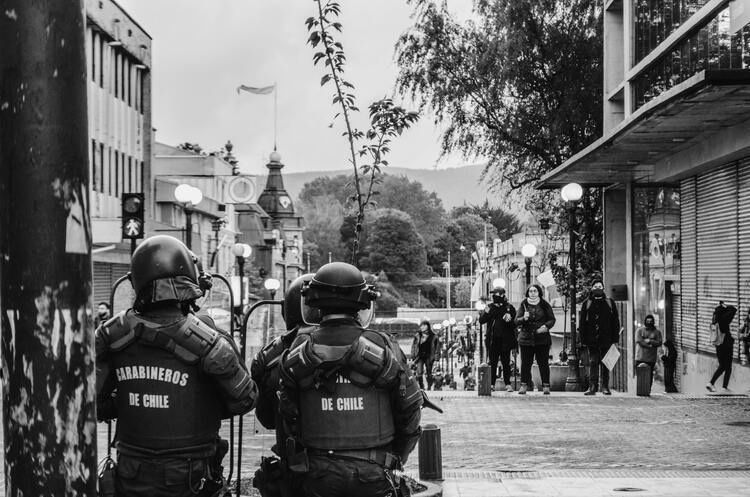
Drug trafficking and drug-related violence have increased dramatically in Latin America's Southern Cone during the last decade. Illicit activities have increased and diversified in Argentina, Chile, and Uruguay in a way that threatens political and social inclusion. The talk will discuss the evolution of drug-related crime and how these dynamics affect social and political stability in the long term. It will also address how governments have reacted, the nature of their strategies, and the extent to which these countries have learned from Central and North American experiences.
About the Speakers
Juan Bogliaccini is a Professor of Political Science at the Department of Social Sciences, Universidad Católica del Uruguay (UCU). He is also Chair of the Methods Center at UCU, and editor of the Latin American Political Economy Series at Palgrave Macmillan. He obtained a PhD in Political Science at the University of North Carolina at Chapel Hill in 2012. His work focuses on the political economy of redistribution and inequality, in the areas of comparative capitalism, skills formation, security and welfare states. His recent work has appeared, among other places, in Economics & Politics, Studies in Comparative International Development, Third World Quarterly, Development Policy Review, Journal of Latin American Studies, LARR, Cambridge University Press, Oxford University Press, Palgrave Macmillan.
Emiliano Tealde is an Associate Professor of the Department of Social Sciences at the Universidad Católica del Uruguay. He obtained his Ph.D. in Economics at the Università Degli Studi di Siena, Italy. His research is focused on studying the causes and consequences of criminal activity.
Additional Information
Program
Einaudi Center for International Studies
Latin American and Caribbean Studies
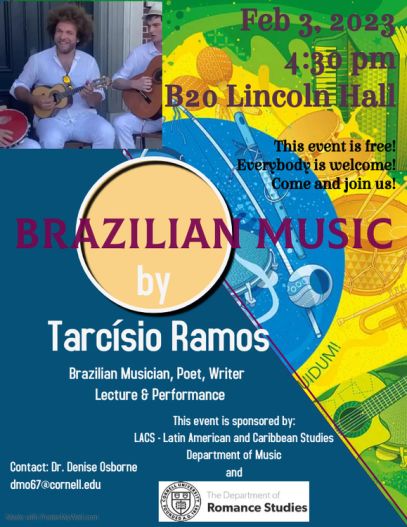
Brazilian Music by Tarcísio Ramos
February 3, 2023
4:30 pm
B20 Lincoln Hall
Tarcísio Ramos is a Brazilian musician, poet, writer. This event will be lecture and performance.
This event is free. Everybody is welcome. Come and join us!
This event is sponsored by LACS (Latin American and Caribbean Studies), Department of Music and Romance Studies.
Additional Information
Program
Latin American and Caribbean Studies
Socio-Eco Benefits of Collective Rice Certification in the D.R.
April 26, 2023
12:25 pm
Emerson Hall, 135
Abstract
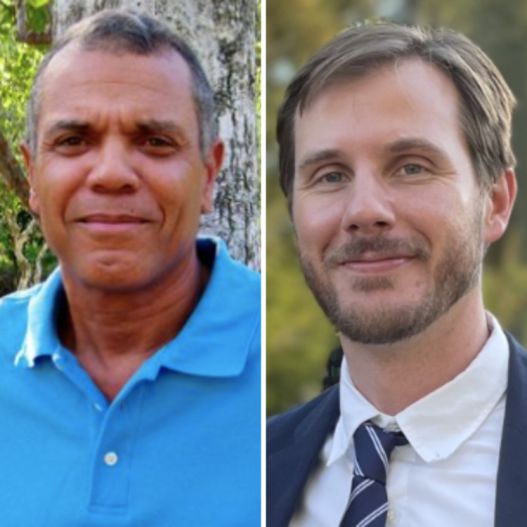
The industrialized practices of rice production in the Dominican Republic create extensive environmental and social costs through fertilizer and pesticide run-off, soil erosion, economic vulnerability, and low labor standards. Dr. Payton and Dr. Cox will discuss the challenges and promises of a sustainable rice certification scheme in the province of Montecristi in the Dominican Republic. Dr. Payton has led this certification effort for several years, largely through his leadership of AgroFrontera, a local Dominican NGO, with assistance from Dr. Cox as an academic partner and consultant.
About the speakers
As Executive Director of AgroFrontera, Frederick Payton leads programs that enhance biodiversity conservation and improve the economic performance and social responsibility of local, national and international food systems, with particular focus on improving livelihoods of small-scale farmers and artisanal fishers. Dr. Payton has worked at the Institute of Community and Area Development and the Office of International Agriculture at the University of Georgia and was a senior scientist and interim director of the International Potato Center’s Central American and Caribbean regional office. Dr. Payton has served on the board of directors of Organic Farming Research Foundation, Henry A. Wallace Institute for Alternative Agriculture and Georgia Organics. He holds a Ph.D. in Horticulture from Cornell University.
Michael Cox is an environmental social scientist who studies environmental policy and governance with a focus on community-based natural resource management and a socio-ecological systems research consultant with AgroFrontera. He has conducted empirical fieldwork-based analyses of irrigation systems in the Southwest United States, Peru and Kenya. His current empirical work is focused on community-based fisheries and rice farming systems in the Dominican Republic, where he collaborates with AgroFrontera, a local Dominican NGO. He is the co-founder and co-host of the In Common Podcast, which is the official podcast of the International Association for the Study of the Commons. He is finishing a book project on environmental property rights, to be published in 2023.
Seminar hosts
This seminar is co-hosted by Perspectives in Global Development and the Latin American and Caribbean Studies Seminar Series.
The Perspectives in Global Development seminars are held Wednesdays from 12:25 – 1:15 p.m. eastern time during the semester. The series will be presented in a hybrid format with some speakers on campus and others appearing via Zoom. All seminars are shown in Emerson Hall 135. Students, faculty and the general public are welcome to attend. The series is co-sponsored by the Department of Global Development, the Department of Natural Resources and the Environment, the Charles H. Dyson School of Applied Economics and Management, and the School of Integrative Plant Science as part of courses GDEV 4961, AEM 4961, NTRES 4961, GDEV 6960, AEM 6960, and NTRES 6960. Learn more about the Latin American and Caribbean Studies Seminar Series.
Additional Information
Program
Latin American and Caribbean Studies
Peru, Chile, and the Pacific: Toward Collaborative and Parallel Histories
February 14, 2023
12:25 pm
Uris Hall, G08
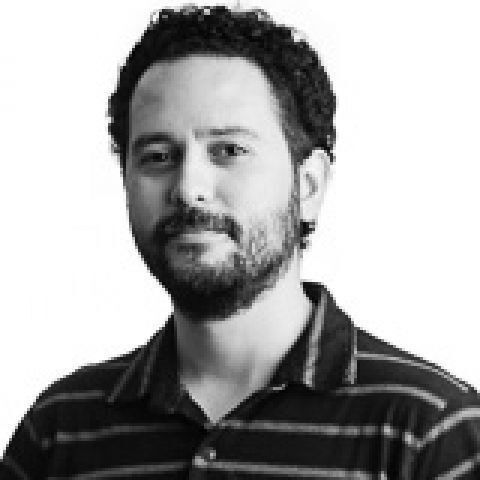
Joshua Savala relates that the War of the Pacific (1879–1883) looms large in the history of Peru and Chile, and has been the structuring element in historical scholarship. In this talk, based on my recent book Beyond Patriotic Phobias, I explore points of collaboration and parallel histories shared between Peruvians and Chileans.
In particular, he highlights the overlooked cooperative relationships of workers across borders, including maritime port workers, doctors, and the police. These groups in both countries were intimately tied together through different forms of labor: they worked the ships and ports, studied and treated disease transmission in the face of a cholera outbreak, and conducted surveillance over port and maritime activities because of perceived threats like transnational crime and labor organizing. By following the movement of people, diseases, and ideas, Savala reconstructs the circulation that created a South American Pacific world. The resulting story is one in which communities, classes, and states formed transnationally through varied, if uneven, forms of cooperation.
About the Speaker:
Joshua Savala received his PhD in 2019 from the Department of History at Cornell and is currently an Assistant Professor at Rollins College, where he also serves as the Director of the Latin American and Caribbean Studies program. He specializes in the history of Peru, Chile, labor and working-class history, and oceans in history. He published his first book, Beyond Patriotic Phobias: Connections, Cooperation, and Solidarity in the Peruvian-Chilean Pacific World in 2022 with the University of California Press.
Additional Information
Program
Einaudi Center for International Studies
Latin American and Caribbean Studies
Language Resource Center Speaker Series - Florencia Henshaw
March 25, 2023
11:00 am
Stimson Hall, G25
"Guiding SLA Principles and Assessment"
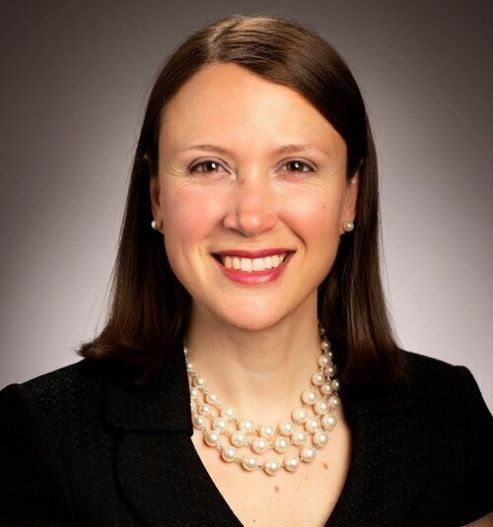
Florencia Henshaw
Director of Advanced Spanish, University of Illinois, Urbana-Champaign
The goal of this interactive session is to help language educators understand how they can develop materials and implement classroom strategies that are informed by core principles of proficiency-based instruction, and doing so will help their students develop communicative ability in the target language. First, we will focus on setting goals informed by the ACTFL Proficiency Guidelines, and we will review some fundamental aspects of second language acquisition, particularly as they pertain to proficiency-oriented instruction. Then, participants will evaluate to what extent specific activities help to maximize proficiency development by dissecting their merits and shortcomings.
Bio: Florencia Henshaw has a Ph.D. in second language acquisition and teacher education from the University of Illinois, Urbana-Champaign, where she is now the Director of Advanced Spanish. She is an award-winning educator who has published and presented nationally and internationally on technology integration and research-based pedagogical practices. Dr. Henshaw is also the host of Unpacking Language Pedagogy (available as a podcast and YouTube channel), where she summarizes and discusses research articles, activities, terms, and various topics related to language teaching. Her co-authored book, Common Ground: Second Language Acquisition Theory goes to the Classroom, aims to help educators visualize how to put principles into action.
This event is part of the Spring 2023 LRC Learning Community Common Ground: Moving SLA Theory into Practice, organized by the Central New York Humanities Corridor Working Group on Cultures and Languages Across the Curriculum (CLAC). Sponsored by the Central New York Humanities Corridor from an award by the Mellon Foundation.
The event will be held in person in G25 Stimson and will also be streamed live over Zoom.
Registration is required. The event is free and open to the public. Campus visitors and members of the public must adhere to Cornell's public health requirements for events.
Additional Information
Program
Einaudi Center for International Studies
Latin American and Caribbean Studies
Social and Political Impacts of Indigenous Peoples Uprisings in Ecuador

April 13, 2023
4:30 pm
Uris Hall, G08
Leonidas Iza, President of the Confederation of Indigenous Nationalities of Ecuador (CONAIE), will discuss the goals, consequences, shortcomings, and gains of the indigenous peoples' uprisings of 2019 and 2022 in Ecuador.
Since the '80s, CONAIE has been deemed one of the most influential social movements in Latin America. CONAIE influenced the last two Ecuadorian constitutions, and it bolstered regional debates on self-determination, pluri-nationality, rights of nature, and prior consent. However, the last two major collective actions have faced a different reality:
A new polarization in politics and new identities of the offspring of the first national uprisingMr. Iza will discuss these new obstacles and identities and the future of the indigenous movement in Ecuador.
About the Speaker
Segundo Leonidas Iza Salazar, is an Ecuadorian indigenous leader. He is a member of the Kichwa nationality, people Panzaleo. Mr. Iza is the current President of the Confederation of Indigenous Nationalities of Ecuador CONAIE). He studied Environmental Engineering at the Universidad Técnica de Cotopaxi. Mr. Iza started as a community leader as a teenager; before he was elected President of CONAIE, he was President of the Indigenous Movement of Cotopaxi (MICC). He became national and international notoriety after participating in the indigenous uprising of 2019.
He was a crucial part of the negotiation team of CONAIE with the government in a live broadcast conversation. He is a controversial actor in national politics with high support from the CONAIE's grassroots and the working class. Because of his participation in his movement's collective actions, Mr. Iza has been prosecuted for several crimes with no conviction. The New York Times included him as one of the "Guardians of the Future'' in 2022, a list of indigenous leaders advocating against climate change.
Publications
His book "El Estallido'' (The Outbreak, 2020) is a detailed chronicle of the 2019 indigenous uprising and a profound reflection on the current identity and future of the indigenous movements of Ecuador.
Additional Information
Program
Einaudi Center for International Studies
Latin American and Caribbean Studies
LACS Film Series: La Sirga
March 9, 2023
4:45 pm
Uris Hall, G08
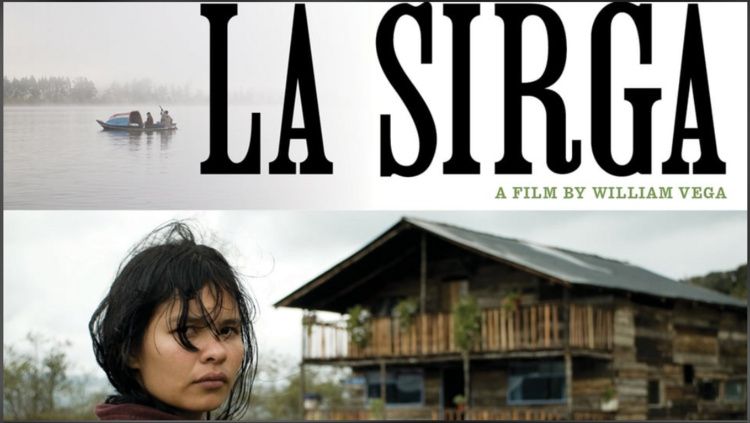
Alicia is helpless. War memories invade her mind like threatening thunder. Uprooted by the armed conflict, she tries to reshape her life in La Sirga, a dilapidated hostel on the shores of a great lake in the highlands of the Andes. There, on a swampy and murky beach, she will try to settle down until her fears and the threat of war resurface again.
A Cannes Film Festival (Directors' Fortnight).
About the Film Director
William Vega is a graduate of the Universidad del Valle's School of Communications and Journalism. He specialized in Film and Television Screenwriting at the School of Arts and Entertainment (TAI) in Madrid. Vega has worked as a director, screenwriter and assistant director on numerous film and television projects. His first film La Sirga earned him outstanding reviews and a reputation as one of the Colombian film industry's young, promising talents. The film had its world premiere at the 65th Cannes Festival Directors' Fortnight and has been selected for major festivals around the world including the Discovery section of the Toronto International Film Festival (TIFF) and the Latin Horizons section of the San Sebastian Festival.
********
Pizza will be served
Additional Information
Program
Einaudi Center for International Studies
Latin American and Caribbean Studies
The Lifeworld of Elizabeth Symons: Family biography and Atlantic geographies in a multigenerational letter collection
February 21, 2023
12:25 pm
Uris Hall, G08
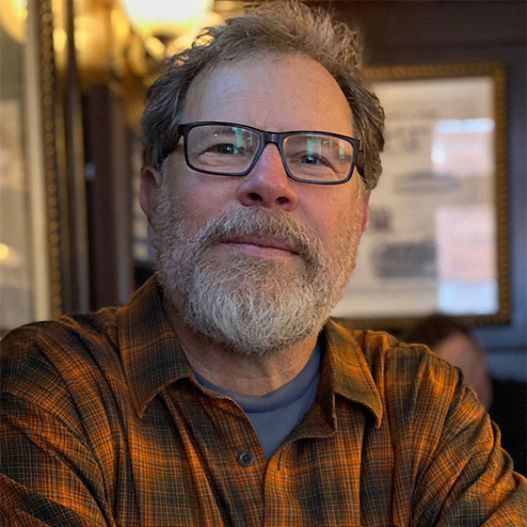
Karl Offen's presentation explores a multigenerational family letter collection to illustrate the relationship between family biography and Atlantic geographies from the mid-eighteenth to the early nineteenth centuries. Among the 300 documents in the letter collection that he and a colleague tracked down from a distant heir and are now held by Special Collections at the University of Bristol Library. In this presentation, Karl will focus on 40 letters written by an upper-middle-class homemaker from Bristol, England, Elizabeth Symons.
Most of Elizabeth’s letters were sent to her brother, Robert Hodgson, a trader and the British superintendent on the Mosquito Shore in eastern Central America (1768-1775). Elizabeth’s daughter and son-in-law gathered and preserved the documents to press property claims on the shore following the family’s demise in the early nineteenth century.
Combining a broad range of domestic and Atlantic themes from the period, the intimate letters provide a rare opportunity to describe how an ordinary Bristolian woman experienced and contributed to transatlantic trade and Atlantic geographies in her everyday life, and how these interacted with developments in Mosquitia, a British enclave in eastern Central America.
About the Speaker
Karl Offen is a historical geographer and political ecologist whose research explores Atlantic environmental history, the history of cartography, and Afro-Amerindian interactions in Central America, Colombia, and the Caribbean basin. He has an MA in Latin American Studies and a PhD in Geography. He is currently a Professor of Geography and the Environment at Syracuse University.
Additional Information
Program
Einaudi Center for International Studies
Latin American and Caribbean Studies