
Latin American and Caribbean Studies
On Refugee Grief: An Intergenerational Remembrance

April 20, 2023
4:30 pm
Physical Sciences Building, 401
A Keynote Event for Displaced. Detained. Undeterred: A Critical/Creative Symposium
Thursday, April 20, 2023, Physical Sciences Building 401
4.30 Opening Remarks
Saida Hodžić (Cornell University)
4.45 KEYNOTE DIALOGUE
In this keynote, speakers Evyn Lê Espiritu Gandhi and Yến Lê Espiritu offer an intergenerational remembrance of Đại Tá [Colonel] HồNgọc Cẩn,our cậu hai [oldest maternal uncle] and ông hai[oldest granduncle] respectively, an Army of the Republic of Vietnam officer who was publicly executed by a Communist firing squad. This remembrance is a portal toa discussion on refugee grief, not as a private or depoliticized sentiment but as a resource forenacting a politics that confronts the conditions under which certain lives are considered moregrievable than others. Focusing on quotidian memory places, particularly Internet memorialsconstructed by the Vietnamese diasporic community, they will discuss how and why South Vietnam’swar dead have become so central to the refugees’ retellings of South Vietnamese losses in theUnited States. At the same time, they point out that these commemoration efforts can and dolead to harsh and unrelenting attacks against the living, especially those who harbor morecritical visions of the diasporic community.
The keynote will be followed by a reception.
To attend the keynote in person, register here. To attend the keynote virtually, register here.
Speakers
Evyn Lê Espiritu Gandhi is an assistant professor of Asian American Studies at the University of California, Los Angeles (Tovaangar). Author of Archipelago of Resettlement: Vietnamese Refugee Settlers and Decolonization across Guam and Israel-Palestine, Dr. Gandhi is the co-editor with Vinh Nguyen of The Routledge Handbook of Refugee Narratives.
Yến Lê Espiritu is Distinguished Professor of Ethnic Studies at the University of California, San Diego. Her books Body Counts: The Vietnam War and Militarized Refuge(es) and Departures: An Introduction to Critical Refugee Studies (co-editor) have charted an interdisciplinary field of critical refugee studies, which reconceptualizes “the refugee” not as an object of rescue but as a site of social and political critiques. Dr. Espiritu is also an inaugural member of The Critical Refugee Studies Collective.
Additional Information
Program
Southeast Asia Program
Einaudi Center for International Studies
Reppy Institute for Peace and Conflict Studies
Institute for European Studies
South Asia Program
Latin American and Caribbean Studies
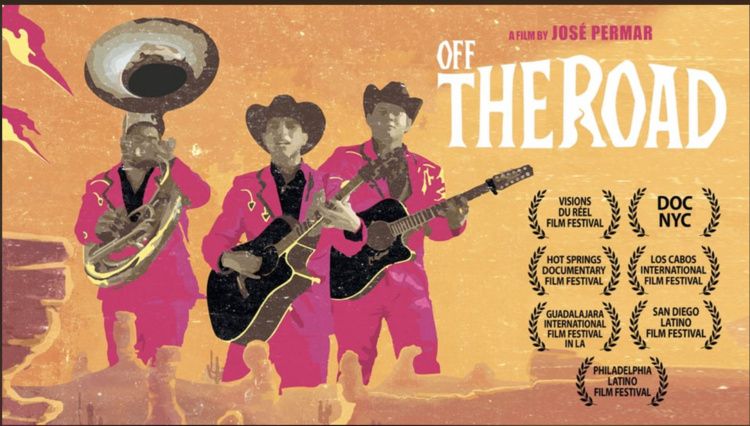
LACS Film Series: Off the Road
March 30, 2023
5:30 pm
Uris Hall, G08
The quietest desert on the Mexican side of the border is about to be crossed by the biggest all-terrain car race in the world. In OFF THE ROAD, three die-hard fans seek to escape the monotony to find a place for themselves in this rip-roaring event.
About the Director
José Permar is an Ariel Award-winning Mexican filmmaker. He was nominated for a Student Academy Award and received a Special Mention at Berlinale for his documentary AURELIA AND PEDRO. His short films OUTSIDE and BEAST have screened at the Morelia International Film Festival, the Latin American Film Festival, and IFSVF in Beijing.
***
Pizza will be served.
***
We are happy to credit Kanopy for using the film, Off the Road, including its title and film image, on our website and for promotional posters across campus.
Additional Information
Program
Einaudi Center for International Studies
Latin American and Caribbean Studies
Contesting Autocracy: Lessons from Democratic Social Movements in Portugal, Italy, and Chile

March 6, 2023
4:00 pm
Uris Hall, G08
Autocracy has been on the rise in global political affairs over the past decade, becoming a focal point of academic and public debate. Less attention has been focused, however, on the rise of social protest movements that contest authoritarian regimes in a large number of countries. This panel seeks to draw lessons from previous democratic social movements in Portugal, Italy, and Chile to analyze what role they play in opening up autocratic regimes and paving the way for democratic transitions.
Panelists
Tiago Carvalho, Centro de Investigação e Estudos de Sociologia, Instituto Universitario de Lisboa and Co-Chair of the Social Movements Research Network of the Council of European Studies
Sidney Tarrow, Emeritus Maxwell Upson Professor of Government, Cornell University
Ken Roberts, Richard J. Schwartz Professor Government, Cornell University
Moderator
Prof. Rachel Beatty Riedl, Director of the Mario Einaudi Center for International Studies, John S. Knight Professor of International Studies, and Professor of Government at Cornell University
Register for virtual viewing.
Hosted by the Institute for European Studies in collaboration with the Einaudi Center’s Democratic Threats and Resilience global research priority, this event is cosponsored by the center for Latin American and Caribbean Studies and by the department of Government.
Additional Information
Program
Latin American and Caribbean Studies
Institute for European Studies
Einaudi Center for International Studies
Bienvenidos

January 27, 2023
6:30 pm
Anna Comstock Hall (Latino Living Center)
Join us for some arroz con leche and conchas on the house to celebrate the beginning of the spring semester
Please register via Campus Groups: https://cglink.me/2ee/r1956225
OPEN TO THE CORNELL COMMUNITY!
Additional Information
Program
Latin American and Caribbean Studies
"Capturing the Voice of Venezuelan Migrants" by Douglas Lyon, MD

March 16, 2023
12:25 pm
Uris Hall, G08
The story of TodoSomos, two years on the Venezuelan Colombian border, rigorously documenting the humanitarian crisis through the collection of first-person narrative and how we created an archive of the story that is undeniable and inconvenient to those responsible for the crisis.
TodoSomos on the Colombian Border
TodoSomos is a US-based nonprofit specializing in collecting, analyzing, and sharing narratives of those afflicted by humanitarian crises. Collecting testimony in a rigorous ongoing way provides an undeniable record of what a refugee population has been through over time. Why they left, what they faced on their journey, their fears, and their hopes for the future. Our work is that of sociologists and anthropologists, only in conflict and unstable areas requiring both nimbleness and academic rigor. We sample broadly over a long period and with the open-ended question, “tell us your story.” The story you would share with your best friend, grandfather, or sister. Why did you leave? What happened along the way? Where will you go? What are your hopes and fears?
From the fall of 2019 through the spring of 2022, in 26 legal ledgers, we collected over 2,000 handwritten testimonies. On a monthly basis, we used local community to read through and summarize the narratives. From these narratives, we produced a quarterly report for the United Nations, National and International NGOs, and local governments involved in the immediate response. We will make our greater archive available to academic institutions as they review, reflect, and publish on this critical moment in global history.
About the Speaker
Douglas Lyon is a family physician and epidemiologist with more than 25 years spent working in Oregon and Internationally with Doctors without Borders, the US Centers for Disease Control, and the UN High Commission for Refugees. His work in the US has primarily cared for the underserved in county and migrant health clinics. His international work has been in various positions as a clinician, medical advisor, and country director, principally in complex emergencies and the management of epidemics – HIV/AID, Cholera, Ebola, and COVID-19.
He is the founder of an NGO called TodoSomos, which collects first-person narratives of Venezuelan refugees in Colombia and South America - TodoSomos hopes to bring global attention to the hardship and cause of the displacement of the more than 5 million that have left their country over the last three years.
His favorite quote is from Mahatma Gandhi, ‘The best way to find yourself is to lose yourself in the service of others.’
********
Cosponsored by the Department of Roman Studies
This is an in-person event, however, if you can't make it, join us by registering through the Zoom link below:
https://cornell.zoom.us/webinar/register/WN_CWI6Hqd-QvO0LpkJTBZ5LQ
After registering, you will receive a confirmation email containing information about joining the webinar.
Additional Information
Program
Einaudi Center for International Studies
Latin American and Caribbean Studies
Video: Laidlaw Scholar Kobi Rassnick in Guatemala
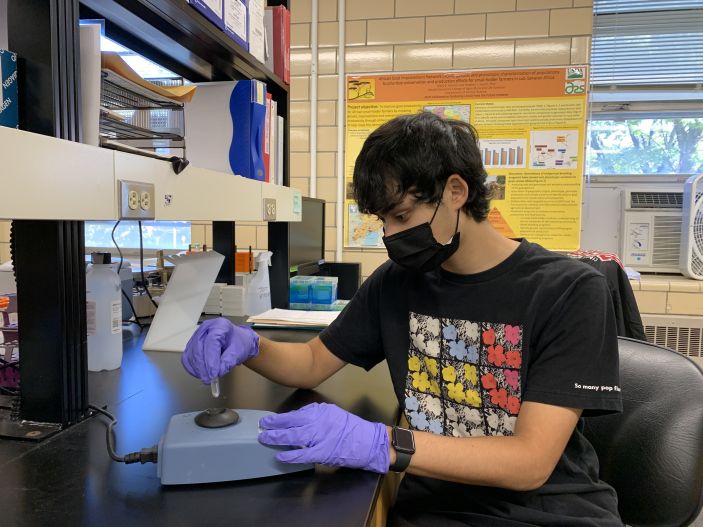
Laidlaw scholar Kobi Rassnick traveled to Santiago Atitlán, Guatemala, for his leadership in action experience. He worked with FARVets, a group based out of the Cornell College of Veterinary Medicine.
Additional Information
Grad Chats: Beyond the IRB: Ethics and International Research

March 29, 2023
4:30 pm
Uris Hall, G-08
Current calls to decolonize global research renew the institutional and personal scrutiny of our “best practices” in conducting field research. Beyond formal adherence to the Belmont principles of “respect, beneficence, and justice,” researchers must reexamine some of the hidden (and not so hidden) costs borne by the local community in the research effort. Panelists will discuss ethical considerations of international research and ethnography in a variety of methodological practices: randomized control trials, focus group discussions, essay competitions, and selective summer camps.
Moderator
Rachel Beatty Riedl (Government, A&S; Einaudi Center)Panelists
Arnab Basu (Dyson School)Alex Nading (Anthropology, A&S)Sarah Thompson (South Asia Program, Einaudi Center)***
Grad Chats: Conversations on International Research and Practice is a series hosted by the Mario Einaudi Center for International Studies to support graduate students with interdisciplinary training and planning around conducting international research.
Spring 2023 Schedule
From Plan A to Plan B: Designing Research for a Changing World (Thursday, February 16, 4:30 pm – 6:00 pm, Uris Hall G02)Beyond the IRB: Ethics and International Research (Wednesday, March 29, 4:30 pm – 6:00 pm, Uris Hall G08)Best Practices and Challenges in International Field Research (Thursday, March 30, 4:30 pm – 6:00 pm, Uris Hall G02)Finding a Research Focus through Creative Writing (Tuesday, April 18, 4:30 pm – 6:00 pm, Uris Hall G08)Travel Health and Safety Awareness for Conducting Research Abroad (Tuesday, May 9, 4:30 pm – 6:00 pm, Uris Hall G08)
Additional Information
Program
Einaudi Center for International Studies
East Asia Program
Southeast Asia Program
Latin American and Caribbean Studies
Institute for African Development
Institute for European Studies
South Asia Program
Grad Chats: From Plan A to Plan B: Designing Research for a Changing World

February 16, 2023
4:30 pm
Uris Hall, G-02
What do you do when the site where you planned to do your research has a major disruption making your research infeasible? What do you do when a loved one gets sick and you need to find more time for caregiving in the last semester of your program? What do you do when you get a job—a year earlier than you anticipated—and you need to finish quickly? Have a Plan B! Come hear from current and former PhD students who have had to make changes in plans, how they negotiated the process with their committee, and where they are today.
Moderator
Mildred Warner (City and Regional Planning, AAP)Panelists
Gloria Blaise (Natural Resources and the Environment, CALS)Michael Cary (Global Development, CALS)George Homsy (Binghamton University)Adam (Chuling) Huang (International and Comparative Labor, ILR)***
Grad Chats: Conversations on International Research and Practice is a series hosted by the Mario Einaudi Center for International Studies to support graduate students with interdisciplinary training and planning around conducting international research.
Spring 2023 Schedule
From Plan A to Plan B: Designing Research for a Changing World (Thursday, February 16, 4:30 pm – 6:00 pm, Uris Hall G02)Best Practices and Challenges in International Field Research (Tuesday, March 14, 4:30 pm – 6:00 pm, Uris Hall G08)Beyond the IRB: Ethics and International Research (Wednesday, March 29, 4:30 pm – 6:00 pm, Uris Hall G08)Finding a Research Focus through Creative Writing (Tuesday, April 18, 4:30 pm – 6:00 pm, Uris Hall G08)Travel Health and Safety Awareness for Conducting Research Abroad (Tuesday, May 9, 4:30 pm – 6:00 pm, Uris Hall G08)
Additional Information
Program
Einaudi Center for International Studies
East Asia Program
Southeast Asia Program
Latin American and Caribbean Studies
Institute for African Development
Institute for European Studies
South Asia Program
Town Hall: Black at Cornell

February 2, 2023
6:00 pm
Africana Center, Multi-purpose room
Black History Month is a time to assess, ask questions, and come together. Join us for this town hall and community event hosted by the Mario Einaudi Center for International Studies to kick off Black History Month on campus and discuss the encounter between African Americans and Black people outside the United States.
To be Black is to be part of a community that has multiple identities and nationalities. Our encounters and experiences show historical, political, and cultural solidarities but, at the same time, capture tensions among ways of being Black.
At this event, faculty, staff, and students will gather to ask the questions: What does Blackness here at Cornell mean? Who defines it? What do Black people owe each other? What of each other’s histories do we know and should know? And what should be done?
Stay after the town hall to enjoy time with friends, refreshments, and music from DJs Ishion Hutchinson and Esther Kondo Heller.
***
Free Ticket Required
Limited seating: Reserve your free ticket today!
Please note that this is an in-person community event. The discussion will not be recorded or livestreamed.
***
Schedule
Town Hall: 6:00–7:30 p.m.Food and Music: 7:30–9:00 p.m.Faculty Speakers
Mukoma Wa Ngugi (Literatures in English, Africana Studies and Research Center, A&S)Carole Boyce Davies (Africana Studies and Research Center, Literatures in English, A&S)Russell Rickford (History, A&S)Ishion Hutchinson (Literatures in English, A&S)Michell Chresfield (Africana Studies and Research Center, A&S)Grant Farred (Africana Studies and Research Center, A&S)Derrick Spires (Literatures in English, A&S)Lyrae Van Clief-Stefanon (Literatures in English, A&S)Misha Inniss-Thompson (Psychology, A&S)Student Speakers
Harmela Anteneh '23 | Alana Berry '24 | Obioha Chijioke '24 | Esther Kondo Heller, MFA candidate | Setor Kudiabor '25 | Maia Lee ' 24 | Rumbidzai Mangwende '23 | Amira Olingou '25 | Imani Rezaka '24 | Brice Roundtree '24 | Ami Tamakloe, PhD student | Amandla Thomas-Johnson, PhD student | Selam Woldai '23 | Members of Black Students United and the Caribbean Students' Association
Host and Sponsors
Hosted by the Einaudi Center as part of its inequalities, identities, and justice global research priority, this event is cosponsored by the Africana Studies and Research Center in the College of Arts and Sciences.
Additional Information
Program
Einaudi Center for International Studies
Institute for African Development
Latin American and Caribbean Studies
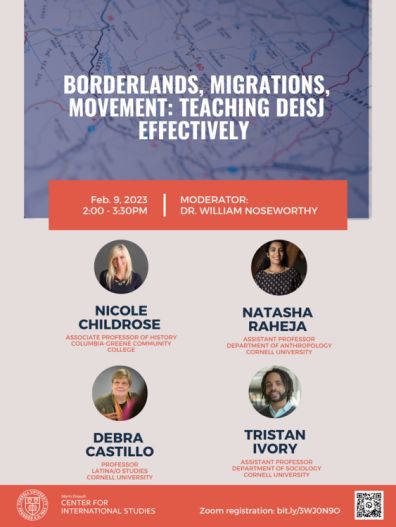
Borderlands, Migrations, Movement: Teaching DEISJ Effectively
February 9, 2023
2:00 pm
Borderlands, migrations, and movement are prevalent themes in post-secondary education. They connect students to seemingly disparate experiences in an increasingly inter-connected world. How do we engage with these topics to teach effectively about diversity, equity, inclusion, and social justice? In this workshop, we combine the expertise of faculty across disciplines and area studies to share ideas and resources with one another.
This online workshop is sponsored by the Mario Einaudi Center for International Studies, with funding support from the U.S. Department of Education Title VI NRC Program.
Speakers:
Nicole Childrose (History, Columbia-Green Community College)
Debra Castillo (Latina/o Studies, Cornell)
Tristan Ivory (sub-Saharan Africa/Sociology, Cornell)
Natasha Raheja (South Asia/Anthropology, Cornell)
Additional Information
Program
Einaudi Center for International Studies
Southeast Asia Program
Latin American and Caribbean Studies
Institute for African Development
South Asia Program