
Latin American and Caribbean Studies
Is Mexico's Ban on Subcontracting Helping Workers?

Lance Compa, LACS
A new law in Mexico is banning labor subcontracting. Lance Compa, senior lecturer at the ILR School, calls the legislation a “very significant” step. Compa says the experience that Mexico learns from this will be an important lesson for other countries.
Additional Information
EMI Conference 2021 | Emerging Market Multinationals: Building the future on ESG excellence
November 5, 2021
8:00 am
Cornell Tech
The Emerging Markets Institute (EMI) was launched in 2010 to broaden global leadership horizons in business research and talent development. Every year, the EMI holds an Annual Conference to bring together business and opinion leaders, academics, and students to discuss emerging markets.
The conference’s key event is the launch of the annual Emerging Markets Multinationals Report, authored by Lourdes Casanova and Anne Miroux. The conference also holds panels discussing business in EMs, an annual case and pitch competition, and prompts thought leadership about the future of EMs.
Please visit the conference website to register and learn more about the event.
Additional Information
Program
Einaudi Center for International Studies
Latin American and Caribbean Studies
Dissecting Discrimination: The Living Legacy of Migration, Race, and Politics

August 12, 2021
1:00 pm
Migration flows have been entangled with race for centuries. In this webinar, Cornell faculty discuss the relationship between human migration and race-based discrimination. From the earliest forced movement of enslaved peoples to nations built on excluding or extracting from particular racial-ethnic groups, we highlight histories of colonialism and conquest and examine the ways in which these are perpetuated today. As human migration continues to rise—now reaching its highest point in history—it is urgent that we examine the injustices that race-based rules and norms perpetuate on newcomers and longstanding citizens alike.
This discussion is co-sponsored by eCornell and the Migrations initiative.
Additional Information
Program
Latin American and Caribbean Studies
International Research Key to Innovation

VP of International Affairs in The Hill
New R&D legislation undercuts innovation by limiting productive collaboration with China, says LASP faculty Wendy Wolford.
Additional Information
Celebration Conversations: Caribbean American Heritage
July 22, 2021
12:00 pm
Celebration Conversations are spaces to celebrate the stories, accomplishments, cultures, and heritages of Cornell staff, centering on historically marginalized voices. These conversations provide opportunities to bring us closer together and create a better understanding of our colleagues at Cornell. We encourage all staff to attend to connect with each other, support their colleagues, and deepen everyone's sense of belonging at Cornell.
All are invited to join us Thursday, July 22 at noon for a fun conversation on the rich culture and heritage of the Caribbean. Bring your dancing shoes!
Register in advance for this meeting:
https://cornell.zoom.us/meeting/register/tJYkcOqgrz0qGtcP_mfuurOMsICnse…
After registering, you will receive a confirmation email containing information about joining the meeting.
Additional Information
Program
Einaudi Center for International Studies
Latin American and Caribbean Studies
REPAL Annual Conference, Virtually at Cornell University, July 16, 10am-4pm
July 16, 2021
10:00 am
The Latin American and Caribbean Studies Program and Department of Government at Cornell University, will host this year’s virtual REPAL Annual Conference from July 15 to 17th, 2021-REPAL (Red para el Estudio de la Economía Politíca de América Latina). Speakers are scheduled for the three-day conference from 10am to 4pm each of the days.
2021 Conference format: 30-minute individual sessions (12-minute presentations with 15 minutes of discussion) in four parallel tracks. Papers will be posted in a website accessible only to conference participants. Participants are expected to read the papers in advance to enrich the discussion at the conference. We encourage the attendance and participation of non-presenters as well as presenters.
Registration for Repal 2021 is now open! Please register here. (Registration payments for those who previously registered for the cancelled 2020 conference will carry over to this conference.) If you are facing economic hardships due to Covid, the registration fee can be waived; please contact repalconference@gmail.com.
The final panel is free and open virtually to the public and is at 3pm on 7/17 entitled Covid-19 and Latin America, details can be found at: https://events.cornell.edu/event/covid-19_in_latin_america_politics_eco…
Additional Information
Program
Einaudi Center for International Studies
Latin American and Caribbean Studies
REPAL Annual Conference, Virtually at Cornell University, July 15, 10am-4pm
July 15, 2021
10:00 am
The Latin American and Caribbean Studies Program and Department of Government at Cornell University, will host this year’s virtual REPAL Annual Conference from July 15 to 17th, 2021-REPAL (Red para el Estudio de la Economía Politíca de América Latina). Speakers are scheduled for the three-day conference from 10am to 4pm each of the days.
2021 Conference format: 30-minute individual sessions (12-minute presentations with 15 minutes of discussion) in four parallel tracks. Papers will be posted in a website accessible only to conference participants. Participants are expected to read the papers in advance to enrich the discussion at the conference. We encourage the attendance and participation of non-presenters as well as presenters.
Registration for Repal 2021 is now open! Please register here. (Registration payments for those who previously registered for the cancelled 2020 conference will carry over to this conference.) If you are facing economic hardships due to Covid, the registration fee can be waived; please contact repalconference@gmail.com.
The Saturday, 7/17 final Keynote Panel "Covid-19 and Latin America” is free webinar and virtually open to the public on the last day of the conference beginning at 3:00pm. It can be attended registering (for free) at the link: https://bit.ly/2V9PkoH “
Additional Information
Program
Einaudi Center for International Studies
Latin American and Caribbean Studies
Covid-19 in Latin America: Politics, Economics, and Public Health Impacts
July 17, 2021
3:00 pm
Register at: https://cornell.zoom.us/webinar/register/WN_DmadXQe4QsidxC_MITCu3g
This plenary panel will discuss the consequences of the Covid-19 pandemic in the region. It features scholars working on issues like variation in policies to face the pandemic, the impact of the former and latter on economic inequality, poverty, unemployment, the gender gap, access to vaccines, among others.
Chair: Wendy Hunter, University of Texas at Austin
Merike Blofield, German Institute for Global and Area Studies
Magdalena Gil, Pontificia Universidad Católica de Chile
Nora Lustig, Tulane University
Ken Shadlen, London School of Economics
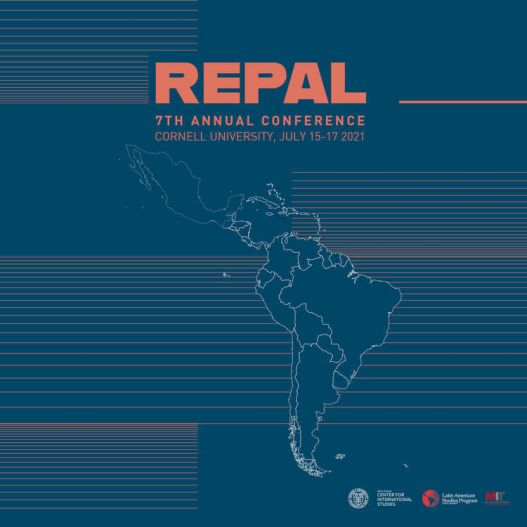
The final Keynote Panel of the 7th Annual REPAL (Red para el Estudio de la Economía Política de América Latina), held virtually at Cornell University 7/15-17/2021.
Additional Information
Program
Einaudi Center for International Studies
Latin American and Caribbean Studies
REPAL Annual Conference, Virtually at Cornell University, July 17, 10am-4pm
July 17, 2021
10:00 am
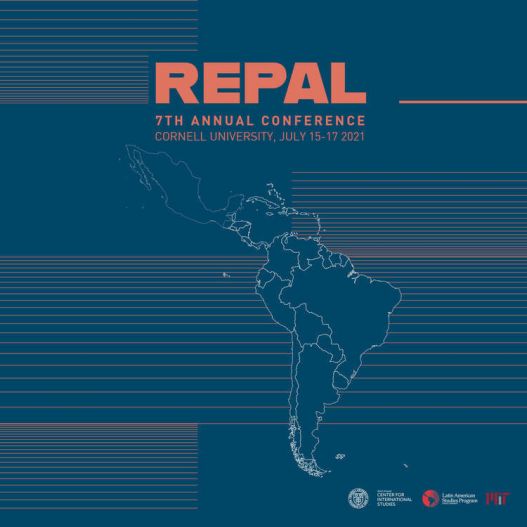
The Latin American and Caribbean Studies Program and Department of Government at Cornell University, will host this year’s virtual REPAL Annual Conference from July 15 to 17th, 2021-REPAL (Red para el Estudio de la Economía Politíca de América Latina). Speakers are scheduled for the three-day conference from 10am to 4pm each of the days.
2021 Conference format: 30-minute individual sessions (12-minute presentations with 15 minutes of discussion) in four parallel tracks. Papers will be posted in a website accessible only to conference participants. Participants are expected to read the papers in advance to enrich the discussion at the conference. We encourage the attendance and participation of non-presenters as well as presenters.
Registration for Repal 2021 is now open! Please register here. (Registration payments for those who previously registered for the cancelled 2020 conference will carry over to this conference.) If you are facing economic hardships due to Covid, the registration fee can be waived; please contact repalconference@gmail.com.
Additional Information
Program
Einaudi Center for International Studies
Latin American and Caribbean Studies
Meet Political Cartoonist Pedro X. Molina

Incoming Visiting Scholar Fights for Fair Elections in Nicaragua
The Nicaraguan cartoonist joins Einaudi's Latin American Studies Program this fall as an IIE Artist Protection Fund Fellow. Listen to an interview.