
Migrations Program
40 New York State Teachers Attend ISSI

Testimonies of Migration in the Classroom
Forty elementary, middle, and high school educators from across New York State participated in the 2023 International Studies Summer Institute (ISSI), hosted annually by the Mario Einaudi Center for International Studies.
This year’s theme, “Testimonies of Migration,” explored personal narratives from migrants and offered resources for teachers to engage with migrant stories and students in a culturally responsive way.
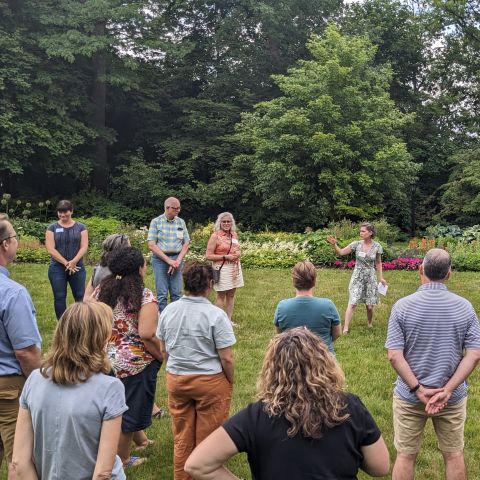
Teachers learned from scholars and experts in panel discussions, networked with each other in breakout groups, and engaged in hands-on activities around the Cornell campus.
Panels and workshops included scholars and experts from the Migrations initiative, who cosponsored the event, and community partners who work with migrant populations in the state.
A morning panel discussion on ethical and culturally responsive engagement preceded a conversation with Mary Jo Dudley of the Cornell Farmworker Program on supporting immigrant families in schools.
"I personally felt this was the best workshop I have attended. The material was so tangible and relatable regardless of population taught."
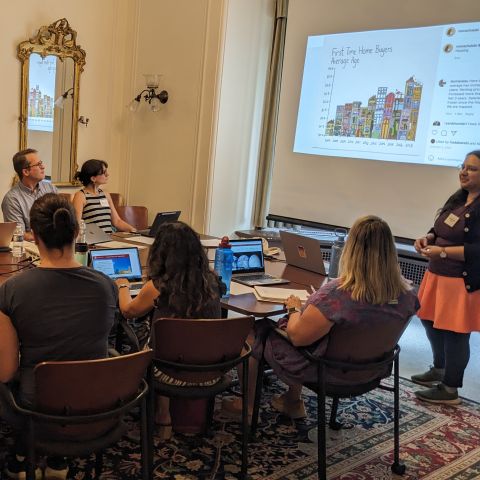
Afternoon sessions brought teachers together in small groups to explore migrant narratives using hands-on, project-based learning. A session led by Nausheen Husain, a journalist and assistant professor in the Newhouse School of Public Communications at Syracuse University, shared tools for exploring data sets with students to better understand people’s experience of migration.
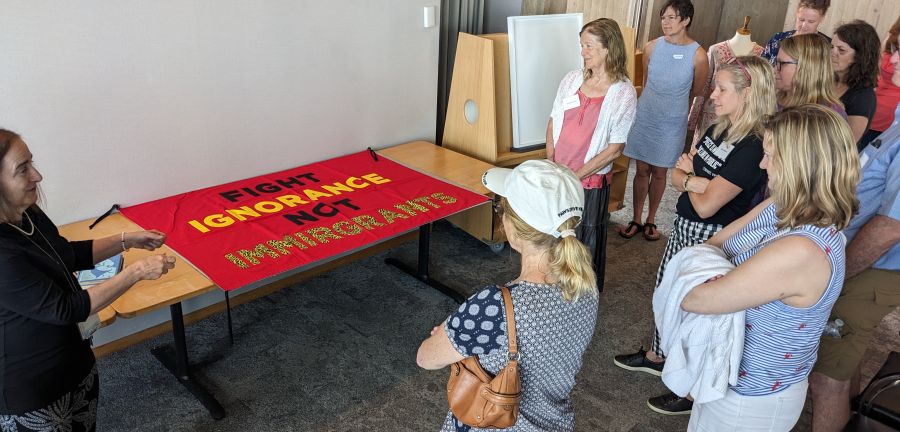
The final session of the day took place at the Herbert F. Johnson Museum of Art. Inspired by a past museum exhibit called "how the light gets in," museum staff displayed artwork on migration ranging from a collaborative handmade dress to that might influence curriculum in teachers' classrooms.
Among artworks from Ai Weiwei, Mohamad Hafez, and Meschac Gaba, participants were especially struck by the collaborative fabric piece “DAS KLEID / THE DRESS” by Elisabeth Masé. A group of immigrant women created this piece, embroidering their hopes for the future with red thread on tan cloth, which was then sewn into a dress.
"I am excited to incorporate what I have learned into my lessons. I also feel more at ease teaching about other cultures. I realize I don't have to know everything and can learn with my students about new cultures."
View more photos from the institute on Facebook.
ISSI was sponsored by the Einaudi Center, East Asia Program, Institute for African Development, Institute for European Studies, Latin American and Caribbean Studies, South Asia Program, Southeast Asia Program, Migrations: A Global Grand Challenge, the South Asia Center at Syracuse University, TST-BOCES, and the U.S. Department of Education Title VI Program.
Additional Information
Commentary Calls for Equal Access to Healthcare for DACA Recipients and All Immigrants
Gunisha Kaur and Stephen Yale-Loehr, Migrations
Recent uncertainties regarding the legal status of the Deferred Action for Childhood Arrivals (DACA) program underscore the urgency for policymakers to reassess long-standing restrictions on government-sponsored healthcare subsidies for all immigrants.
Additional Information
Advice for the Class of 2023

From Former Migrations Scholars
A year after their graduation, some of our past undergraduate Migrations scholars share advice for the class of 2023!
Alexis Fintland '22
Program and Research Assistant at the Migration Policy Institute
Working with the Migration Policy Institute’s National Center for Immigrant Integration Policy in Washington, D.C., Alexis conducts research to promote the civic, economic, and linguistic integration of immigrants and refugees in the United States. Her analyses focus on equity issues in workforce and education systems to inform policy recommendations for government officials and community leaders.
"As an undergraduate Migrations scholar, I was able to build deeper relationships with Cornell faculty members who have a rich knowledge of immigration policy, law, and history," said Alexis. "This mentorship and guidance from my professors ultimately drove me to apply for a position at my dream organization, where I am thrilled to work in an environment that gives me the opportunity to learn from the top experts in the field.”
Her advice to graduating seniors in 2023? "Slow down and be open to changing your plans. Cornell is fueled by a fast-paced culture that can push people to make hasty decisions for the sake of having post-grad plans. Post-graduation is a time to step back and do what you really want to do. Had I given in to the pressure, I would have gone straight to graduate school and missed out on a dream opportunity. Taking a bet on myself and waiting to get some hands-on work experience was the best decision I've ever made."
Danielle Berkowitz-Sklar '22
Program Coordinator at the Environmental Defense Fund

In her work, Danielle advocates for environmental justice and stronger clean air regulations in the U.S.—work she was engaged in as a Migrations scholar and also as an intern with the Einaudi Center’s Institute for African Development.
"Environmental degradation and climate change is a human rights issue that often results in the displacement of vulnerable individuals, families, and communities," said Danielle.
"Being a Migrations scholar reinforced to me the importance of putting people and public health at the center of climate action. I was able to gain experience working with a team to put on virtual, hybrid, and in-person events, which is exactly what I am doing in my current position."
Vanessa Olguín '22
Fulbright in Peru

As a Fulbrighter, Vanessa is developing a research project on the state of international migrant protection in Peru and the role of local and international NGOs in helping to secure that protection. She is being hosted by the Instituto de Democracia y Derechos Humanos at the Pontificia Universidad Católica del Perú.
"The undergraduate Migrations group as a whole and the dedication that they all had to migration studies, migrant justice, and rights really allowed me a space to ask questions, to continue to be curious and confident in the fact that what I was interested in was important," said Vanessa.
The two biggest lessons she's learned are to not be afraid to try new things and that it's okay to not have it all figured out.
"I think one thing that Fulbright and my undergraduate years at Cornell taught me is that there is value in your thoughts, ideas and curiosities!" said Vanessa. "Try to not be afraid to reach out to that professor, apply to that one dream job, ask that question aloud in class, or apply to that competitive program. There might always be a person, a space, or an institution that says no to you, but don't say no to yourself first."
Luis Tamayo '22
Associate Property Claims Adjuster at Amica Mutual Insurance
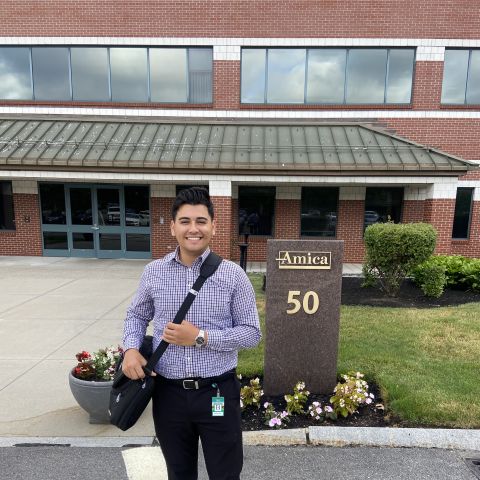
Luis took a gap year after graduation and worked as an insurance claims adjuster as he prepared for law school. He hopes to become an immigration attorney.
"This career choice has been a dream of mine as a son of immigrant parents and, thanks to the Migrations scholars program, I was able to truly define my career aspiration in my academic work by sharing space with such passionate individuals that had similar interests as me," said Luis.
"Being an adjuster depends on communication, critical thinking, and self-initiative, all of which I strengthened throughout my time as a Migrations scholar. More importantly, the program encouraged us to consider and value different perspectives, a skill that I carry with me each day as I speak with parties from diverse backgrounds."
Additional Information
Three Years of Migrations

Big Red Scholars Navigate a World in Motion
Read about Einaudi's immigrant health team and the Migrations initiative's expanding body of research, workshops, conferences, seminars, and more.
Additional Information
Commentary: Transit Ban Wrong Immigration Approach
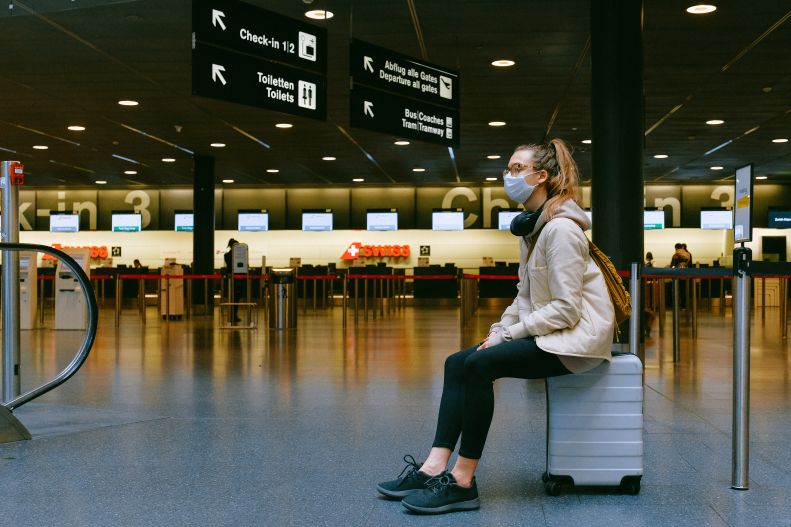
Estelle McKee, Global Public Voices
Estelle McKee, professor of law, discusses the transit ban proposed by the Biden administration, noting that New York state has volunteered to sponsor more Ukrainian refugees than any other state.
Additional Information
Onward, Upward?

Tristan Ivory on Immigrants' Outcomes
Einaudi faculty member and past Global Public Voices fellow is tracking the long-term effects of migration.
Additional Information
Health Workers in NYC Describe Confusion, Errors in Early Days of Asylum Seeker Vaccine Clinics

Gunisha Kaur, Migrations
On caring for asylum seekers: “These are incredibly complex patients. Some of the most complex that I see,” says Gunisha Kaur, assistant professor of anesthesiology at Weill Cornell Medicine.
Additional Information
Rare and Distinctive Language Fellowships

Details
If you love languages, our newest summer funding opportunity is for you!
Rare and distinctive (RAD) languages set Cornell apart. Cornell offers over 50 languages, including some of the world's least frequently taught—from Ukrainian to Quechua, Urdu to Burmese.
With the help of a RAD Language Fellowship, you can achieve fluency in your choice of these languages. Learning RAD languages offers insight into vibrant cultural identities and traditions and gives you the ability to work effectively in places around the globe.
Cornell Chronicle: Einaudi Fellowships Support Students Learning Uncommon Languages
Amount
For summer study at any level (graduate or undergraduate): $3,500 stipend, plus a fees and tuition allowance of up to $5,000.
Eligibility
All currently enrolled Cornell graduate and undergraduate students are eligible for RAD fellowships. You do not need to be a citizen or permanent resident of the United States or complete a FAFSA, which FLAS requires.
You must be planning to study a modern language among the least commonly taught languages offered at Cornell (see sidebar).
To be a successful applicant, you need to show potential for high academic achievement and agree to pursue full-time study of a language in accordance with the university’s requirements. You do not need to have previous experience or coursework in the language you plan to study. Lowest priority will be given a candidate who is a native speaker of the language.
How to Apply
In your application, you will be asked to provide information on your proposed study location. You must identify your own preferred program.
We recommend the following U.S. summer intensive language programs, although we will consider any programs—domestic or overseas—that meet the minimum requirements.
- African Summer Language Institute (ASLI)
- Indiana University Summer Language Workshop
- South Asia Summer Language Institute (SASLI)
- Southeast Asian Studies Summer Institute (SEASSI)
- YIVO-Bard Summer Program
Your program must be at least six weeks in duration and offer at least 120 student contact hours. Please indicate the language level you intend to study during the award period.
Requirements
- Be a currently enrolled Cornell student.
- Plan to attend an approved summer intensive language acquisition program.
- Use the online application to submit your materials, including:
- Two letters of recommendation from faculty members.
- An official transcript of one full academic year of coursework.
- An optional third letter of recommendation from a language instructor.
Additional Information
Nicole T. Venker
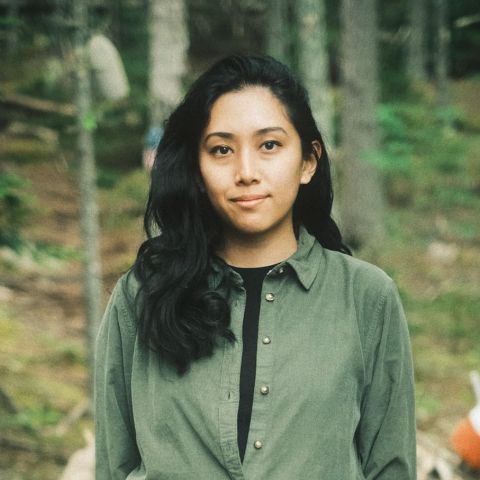
Jesse F. and Dora H. Bluestone Peace Studies Fellow; Migrations Graduate Fellow
Nicole T. Venker is a human-environment geographer whose work explores how conflict-driven migration shapes rural livelihoods, environmental access, and food sovereignty.
She is a doctoral candidate in the Department of Natural Resources and the Environment. Her dissertation investigates the impacts of Myanmar’s protracted civil war on refugees’ experiences of displacement, temporary relocation, and resettlement in the U.S. and Thailand.
Additional Information
Program
Role
- Student
- PACS Current Graduate Fellow
- Graduate Fellow
- Graduate Student
Contact
Email: ntt22@cornell.edu
Global PhD Research Awards
Details
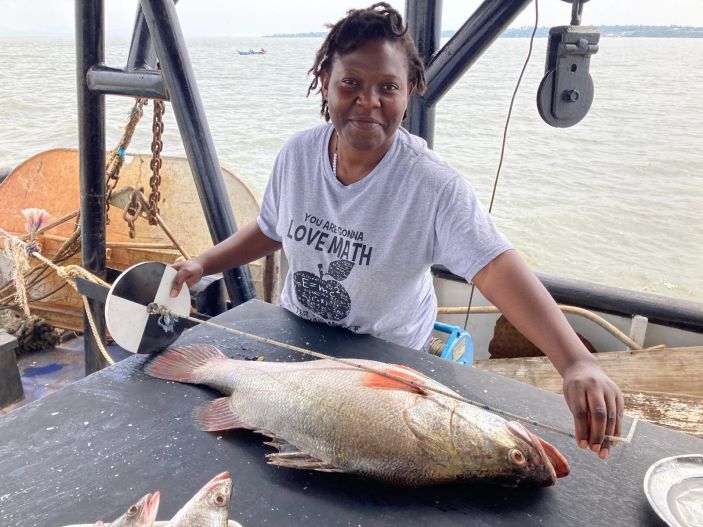
Conduct your international field research with a $10,000 award to support fieldwork expenses.
The Einaudi Center’s Amit Bhatia ’01 Global PhD Research Awards fund international fieldwork to help Cornell students complete their dissertations. Through a generous gift from Amit Bhatia, this funding opportunity annually supports at least six PhD students who have passed the A exam. Recipients hold the title of Amit Bhatia ’01 Global PhD Research Scholars. Meet the scholars.
All disciplines and research topics are welcome. Please indicate in your application if your project aligns with one of the Einaudi Center's global research priorities or one of our regional and thematic programs.
Eligibility
Cornell graduate students who have passed the A exam and been admitted to candidacy are eligible to apply. International fieldwork must be a critical component of your dissertation research. You must commit to travel abroad to conduct fieldwork for 9–12 months.
Please note that this award is meant to be supplementary to your primary funding source. This award does not provide tuition credit and requires students to be in absentia. A report is required upon completion.
Amount
$10,000, to be used before the end of the sixth PhD year. The award can cover the following expenses:
- International travel (economy airfare, visa fees)
- Domestic travel within the fieldwork country
- Accommodation and living expenses
- Research expenses (permits, translation costs, internet, archive access, survey costs, lab fees, etc.)
We encourage you to apply for other Cornell and external funding to complement this award, but please note that you are not eligible to apply for Einaudi’s travel grants. If you have already received a travel grant and wish to apply for a Global PhD Research Award, you may return your travel grant if you receive this award.
Please note that you may only bill for a research expense once. If an expense is already covered by this award or a Graduate School research travel grant, you may not use other Cornell or external grants to pay the same expense.
International Travel Approval
All international travel must be registered with the Cornell International Travel Registry. In line with Cornell’s international travel policy, selected students who plan to travel to a country flagged by the US Department of State as a "Level 4: Do not travel," or by the CDC as Level 4 "Special Circumstances," must get their travel plans reviewed and approved via a petition process by the International Travel Advisory & Response Team (ITART). ITART petitions are triggered by rules built into the Travel Registry, so if selected students’ travel requires a petition, the Travel Registry will prompt them for additional information about, and a rationale for, their elevated risk travel plans.
Please be aware that regardless of your destination, approval may be withdrawn if there is a change in the risk level of your destination or if we find that you have violated any contingencies of approval given. In such instances, you will be required to refund the award.
To receive the award, selected students must follow the university’s guidelines to petition for permission to travel internationally, to be submitted no earlier than six weeks and at least two weeks before the scheduled travel. In addition, students must participate in a short, online international travel predeparture orientation course designed by the university’s International Health & Safety team in order to receive travel approval.
Deadline
Applications, recommendation letters, and transcripts are due Friday, March 7, 2025 (11:59 p.m. ET).
How to Apply
Please order your official electronic transcript through the Office of the Registrar (see below); do not send your transcript directly. In the application, you will be asked to provide the following:
- Official electronic transcript (send to programs@einaudi.cornell.edu)
- Abstract of your dissertation project (maximum 150 words)
- Introduction to your dissertation project (maximum 400 words)
- Statement explaining the contribution of your research to existing literature and its relevance to advancing the human condition, planetary sustainability, or other impacts (maximum 400 words)
- Statement about publications that have most significantly informed your research (maximum 100 words)
- Statement explaining your plans for international field research (maximum 600 words)
- International field research budget information
- NetID email address of your recommender (your graduate thesis advisor)
FAQ
More Questions?
Join us for an upcoming information session.
Please email our academic programming staff if you have additional questions about the program or your application.