Migrations Program

Rare and Distinctive Language Fellowships

The deadline for this opportunity has passed.
Application Deadline: February 19, 2025
Application Timeframe: Spring
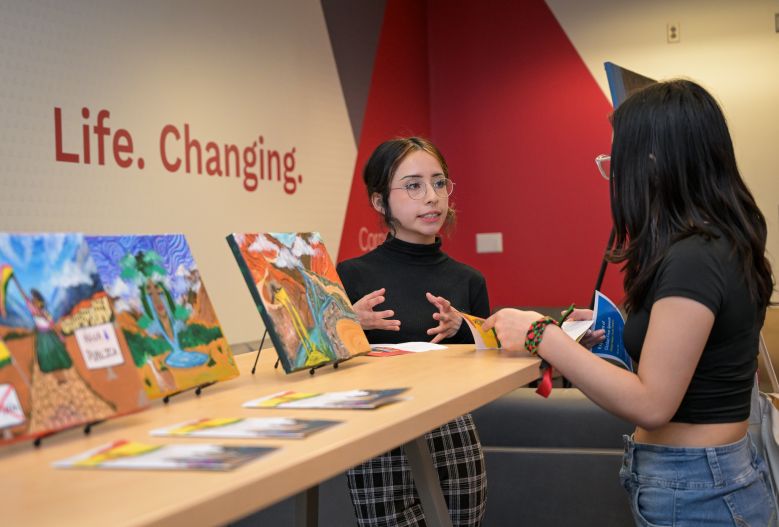
Adeolu Ademoyo with a student learning Yoruba

Details

If you love languages, our newest summer funding opportunity is for you!

Rare and distinctive (RAD) languages set Cornell apart. Cornell offers over 50 languages, including some of the world's least frequently taught—from Ukrainian to Quechua, Urdu to Burmese.

With the help of a RAD Language Fellowship, you can achieve fluency in your choice of these languages. Learning RAD languages offers insight into vibrant cultural identities and traditions and gives you the ability to work effectively in places around the globe.

Cornell Chronicle: Einaudi Fellowships Support Students Learning Uncommon Languages


Amount

For summer study at any level (graduate or undergraduate): $3,500 stipend, plus a fees and tuition allowance of up to $5,000. 

Eligibility

All currently enrolled Cornell graduate and undergraduate students are eligible for RAD fellowships. You do not need to be a citizen or permanent resident of the United States or complete a FAFSA, which FLAS requires.

You must be planning to study a modern language among the least commonly taught languages offered at Cornell (see sidebar).

To be a successful applicant, you need to show potential for high academic achievement and agree to pursue full-time study of a language in accordance with the university’s requirements. You do not need to have previous experience or coursework in the language you plan to study. Lowest priority will be given a candidate who is a native speaker of the language.

How to Apply

In your application, you will be asked to provide information on your proposed study location. You must identify your own preferred program.

We recommend the following U.S. summer intensive language programs, although we will consider any programs—domestic or overseas—that meet the minimum requirements.

Your program must be at least six weeks in duration and offer at least 120 student contact hours. Please indicate the language level you intend to study during the award period.

Requirements

  • Be a currently enrolled Cornell student.
  • Plan to attend an approved summer intensive language acquisition program.
  • Use the online application to submit your materials, including:
    • Two letters of recommendation from faculty members.
    • An official transcript of one full academic year of coursework.
    • An optional third letter of recommendation from a language instructor.


Additional Information

Nicole T. Venker

Nicole Venker headshot

Jesse F. and Dora H. Bluestone Peace Studies Fellow; Migrations Graduate Fellow

Nicole T. Venker is a human-environment geographer whose work explores how conflict-driven migration shapes rural livelihoods, environmental access, and food sovereignty. 

She is a doctoral candidate in the Department of Natural Resources and the Environment. Her dissertation investigates the impacts of Myanmar’s protracted civil war on refugees’ experiences of displacement, temporary relocation, and resettlement in the U.S. and Thailand. 

Additional Information

Program

Role

  • Student
  • PACS Current Graduate Fellow
    • Graduate Fellow
      • Graduate Student

Contact

Global PhD Research Awards

The deadline for this opportunity has passed.
Application Deadline: March 7, 2025
Application Timeframe: Spring
Angela Nankabirwa measures a large fish laying on a table.

Details

Conduct your international field research with a $10,000 award to support fieldwork expenses.

The Einaudi Center’s Amit Bhatia ’01 Global PhD Research Awards fund international fieldwork to help Cornell students complete their dissertations. Through a generous gift from Amit Bhatia, this funding opportunity annually supports at least six PhD students who have passed the A exam. Recipients hold the title of Amit Bhatia ’01 Global PhD Research Scholars. Meet the scholars.

All disciplines and research topics are welcome. Please indicate in your application if your project aligns with one of the Einaudi Center's global research priorities or one of our regional and thematic programs.


Eligibility

Cornell graduate students who have passed the A exam and been admitted to candidacy are eligible to apply. International fieldwork must be a critical component of your dissertation research. You must commit to travel abroad to conduct fieldwork for 9–12 months.

Please note that this award is meant to be supplementary to your primary funding source. This award does not provide tuition credit and requires students to be in absentia. A report is required upon completion.

Amount

$10,000, to be used before the end of the sixth PhD year. The award can cover the following expenses:

  • International travel (economy airfare, visa fees)
  • Domestic travel within the fieldwork country
  • Accommodation and living expenses
  • Research expenses (permits, translation costs, internet, archive access, survey costs, lab fees, etc.)

We encourage you to apply for other Cornell and external funding to complement this award, but please note that you are not eligible to apply for Einaudi’s travel grants. If you have already received a travel grant and wish to apply for a Global PhD Research Award, you may return your travel grant if you receive this award.

Please note that you may only bill for a research expense once. If an expense is already covered by this award or a Graduate School research travel grant, you may not use other Cornell or external grants to pay the same expense.

International Travel Approval

All international travel must be registered with the Cornell International Travel Registry. In line with Cornell’s international travel policy, selected students who plan to travel to a country flagged by the US Department of State as a "Level 4: Do not travel," or by the CDC as Level 4 "Special Circumstances," must get their travel plans reviewed and approved via a petition process by the International Travel Advisory & Response Team (ITART). ITART petitions are triggered by rules built into the Travel Registry, so if selected students’ travel requires a petition, the Travel Registry will prompt them for additional information about, and a rationale for, their elevated risk travel plans.

Please be aware that regardless of your destination, approval may be withdrawn if there is a change in the risk level of your destination or if we find that you have violated any contingencies of approval given. In such instances, you will be required to refund the award. 

To receive the award, selected students must follow the university’s guidelines to petition for permission to travel internationally, to be submitted no earlier than six weeks and at least two weeks before the scheduled travel. In addition, students must participate in a short, online international travel predeparture orientation course designed by the university’s International Health & Safety team in order to receive travel approval.

Deadline

Applications, recommendation letters, and transcripts are due Friday, March 7, 2025 (11:59 p.m. ET).

How to Apply

Please order your official electronic transcript through the Office of the Registrar (see below); do not send your transcript directly. In the application, you will be asked to provide the following:

  1. Official electronic transcript (send to programs@einaudi.cornell.edu)
  2. Abstract of your dissertation project (maximum 150 words)
  3. Introduction to your dissertation project (maximum 400 words)
  4. Statement explaining the contribution of your research to existing literature and its relevance to advancing the human condition, planetary sustainability, or other impacts (maximum 400 words)
  5. Statement about publications that have most significantly informed your research (maximum 100 words)
  6. Statement explaining your plans for international field research (maximum 600 words)
  7. International field research budget information
  8. NetID email address of your recommender (your graduate thesis advisor)

FAQ

If selected, when will I be required to start my fieldwork?

Fieldwork must commence within the academic year, which begins July 1. For the foreseeable future, the COVID-19 pandemic will continue to impact the safety and feasibility of international Cornell travel. In the event that you are not able to travel due to pandemic-related travel restrictions or other emergencies, extensions may be possible.

If I commence my fieldwork before the announcement of the award, will I still be eligible to receive the award if selected? Would it still be counted towards the 9-12 months of fieldwork?

Fieldwork completed following the award will be considered toward the 9-12 months of required fieldwork, but not fieldwork conducted earlier.

I have not yet taken the A exam. Can I still apply?

Yes, but you must complete the A exam before the awarding decision is made (typically 4-6 weeks after the application deadline).

I have questions about in absentia status.

Please refer to the Graduate School’s policies or contact the Graduate School.

Can I conduct the 9-12 months of required fieldwork in two parts? If the total duration of the fieldwork adds up to 9-12 months, does it have to be continuous?

No. Fieldwork needs to be continuous since the student must be in absentia during the entire duration of fieldwork.

Can my previous fieldwork count towards the 9-12 months of fieldwork?

Any fieldwork conducted prior to the semester of application will not count towards the 9-12 months. We will consider fieldwork conducted during the semester of application.

I am currently in my fifth year and about to start the sixth year of my PhD. Am I eligible to apply?

Yes, but if selected, the award must be utilized before the end of the sixth year.

I have completed most of my fieldwork. I need to conduct fieldwork for a duration less than 9-12 months (six months, for instance). Can I apply?

No.

Can you please confirm that you have received my application? Will I be notified if I am not selected?

Yes, all applicants will receive a confirmation message and will be notified of the decision, typically within six weeks of the application deadline.

Is the recommendation letter from the thesis advisor due by the application deadline?

Yes.

How will my recommender submit their recommendation letter?

When you submit your application, your recommender will receive an email message with a link that they can use to submit their recommendation letter. If you or your recommender has questions or encounters any issues, please contact programs@einaudi.cornell.edu

I have completed the fieldwork, but I have some outstanding fieldwork-related expenses that need to be funded (for instance, lab analysis, translation, etc.). Can I use this award to cover these research expenses?

No, the funds are specifically for international fieldwork and may not be used for other expenses incurred after your fieldwork has been completed.

If I receive this award, can I postpone my Sage Fellowship?

Please contact the Graduate School at grad_funding@cornell.edu if you have questions about your Sage Fellowship.

More Questions?

Join us for an upcoming information session

Please email our academic programming staff if you have additional questions about the program or your application.

Additional Information

Kathryn Fiorella

kathryn fiorella headshot

Director, Migrations Program

Kathryn Fiorella is an associate professor of public and ecosystem health in the College of Veterinary Medicine. Her research interests include planetary health/one health, fisheries, livelihoods, HIV/AIDS, nutrition and environmental change.

Additional Information

Program

Role

  • Faculty
  • SEAP Core Faculty
    • Einaudi Faculty Leadership

Contact

Seed Grants

The deadline for this opportunity has passed.
Application Deadline: March 16, 2026
Application Timeframe: Spring
Kassam climate/calendar research team in the field

Details

The Einaudi Center's faculty seed grants launch international studies research and activities that show promise to grow and secure external follow-on funding.

Tenured and tenure-track Cornell faculty are eligible to apply. All disciplines and topics are welcome. Read about recent research Einaudi seeded.


Building International Studies Capacity

Einaudi Center seed grants support international studies research and collaborations that reach across world regions and bring together researchers who have deep knowledge in different regions and disciplines. The awards launch early-stage interdisciplinary research projects with clear plans for scaling up and securing external funding support. 

The Einaudi Center is dedicated to international studies. Our seed grants focus on complex global and regional issues and community-engaged methodologies across the social sciences, hard sciences, and humanities. Some research conducted abroad and international collaborations—while valuable—do not qualify for the awards.

Proposals must align with the mission and interests of at least one of our international studies programs. The application requires only your own thoughtful assessment of how your project might contribute to the work of one or more programs. 

Proposals that engage with two or more geographical regions are eligible for larger awards of up to $25,000.


Eligibility

Tenured and tenure-track Cornell faculty in all colleges and schools are eligible to apply as individuals or teams. The Einaudi Center will not accept proposals from past awardees who failed to submit the required final report by the deadline stated in the award letter.

  • Funding-eligible activities: Data collection, research assistance, travel, meetings
  • Not eligible for funding: Salary offset, summer salary, computers and equipment, student stipends/tuition

Requirements

  • All funds must be used within one year of the award date.
  • You must submit a final report to the Einaudi Center director within one year of the award date. The report must include:
    • A summary and assessment of the research and activities you accomplished.
    • An update on your external follow-on funding proposal.
    • A promotional paragraph written for nonspecialists (100 words maximum) describing the outcome and value of your project.
  • The Einaudi Center must be acknowledged in all publications, promotion, and media coverage related to your funded research and activities. Please inform the Einaudi Center in advance of publications and other project outcomes.

How to Apply

Complete the seed grant funding application and submit a proposal including the following:

  • Curricula vitae (CVs) for principal faculty
  • Statement including objectives, activities, work plan, expected outputs, beneficiaries, and impact
  • Human subjects approval, if relevant
  • Detailed budget with justification of expenses
  • Plans for pursuing future research and external funding support

Evaluation 

All successful proposals will meet these criteria. The proposal:

  • Shows a high likelihood of generating new knowledge of key economic, environmental, social, cultural, or political problems in the world.
  • Includes clearly articulated deliverables.
  • Includes a budget appropriate for planned activities.
  • Includes a plan for obtaining full project funding to sustain and expand the research.

Questions?

Please email our academic programming staff if you have questions about the seed grant program or your application.


Additional Information

Gunisha Kaur

Gunisha Kaur in a doctor's coat

Medical Director, Weill Cornell Center for Human Rights

Gunisha Kaur is an anesthesiologist specializing in global health and human rights, particularly among displaced populations. She serves as medical director of the Weill Cornell Center for Human Rights and as director of the Anesthesiology Global Health Initiative.

Additional Information

Program

Role

  • Faculty

Contact

Subscribe to Migrations Program