
Reppy Institute for Peace and Conflict Studies
Information Session: South Asia Summer Language Fellowships

February 4, 2026
4:30 pm
Uris Hall, G08
Achieve fluency in a language of South Asia with the help of a Foreign Language and Area Studies (FLAS) summer fellowship. You’ll gain valuable knowledge about cultures and countries in which your language is commonly used, while developing skills in a language critical to the needs of the United States. Graduate and undergraduate students are eligible.
Eligible South Asian languages available for in-person or virtual intensive language study include Bengali, Dari, Gujarati, Hindi, Kannada, Malayalam, Nepali, Oriya, Pashto, Persian, Punjabi, Sinhala, Tamil, Telugu, Tibetan & Urdu.
The deadline to apply is February 18, 2026.
Can't attend? Contact sap@einaudi.cornell.edu for more information.
Additional Information
Program
Einaudi Center for International Studies
Reppy Institute for Peace and Conflict Studies
Southeast Asia Program
South Asia Program
Southwest Asia and North Africa Program
Migrations Program
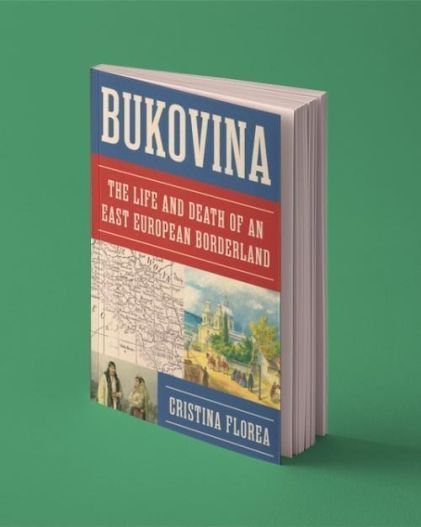
Book Symposium: "Bukovina: The Life and Death of an East European Borderland"
April 9, 2026
12:00 pm
Uris Hall, G08
"Bukovina: The Life and Death of an East European Borderland" (Princeton University Press, December 2025)
The making and remaking of Bukovina, a disputed Eastern European borderland, from the eighteenth century to the present day
Bukovina, when it has existed on official maps, has always fit uneasily among its neighbors. The region is now divided between Romania and Ukraine but has long been a testing ground for successive regimes, including the Habsburg Empire, independent and later Nazi-allied Romania, and the Soviet Union, as each sought to reshape the region in its own image. In this beautifully written and wide-ranging book, Cristina Florea traces the history of Bukovina, showing how this borderland, the onetime buffer between Christendom and Islam, found itself at the forefront of modern state-building and governance projects that eventually extended throughout the rest of Europe. Encounters that play out in borderlands have proved crucial to the development of modern state ambitions and governance practices.
Drawing on a wide range of archives and published sources in Russian, Ukrainian, German, Romanian, French, and Yiddish, Florea integrates stories of ethnic and linguistic groups—rural Ukrainians, Romanians, and Germans, and urban German-speaking Jews and Poles—who lived side by side in Bukovina, all of them navigating constant reconfiguration and reinvention. Challenging traditional chronologies in European history, she shows that different transformations in the region occurred at different tempos, creating a historical palimpsest and a sense among locals that they had lived many lives.
A two-hundred-year history of a region shaped by the conflicting pulls of imperial legacies and national ambitions, Bukovina reveals the paradoxes of modern history found in a microcosm of Eastern Europe.
About the speaker
Atina Grossmann is Distinguished Professor of History at the Cooper Union in New York City where she teaches courses on modern Europe, Fascism and National Socialism, the Holocaust, refugees and migration in global context as well as gender and sexuality studies. Relevant publications include: The Surviving Remnant: Documents on Jewish Displaced Persons in Postwar Germany 1945-1950 (with A.Kramen, A Patt, T. Lewinsky, 2024); chapter on “Aftermath” (with K. Bohus) in Cambridge Encyclopedia of the Holocaust (2015); Our Courage/Unser Mut: Jews in Europe after 1945 (with K. Bohus 2020), Shelter from the Holocaust: Rethinking Jewish Survival in the Soviet Union (with M.Edele and S. Fitzpatrick 2017), Wege in der Fremde: Deutsch-jüdische Begegnungsgeschichte zwischen New York, Berlin, und Teheran (2012), and Jews, Germans, and Allies: Close Encounters in Occupied Germany (Princeton 2007/09, German edition Wallstein 2012). as well as “Trauma, Privilege, and Adventure: Jewish Refugees in Iran and India” (in Jews and Colonialism, ed. Stefan Vogt, 2023). In 2022-23 she was the Ina Levine Invitational Senior Scholar in Residence at the Mandel Center for Advanced Holocaust Studies, USHMM. Her current research focuses on” Jewish Refugees from National Socialism in Iran and India: Between ‘Orient’ and European Catastrophe” as well as the entanglements of family memoir and historical scholarship.
Additional Information
Program
Einaudi Center for International Studies
Reppy Institute for Peace and Conflict Studies
Institute for European Studies
Information Session: Graduate Student Opportunities at the Einaudi Center

February 9, 2026
4:30 pm
Uris Hall, G08
Join us to learn about opportunities for graduate students with the Einaudi Center for International Studies. This session will discuss how to discover or strengthen global interests, including research and travel grants, guest lectures, fellowships, and more!
Can't attend? Email programs@einaudi.cornell.edu for more information.
Additional Information
Program
Einaudi Center for International Studies
Reppy Institute for Peace and Conflict Studies
East Asia Program
Southeast Asia Program
Latin American and Caribbean Studies
Institute for European Studies
South Asia Program
Migrations Program
Institute for African Development
Southwest Asia and North Africa Program
The TikTok China Question Is Being Swept Under the Rug

Sarah Kreps, PACS
Sarah Kreps, professor and director of the Tech Policy Institute at Cornell University, comments on the limits of the proposed TikTok oversight framework.
Additional Information
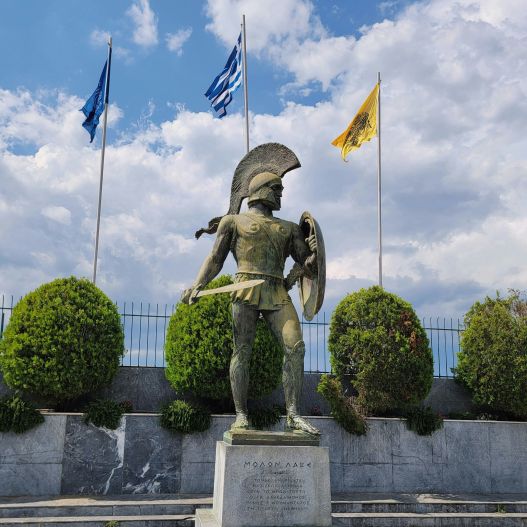
How Sparta, Invoked by Netanyahu and the Trump Team, Explains 2025
Barry Strauss, PACS
Barry Strauss, professor emeritus at Cornell University, discusses misconceptions about Sparta’s autarky and isolation.
Additional Information
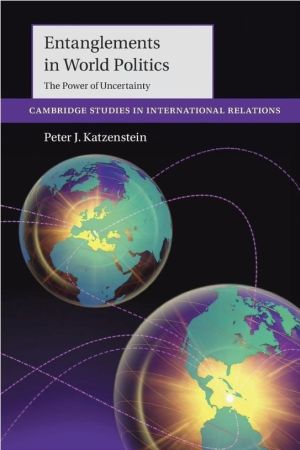
Entanglements in World Politics: The Power of Uncertainty
By Our Faculty
In this seminal study, Peter J. Katzenstein drags the analysis of world politics from the Newtonian humanism of the nineteenth century into a new post-Newtonianism of the twenty-first. The key concept is entanglement. By examining differences in context, process, and language, Katzenstein specifies how risk and uncertainty intertwine. Three deeply researched case studies – finance and political economy, nuclear crisis politics and war, and global warming and AI – support his original arguments. A chapter on power further illustrates the risk-uncertainty conundrum.
Book
Additional Information
Program
Type
- Book
Publication Details
Publication Year: 2025
Journal: Cambridge Studies in International Relations
ISBN: 9781009675819
Iran in Context: War and Its Return
March 5, 2026
4:45 pm
Uris Hall, G08
In light of the war with Iran, Arang Keshavarzian's book talk will now be a roundtable discussion on recent events. This conversation will examine the war with Iran beyond the headlines, situating this latest outbreak of violence within broader historical, social, and regional contexts and debates.
The event is hosted by the Southwest Asia and North Africa Program (SWANA), part of the Einaudi Center for International Studies, and cosponsored by the Department of Near Eastern Studies.
Panel
Arang Keshavarzian (Middle East Studies, New York University)Golnar Nikpour (History, Dartmouth College)Seema Golestaneh (SWANA director and Near Eastern Studies, Cornell University)Moderator: Mostafa Minawi (History, Cornell University).
***
About Arang Keshavarzian
Arang Keshavarzian is Professor of Middle Eastern and Islamic Studies at New York University. His research and teaching centers on questions of political economy of Iran and the wider Middle East. He has had a particular interest in the relationship between spatialization, capitalism, and political power. He is the author of Bazaar and State in Iran: The Politics of the Tehran Marketplace (Cambridge UP, 2007) and co-editor, with Ali Mirsepassi, of Global 1979: Geographies and Histories of the Iranian Revolution (Cambridge UP, 2021). His most recent book is Making Space for the Gulf: Histories of Regionalism and the Middle East (Stanford UP, 2024). It is the recipient of the 2025 Roger Owen Prize from MESA for best book in economic history, economics, and political economy, as well as an honorary mention for the 2025 biannual book award from the Association for Gulf and Arabian Peninsula Studies. His articles on various topics have appeared in several edited volumes as well as Politics & Society; International Journal of Middle East Studies, Geopolitics; Economy & Society; International Journal of Urban and Region Research, and Middle East Report.
Additional Information
Program
Einaudi Center for International Studies
Southwest Asia and North Africa Program
Institute for European Studies
South Asia Program
Reppy Institute for Peace and Conflict Studies
Bukovina: East European Microcosm
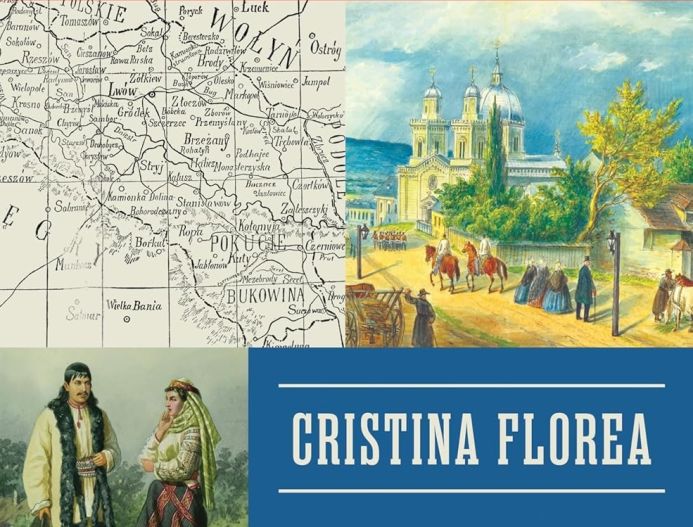
Cristina Florea in World in Focus
A new book from Cristina Florea (IES/PACS) recounts the complex history of Bukovina, a vanished borderland and buffer between Christendom and Islam. The region is now divided between Romania and Ukraine.
“[Bukovina] was a place where one might be born under one regime, grow up under another, come of age under a third, and die as a citizen of a completely different state. Within a single lifetime, people experienced multiple forms of government and were subjected to successive cultural and political projects.”
In Bukovina: The Life and Death of an East European Borderland (Princeton UP: December 2025), Cristina Florea tells the story of a place that no longer appears on maps, but continues to be shaped by competing national ambitions and the afterimages of successive empires.
Drawing on sources in Russian, Ukrainian, German, Romanian, French, and Yiddish, the book integrates stories of rural Ukrainians, Romanians, Germans, and urban German-speaking Jews and Poles who lived side by side in Bukovina—all navigating constant change and reinvention.
Today, Bukovina is once again at the center of geopolitical realignment, Florea said: “It is home to refugees fleeing eastern Ukraine and shaped by the afterlife of yet another empire: the Soviet Union. The story I tell in this book, as it has become painfully clear, has not ended.”
After the book's publication on December 16, Florea spoke with the College of Arts and Sciences about how the small borderland of Bukovina found itself at the forefront of modern state-building and governance projects that eventually extended through the rest of Europe.
“Enlightenment-era imperial projects, liberalism and its limits, competing nationalisms, two world wars, occupations and liberations, postwar reconstruction, and the dilemmas of governing diversity,” she said, “all unfold here almost as if we were watching Europe’s history on fast-forward.”
Cristina Florea is the Institute for European Studies Director's Faculty Fellow. She is an assistant professor of history (A&S) and frequent media voice on current events in Central and Eastern Europe.
Featured in World in Focus Briefs
Additional Information
Topic
- World in Focus
Program
Greenland: The Last Colony in Europe
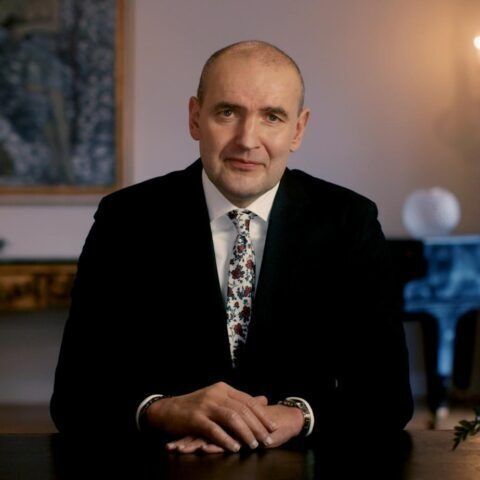
March 19, 2026
12:00 pm
Clark Hall, 700
Guðni Th. Jóhannesson, former President of Iceland and current professor of history at the University of Iceland, explores Greenland’s complex path from colony to emerging nation—and its future, as seen from its closest European neighbor.
Drawing on Iceland’s own experience of gaining independence from Denmark, he examines the historical ties, political tensions, and geopolitical stakes that shape Greenland’s future amid growing great-power interest in the Arctic. The lecture offers a unique perspective from nearby Iceland on Greenland and broader questions of sovereignty, self-determination, and small-state resilience in an era of global change.
About the Speaker
Guðni Th. Jóhannesson is a 2026 Messenger Lecturer at Cornell. He served as the sixth president of Iceland from 2016 to 2024. Running as an independent, he won the 2016 election with a plurality of the vote, becoming the youngest person ever to serve as Iceland's president. His approval rating reached an unprecedented 97% in his first term. During his years in office, he elevated Iceland's international profile and advocated for human rights, inclusive democracy, climate action, and renewable energy solutions. As a historian at the University of Iceland, his research focuses on modern Icelandic history. He has published works on the Cod Wars, the 2008–2011 Icelandic financial crisis, and the Icelandic presidency.
***
About the Event
This lecture is hosted by the Reppy Institute for Peace and Conflict Studies, part of the Einaudi Center for International Studies. It is cosponsored by the Einaudi Center's Institute for European Studies and the Cornell Brooks School Tech Policy Institute.
Guðni Th. Jóhannesson's visit is sponsored by the Messenger Lecture series.
Additional Information
Program
Einaudi Center for International Studies
Reppy Institute for Peace and Conflict Studies
Institute for European Studies
Voices of Resilience
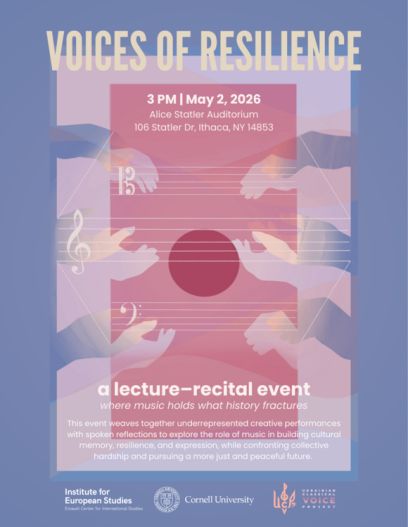
May 2, 2026
3:00 pm
Alice Statler Auditorium
“Voices of Resilience” is a lecture-recital presentation developed in collaboration with the Ukrainian Classical Voice Project, a non-profit organization, and enabled by the Mario Einaudi Center for International Studies and sponsored by the Institute for European Studies.
The program interweaves performance with spoken reflection to explore the role of music as a vehicle for peace-making, solidarity, and unity in the face of hardship.
Centering marginalized and underrepresented creative voices, the event highlights music as a powerful site of cultural memory, resilience, and collective expression.
Through music and dialogue, the presentation engages themes of culture, poetry, narrative, migration, and peace pedagogy, affirming the vital role of artistic collaboration in fostering global understanding, shared hope, and a collective pursuit of a more just and peaceful future.
Additional Information
Program
Einaudi Center for International Studies
Institute for European Studies
Migrations Program
Reppy Institute for Peace and Conflict Studies