
Reppy Institute for Peace and Conflict Studies
Information Session: Fulbright U.S. Student Program
November 17, 2025
4:45 pm
The Fulbright U.S. Student Program supports U.S. citizens to study, conduct research in any field, or teach English in more than 150 countries. The program is open to graduate students, recent graduates, and young professionals. Undergraduate students who wish to begin the program immediately after graduation are encouraged to start the process in their junior year. Recent graduates are welcome to apply through Cornell.
The Fulbright program at Cornell is administered by the Mario Einaudi Center for International studies. Applicants are supported through all stages of the application and are encouraged to start early by contacting fulbright@einaudi.cornell.edu.
Register for the virtual session.
Can’t attend? Contact fulbright@einaudi.cornell.edu.
Additional Information
Program
Einaudi Center for International Studies
Reppy Institute for Peace and Conflict Studies
East Asia Program
Southeast Asia Program
Latin American and Caribbean Studies
Institute for European Studies
South Asia Program
Migrations Program
Institute for African Development
Southwest Asia and North Africa Program
Monitoring and Accompanying Peacebuilding Processes in Post-Accord Contexts: The Case of Colombia
November 6, 2025
12:00 pm
Uris Hall, G08
This lecture discusses the concept of peace agreements as platforms for constructive social change, which requires authentic engagement and institutional transformations. It posits that signing peace accords is an important yet, alone and by itself, an insufficient step towards peacebuilding. Rather, the challenge of peacebuilding after wars lies in a robust implementation of the commitments reached at the negotiation table. Dialogue and inclusion during the negotiations needs to be permanent and continued after the signature. This lecture discusses these aspects in particular in the Colombian case, and highlights the role of third-party monitors in accompanying the process.
About the speaker
Josefina Echavarría Álvarez is professor of the practice and the director of the Peace Accords Matrix (PAM) program at the Kroc Institute for International Peace Studies, part of the Keough School of Global Affairs at the University of Notre Dame. She leads PAM’s researchers, faculty and staff in the South Bend campus, as well as PAM’s field units that carry out official monitoring of the implementation of peace accords in real time. In Colombia, PAM’s Barometer Initiative carries out official monitoring of the entire 2016 Final Peace Agreement between the Colombian government and the former FARC-EP guerrillas. In the Philippines, in partnership with Catholic Relief Services (CRS) Philippines, PAM-Mindanao provides monitoring methodology and technical assistance to measure the progress of the Normalization Annex of the 2014 agreement between the Government of the Philippines and the Moro Islamic Liberation Front (MILF). Josefina also directs the Legacy Project for “Preserving and Engaging the Digital Archive of the Colombian Truth Commission", which guarantees continued access to more than 200,000 files including audiovisual, non-textual knowledge and digitized documents compiled by the Colombian Truth Commission.
Host
Reppy Institute for Peace and Conflict Studies, part of the Einaudi Center for International Studies
Additional Information
Program
Einaudi Center for International Studies
Reppy Institute for Peace and Conflict Studies
Latin American and Caribbean Studies
Is (Cutting) International Aid Good?
October 22, 2025
5:00 pm
Goldwin Smith Hall, G76, Lewis Auditorium
Lund Critical Debate
Since January 2025, the United States has slashed billions in international aid—and effectively dismantled the U.S. Agency for International Development (USAID), responsible for administering U.S. development and humanitarian aid around the world. In what has become the largest restructuring of aid in the nation’s history, thousands of UN-administered programs have also lost funding, disrupting critical programs and services, breaking supply chains, and leading to widespread closures and layoffs.
These sweeping cuts affect food security, global health, democratic governance, and more—and the stakes have never been higher. As the landscape of international aid evolves, the world faces new questions about the impact of aid on communities, what makes international aid effective—and how to move forward.
This year's Lund debate from the Mario Einaudi Center for International Studies brings together policy and practice experts for an unfiltered look at the future of international aid. Join Einaudi Center faculty Chris Barrett (Dyson/Brooks) and Muna Ndulo (Law) as they tackle these questions: Who benefits from aid? Do some types of aid work better than others? Should we pursue new approaches to international development? What are the best ways to take strategic action in the world while investing in America’s security, economy, and global position?
***
Interested in attending? Complete this RSVP.
***
Panelists
Chris Barrett is the Stephen B. and Janice G. Ashley Professor of Applied Economics and Management in the Dyson School of Applied Economics and Management and a professor in the Cornell Brooks School of Public Policy. He is coeditor-in-chief of the journal Food Policy and a frequent commentator and policy advisor on food security and agricultural economics. Barrett won the USAID Science and Technology Pioneers Prize (2013), among many other awards for research, teaching, and public outreach. Read recent Chronicle coverage of Barrett's research.
Muna Ndulo is the William Nelson Cromwell Professor of International and Comparative Law at Cornell Law School and an internationally recognized scholar in the fields of constitution making, governance and institution building, international criminal law, African legal systems, and human rights. Ndulo has served as consultant to the African Development Bank, World Bank, Economic Commission for Africa, United Nations Development Program, and other international organizations. He led the Einaudi Center's Institute for African Development from 2001 to 2020.
Moderator
Paul Kaiser is the Einaudi Center's practitioner in residence in fall 2025. Kaiser has extensive experience in international development, with a focus on sub-Saharan Africa, South Asia, and the Pacific Islands. His career spans roles at USAID, the Millennium Challenge Corporation, and World Bank. Previously, Kaiser taught political science and African studies at Mississippi State University and the University of Pennsylvania.
***
About the Debate
The Lund Critical Debate is a signature event of the Mario Einaudi Center for International Studies. Established in 2008, Einaudi's Lund Debate series is made possible by the generosity of Judith Lund Biggs '57.
Additional Information
Program
Einaudi Center for International Studies
Reppy Institute for Peace and Conflict Studies
East Asia Program
Southeast Asia Program
Latin American and Caribbean Studies
Institute for African Development
Institute for European Studies
South Asia Program
Migrations Program
Southwest Asia and North Africa Program
US Says 'Framework' for TikTok Ownership Deal Agreed with China

Sarah Kreps, PACS
Sarah Kreps, director of the Tech Policy Institute at Cornell University, raises concerns about data security and algorithm control in the proposed TikTok ownership deal.
Additional Information
Research at Risk: Cultural and Language Fluency
SEAP and SAP lose funding, seek solutions
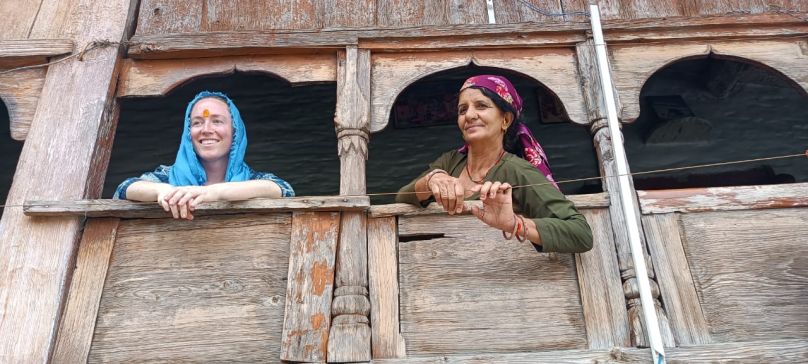
The federal government has announced the end of National Resource Center and FLAS funding, which have supported area studies training for decades.
Additional Information
Faculty Research Seed Grants: Global Hubs Info Session
October 1, 2025
12:00 pm
Join this info session to learn about 2026 Global Hubs Faculty Research Seed Grants offered by Global Cornell as part of our Global Hubs initiative. Info session attendees will learn about the grant opportunity and application tips through a short presentation and Q&A.
Through these seed grants, Cornell faculty from across the university are invited to apply for research funds to work with collaborators at Hubs partner institutions. Funded projects should lead to tangible outcomes, including the submission of at least one co-authored peer-reviewed publication and at least one application for external grant funding.
Up to 20 applications for research with a Global Hubs collaborator will be funded.
Successful proposals will receive up to $5,000 from Cornell, with the potential for matching funds from some Global Hubs partner universities.
Application deadline: October 15, 2025, 4:00 p.m. ET
Project duration: January 1–December 31, 2026
Virtual information sessions:
September 18, 2025, 12:00–1:00 p.m. ET (register)
October 1, 2025, 12:00–1:00 p.m. ET (register)
Learn more and apply for a Global Hubs joint seed grant.
Additional Information
Program
Einaudi Center for International Studies
Latin American and Caribbean Studies
Reppy Institute for Peace and Conflict Studies
East Asia Program
Southeast Asia Program
Institute for African Development
Institute for European Studies
South Asia Program
Migrations Program
Southwest Asia and North Africa Program
Faculty Research Seed Grants: Global Hubs Info Session
September 18, 2025
12:00 pm
Join this info session to learn about 2026 Global Hubs Faculty Research Seed Grants offered by Global Cornell as part of our Global Hubs initiative. Info session attendees will learn about the grant opportunity and application tips through a short presentation and Q&A.
Through these seed grants, Cornell faculty from across the university are invited to apply for research funds to work with collaborators at Hubs partner institutions. Funded projects should lead to tangible outcomes, including the submission of at least one co-authored peer-reviewed publication and at least one application for external grant funding.
Up to 20 applications for research with a Global Hubs collaborator will be funded.
Successful proposals will receive up to $5,000 from Cornell, with the potential for matching funds from some Global Hubs partner universities.
Application deadline: October 15, 2025, 4:00 p.m. ET
Project duration: January 1–December 31, 2026
Virtual information sessions:
September 18, 2025, 12:00–1:00 p.m. ET (register)
October 1, 2025, 12:00–1:00 p.m. ET (register)
Learn more and apply for a Global Hubs joint seed grant.
Additional Information
Program
Einaudi Center for International Studies
Latin American and Caribbean Studies
Reppy Institute for Peace and Conflict Studies
East Asia Program
Southeast Asia Program
Institute for African Development
Institute for European Studies
South Asia Program
Migrations Program
Southwest Asia and North Africa Program
18 Cornellians Receive Fulbright Awards

With Support from Einaudi
They will conduct research, study, and teach English in Canada, France, Honduras, India, Jamaica, the Netherlands, Norway, and Taiwan.
Most will be on site by October.
The Fulbright program is the U.S. government's flagship international educational exchange program. The Einaudi Center administers the Fulbright program at Cornell, providing all the resources students and alumni need to apply for Fulbright funding for international experiences.
Cornell consistently ranks as a “top producer” among universities with the highest number of candidates selected for the Fulbright U.S. Student Program. With this year's Fulbrighters, we are celebrating over 600 awards since the 1940s!
We're excited to congratulate conservationist Kyrin Pollock, one of this year's five Fulbright–National Geographic Award recipients—and the first Cornellian ever to receive the prestigious award. Kyrin will spend the year working with the Olokhaktomiut Hunters and Trappers Committee in Ulukhaktok, Canada, to document how industrial noise is transforming Arctic waters. Watch for more news about her journey from National Geographic and Einaudi.
The next cycle of Fulbright U.S. Student Program is open now. The Einaudi Center encourages Cornell undergraduate students, graduate students, and recent alumni to explore the opportunity and apply.
Meet the Fulbrighters

Alexis Anderson '23
Honduras
Research: Impacts of Coastal Pollution on Stony Coral Tissue Loss Disease in Roatán, Honduras
“Improving the knowledge base on how SCTLD spreads is critical to help stop further global expansion of the disease.”
Erin Connolly '22
Norway
Research: Phorid Fly Biodiversity Across the Latitudinal Gradient of Norway
“Early months of my work in Trondheim will be based in the laboratory …, while the later months of the award will be dedicated to … a diurnal sampling scheme fieldwork project.”
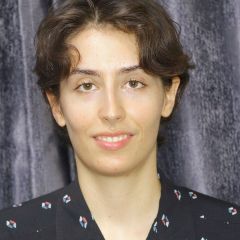
Isabella Culotta '22
Netherlands
Master of Design: Probing Our Perceptions of Waste at the Design Academy of Eindhoven
“Our aversion to speaking and even thinking about our waste constrains our discovery and implementation of innovative waste management systems.”
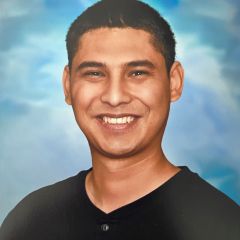
Gabriel Godines '23
Taiwan
English Teaching Assistant
“My experience in the U.S. Navy sparked my interest in East Asia, particularly in fostering understanding between the U.S. and China.”
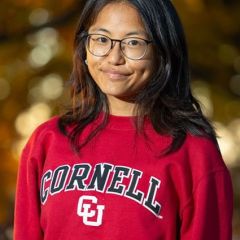
Tenzin Kunsang '25
India
Research: Reconceptualizing Education in Exile: Transnationalism in the Tibetan Children's Village
“These findings will help … to promote domestic language and cultural preservation among Tibetan-American students amid the politicization of schools in Tibet.”

Michelle Lee '25
France
English Teaching Assistant
“Due to the COVID-19 pandemic in 2020, I missed an opportunity to study abroad in France. This setback has motivated me to regain the chance to experience the country firsthand.”
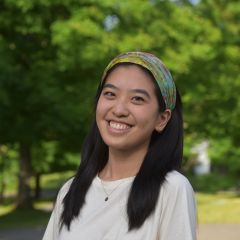
Tiffany Liu '22
Taiwan
English Teaching Assistant
“I … hope to observe the various technological initiatives currently pioneered by the Ministry of Education in Taiwan, including the movement to integrate AI.”
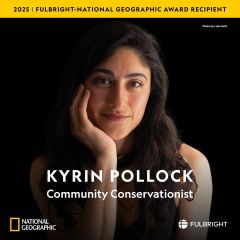
Kyrin Pollock, MEng '19
Fulbright–National Geographic Award Recipient (Canada)
Research: Arctic Echoes: Exploring Inuvialuit Knowledge and Marine Soundscapes in Conservation
“My work will address a gap in Arctic marine bioacoustics research … with documentation of Indigenous knowledge and an audio sample of the changing Arctic Ocean soundscape.”
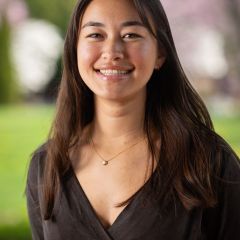
Caitlyn Sams '25
Jamaica
Research: Herbal Medicine in Oncology: Safety of Psilocybin and Cancer Therapy Co-Medication
“This project will … spark conversations about herbal medicine use and promote avenues for holistic cancer care.”
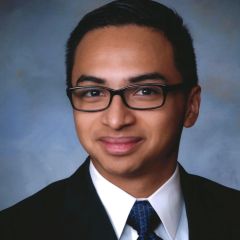
Miguel Soto Tapia '20
Taiwan
English Teaching Assistant
“I want to undertake an English teaching assistantship in Taiwan because I love language, teaching, and mentoring.”
Apply for Fulbright
The Einaudi Center supports you throughout the entire process of applying. The Fulbright U.S. Student Program is open to undergraduate students, graduate students, and recent Cornell alumni.
Additional Information
Information Session: Global Research Fellows
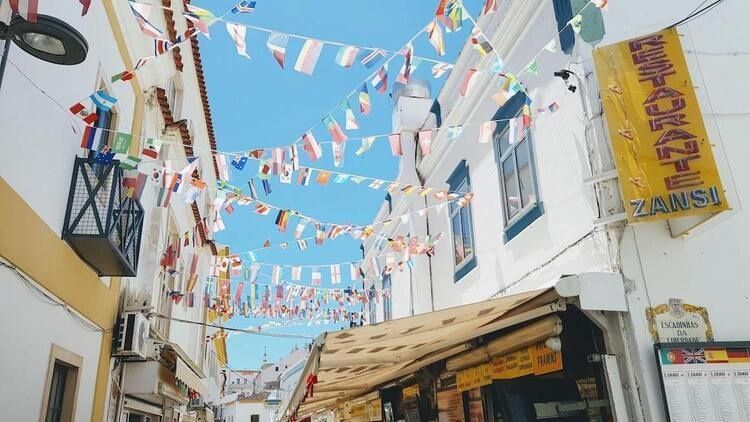
September 11, 2025
4:30 pm
Uris Hall, G08
Global Research Fellows are a new interdisciplinary research and professional development community at the Einaudi Center for advanced graduate students, Cornell postdocs, and visiting and local scholars. You'll find a community of fellow researchers with regional and international interests and a desire to foster a more equitable world.
Eligible students:
• Have completed at least two years of graduate education
• Engaged in research on a topic of global or regional studies significance
• Hold a strong desire to impact global challenges and create real-world solutions
• Interested in engaging and collaborating with other researchers
Can’t attend? Contact programs@einaudi.cornell.edu.
***
The Mario Einaudi Center for International Studies hosts info sessions for graduate and for undergraduate students to learn more about funding opportunities, international travel, research, and internships. View the full calendar of fall semester sessions.
Additional Information
Program
Einaudi Center for International Studies
Reppy Institute for Peace and Conflict Studies
East Asia Program
Southeast Asia Program
Latin American and Caribbean Studies
Institute for African Development
Institute for European Studies
South Asia Program
Migrations Program
Southwest Asia and North Africa Program
The Nevada-Semipalatinsk Movement: Transnational Activism in a Time of Transition

By Our Faculty
Matthew Evangelista, emeritus professor of history and political science, writes about antinuclear activism at the end of the Cold War in his latest article.
Article
Additional Information
Program
Type
- Article
Publication Details
Publication Year: 2025
Journal: Journal of Cold War Studies
Publication Number: 27:2