
Reppy Institute for Peace and Conflict Studies
Cybersecurity Expertise: Practice, Performance, Power

June 17, 2022
9:30 am
This two-day workshop aims to center analysis of the people, organizations and work that ultimately make and break cybersecurity. However, it aims to do so in a way that bridges the gap between two very different kinds of methods and theoretical perspectives: science and technology studies, which tends to adopt a grounded and “bottom-up” approach to analysis; and international relations, which tends to take more of a “top-down” approach that centers nation-states and the international system.
SCHEDULE
THURSDAY, JUNE 16 - 9:45 am - 5:00 pm (ET)
9:45—10:15 am Welcome and Lightning Round
Workshop participants will be asked to introduce themselves in 1-2 minutes.
Panel 1 -10:15 – 12:15 PM THREATS
Chair: Sarah Kreps, Cornell University
Discussant: Frank Smith, Naval War College
Whose Expertise? The Static, Contingent, and Recursive Strategies of Malware Analysis and Detection
Andrew Dwyer, Durham University
Dark champions: The Emergence of Commercial Cyber Threat Intelligence in Great Power Competitor States
JD Work, Columbia University
The Making of Cyber(in)security: Sociotechnical Practices and Anticipation of Future Threats
Lilly Muller, Kings College London
Protest, Police, and the Sociotechnical Construction of Threat
Jason Ludwig and Rebecca Slayton, Cornell University
Panel 2 -1:15 – 2:45 PM HACKERS
Chair: Rebecca Slayton, Cornell University
Discussant: Jesse Sowell, University College London
The Hack-and-Leak
Gabriella Coleman, Harvard University
Computer Security and Its Discontents: The Anti-Security Movement, 2000 – 2002
Matt Goerzen, Harvard University
Bounty Everything: Hackers and the Making of the Global Bug Marketplace.
Ryan Ellis, Northeastern University; Yuan Stevens
Panel 3 - 3:30-5:00 PM MATERIALITY
Chair: Lilly Muller, Cornell University
Discussant: Aaron Gluck-Thaler, Harvard University
The Casual Counterfeiter in the Age of Desktop Publishing
Gili Vidan, Cornell University
Black sites: cybersecurity expertise and digital absence
James Shires, Leiden University
The Blurry Lines Between Operations and Information
Clare Stevens, Bristol University
FRIDAY, JUNE 17, 9:30 am-1:30 pm (ET)
Chair: Lilly Muller, Cornell University
Discussant: Jon Lindsay, Georgia Tech
Panel 1 - 9:30 am-11:30 am ORGANIZATIONS
The Technopolitics of Cybersecurity Incident Response
Rebecca Slayton and Frank Smith
Collective Resistance in the Digital Domain: An Exploratory Case Study of the Cyber Partisans
Max Smeets, ETH Zurich
Global Innovation, Knowledge Management, and Cybersecurity: UK Universities as a Case Study
Madeline Carr, University College London
Operational Epistemic Authorities in the Internet's Infrastructure
Jesse Sowell, University College London
12:30 - 1:30 pm FUTURE DIRECTIONS
Open discussion of research gaps and next steps
SPONSORED BY
Reppy Institute for Peace and Conflict Studies
Mario Einaudi Center for International Studies
U.S. National Science Foundation Award # 1553069.
Register here : https://cornell.zoom.us/meeting/register/tJwpd-yvqz4oE9Ld5SDfXOhPZkxFpC…
Additional Information
Program
Einaudi Center for International Studies
Reppy Institute for Peace and Conflict Studies
Congratulations, Faculty and Students

Einaudi Awards Fund Global Research and Activities
Einaudi awarded seed grants, student travel grants, and internships totaling $355,000. Congratulations to this year's recipients!
Additional Information
June Opportunities for Faculty
ICC Grants and Fulbright-Hays FRA
Get funding support for your international teaching and research. Letters of intent due in June! Find out how to apply.
Additional Information
Ukraine: War, Economy, Path to Rebuilding
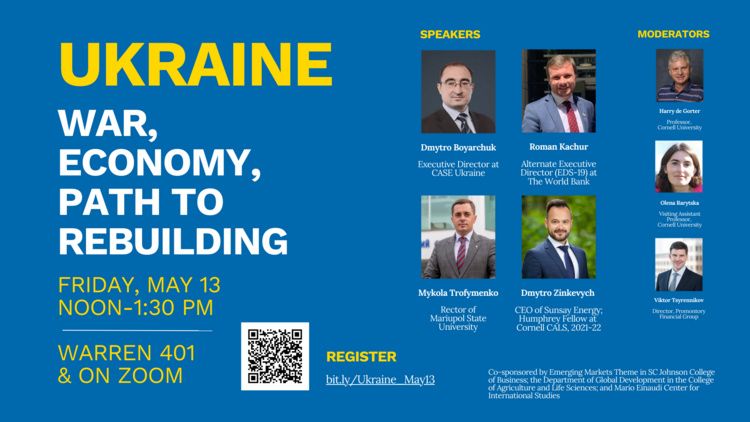
May 13, 2022
12:00 pm
Warren, 401
Hybrid event: Warren 401 and on Zoom. Now in its third month, the unfolding crisis in Ukraine has killed thousands, displaced millions, and destroyed civil infrastructure throughout the country. The damages to Ukraine's economy exceed $1 trillion by some estimates. While the war is far from the end, a panel of Ukrainian experts will converge at Cornell for a hybrid event to discuss the war, economy, and the path to rebuilding. This is a hybrid event. Guests are welcome to attend the event at Warren 401 on the Cornell campus or take part on Zoom. Speakers: Dmytro Boyarchuk will be speaking from Ukraine, where he is executive director at CASE Ukraine. He has extensive expertise in macro-economic forecasting, social policy and fiscal sector. He will be speaking from UkraineRoman Kachur is alternate executive director at the World Bank. Before the World Bank, Roman worked as a deputy finance minister in Ukraine and is an expert on international finance. He will be speaking from the United StatesMykola Trofymenko is the rector at Mariupol State University. He will be speaking from UkraineDmytro Zinkevych is the CEO of Sunsay Energy, a company that provides solar energy solutions in Ukraine, and he is a current a Humphrey fellow at Cornell studying challenges and solutions in the renewable energy sector. He will be speaking from the United States.Moderators: Harry de Gorter, professor at CornellOlena Rarytska, visiting assistant professor at CornellViktor Tsyrennikov, director at the Promontory Financial Group Co-sponsors: Emerging Markets Theme in the SC Johnson College of Business, the Department of Global Development in the College of Agriculture and Life Sciences, and the Mario Einaudi Center for International Studies.
Additional Information
Program
Einaudi Center for International Studies
Institute for European Studies
Reppy Institute for Peace and Conflict Studies
The Long History of Disinformation During War

Barry Strauss, PACS
Barry Strauss, professor of humanistic studies, writes this piece about the history of disinformation during war.
Additional Information
Inequalities, Identities, and Justice - International Studies Summer Institute 2022

June 28, 2022
9:00 am
A.D. White House
The 2022 International Studies Summer Institute (ISSI), a professional development workshop for practicing and pre-service K–12 teachers hosted annually by the Cornell University Einaudi Center for International Studies in collaboration with the Syracuse University South Asia Center, will be exploring inequalities, identities, and justice.
During this cross-curriculum workshop, educators will engage in activities that integrate world-area knowledge from regions such as South Asia, Southeast Asia, Latin America, and Africa by exploring inequalities, identities, and justice, both historical and contemporary issues. Teachers will explore ideas on how to use the experience of the protests against racism and structural inequality, which crescendoed in the United States and more than 60 countries around the world in 2020. Doing so will grant them extensive knowledge about intersectional inequalities worldwide where marginalized groups struggle to access resources, health, rights, security, and well-being. Topics will address inequalities experienced across the globe, including cleavages in a society like race, religion, gender and sexuality, class, caste, language, and ethnicity.
The nature of this theme, the 2022 ISSI, will be suitable for elementary, middle, and high school teachers from various disciplinary backgrounds. Participating teachers will complete a lesson plan that incorporates content from the workshop with the support and guidance of our outreach staff.
Topics and list of presenters:
Social injustices vulnerabilities and climate change in the Brazilian Amazon, by Fabio ZukerFábio will present how climate change exacerbates already existing inequalities, injustices, and vulnerabilities, taking as a departing point his own fieldwork at the Tapajós River (Pará Brazilian amazon), and the questions around the denial of indigenous identity by soy farmers. He will also mention other examples of how environmental conflicts and soybean expansion in the savannah-like biome named cerrado have exacerbated the sanitary vulnerabilities of the Xavante people during the Covid-19 pandemic.
Education and Social Transformation of Africa: Historical and Contemporary Factors of Gender Inequality, by N’Dri Assie-Lumumba The contemporary European-inherited systems of formal education that were introduced to African societies during the colonial era, were at their inception imbued with inequality on various grounds. Among the grounds of inequality, the gender-based imbalance was the most persistent, with typical patterns of female under-representation in education. In the 20th century, after independence, there was considerable progress in female enrolment, due to robust policies. However, in many countries, a plateau had peaked dating decades back. However, numerous reforms that are in place, lack either consistent implementation or tend to reproduce and intensify gender inequality. The gaps, which exist at the basic level, tend to generally widen in higher education. Furthermore, post-secondary education tends to be characterized by gender-based disciplinary clusters that have negative implications for the female population. These distortions impede access to education for girls and women, a basic human right. Furthermore, considering the centrality of formal education that translates to socio-economic attainments of individuals, families, and ultimately national development of the State, it is imperative to undertake educational policies that are transformational.
Hindu Exceptionalism in India, by Mona Bhan In this talk, Bhan discusses how Narendra Modi and his right-wing Hindu allies’ from the BJP, India’s ruling Hindu majoritarian political party, have diligently promoted “Hindu exceptionalism” as a framework for everyday governance (Bhan and Bose 2020). A vital goal of the BJP government since it came to power in 2014 was to establish India as a “Hindu Rashtra (nation)” and frame Muslims as foreign invaders responsible for diminishing Hindu glory and weakening India’s ancient and unique Hindu civilization. Bhan draws from her ethnographic fieldwork in the Indian-occupied region of Kashmir to discuss how Hindu exceptionalism has sanctioned unprecedented violence against Kashmir’s Muslim populations. She also explores how this legitimized settler-colonial interventions to materialize India’s transformations into a Hindu Rashtra.
The Rohingya Question in Myanmar’s Rakhine State, by Kyaw Yin Hlaing Since 2012, Myanmar's Rakhine State has been a site of communal violence and human rights violations. While around a million Rohingya now live in Bangladesh as refugees, hundreds of thousands of others were (and remain) internally displaced. A large majority of Rohingya have lost not only their homes, but also their citizenship and access to higher education and proper medical care. Mutual misunderstandings and lack of trust between Rohingya and members of other ethnic groups, especially the Rakhine, have caused persistent communal tensions that often boil over into communal violence. As a result, Rakhine State had become the most volatile state in Myanmar. However, there have recently been some positive developments. Awareness-raising on social cohesion by local civil society organizations and the political changes that have occurred following the military coup in 2021 have contributed to these improvements. This talk will explain how communal tensions between the Rohingya and other ethnic groups have evolved and how recent political changes have contributed to ameliorating these tensions in Rakhine State.
Teaching ‘the East’ in ‘the West’: From Postcolonial Theory to Pedagogical Practice, by Dr. Andrew Harding One of the major criticisms levelled at area studies disciplines over the last twenty years is that the division of the globe into distinct geo-political regions (e.g. “East Asia”) was initially undertaken in the interest of U.S. national security, rather than with a mind to greater cross-cultural understanding and collaboration. As a result, flagship Area Studies classes such as “Introduction to Japan” have tended to posit the target culture as an object “over there” which requires analysis precisely because it is distinct from “our” way of life “over here”. In a world in which border- and culture-crossing is increasingly the normal experience however, this assumed affinity between region and identity is becoming rapidly out of date and, from the perspective of students, largely irrelevant to their experience of the world as a single global continuum. In this presentation, I foreground a pedagogical approach in which I center authorial positionality, rather than national positionality, in relation to East Asian histories and societies. Rather than assuming that an author speaks for Japan, for example, what might it mean to think of them writing from or even to Japan? Why limit area studies to a study of those we assume to be from or representative of the “area” at all? By thus foregrounding an approach to “area” from a social, rather than national-cultural positionality, students are encouraged to consider social relations as a global operation, rather than one that is nationally or even culturally confined.
Registration is required https://bit.ly/22ISSI
Sponsored by Syracuse University, Moynihan Institute for Global Affairs, South Asia Center, Cornell University’s Mario Einaudi Center for International Studies, Southeast Asia Program, South Asia Program, Institute for African Development, East Asia Program, Latin American Studies Program, Cornell Institute for European Studies, TST-BOCES, U.S. Department of Education Title VI Program
Additional Information
Program
Einaudi Center for International Studies
Reppy Institute for Peace and Conflict Studies
East Asia Program
Southeast Asia Program
Latin American and Caribbean Studies
Institute for African Development
South Asia Program
Institute for European Studies
"I see your humanity"

Nobel Laureate Offers Wisdom for Forging Lasting Peace
Leymah Gbowee spoke to a crowd of more than 450, with hundreds more online, at the first in-person Bartels lecture since 2019.
Additional Information
Bartels Video on YouTube

Leymah Gbowee's May 3 Lecture
Miss the Bartels lecture? Watch Nobel peace laureate Leymah Gbowee speak at Cornell.
Additional Information
PACS Faculty Member Discusses "The Politics of Maps"

Christine Leuenberger, PACS
The Politics of Maps: Cartographic Constructions of Israel/Palestine (Oxford University Press, 2020) blends science and technology studies, sociology, and geography with archival material, in-depth interviews and ethnographies to explore how the geographical sciences came to be entangled with the politics, territorial claim-making, and nation-state building of Israel/Palestine.
Additional Information
Domestic and Global Politics of Police Violence

Sabrina Karim, PACS/SAP/IAD
Awarded an NSF Career award, Professor Sabrina Karim in the Government Department is developing research on the domestic and global politics of police violence to confront the challenge of excessive and/or illegitimate violence around the world.