
South Asia Program
Chinese Users Don’t Need a Central Bank Digital Currency, But There’s Good Reason for It: Professor

Eswar Prasad, SAP
Eswar Prasad, professor of economics and international trade policy, talks about why the People’s Bank of China wanting a digital currency.
Additional Information
The Most Important Meeting Yet for Global Pandemic Response — and Drugmakers

Kaushik Basu, SAP
In this op-ed, Kaushik Basu, professor of economics, and Nicole Hassoun, a former Einaudi Center visiting scholar, argue that global health leaders must adopt a treaty on pandemic preparedness and response and that it must prioritize new incentives for pharmaceutical companies and equity between nations.
Additional Information
Afghan Students Find Haven at Cornell
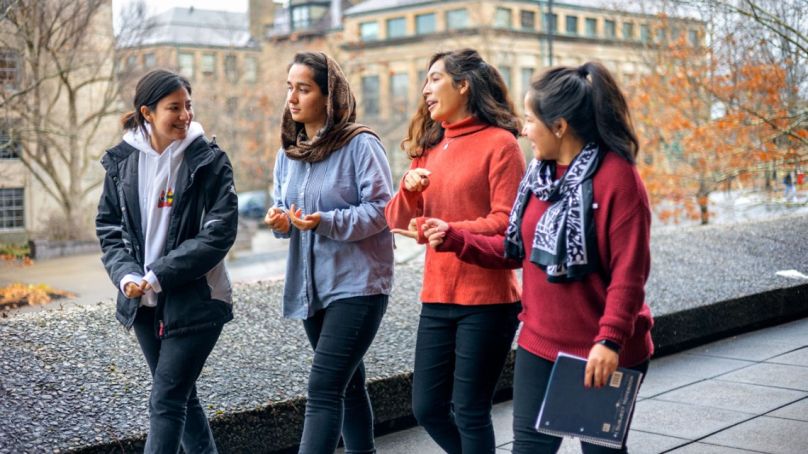
Einaudi Center Welcomes Women Scholars
“The events that brought these students here are traumatic, but their stories demonstrate real bravery and leadership,” said VP Wendy Wolford.
Additional Information
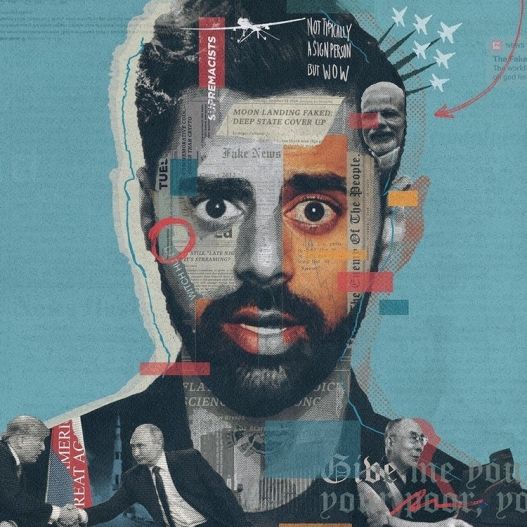
Caricaturing Religious Difference and the Pop Culture Muslim
February 21, 2022
12:15 pm
Uris Hall, G08
Talk by Samah Choudhury (Religious Studies, Ithaca College)
Our contemporary moment has witnessed a precipitous rise in the presence of American Muslim comedians in pop culture - on television, movies, and on the stage. I map their unprecedented popularity to the contemporary moment when American “Muslim” humor is named as such, as well as the complications that arise from imposing a religious referent interchangeably with terms like “racial” or “ethnic” as they relate to the constitution of the 21st-century Western subject. This gendering, racialization, and a growing progressive consensus on issues of intersectionality have come to provide a common language for comedians to identify as Muslim over strictly racial and ethnic nomenclature. Yet this humor replicates a subjugating racialized, religionized, and "masculine" vision of Islam – outside of themselves – by limiting its articulation to normative Sunni ideals and injunctions. For comedians like Hasan Minhaj, there is an inconsistent stepping in and out in of language that names him as Muslim, Indian, Desi, or simply “brown” that relies on aesthetics of American Blackness to register an opposition to white secularity.
Samah Choudhury is an Assistant Professor of Religious Studies at Ithaca College. Her research surrounds Islam, humor, and the politics of social legibility in the United States. Her current book manuscript looks at the ways that Islam and Muslims are articulated through standup comedy and how they speak back to broader transnational practices and discourses of race, masculinity, and secularism. She holds a PhD from UNC Chapel Hill in Religious Studies.
Co-sponsored by the Asian American Studies Program and the Religious Studies Program.
Photo: Netflix/Patriot Act with Hasan Minhaj
Additional Information
Program
Einaudi Center for International Studies
South Asia Program
JP Morgan Boss Regrets Saying Bank Will Outlast Chinese Communist Party

“Dimon’s apology shows the degree of deference foreign businesses have to show to the Chinese government in order to remain in its good graces and maintain access to the country's markets,” says Eswar Prasad, professor of economics and international trade policy.
Additional Information
Ayesha Matthan

Graduate Student
Ayesha Matthan is a PhD student in the department of History of Art and Visual Studies. She is interested in photojournalistic practices, popular visual culture and politics in the Indian subcontinent from the 19th century to the present day.
She holds a Bachelors in English Literature from St. Stephen’s College, Delhi and a degree in Journalism from the Asian College of Journalism, Chennai. She was subsequently an arts journalist with the national daily The Hindu in Bangalore.
Additional Information
Future Directions in the Study of Migration and Racial Justice: A Postdoctoral Symposium

December 8, 2021
4:00 pm
Uris Hall, G-08
The Mario Einaudi Center for International Studies, in partnership with the Society for the Humanities, presents this symposium featuring five cutting-edge researchers whose work crosses disciplinary lines to tackle some of the world’s most pressing problems.
Join postdoctoral fellows Mohamed Abdou, Eman Ghanayem, Bamba Ndiaye, Eleanor Paynter, and Grace Tran for a discussion of their work in the fields of migration studies and global racial justice. Topics will include identity, colonialism and decolonization, indigeneity and dispossession, refugee studies and mobility, economic and social justice, and critical race theory. Learn how new approaches and developments are changing scholarship in these critical fields.
Einaudi Center director Rachel Beatty Riedl will introduce the event, and Viranjini Munasinghe (Department of Anthropology) will moderate.
Speakers
Mohamed Abdou, Global Racial Justice Postdoctoral Fellow, Einaudi Center"Non-statist Indigenous and Muslim Conceptualizations of Sovereignty: The Decolonial Inseparability of Race from Religion"
Eman Ghanayem, Mellon Postdoctoral Fellow, Department of Comparative Literature and Society for the Humanities"Being Native, Being Refugee"
Bamba Ndiaye, Mellon Postdoctoral Fellow, Department of Music and Society for the Humanities"From Mbas Mi to Mbëkk Mi: Covid-Induced Migration and Social Movement Advocacy in Senegal"
Eleanor Paynter, Migrations Postdoctoral Fellow, Einaudi Center"Witnessing Migration 'Crises': Race, Coloniality, and Asylum in Italy"
Grace Tran, Migrations Postdoctoral Fellow, Migrations Initiative"What’s Love Got to Do With It?: Transformative Effects of Vietnamese-American Engagement in 'Marriage Fraud' Arrangements"
Additional Information
Program
Einaudi Center for International Studies
Reppy Institute for Peace and Conflict Studies
East Asia Program
Southeast Asia Program
Latin American and Caribbean Studies
Institute for African Development
Institute for European Studies
South Asia Program
Laidlaw Scholars Info Session: support for first- and second-year research projects

November 30, 2021
5:00 pm
Tatkon Center, 105 RPCC
Learn about the Laidlaw Undergraduate Leadership and Research Program. Open to first- and second-year students, this 2-year program provides generous support to carry out internationally-focused research, develop leadership skills, engage with community projects overseas, and join a global network of like-minded scholars from more than a dozen universities.
Join us to learn more about the program, its benefits, and the application process, as well as tips for approaching potential faculty research mentors and writing a successful application. Sponsored by the Tatkon Center for First-Year Students and the Mario Einaudi Center for International Studies.
Additional Information
Program
Einaudi Center for International Studies
Reppy Institute for Peace and Conflict Studies
East Asia Program
Southeast Asia Program
Institute for African Development
Institute for European Studies
South Asia Program
Latin American and Caribbean Studies
Biden Sells Infrastructure Improvements as a Way to Counter China

Eswar Prasad, SAP
“It’s an important step, although it’s not a huge one, if one thinks about the progress China has made in building up its physical and soft infrastructure,” says Eswar Prasad, professor of economics and trade policy. Prasad also discusses President Biden’s meeting with President Xi Jinping of China in The Wall Street Journal.
Additional Information
"Strange Parallels: Consecrated Chinese Buddhist Images in Context"
December 3, 2021
12:00 pm
Please join us for a talk by James Robson 羅柏松 (James C. Kralik and Yunli Lou Professor of East Asian Languages and Civilizations, Harvard University).
It has become increasingly well-known that religious statues throughout Asia have hidden cavities that are filled with various objects inserted during a consecration ritual. This talk explores the hidden world of these statues through a discussion of a large collection of statues from throughout East Asia (China, Korea, Japan, and Vietnam), including some intriguing European examples. The history of such images has been the object of much research in Japan and Korea that this talk will also use to contextualize the Chinese Buddhist images. These statues provide a valuable glimpse of local religion, ritual practice, lay devotion, and sutra fragments. These statues also raise a host of significant interpretive questions for historians of religion, including issues such as the place of icon animation, idolatry, and iconoclasm in Chinese Buddhism and Chinese Religious history generally. The images discussed in this talk contain a niche carved into their back (or sometimes in the uṣṇīṣa, base, or pedestal) that is filled with a variety of objects, including relics, religious manuscripts and printed texts, medicinal herbs, desiccated insects, talismans with magical writing, and a “consecration certificate” or “vow text.” These statues are ubiquitous but have had a particularly intriguing history of visibility and concealment in East Asia and in Western scholarship. This talk will raise questions about why sacred images and icons such as these have been objects of extreme devotion for some, but also presented problems for priests, politicians, missionaries, philosophers, and academics who for various reasons have found them distasteful, attacked their validity and power, and have tried to hide them away or destroy them. Why, even in the face of ideological critique and iconoclastic destruction, have they persisted and proliferated?
The Cornell Buddhist Studies Seminar Series is co-sponsored by the GPSA-FC, the Departments of Anthropology, Asian Studies and Philosophy, by the South Asia Program, and by the Society for the Humanities. The talk is open to all interested; for accessibility queries please contact buddhiststudies@cornell.edu
Additional Information
Program
East Asia Program
Southeast Asia Program
South Asia Program