
Southeast Asia Program
The 27th Cornell SEAP Graduate Student Conference: Mobility
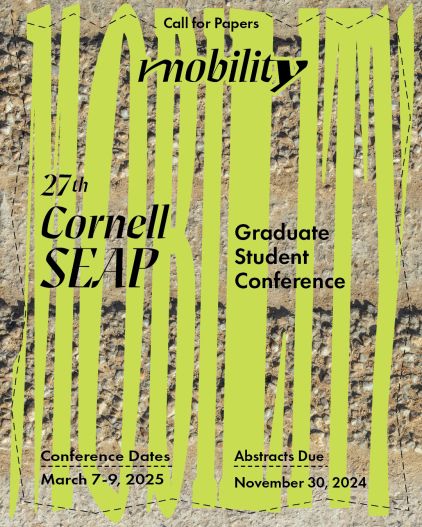
Abstracts due November 30
How is Southeast Asia animated and made to move? Who crosses boundaries, who stays still, and what jams, messes, conscriptions, and inscriptions are we bound to? Resisting both dreams of frictionless passage and fantasies of fixed origins, the theme of the 27th SEAP Graduate Student Conference waves in reflections on mobility and its constraints. We await explorations of that which is trans (-national, -Pacific, -imperial, -gressive) or in trans (-ition, -mission, -lation). We welcome interrogations on that which is mobile yet clandestine, unintended, or interrupted. What kinetic energies are released by diasporas in seeds, chemicals, finances, and tastes? What constitutes the motion in activist, insurgent, protest, or resistance movements, and who moves against the movers? What disturbed temporalities, what uncertain spatialities, what contingent choreographies are produced by the travel of soldiers, pollutants, scientists, viruses, and images of young hippos in Thai zoos? Moo Deng and we invite submissions which agitate stagnant pools of nationality and syncopate staid rhythms of history. Viewing the academy itself as a site of stupor, we also welcome scholarship which unsettles the heavy dust of area studies.
Additional Information
CFP: Teach a GETSEA Mini-Course
Open to faculty from any institution
The consortium for Graduate Education and Training in Southeast Asian Studies (GETSEA) has funding to offer a series of non-credit, specialized mini-courses to be held online through synchronous video-conferencing. The primary focus should be Southeast Asia and can be on any topic or in any discipline, incorporating voices and perspectives from Southeast Asia. Multidisciplinary and cotaught collaborative courses are encouraged. We particularly welcome courses with a narrow focus on particular topics which might not normally be taught as a full semester-long course.
Additional Information
Information Session: Laidlaw Research and Leadership Program

November 13, 2024
12:00 pm
The Laidlaw Undergraduate Leadership and Research Program promotes ethical leadership and international research around the world—starting with the passionate leaders and learners found on campuses like Cornell. Open to first- and second-year students, the two-year Laidlaw program provides generous support to carry out internationally focused research, develop leadership skills, engage with community projects overseas, and become part of a global network of like-minded scholars from more than a dozen universities. We’ll also share tips for approaching potential faculty research mentors and writing a successful application.
Register for the virtual session.
Can’t attend? Contact laidlaw.scholars@cornell.edu.
***
The Mario Einaudi Center for International Studies hosts info sessions for graduate and for undergraduate students to learn more about funding opportunities, international travel, research, and internships. View the full calendar of fall semester sessions.
Additional Information
Program
Einaudi Center for International Studies
Reppy Institute for Peace and Conflict Studies
East Asia Program
Southeast Asia Program
Latin American and Caribbean Studies
Institute for African Development
Institute for European Studies
South Asia Program
Migrations Program
Vietnamese Conversation Hour
December 6, 2024
3:00 pm
Stimson Hall, G25
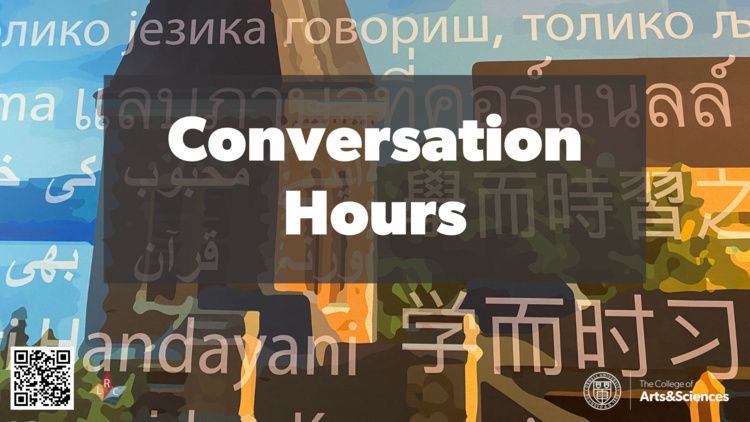
Come to the LRC to practice your language skills and meet new people. Conversation Hours provide an opportunity to use the target language in an informal, low-pressure atmosphere. Have fun practicing a language you are learning! Gain confidence through experience! Just using your new language skills helps you learn more than you might think. Conversation Hours are open to any learner, including the public.
Additional Information
Program
Southeast Asia Program
Experts Look Abroad for Lessons in Super Election Year

"Democracy is on the ballot"
Ten area studies and government experts weigh in on worldwide elections.
Additional Information
Information Session: East Asia Program Funding Opportunities
October 30, 2024
2:00 pm
Uris Hall, G08
The East Asia Program (EAP) offers several categories of fellowships and grants to support student and faculty research and study related to East Asia:
EAP Graduate Area Studies Fellowships East Asian Language Study Grants EAP Research Travel GrantsCan’t attend? Contact eap@cornell.edu.
Additional Information
Program
Einaudi Center for International Studies
Reppy Institute for Peace and Conflict Studies
East Asia Program
Southeast Asia Program
Latin American and Caribbean Studies
Institute for African Development
Institute for European Studies
Indonesian Conversation Hour
December 5, 2024
12:00 pm
Stimson Hall, G25
Come to the LRC to practice your language skills and meet new people. Conversation Hours provide an opportunity to use the target language in an informal, low-pressure atmosphere. Have fun practicing a language you are learning! Gain confidence through experience! Just using your new language skills helps you learn more than you might think. Conversation Hours are open to any learner, including the public.
Additional Information
Program
Southeast Asia Program
Exhibit opening - The Making of Barkcloth: Place, Gender, and Trans-Local Community

October 2, 2024
4:30 pm
Human Ecology Building (HEB), Rachel Hope Doran and Terrace Level Display Cases
Please join us at the Rachel Hope Doran '19 & HEB Level T Display Cased at the College of Human Ecology, for the opening of "The Making of Barkcloth: Place, Gender, and Trans-Local Community." The exhibition is curated by Human Centered Design PhD Student Iris Luo '27 and funded in part by the Charlotte Jirousek Fellowship.
Additional Information
Program
Southeast Asia Program
Barkcloth Conservation Workshop

October 2, 2024
1:00 pm
Human Ecology Building (HEB), 141
Conservation is a field at the intersection of art and science, requiring practitioners to have knowledge through both lenses. In this Barkcloth Conservation Workshop, we invite our special guest, Mimi Leveque, a trained archaeologist and lifelong conservator, who is an amazing and knowledgeable educator with extensive cross-cultural work experience. She worked for over twenty years at the Peabody Essex Museum in Salem, Massachusetts. In particular, she has worked with hundreds of historic bark cloths as part of the Bark Cloth Relocation Project at PEM.
In this workshop, you will observe and experience some simple hands-on learning of two primary approaches to barkcloth treatment - humidification and mending. This workshop is open and welcome to people with any level of knowledge and experience in textile conservation, passion is the most important thing!
Mimi Leveque is a conservator of objects and textiles with a special interest in indigenous organic materials and archaeological objects. Since 2021, she has been working on the Pacific Barkcloth Project at the Peabody Essex Museum, to conserve, document, and rehouse the collection of over 900 barkcloth objects. She has been on staff as conservator at the Peabody Essex Museum, the Museum of Fine Arts, Boston, and the Rhode Island School of Design Museum, Providence, as well as consulting for many museums and cultural institutions as the director ArchaeaTechnica Art Conservation Services.
Mimi received an M.A.C. in objects and textile conservation in 1978 from Queen’s University, Kingston, Ontario, Canada, and an M.A. in Western Asiatic Archaeology from the Institute of Archaeology (now University College), University of London, UK. She has done archaeological field conservation in such far-flung places as Iran, Pakistan, Syria, Italy, Peru, and England.
Additional Information
Program
Southeast Asia Program
The Making of Barkcloth: Place, Gender, and Trans-Local Community

January 10, 2025
8:00 am
Human Ecology Building (HEB), Rachel Hope Doran '19 & HEB Level T Display Cases
Barkcloth is a type of non-woven textile, made directly from the inner bark of trees through a process of soaking, fermentation, and beating. Throughout history, barkcloth has been made for everyday and ceremonial uses, and could be found all along the migratory routes of Austronesian-speaking ancestors. "The Making of Barkcloth: Place, Gender, and Trans-Local Community" invites you to explore the interconnectedness among the vast waters through the lens of barkcloth, the voyagers and makers who traverse these vast waters illuminate a form of mobility that transcends geographical regional boundaries. In the exhibition, we will take a close look at barkcloth – from the front, the back, and magnified – examining the surface and the structure. Similarly, contemporary artists and designers examine and innovate upon traditional techniques. And scholars dig into the archives to examine the fissures and faults of historic records. This is a journey along the ocean, connecting art and science, past and future.
The exhibition is curated by Human Centered Design PhD Student Iris Luo '27 and funded in part by the Charlotte Jirousek Fellowship.
Additional Information
Program
Southeast Asia Program