Southeast Asia Program
From Hornbills to All Birds: Indonesia’s Conservation Journey
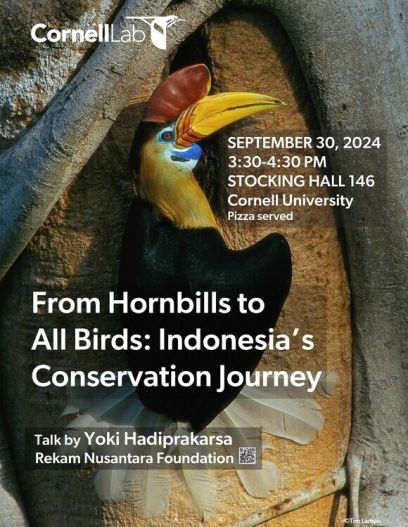
September 30, 2024
3:30 pm
Stocking Hall, 146
The Indonesian archipelago is home to a globally significant number of bird species, including endemics, but also holds the highest number of globally threatened species. The Helmeted Hornbill crisis in 2013, followed by the songbird crisis, are serious portraits of bird conservation issues in Indonesia. This talk will describe the journey of Indonesian bird conservation, which continues to fight against species extinction and map a better future for Indonesia's wildlife and people.
Speaker bio
Yokyok (Yoki) Hadiprakarsa is a seasoned wildlife conservation biologist with a tech-savvy approach and over 20 years of experience in spearheading conservation efforts throughout Indonesia and Southeast Asia. Currently serving as Director for the Forestry Program for Rekam Nusantara Foundation, Yoki is an alumnus of the University of Georgia’s Warnell School of Forestry & Natural Resources. Yoki’s expertise in wildlife conservation has been instrumental in various projects with international organizations like UNDP, SNV, MCA-I and USAID. A passionate hornbill conservationist, he has initiated numerous projects to protect these birds and combat their illegal trade, notably through CITES. Yoki holds key positions in the Indonesian Ornithologists' Union, the IUCN SSC Hornbill Specialist Group, and the IUCN SSC Indonesia Species Specialist Group. He co-founded the Rekam Nusantara Foundation, which aims to better understand Indonesia through science-based approaches.
Additional Information
Program
Southeast Asia Program
Urban Ecologies on the Edge: A GETSEA Community Book Read by Kristian Karlo Saguin
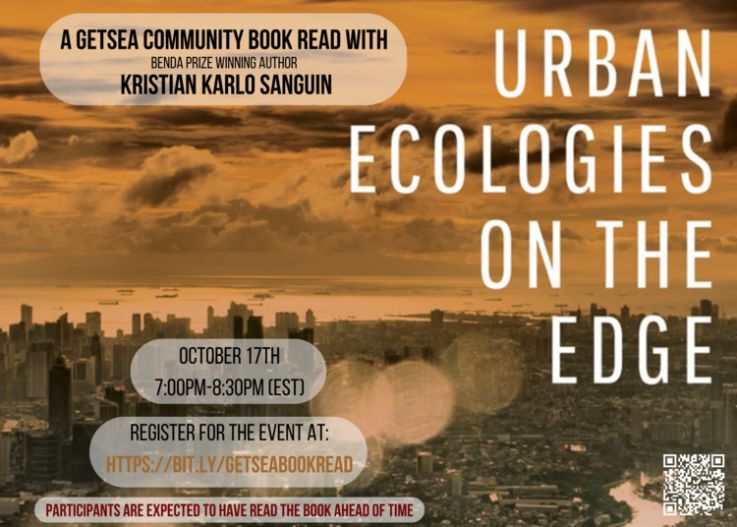
October 16, 2024
7:00 pm
A community book read with Kristian Karlo Saguin, author of Urban Ecologies on the Edge: Making Manila’s Resource Frontier and winner of the 2024 Benda Prize.
Register here for the Zoom link. Participants are expected to have read the book.
Urban Ecologies on the Edge offers an innovative and theoretically groundbreaking perspective on the production and maintenance of new resource frontiers on the edge of a rapidly expanding city in the Global South. Using the case study of Laguna Lake in Metro Manila, Saguin demonstrates with methodological versatility the dynamic relationship between economic development and environmental management as diverse stakeholders attempt to access and control commodity flows within chains of urban provisioning. Through meticulous storytelling, the book artfully traces the intertwined socioecologies of floods, food, fish, fisherfolk, and infrastructures. With precision and clarity, it reveals how human and nonhuman actors contend for diverse and increasingly exhausted resources, while confronting risk and precarity that manifest in conflicting visions of the future sustainability of the lake and surrounding city.
Additional Information
Program
Einaudi Center for International Studies
Southeast Asia Program
Introduction to the Martial Law Digital Library
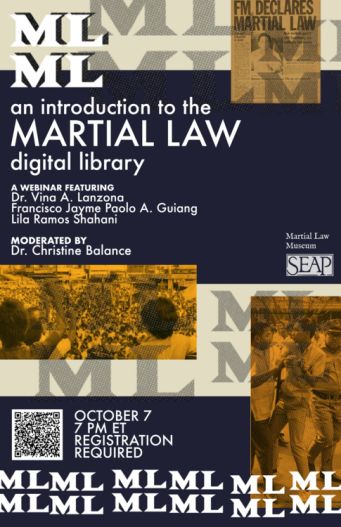
October 7, 2024
7:00 pm
A webinar featuring Vina A. Lanzona, Francisco Jayme Paolo A. Guiang, and Lila Ramos Shahani, moderated by Christine Balance and organized by the Southeast Asia Digital Library.
Vina A. Lanzona: "Origins and Vision of the Martial Law Library: Navigating the Difficult Philippine Past"
Associate Professor in History and former director of the Center for Philippine Studies at the University of Hawaii at Manoa
In this talk, Vina Lanzona will share the beginnings of the idea of a digital library of Martial Law materials, as well as the vision of the project. She will outline the major challenges as well accomplishments of this collaborative project that spans across countries, oceans and continents. Central to her presentation is to show how to navigate the website, taking all of us into a unique journey into this painful and controversial period in Philippine history.
Francisco Jayme Paolo A. Guiang: “Marcosian propaganda as fascist propaganda: Myth-making and historical distortions in the 21st century”
Assistant Professor at the Department of History, University of the Philippines Diliman
In this talk, Jio Guiang argues that Marcosian propaganda is a form of fascist propaganda that utilizes networked disinformation as a means to manipulate public discourse and generate mass support. In recent years, social media platforms have become conduits for political myth-making and historical distortions that ultimately subscribe to the playbook of “fascist propaganda” in the Philippines. Thus, this presentation will show examples of social media materials so as to reveal how some forces within the Philippine political establishment have deployed this type of propaganda to systematically weaponize disinformation and gain public support—a tactic that had been proven effective for the Rodrigo Duterte and the Ferdinand “Bongbong” Marcos Jr. regimes.
Lila Ramos Shahani: "Grieving the ungrievable: Trauma and Memory during Martial Law"
Expert Member of two International Scientific Committees of the International Council on Monuments and Sites (ICOMOS), where she specializes in the Interpretation and Presentation of Cultural Heritage Sites (ICIP) and Intangible Cultural Heritage (ICICH)
If memorials can be described as the performance of memory, which stories do they privilege, and which do they eclipse or deliberately erase altogether? Memorials (monuments, historical markers, art, texts) can also be seen as the materialization of certain stories. But memorialization paradoxically preserves, even as it represses, memory itself. It is this dialectical relationship between memory and memorialization, one that is unending and open-ended, that I seek to unpack. I look at the relationship between grieving and trauma -- how the two are inseparable yet unresolvable -- in relation to narratives of torture by survivors of Martial Law in the Philippines. Following Judith Butler’s notion of “grievability,” I ask: whose lives (and stories) have been deemed to be grievable, whose have not, and how have these calibrations influenced the way Martial Law has been commemorated? Based on first-hand interviews with survivors and numerous affidavits, I examine the relative absence of memorialization of Filipino Muslims (“Moros”), particularly women, whenever the brutal record of the Marcos regime is recalled.
Additional Information
Program
Einaudi Center for International Studies
Southeast Asia Program
GETSEA Simulcast Film Screening of "Breaking the Cycle"
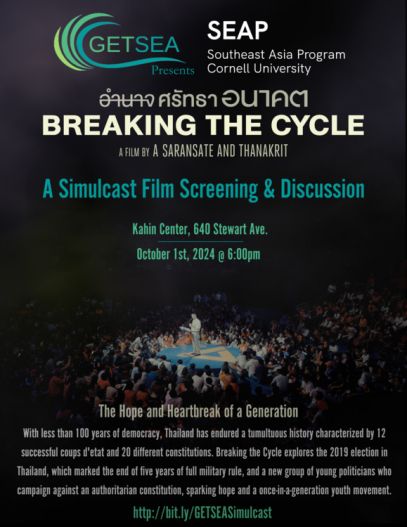
October 1, 2024
6:00 pm
Kahin Center
Breaking the Cycle captures the political awakening among Thais after the rise and fall of Thanathorn, a young politician who calls to end the cycle of coups d’etat. The film explores the 2019 election in Thailand, which marked the end of five years of full military rule and a new group of young politicians who campaign against an authoritarian constitution, sparking hope and a once-in-a-generation youth movement.
Screenings of the film will be held simultaneously at nineteen (19) university campuses across North America. Following the screenings, each campus will come together via Zoom for a discussion with the filmmakers, Aekaphong Saransate and Thanakrit Duangmaneeporn.
The Southeast Asia Program will host a screening at the Kahin Center, 640 Stewart Ave. A virtual-only option for the event will take place via Zoom at https://bit.ly/BreakingTheCycleSimulcast.
Additional Information
Program
Einaudi Center for International Studies
Southeast Asia Program
Across the Archives: Uncovering Hidden Actors in Anthropology Collections
November 21, 2024
10:00 am
A SEADL webinar featuring Amrina Rosyada and I Gde Agus Darma Putra, hosted by Emily Zinger, Southeast Asia Digital Librarian, Kroch Asia Collections Cornell University Library.
How can we use archives to build a narrative about behind-the-scene actors in research?
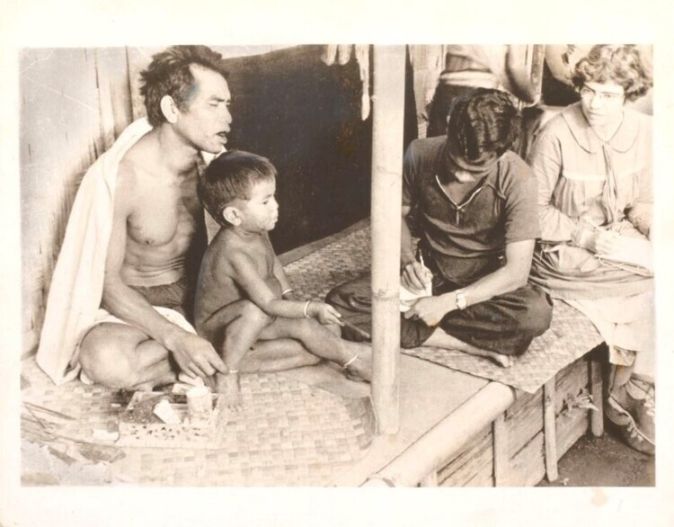
From the US to Indonesia, local research assistants have helped anthropologists with navigating their field sites. However, in the history of the discipline, many of their contributions and life histories remain obscure. In this webinar, we will discuss how we can use archives to highlight the contributions of local research assistants in knowledge production. Rosyada will focus on her research on I Made Kaler, superstar anthropologist Margaret Mead’s Balinese “native secretary” during her historically important fieldwork in Bali, Indonesia (1936 – 1939). Drawing from archives at the Library of Congress and the American Museum of Natural History, her research finds that Made Kaler was tremendously involved in Margaret Mead’s research through intellectual, language training, and domestic labor. Putra, who is fom Bali and translated Made Kaler’s archives into Bahasa Indonesia, will discuss how we can treat archives as “alive” by reflecting on his experience in exploring the traces of Made Kaler’s life in modern-day Bali. We hope to invite you to a conversation about the opportunities and challenges in using archives to build a narrative about important actors in academia who are historically invisible.
About the Speakers
Amrina Rosyada is a PhD candidate in Anthropology at Northwestern University. She wrote her master’s thesis on the invisible labors of a Balinese research assistant—named I Made Kaler—who contributed tremendously to the research work of cherished anthropologist Margaret Mead in Indonesia from 1936 to 1939. Her research has won three prestigious prizes from Asian studies and anthropology professional associations. She is currently doing fieldwork for her dissertation project on the politics of waste in Indonesia.
I Gde Agus Darma Putra is a lecturer at the Hindu Indonesia University. He is also a member of the IBM Dharma Palguna Foundation, which focuses on philological studies of texts written in the Kawi and Balinese languages. In recent years, he has also begun researching Balinese inscriptions written in the ancient Balinese script and language. He translated I Made Kaler’s Balinese fieldnotes into Bahasa Indonesia.
About the Photo
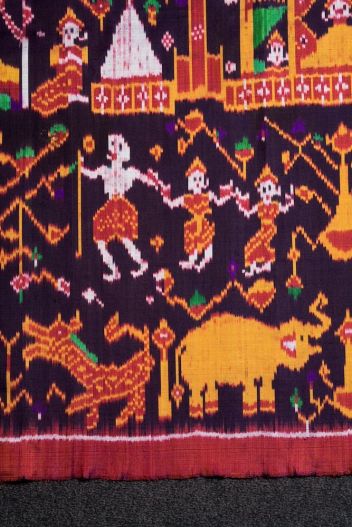
Credit to Margaret Mead Papers and the South Pacific Ethnographic Archives at the Library of Congress.
Additional Information
Program
Einaudi Center for International Studies
Southeast Asia Program
Information Session: Global Internships with Universidad San Francisco de Quito

October 28, 2024
1:00 pm
Go global in summer 2025! Global Internships give you valuable international work experience in fields spanning global development, climate and sustainability, international relations, communication, business, governance, and more.
This session will discuss opportunities with the Universidad San Francisco de Quito, a Cornell Global Hubs partner in Ecuador.
Register for this virtual session.
***
The Mario Einaudi Center for International Studies hosts info sessions for graduate and for undergraduate students to learn more about funding opportunities, international travel, research, and internships. View the full calendar of fall semester sessions.
Additional Information
Program
Einaudi Center for International Studies
Reppy Institute for Peace and Conflict Studies
East Asia Program
Southeast Asia Program
Latin American and Caribbean Studies
Institute for African Development
Institute for European Studies
Migrations Program
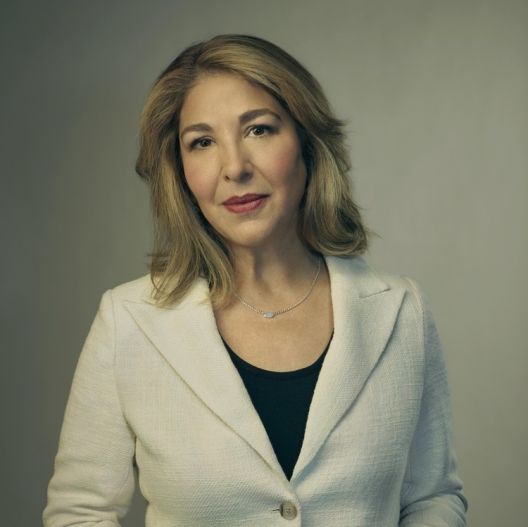
Naomi Klein: Doppelganger Politics
October 23, 2024
5:00 pm
Biotechnology Building, G10
Bartels World Affairs Lecture
The bestselling author of Doppelganger: A Trip into the Mirror World joins us for a personal journey down the conspiracy rabbit hole to explore why our political sphere has become dangerously warped.
When author and social activist Naomi Klein discovered a writer with the same first name but radically different political views was chronically mistaken for her, it seemed too ridiculous to take seriously—until suddenly it wasn’t. As the pandemic took hold, she absorbed a barrage of insults from her doppelganger’s followers.
Klein’s 2023 book Doppelganger follows Other Naomi into a digital underworld of conspiracies, anti-vaxxers, and right-wing paranoia. Klein’s journey reveals mirrored concerns and unlikely connections between well-meaning liberals and the right-wing voices that relish “owning” them.
After a talk sharing her insights, Klein joins distinguished global democracy experts from Cornell to lift the lid on this surreal election moment and examine how our politics have become so twisted and polarized. What can we do to escape our collective vertigo and get back to fighting for what really matters?
***
Panelists
Read election remarks from the panelists in Chronicle coverage of global democracy activities on campus.
Thomas Garrett, Einaudi Center Lund Practitioner in Residence, Distinguished Global Democracy Lecturer (Jeb E. Brooks School of Public Policy)Suzanne Mettler, John L. Senior Professor of American Institutions, Department of Government (College of Arts and Sciences)Kenneth Roberts (moderator), Einaudi Center Democratic Threats and Resilience faculty fellow, Richard J. Schwartz Professor, Department of Government (A&S)
***
This event is sold out.
All free tickets are reserved. If you don’t have a ticket but would like to attend, please arrive 15 minutes early to be put on our wait list.
A reception with refreshments will follow the lecture and panel.
Lecture and Panel: 5:00 | G10 Biotechology BuildingReception: 6:30-7:30 | Biotechnology Building Atrium
***
About Naomi Klein
Naomi Klein is an award-winning journalist and international bestselling author of nine books published in over 35 languages, including No Logo, The Shock Doctrine, and her most recent book Doppelganger: A Trip into the Mirror World (2023). A columnist for The Guardian, her writing has appeared in leading media around the world. She is a tenured professor of climate justice at the University of British Columbia, founding codirector of UBC’s Centre for Climate Justice, and honorary professor of media and climate at Rutgers University.
About the Bartels World Affairs Lecture
The Bartels World Affairs Lecture is a signature event of the Mario Einaudi Center for International Studies. This flagship event brings distinguished international figures to campus each academic year to speak on global topics and meet with Cornell faculty and students, particularly undergraduates. The lecture and related events are made possible by the generosity of Henry E. Bartels ’48 and Nancy Horton Bartels ’48.
Additional Information
Program
Einaudi Center for International Studies
Reppy Institute for Peace and Conflict Studies
East Asia Program
Southeast Asia Program
Latin American and Caribbean Studies
Institute for African Development
Institute for European Studies
South Asia Program
Migrations Program
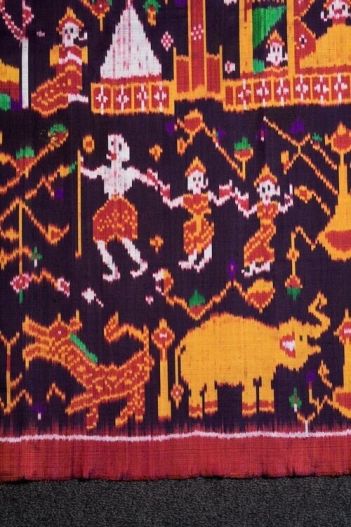
Southeast Asian Language Instruction: Sustainability through Collaboration
September 21, 2024
12:00 am
Africana Studies and Research Center
In a seminal conference, Southeast Asian language instructors from across the country will gather to celebrate the successes of the Southeast Asian Language Council (SEALC), and to plan for the future of Southeast Asian language instruction.
For further details and a full program of the weekend's events, visit the SEALC website.
Organized by the Southeast Asian Language Council (SEALC), hosted by the Cornell University
Southeast Asia Program (SEAP), and co-sponsored by Cornell Language Resource Center (LRC) and the Cornell Department of Linguistics.
Additional Information
Program
Einaudi Center for International Studies
Southeast Asia Program
Language ‘Sustainability through Collaboration’ Conference at Cornell
Via the Cornell Chronicle
Cornell, the only institution offering regular multilevel instruction in all six of the major Southeast Asian languages – Burmese, Indonesian, Khmer, Filipino (Tagalog), Thai and Vietnamese – will host a conference on the teaching of these languages on Sept. 19-21.
Additional Information
Einaudi Welcomes Migrations Program

New Migrations, EAP, SEAP Program Directors
Cornell’s first Global Grand Challenge continues this year as Einaudi's Migrations Program. We also welcome three program directors.
We're excited to announce that Cornell's Migrations initiative is stepping into a new phase as the Migrations Program, part of the Mario Einaudi Center for International Studies. Einaudi's newest regional and thematic program will build on the work of Migrations: A Global Grand Challenge to inform real-world policies and outcomes for populations that migrate.
Migrations researchers and students will continue the important work of studying movement across borders, racism and dispossession, and migration of all living things under the leadership of the program's new director, Kathryn Fiorella. Fiorella is an associate professor of public and ecosystem health in the College of Veterinary Medicine.
“We look forward to building the new Migrations Program at Einaudi to advance our understanding of migration and contribute to solutions for one of the most pressing challenges of our time.”
“I am excited to join Migrations and support scholarship and learning on this critical topic,” said Fiorella.
Fiorella plans to continue expanding Migrations' campuswide footprint established since Global Cornell launched the initiative in 2019.
“Migration has a profound impact on human and wildlife health,” she said. “I'm looking forward to furthering those connections and extending our engagement with faculty in the Master of Public Health program, Department of Public and Ecosystem Health, and College of Veterinary Medicine.”
New Program Directors
Joining the Migrations Program's Kathryn Fiorella are new fall 2024 program directors in the East Asia Program and Southeast Asia Program.
East Asia Program: John Whitman
John Whitman is a professor of linguistics in the College of Arts and Sciences (A&S). His main research focus is the problem of language variation in Japanese, Korean, and other languages.
Southeast Asia Program: Marina Welker
Marina Welker is a professor of anthropology in A&S. Her research centers on the ethical relationship between business and society. She is currently studying a clove cigarette company in Indonesia founded by a Chinese immigrant and controlled by his descendants until 2005, when it was taken over by Philip Morris International.