
Southeast Asia Program
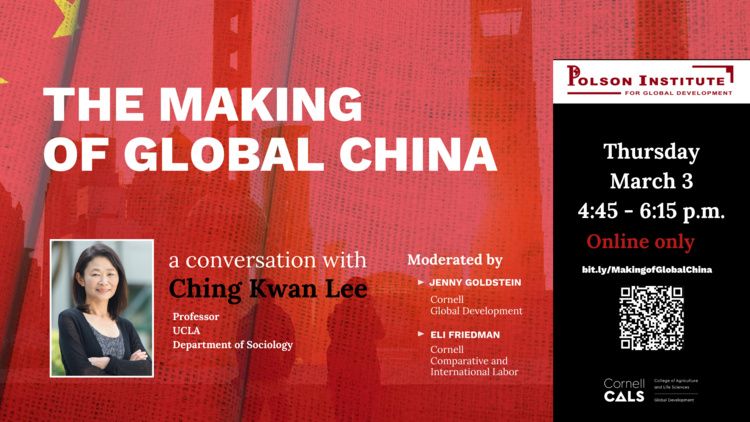
The Making of Global China
March 3, 2022
4:45 pm
Polson Institute for Global Development Seminar
A conversation with Ching Kwan Lee, UCLA
Professor Ching Kwan Lee explores the making of 'Global China' as an economic, cultural, and political phenomenon in this conversation with Jenny Goldstein (assistant professor of global development at Cornell) and Eli Friedman (associate professor and chair of international & comparative labor at Cornell)
Ching Kwan Lee is a Professor of Sociology at UCLA and author of three award-winning monographs on China: Gender and the South China Miracle: Two Worlds of Factory Women (1998); Against the Law: Labor Protests in China’s Rustbelt and Sunbelt (2007); and The Specter of Global China: Politics, Labor, and Foreign Investment in Africa (2017). Her most recent co-edited volumes include Take Back Our Future: an Eventful Sociology of the Hong Kong Umbrella Movement (Cornell University Press, 2019); and The Social Question in the 21st Century: A Global View (University of California Press, 2019).
Moderators:
Jenny Goldstein is an Assistant Professor in the Department of Global Development at Cornell University and a core faculty member of Cornell's Southeast Asian Studies Program. She works across the areas of political ecology, critical development studies, and human geography. She is co-editor of the forthcoming volume The Nature of Data: Infrastructures, Environments, Politics (Nebraska, 2022).Eli Friedman is Associate Professor and Chair of the Department of Comparative and International Labor at Cornell University. He is the author of Insurgency Trap: Labor Politics in Postsocialist China (Cornell 2014); and The Urbanization of People: The Politics of Development, Labor Markets, and Schooling in the Chinese City (Columbia, forthcoming Spring 2022).
The Robert A. and Ruth E. Polson Institute for Global Development supports theoretical and applied social science research. We fund projects and working groups that address issues ranging from economic inequality to discursive politics, contributing to Cornell’s leadership in global development.
Additional Information
Program
Einaudi Center for International Studies
East Asia Program
Southeast Asia Program
Re-envisioning SEAP’s Collaborative Afterschool Language and Culture Program

by Ava White, SEAP programming assistant
As featured in the Fall 2021 SEAP Bulletin, the Afterschool Language and Culture Program (ALCP) – offered through the Mario Einaudi Center for International Studies and managed by the South Asia and Southeast Asia programs – bridges connections between Cornell student volunteers and local K-12 students to foster meaningful language and culture engagement.
Gaining exposure to a variety of cultures in today’s increasingly globalized world is an important part of a K-12 student’s educational experience. Cornell student volunteers who speak foreign languages have worked with thousands of children in the local community to provide engaging experiences learning about other languages and cultures.
During the COVID-19 pandemic, the ALCP re-envisioned the way it operates, as in-person programming at local schools was not possible. In Ithaca and the surrounding areas, the local schools that previously hosted in-person volunteers with the Center’s Afterschool Language and Culture Program ceased normal operations, and students transitioned to online and hybrid learning arrangements.
While the ALCP wanted to bring language learning opportunities into local schools in a virtual capacity, an afterschool program was simply not possible. Teachers expressed concern with virtual after school or in-school collaborative programming for children at the K-12 level, as their students were struggling to adjust in the fully virtual and hybrid settings that had been implemented. This was compounded by the challenge of asking students to participate in yet another virtual session after school, given the level of “Zoom fatigue.”
However, the ALCP is a program with two goals: to provide opportunities for local K-12 students to engage with foreign languages in our increasingly interconnected world, and to provide opportunities for Cornell students to offer their language skills as service to the community and to learn about culturally-competent language education.
Despite the challenges posed by the pandemic, the Einaudi Center developed an engaging professional development opportunity for undergraduates interested in volunteering with the program – a chance for students to learn about language pedagogy, and to develop skills they could leverage for future teaching or while volunteering with the ALCP once pandemic restrictions ease.
The Einaudi Center offered three workshops in April 2021 to serve as a training opportunity for the 30 student volunteers who expressed an interest in volunteering with the ALCP, organized through a Canvas course. Ten to fifteen students attended each workshop, a mix of Ithaca College and Cornell University student volunteers with experience in a variety of languages including Vietnamese, Spanish, French, Italian, Mandarin and others.
Given Cornell’s lack of an education department, the ALCP recruited the expertise of education department faculty at Ithaca College for assistance with the project. This opened a dialogue between Ithaca College and the Einaudi Center, and we hope to explore a collaborative relationship moving forward into Fall 2021.
On April 7, 2021, Senior Lecturer of Global Development at Cornell, Dr. Jeff Perry provided a workshop on Developing Lessons from a Curriculum. The survey workshop stressed the iterative practices of developing lessons based on existing curriculum as well as using various methods and practices to help boost engagement in the classroom.
Dr. Ellie Fulmer, Associate Professor of Education at Ithaca College, presented a workshop on Learning about Students, Multisensory Activities and Assessment Tools, and the Practice of Lesson Design on April 14, 2021. Fulmer co-taught with the assistance of Ithaca College students Lillian Roman (Spanish Education) and Catriona Ferguson (Spanish and Education Studies). The workshop addressed how to consider students’ individual backgrounds when lesson planning and the practice of assessing the success of a lesson.
The third and final workshop in the series took place on April 21, 2021. Assistant Professor of Education at Ithaca College, Dr. Shuzhan Li provided a workshop to identify cultural strengths within diverse communities. Participants used critical race theory to analyze multimodal materials and collaboratively imagine ways to incorporate an asset-based approach in the After School Language and Culture Program.
As we look to the future, we hope to integrate the strengths of the virtual program into the in-person format moving forward. This fall, as vaccination rates increase and restrictions lift, we hope to once again return to local schools for in-person exchanges of culture and language outreach.
Volunteers with introductory, intermediate and advanced knowledge of foreign languages are encouraged to join the program! Please email outreach@einaudi.cornell.edu for updates on fall recruitment of volunteers!
Additional Information
Program
Gatty Lecture: The Balete in the Forest: Superstition and the Menace of Field Labor in Colonial Philippine Botany
February 24, 2022
12:15 pm
Kahin Center
Kathleen "Kat" Cruz Gutierrez is Assistant Professor of History at the University of California, Santa Cruz, where she teaches courses on modern Southeast Asia, the Philippines, and the history of science and the environment. She completed her Ph.D. in Southeast Asian Studies with a Designated Emphasis in Science and Technology Studies (STS) at the University of California, Berkeley. Her dissertation on the international consolidation of botany in the Philippines was shortlisted for Best Dissertation in the Humanities by the International Convention of Asia Scholars in 2021. With Paul Michael Atienza, she is guest co-editing a special issue on STS for Philippine Studies: Historical and Ethnographic Viewpoints. Presently, Dr. Gutierrez is in residence at the Humanities Institute of the New York Botanical Garden completing her first book manuscript.
This Gatty lecture will take place in person at the Kahin Center, but people are also welcome to join us on Zoom. Please register here if you wish to attend via Zoom: https://cornell.zoom.us/meeting/register/tJ0rduioqzgpHNMTX31Z7KpbwfHg58…
For questions, please contact seapgatty@cornell.edu.
In accordance with university event guidance, all campus visitors who are 12 years old or older must also present a photo ID, as well as proof of vaccination for COVID-19 or results of a recent negative COVID-19 test. If you are not currently participating in the Cornell campus vaccination/testing program, please bring proof of vaccination or the results of a recent negative test.
More information on acceptable documentation is available here: https://covid.cornell.edu/visitors/
Additional Information
Program
Einaudi Center for International Studies
Southeast Asia Program
SEA Digital Library Undergraduate Paper Award

Submit your class papers for an award!
We're pleased to share the attached Call for Papers for the 2022 Southeast Asia Digital Library Undergraduate Paper Award, open to students at all CORMOSEA affiliated institutions (see below for a list of eligible institutions). Please share this CFP with your students and encourage them to submit their work for consideration. This award is a wonderful means of engaging undergraduates with primary resources and promoting the use of Southeast Asian Studies digital collections, as well as a publication opportunity for your students.
If you have any questions about the award, please reach out to Emily Zinger, Southeast Asia Digital Librarian, emz42@cornell.edu.
The Southeast Asia Digital Library Undergraduate Paper Award seeks papers from undergraduates concerning original research in Southeast Asian Studies. The first place winner will receive their choice of two books from the Southeast Asia Program Publications catalog. Both first and second place winners will have their papers published on the Southeast Asia Digital Library
Applicants Eligibility
Applicants must be current undergraduate students at CORMOSEA affiliated institutions* at the time of submission. Applicants must agree that, should they win, their papers will be made openly accessible and published online on the Southeast Asia Digital Library
Paper Eligibility
Eligible papers must be within the field of Southeast Asian Studies and reference primary source materials. Papers may be written for a class or independent study within the past three academic years: Spring 2019 - Spring 2022. Papers must be between six to twenty pages in length, excluding references and figures.
Evaluation Criteria
Winning papers will demonstrate the student’s ability to support original research with analysis of primary source materials. Papers that reference materials held in Southeast Asia Digital Library collections will be given increased consideration.
Submission Materials
Submission packets should include a cover page containing the paper title, author name, author email, institutional affiliation, and date. Papers should be submitted as a separate PDF document listing only the title. No author information should be included in the paper itself to allow for blind evaluation.
Submission packets should be emailed to seadl@cornell.edu no later than May 2, 2022
*CORMOSEA Affiliated Institutions: Arizona State University; Cornell University; Harvard University; Indiana University, Bloomington; Michigan State University; Northern Illinois University; Ohio University; University of California, Berkeley; University of California, Los Angeles; University of California, Riverside; University of Hawai’i at Manoa; University of Michigan; University of Washington; University of Wisconsin-Madison; Yale University
Additional Information
Program
Multi-Generational Photovoices of Changing Traditional Farming Systems in Bali: Perspectives from the UNESCO Cultural Landscape
February 16, 2022
12:25 pm
Emerson Hall, 135
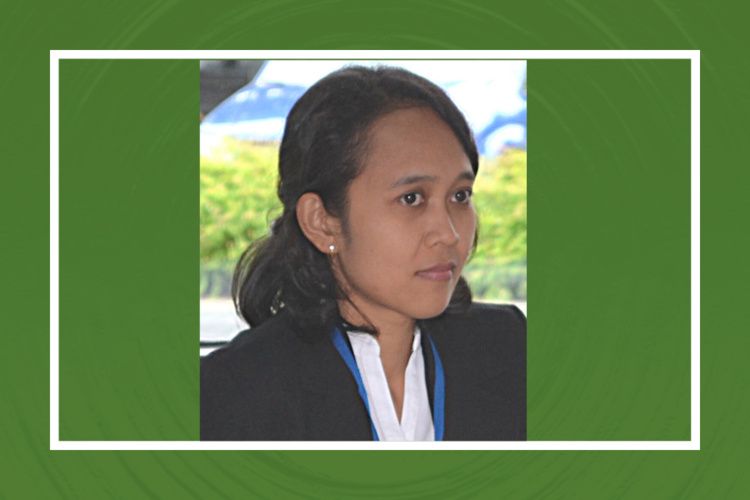
Perspectives in Global Development Seminar Speaker: Wiwik Dharmiasi, Dala Institute and University of Hawaii Location: Emerson 135 and Zoom The traditional farming system in Bali, known as subak, was inscribed as a UNESCO World Heritage Site in 2012. The subak represents water sharing practices in rice cultivation that has existed for over a thousand years. Increasing tourism development on the island, however, has threatened the existence of the subak system. Farmers face challenges in the form of land use change, reallocation of water rights, land taxation, and aging. Inscribing the subak as a World Heritage Site aimed to protect against these threats, but tourism impacts exacerbate challenges in UNESCO designated areas. This is due to a lack of mechanisms for incorporating farmer interests into management plans. This presentation describes engagement with subak farming families at the heart of the UNESCO site. Through a multigenerational photovoices initiative involving eight farming families over a period of two years, this presentation highlights key themes from local farmer perspectives. Overarching themes include: development and land use change; gender and labor; visitor management; and, generational inheritance of cultural practices. Methods of engaging local voices such as this assist in exploring pathways for developing targeted policies that better respond to local farming family concerns. About the Speaker Wiwik Dharmiasih's research focuses on Political Geography, Conflict Transformation, and Community-based Natural Resources Management. She has also worked on climate change adaptation initiatives involving local perspectives of change and supported disaster risk reduction efforts, with a special focus on issues related to water equity, youth, and women. She is currently a Ph.D. student at the Department of Geography and the Environment at the University of Hawaii. She also lectures in the Department of International Relations, Universitas Udayana and is a research associate at Dala Institute in Bali, Indonesia. She actively engages with World Heritage Watch, a network focused on protection, management, and conservation of UNESCO World Heritage Sites. She earned her B.A. in International Relations from the Universitas Pembangunan Nasional “Veteran” Yogyakarta in Indonesia, and an M.A. in Politics from the Jawaharlal Nehru University in New Delhi, India. About the seminar series The Perspectives in Global Development seminars are held Wednesdays from 12:25 – 1:15 p.m. eastern time during the semester. The series will be presented in a hybrid format with some speakers on campus and others appearing via Zoom. Students, faculty and the general public are welcome to attend. The series is co-sponsored by the Department of Global Development, the Department of Natural Resources and the Environment, the Charles H. Dyson School of Applied Economics and Management, and the School of Integrative Plant Science as part of courses IARD 6960, NTRES 6960, PLSCS 6960 and AEM 6960.
Additional Information
Program
Southeast Asia Program
The Sea Forsaken - Rabindrinath Tagore Lecture in Modern Indian Literature

April 22, 2022
4:45 pm
Kahin Center
By Cheran
In this lecture and reading, Cheran will reflect on the important but ambiguous relationship with the sea from both personal and communal perspectives. Drawing on and reading from his various poems about the sea and other water bodies, he will chart an alternative imagination for Tamil identities.
Dr. R. Cheran is Tamil Canadian academic, poet, playwright and journalist. He is a professor at the University of Windsor in Canada. He has authored over fifteen books in Tamil, and his work has been translated into twenty languages. Several volumes of his work have been published in English translation, including The Second Sunrise (Translated by Lakshmi Holmstrom, 2010), In a Time of Burning (Translated by Lakshmi Holmstrom and Sascha Ebeling, 2013) and You Cannot Turn Away (Translated by Chelva Kanaganayakam, 2011). His poems in English translation have also been published in numerous literary magazines, such as Bomb (New York), Modern Poetry in Translation, Many Mountains Moving, Exiled Ink, Mantra Review, and Talisman. His poems have been included in several anthologies, including Singing in the Dark: An Anthology of Lockdown Poems (2020), Many Roads Through Paradise: Sri Lankan Literature (edited by Shyam Selvadurai, 2014), and In Our Translated World: Global Tamil Poetry (edited by Chelva Kanaganayakam, 2014).
Cheran was the recipient of the International Poetry Award from ONV Kurup Foundation in Dubai in 2017. He has performed is poetry at various International Writers’ festivals in the United Kingdom, Singapore, the US, Indonesia, India, Sweden, the Netherlands, Canada, Ramallah, West Bank, Dubai and Mexico. His plays in English language have been produced and performed in Toronto, Canada, New York, Chicago and New Jersey in the US. Singapore’s modern dance group Chowk has produced and performed a dance play based on his poems titled “The Second Sunrise”. The Second Sunrise was performed at the Singapore International dance festival, and Washington’s Kennedy Centre for the Arts.
The Rabindranath Tagore Lecture Series in Modern Indian Literature is made possible by a gift from Cornell Professor Emeritus Narahari Umanath Prabhu and his wife, the late Sumi Prabhu. Inspired by Rabindranath Tagore’s expansive imagination, unbounded by geopolitical boundaries, the series has regularly featured prominent writers from across South Asia and its diasporas.
Additional Information
Program
Einaudi Center for International Studies
South Asia Program
Southeast Asia Program
Bringing Fiction Writer Rattawut Lapcharoensap to My English Class through the Community College Internationalization Fellowship Program

by Stephen Pierson, Professor of English, Onondaga Community College
As Featured in the Fall 2021 SEAP Bulletin, with support from the Community College Internationalization Fellowship Program, a joint post-secondary outreach initiative shared by the Cornell Southeast Asia Program, South Asia Program, and Latin American and Caribbean Studies Program, Professor Stephen Pierson from Onondaga Community College brought fiction writer Rattawut Lapcharoensap to his virtual English classroom as part of a project to internationalize his curricula and highlight diverse voices.
When I learned about the Community College Internationalization Fellowship (CCIF)—a year-long, competitive professional development opportunity for local community college faculty—it had an immediate appeal. This program represents one of SEAP’s many collaborative outreach initiatives aiming to help prepare students to become global-minded citizens by facilitating community college faculty engagement with Cornell University’s area studies programs and the South Asia Center at Syracuse University.
At Onondaga Community College, where I have been teaching English composition and literature for almost twenty years, I played a major role in creating the International/Global Studies Minor, headed up the International Education Committee and ESL Mentoring Service, offered service-learning projects to students working with resettled refugees, and tutored resettled refugees myself through Catholic Charities and Hopeprint, a Core Partner of the Refugee Alliance of Greater Syracuse. Additionally, I have enjoyed teaching Composition 1 with a globalization theme.
All of these activities were undertaken in response to Onondaga Community College’s (OCC) longstanding initiative to internationalize the curriculum. Consequently, the CCIF presented me with an opportunity to internationalize my Composition 2 syllabus (Writing About Literature) by offering support and resources for creating and teaching a course on the contemporary literature of South and Southeast Asia. The entire 2020 CCIF cohort comprised of seven educators from Cayuga Community College, Monroe Community College, Tompkins Cortland Community College, and my home institution of Onondaga Community College, whose work spanned the disciplines of Fine Arts, Geography, History, Sociology, Spanish, Construction Technology, and English. Being a part of this program turned out to be the silver lining in a year clouded by COVID.
For my CCIF internationalization project, I had originally planned on developing a course that would teach modern world literature, including literature from Africa, East Asia, and Latin America, and South Asia. Fortunately, Ms. Kathi Colen Peck, Cornell’s postsecondary outreach coordinator at the Cornell Mario Einaudi Center for International Studies, encouraged me to adopt a narrower focus, such as a module on South and Southeast Asia. It was the first of much sound advice on my project from Ms. Colen Peck and others affiliated with the Center, and I decided to devote the entire class to the contemporary literature of the two regions.
One of the biggest challenges in developing this course was selecting the texts. Not only was the pandemic and a proposed massive reorganization of departments and programs at OCC taking a toll on my nerves, but the contemporary literature of South and Southeast Asia was more massive than I had expected. Having studied classics and comparative Western lit in grad school, I had little to no exposure to literary works of these regions. Ms. Colen Peck helped me surmount this obstacle. She brought on board Dr. Emera Bridger Wilson of the South Asia Center at Syracuse University, Dr. Thamora Fishel of SEAP, and Dr. Daniel Bass of Cornell’s South Asia Program. They assured me I did not have to reinvent the wheel, and after a couple of Zoom meetings and some correspondence, in which they provided me with syllabi, I soon had a syllabus ready and approved by all concerned. What’s more, I was able to locate electronic copies of 80% of the readings, and I made PDFs of the rest. My students—all three sections of English 104: Literature and Composition II—would be reading for free. As a bonus, Ms. Colen Peck provided me with many of the books on the syllabus.
This support was invaluable, but it did not end there. Ms. Colen Peck encouraged me to reach out to two of my colleagues with expertise in South Asia: Drs. David Bzdak and Anisha Saxena, both social studies faculty at OCC. This led to Dr. Saxena becoming the first guest speaker in the class. Dr. Saxena’s visit, in February, was stimulating. She spoke intelligently about the English-language literature and film of India; the historical conflicts among Hindis, Muslims, and Sikhs; as well as about the enduring problems of colorism and sexism in the region. One student, who at the outset of the semester skeptically asked whether the course would be “a geography or English class,” noted that Dr. Saxena made a strong connection with her owing to her own struggles with the racist beliefs that she was taught growing up. This student is now a member of the South Asia Club.
Additionally, several resettled refugee students began to speak up, acknowledging their connections to South and Southeast Asia. One student shared emotional stories about her relatives in Myanmar. The relevance of the course as an example of an internationalized curriculum was now apparent to all. As I write this, I know that students who are staying abreast of the news of the devastating toll that COVID is taking on India will receive it with an understanding and appreciation they would not have without the course. “I’m actually sad this class is over,” student Parker Barrington declared on the last day of class.
I also received help obtaining my second guest speaker, Professor Rattawut Lapcharoensap, acclaimed short story writer, Cornell grad, and creative writing professor at Sarah Lawrence College. Dr. Fishel arranged an introduction by email, and the rest was plain sailing. My students and I had just finished discussing and writing about several of Professor Lapcharoensap’s short stories from his successful collection Sightseeing (2005).[i]
Professor Lapcharoensap’s connection to the students was instantaneous. Dressed in a white, open-collar sport shirt that contrasted with his silky black hair, and seated in front of his massive book collection—including (we infer from his talk) fiction by Amby Bender, Saul Bellows, Anton Chekov, Edward P. Jones, Leonard Michaels, Flannery O’Connor, Leo Tolstoy, among others—Professor Lapcharoensap regaled his audience with a reading of a work-in-progress, a short story called “In the 90s.”
I had misgivings about anyone reading fiction at length via Zoom to my students at this point in the semester, let alone fiction they had not read. Nevertheless, Professor Lapcharoensap’s reading was spellbinding. After he read for ten minutes and proposed to begin the Q&A, one student interjected, “Please continue!” Another seconded, “Yes, please read more.” And so he did, giving his audience another twenty minutes of a tour de force of narrative fiction concerning the associations of the death of a loved one and the end of an era. Although the students could have listened to Professor Lapcharoensap read for another hour, the Q&A that followed his reading was delightful and enlightening. READ MORE
[i] Lapcharoensap, Rattawut, and Dennis Keesmaat. 2005. Sightseeing. Amsterdam: Vassallucci.
Additional Information
Program
Contemporary China Initiative: Instinct and Society
April 25, 2022
4:45 pm
Goldwin Smith Hall, GSH64
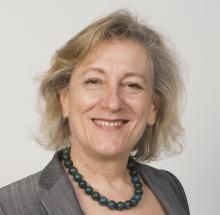
CCCI welcomes Tani Barlow, the George and Nancy Rupp Professor of Humanities and Professor of History at Rice University to speak on, "Instinct and Society."
When Li Zehou burst onto the scene during the 1980s ‘culture fever’ he dragged back in altered form a much earlier foundational debate over evolution and instinct theory launched in the new social theory and human science movement during the May Fourth era. Barlow's general research question now is how society got ontologized a century ago. How did proof of “society,” a materialized model, get so embedded in our explanatory frameworks that we have trouble thinking outside of it, even though we regularly confront questions it cannot resolve.
The Contemporary China Initiative this spring is directed by Arnika Fuhrmann, Associate Professor of Southeast Asian Studies at Cornell University and the author of Ghostly Desires: Queer Sexuality and Vernacular Buddhism in Contemporary Thai Cinema.
This semester's CCCI lecture series is connected to Asian 6623 being taught by Professor Fuhrmann called 'The City.'
CCCI spring 2022 is co-sponsored by the East Asia Program, the Department of History, Asian Studies, the Cornell Society for the Humanities, Comparative Literature, and the Migrations Initiative.
Additional Information
Program
Einaudi Center for International Studies
East Asia Program
Southeast Asia Program
Cold War Reckonings: In the Shadow of Solzhenitsyn UPDATE: ONLY VIRTUAL
April 1, 2022
4:00 pm
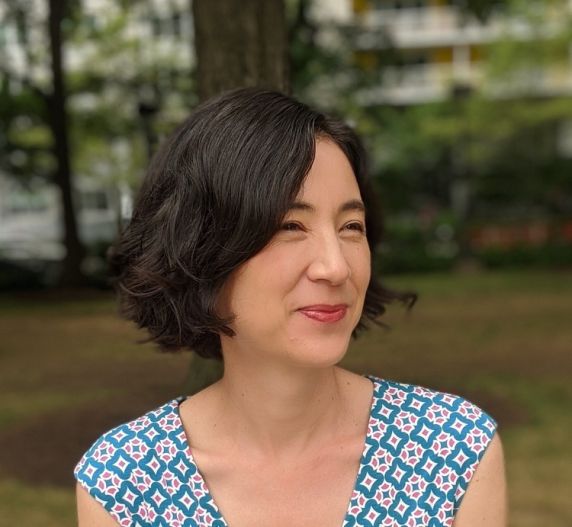
Jini Kim Watson, Associate Professor of English and Comparative Literature at New York University speaks on, 'Cold War Reckonings: In the Shadow of Solzhenitsyn.' UPDATE: ONLY VIRTUAL Register for Zoom below.
How did the Cold War shape political modernity in the decolonizing world, and what do literature and literary networks reveal about such political contestations and their afterlives? In the first half of the presentation, Kim gives an overview of her new book, "Cold War Reckonings: Authoritarianism and the Genres of Decolonization" (Fordham UP, 2021), which examines cultural production that emerges from, and reflects upon, the entanglement of the Cold War and decolonization in East and Southeast Asia.
In the second half, she considers several high-profile dissident writers from the region: Pramoedya Ananta Toer, Kim Chi-ha, and Ninotchka Rosca. Kim argues that these figures challenge Cold War liberal, human-rights notions of the dissident Third World writer via their emphases on incomplete decolonization and bipolar economic restructuring. Such an analysis, suggests Kim, helps us parse the way Cold War exigencies reshaped notions of literary and political freedom in postcolonial Asia.
This event is facilitated by Bonnie Chung, a Ph.D. student in the Department of Literatures in English at Cornell University.
Co-sponsored by the Asian American Studies Program and Literatures in English Department.
Additional Information
Program
Einaudi Center for International Studies
East Asia Program
Southeast Asia Program
Contemporary China | Ant Tribes (Yizu) in China's contested Urban Space
April 11, 2022
11:30 am
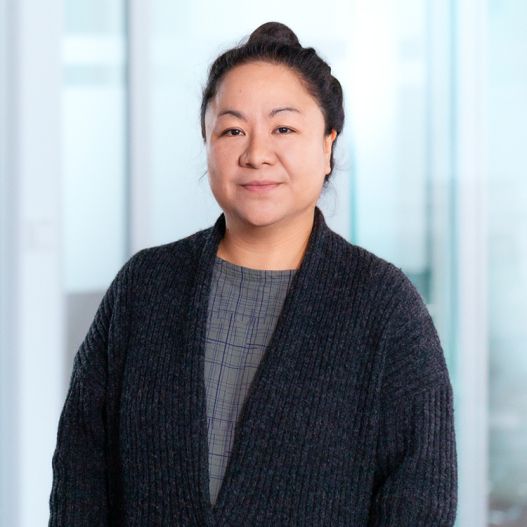
CCCI welcomes Kimiko Suda, Ph.D. Post Doc researcher, National Discrimination and Racism Monitor (NaDiRa) speaking on, 'Ant Tribes'(Yizu) in China´s contested Urban Space: A Discourse Perspective.'
In 2009 the term "Yizu" (Ant tribe) was selected as one of the ten most popular terms in China´s social media discussions. It was coined by the economist Lian Si to provoke a discussion about the social group of migrant graduates from China´s rural areas, working and living in precarious situations in China´s biggest cities, often in so-called urban villages. The term was taken up by various actors from governmental strategists, scientists, social media influencers, TV-script writers, novelists, to critical media activists. They functionalized the figure of the "Yizu" to tell their version of the story about the "Chinese Dream“, urban transformation processes, social stratification, social mobility, new emerging collective identities, and different shades of the brightness of the future. When analyzing the different variations of the narratives about "Yizu", it all boils down to one question: how to keep your human dignity in a social context, in which an increasing economization and mediatization of almost everything shapes everyday life, and makes it impossible to create a stable, publicly respected and self-determined social identity and position.
Kimiko Suda´s talk is based on a chapter of her book "Das Phänomen Yizu“ (published in September 2021 by transcript)
The Contemporary China Initiative this spring is directed by Arnika Fuhrmann, Associate Professor of Southeast Asian Studies at Cornell University and the author of Ghostly Desires: Queer Sexuality and Vernacular Buddhism in Contemporary Thai Cinema.
This semester's CCCI lecture series is connected to Asian 6623 being taught by Professor Fuhrmann called 'The City.'
CCCI spring 2022 is co-sponsored by the East Asia Program, the Department of History, Asian Studies, The Cornell Society for the Humanities, and the Migrations initiative.
Additional Information
Program
Einaudi Center for International Studies
East Asia Program
Southeast Asia Program