
Southeast Asia Program
"Thich Nhat Hanh and the Invention of Zen in Vietnamese Buddhism"

February 4, 2022
2:00 pm
Please join us for a talk by Alexander Soucy (St. Mary's University).
In 2006, a monk and member of the Order of Interbeing wrote an open letter to the disciples of Thích Nhất Hạnh, in which he described his (and hence their) Zen lineage. One of the claims the letter made was that Thích Nhất Hạnh "received the lamp-transmission in Từ Hiếu root temple" ten days before he left for the US in 1966. This portrayal of Thích Nhất Hạnh as Zen master has been uncritically assumed and repeated in the media as well as in the scholarship of Buddhism in the West, mostly by uncritically affixing to him the title of "Zen Master." As Nguyen and Barber noted, however, this assertion of him being part of a Zen lineage is not based in the forms of Buddhist practice and temple organization that actually exist in Vietnam. This presentation will discuss the seeming incongruence between the claims by Thích Nhất Hạnh and his followers and the Buddhist practices and institutions in Vietnam. The purpose is not to disprove their claims, but contextualize the globally important figure of Thích Nhất Hạnh within the developments of Buddhism in Vietnam and with the globalization of Buddhism.
The Cornell Buddhist Studies Seminar Series is co-sponsored by the GPSA-FC, the Departments of Anthropology, Asian Studies and Philosophy, by the South Asia Program, and by the Society for the Humanities. The talk is open to all interested; for accessibility queries please contact buddhiststudies@cornell.edu
Additional Information
Program
East Asia Program
Southeast Asia Program
South Asia Program
Muslim Environmental Ethics as Environmental Justice, Anna Gade
April 27, 2022
4:45 pm
This presentation builds on material in the book, Muslim Environmentalisms (Columbia University Press, 2019), which explains how the idea of "the environment" is an ethical idea. Anthropogenic ecological change considered as a matter of environmental justice (EJ) means developing new scales and connections of theory and practice as environmental ethics. According to Gade's argument, Islam's consequential relations relate not only theory to practice, law to ethics, but also this world to the next in the context of challenges like climate justice. Drawing material from the world's most populous Muslim-majority nation, Indonesia, and elsewhere, Gade presents an overview of current perspectives in Islamic environmental thought and activism that render contemporary Muslim environmental ethics as EJ, and thereby further decolonize the field of Environmental Studies.
Additional Information
Program
Einaudi Center for International Studies
Southeast Asia Program
A Visual Tour of Art in the Kahin Center
by Alexandra Dalferro, PhD candidate in anthropology
As featured in the Fall 2021 SEAP Bulletin, Alexandra takes us on a visual tour of art in the Kahin Center with fun historical facts and gorgeous images.
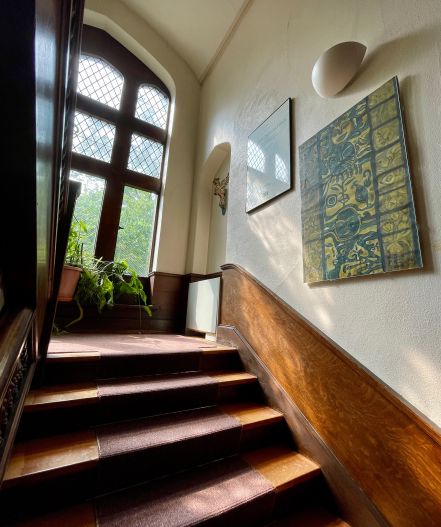
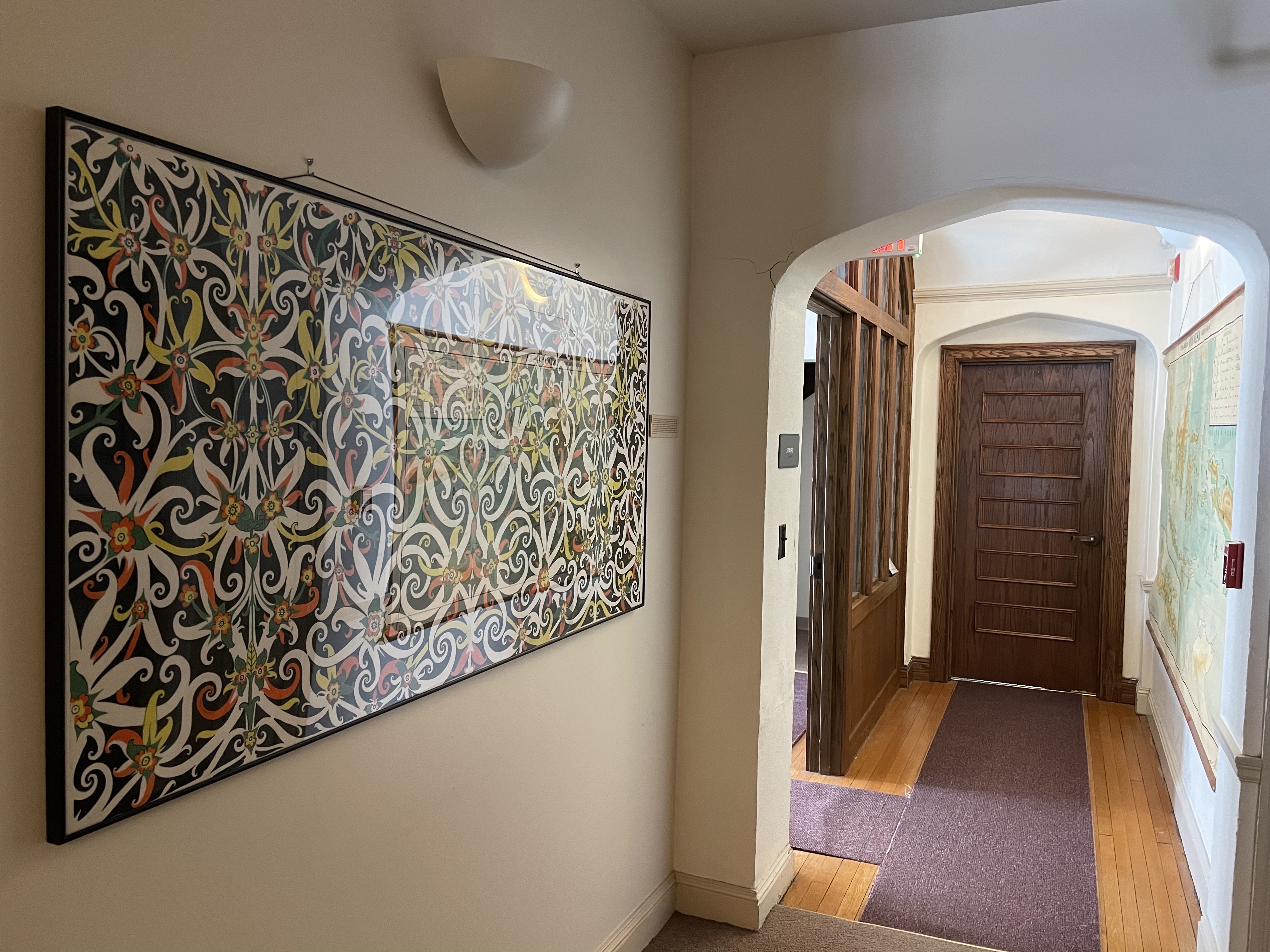
During the pandemic when the Kahin Center was closed indefinitely, I entered quickly a few times to look for books that I had left in my office on the second floor. After climbing the creaky front stairs, I always paused for a moment to appreciate the Dayak painting by Jok Bato that was made in 1973 and acquired by Carol Rubenstein while she was researching oral literature in Sarawak, Malaysia. The painting features the “Tree of Life” motif that is often found in Dayak art, and it represents the constant intermingling of all forms of life.
Rubenstein was a scholar at the Kahin Center from 1992 to 1993, and as she reflected on the culture shock she experienced each time she returned to the U.S. from trips abroad, she also considered how cold and desolate Ithaca winters might feel to Southeast Asian visitors. Rubenstein thus hoped that this glimpse of verdant jungle tendrils would help all those who pass through Kahin to feel more “at home.” My time with the painting was a warm refuge when I missed gathering at Kahin for talks and events and ensconcing myself in an office to write.
Now that the Kahin Center is open again, I examine its interior with eager, fresh eyes, enjoying its carved wood panels, paintings, posters, Buddha images, maps, and sculptures. The art that fills the Kahin materializes SEAP’s history and the lives and interests of the individuals who have shaped it. Some works have been donated by SEAP alumni and visiting scholars, like a small bust of the Thai radical Chit Phumisak (1930-1966) given to Kahin by historian Charnvit Kasetsiri (PhD Cornell 1972). Chit sits on a shelf in the large meeting room and listens intently to Gatty lectures.
Art historian Nora Taylor (PhD Cornell 1997) gifted the striking gouache painting, “Faces,” by Hoàng Hà Tùng (b. 1956) created in 1994 that hangs in the front staircase, its leafy green hues extending to the row of plants that bask in the sun of the nearby window. Taylor got to know Tùng during her research in Hanoi, and he was trained as a set designer and worked in folk theatre (hát chèo), which he also uses as a subject for many of his paintings. Taylor recalls Tùng’s sense of humor and notes how his paintings are “rich with expression and deep observation about human nature.”
Some pieces at Kahin belong to the Johnson Museum of Art, and some have been gifted or are on loan from SEAP faculty members, like the Chinese propaganda banners acquired by Thak Chaloemtiarana at the Salt City Antique Show in Syracuse. Other displays are more ephemeral; graduate students enjoy decorating their offices with photographs from fieldwork that they might gaze at for encouragement during long nights working on dissertation chapters, or they cover their desks with vibrant printed batik cloths or hang reproductions of favorite paintings and prints that they can turn to for pleasure and inspiration.
In Room 212, a graduate student office, drawings of monsters used in the short film Kahin’s Last Scare directed by anthropologist Emiko Stock (PhD Cornell 2019) keep company with a Balinese painting depicting a scene from the Ramayana donated by SEAP alumna Donna Harvey (PhD Cornell 1974) and a temple rubbing of Angkor Wat. These works are a bricolage of media types, time periods, moods, and sensibilities, and they capture the dynamic spirit of the Kahin Center and its art.
Additional Information
Program
History of Philippine Studies at Cornell

by Claire Cororaton, Ph.D. candidate in history
As featured in the Fall 2021 SEAP Bulletin, Claire Cororaton's article on the "History of Philippine Studies at Cornell" covers a wide array of decades and topics. Indeed, Cornell University’s connections with the Philippines run deep. As the United States’ only true historical colony in Asia, the Philippines was one of the few Southeast Asian countries that might have piqued interest among American academics in the early twentieth century. The narrative of American exceptionalism, however, was entrenched. Knowledge of the Philippines, like the rest of the region, remains marginal and invisible. Thus, the genealogy of Philippine Studies at Cornell adumbrates this conflictive political history between both countries. As the institutional and intellectual configurations of area studies and Philippine Studies shift, Cornell University has served as a nexus for generating and critiquing knowledge on and about the Philippines.
American Colonialism and the first generation of Filipino pensionados
Cornell University’s involvement in the US colonial project in the Philippines indexes the formation of colonial knowledge production in the service of “nation-building” projects. In 1899, Jacob Schurman, then President of Cornell University, was appointed to lead the United States’ First Philippine Commission in charge of making preliminary recommendations on the future of colonial governance. Traces of Cornell University’s involvement in the Philippines from a century ago can be found in the the Rare and Manuscript Collections in the papers of those involved in preliminary reconnaissance trips to the Philippines such as Frank Ernest Gannet (Class of 1898), Gerow D. Brill (Class of 1888), Bernard Edward Fernow (Professor, College of Forestry).
Given the focus of the United States on building educational institutions, a select group of Filipinos went to US universities, including Cornell, to contribute to nation-building “back home.” As part of the “Pensionado” Scholarship Program, Filipinos were among the earliest Asian students to enroll in Cornell, meeting international students from Asia in the “Cosmopolitan Club.” Notable Filipino Cornell alumni, such as Vidal A. Tan, Tomas Mapua, and Victor Buencamino would go on to establish foundational institutions in government, business, and education. Although less studied for their contributions to the genealogy of Philippine Studies, these scholars foreshadow the contours of modern knowledge production of and about the Philippines and the politics of location in such production.
The Philippines meets “Southeast Asian Studies:” Post-WWII nation-building
The post-World War II era of decolonization reconfigured new conceptual matrices for scholarship as well as new institutional, political, and academic networks in the study of the Philippines. At the institutional level, Cornell’s links with the Philippines remained strongest in the agricultural and life sciences as well as other technical schools. In 1952, Cornell partnered with the University of the Philippines-Los Baños to rebuild the university, which had been devastated by World War II. From 1952-1960, thirty-five Cornell professors participated in the project, serving one to three-year appointments at Los Baños.
This project was a foundational moment in the collaboration between Cornell and the Philippines in providing technical assistance for agricultural development projects. Thanks to the institutional connections built through this project, in 1960, the International Rice Research Institute (IRRI) was established in Los Baños, which remains an important center for research in global agricultural studies. Furthermore, Cornell was home to scholars of the Philippines such as the economist Professor Frank Golay, an eminent specialist of Philippine economy and director of the SEAP Program (1970-1976), and Professor Robert Polson who established a rural social science research program in central Philippines.
Despite the historical predominance of the College of Agriculture and Life Sciences (CALS) and the social sciences in the study of Philippine-related topics, the founding of the Southeast Asia Program (SEAP) in 1950 facilitated new interdisciplinary scholarly connections. Language was the link. In 1964, Professor John Wolff, a linguist of Bahasa Indonesia, proposed the Tagalog Program to provide students who were working in the Philippines an opportunity to learn Tagalog and/or Cebuano. Wolff developed new materials for Tagalog learning, including the foundational and still-standard textbook on Filipino (Tagalog). Through the years, particularly through financial support from the Foreign Language and Area Studies (FLAS) program, students of the Filipino (Tagalog) language at Cornell would include not just American scholars involved in Philippine-related projects but also second and third generation Filipino-Americans and non-Filipino international students interested in the Philippine diaspora.
A “Cornell School” of Philippine Studies?
The 1970s was a watershed moment in Philippine historiography. Amidst the tightening rule of martial law under President Ferdinand Marcos, scholars began to question the nationalist historiography of the 1950s and increasingly linked the study of history with the struggle for social justice. At this time, Cornell already had a strong reputation among the academic community in the Philippines since it had produced some of the Philippines’ foremost scholars such as Cesar Adib Majul (Government, ’57) and David Wurfel (Government, ’60). Thus, by happenstance or personal connection, more Filipino students found themselves at Cornell, itself known for the political activism of its professors.
Several monographs now considered canonical in the field of Philippine Studies were first written as dissertations by Cornell graduate students: Pasyon and Revolution (1979) by Reynaldo Lleto, Contracting Colonialism (1988) by Vicente Rafael, Clash of the Spirits (1998) by Filomeno Aguilar, Making Mindanao by Patricio Abinales (2000), and Necessary Fictions: Philippine Literature and the Nation (2000) by Carol Hau. These pioneering works of scholarship foregrounded the discursive analysis of culture and politics to the study not only of the Philippine’s history but also of colonialism, nationalism, and imperialism more broadly.
If we can then call such a thing as a “Cornell School” of Philippine Studies, as Carol Hau suggests, it is in the “intellectually promiscuity” evident in these interdisciplinary works. Filipino students at Cornell occupied the position of “transnational intellectuals,” defamiliarizing and denaturalizing the Philippines via the comparative lenses offered by area studies. By working with specialists of other countries such as Professor James Siegel and Professor Takashi Shiraishi, these path-breaking scholars expanded the theoretical and narratological frames for unpacking the complexity of the Philippine historical experience.
Central to this story is Professor Benedict Anderson, whose deep commitment and scholarly interest in the Philippines made Cornell an intellectually rich environment for Philippine scholars. Towards the end of his career, Professor Benedict Anderson became interested in the Philippines and published theoretically provocative works such as Under the Three Flags (2007), as well as essays in The Spectre of Comparisons (1998). Such intellectual productivity was collaborative and bi-directional. Anderson taught his students as much as learned from them, serving as a teacher, adviser, and friend to a large community of Philippine scholars, such as Patricio Abinales (‘97), Carol Hau (’98), Andrew Abalahin (’01), Joel Rocamora (’74), Vicente Rafael (’84), and Filomeno Aguilar (’92). This generation of scholars at Cornell broadened the possibility of what Philippine Studies could be by imbricating them in wider transnational and interdisciplinary frames of study. READ MORE
Additional Information
Program
Expanding Southeast Asian Language Learning

by REN Chao, Elisebeth Doty, and Ava White
As featured in the Fall 2021 SEAP Bulletin, this article highlights an exciting new partnership between two consortia on Southeast Asian studies that have joined forces to improve collaboration in the teaching of Southeast Asian languages.
With support from the Henry Luce Foundation, the Southeast East Asian Language Council (SEALC) and the Graduate Education and Training in Southeast Asian Studies (GETSEA) consortia award financial assistance to students who incur tuition fees when studying a Southeast Asian language during the academic year at an institution other than their home institution via synchronous distance learning. This award is intended to facilitate cross-institutional collaboration and increase access to Southeast Asian language instruction, especially for students who seek to study a language or level of study not currently offered at their home institution.
SEALC and GETSEA consider several factors when awarding students and determining placements. The first is the mission of SEALC and GETSEA to uphold and expand institutional support for the teaching of Southeast Asian languages and Southeast Asian language instructors. In the interest of this mission, the SEALC-GETSEA awards support for distance, synchronous language classes taught by lecturers hired minimally as part-time staff by the North American host institution.
In addition to this mission, SEALC and GETSEA consider the requests and time constraints of the student applying for language tuition support when assigning placements in order to maximize the language gains of the student. These considerations frequently allow support of students looking for first through third year language instruction but rarely those who require more advanced levels. Finally, in order to support the greatest number of qualified students possible, SEALC-GETSEA strives to place students in high-quality courses with reduced tuition costs and looks forward to supporting additional institutions in their efforts to increase the accessibility of their Southeast Asian less commonly taught language courses via synchronous distance learning.
To grasp the true significance of the SEALC-GETSEA language tuition support awards from the student perspective, please enjoy the article below by author REN Chao. Chao is a SEALC-GETSEA awardee from academic year 2020-2021 and a member of the GETSEA graduate student advisory council. His article highlights the academic, professional, and personal benefits of continued Southeast Asian language study made possible by the SEALC-GETSEA awards based on his own experience and his interviews with fellow awardees.
From REN Chao, PhD Candidate in history at University of Michigan
“Mingalaba Chao, you look incredibly awake for what time it is where you are,” said Saya Justin Watkins, Professor of Burmese at the School of Oriental and African Studies (SOAS) in London. This is how I spent most of the Monday and Friday mornings of this past academic year—early morning hours, barely awake, holding tea in my Michigan mug, and dialing into my remote Burmese class from Russell Square, ready to crack another passage in literary Burmese. Since I was the only one in the class located in the Western Hemisphere, classes are scheduled at 8 a.m. or sometimes even 7 a.m. so that other classmates won’t need to stay up too late. These morning classes not only gave me—a notoriously non-morning person—a reason to get up early, but also offered me a precious refuge away from the constant anxieties of the pandemic and of unsavory domestic and international politics, which have quite literally plagued so many of us over the past year.
As a graduate student studying colonial Southeast Asian history at the University of Michigan, I have always wanted to learn the Burmese language systematically, but it is not currently offered at my home institution. In September 2020, I was fortunate to receive a SEALC-GETSEA award and enrolled in the remote Burmese language class offered by the School of Oriental and African Studies. This award has proved to be tremendously helpful for my studies, especially at this particular juncture. With the pandemic still ongoing around the globe, on-site research has become impossible, so many of us had to change research plans. Under such restrictive circumstances, language learning has become a wonderfully productive alternative to research, and a distracting mental health refuge.
I had always hoped to find some language preparation before diving deeper into the study of archival documents, but struggled to find rigorous and affordable Burmese language-learning opportunities in previous years. The SEALC-GETSEA language training award met this need perfectly. Despite the absence of Burmese language instruction at my home institution, the this award allowed me to further my training in the Burmese language and better prepare myself for future research.
Additional Information
Program
Future Directions in the Study of Migration and Racial Justice: A Postdoctoral Symposium

December 8, 2021
4:00 pm
Uris Hall, G-08
The Mario Einaudi Center for International Studies, in partnership with the Society for the Humanities, presents this symposium featuring five cutting-edge researchers whose work crosses disciplinary lines to tackle some of the world’s most pressing problems.
Join postdoctoral fellows Mohamed Abdou, Eman Ghanayem, Bamba Ndiaye, Eleanor Paynter, and Grace Tran for a discussion of their work in the fields of migration studies and global racial justice. Topics will include identity, colonialism and decolonization, indigeneity and dispossession, refugee studies and mobility, economic and social justice, and critical race theory. Learn how new approaches and developments are changing scholarship in these critical fields.
Einaudi Center director Rachel Beatty Riedl will introduce the event, and Viranjini Munasinghe (Department of Anthropology) will moderate.
Speakers
Mohamed Abdou, Global Racial Justice Postdoctoral Fellow, Einaudi Center"Non-statist Indigenous and Muslim Conceptualizations of Sovereignty: The Decolonial Inseparability of Race from Religion"
Eman Ghanayem, Mellon Postdoctoral Fellow, Department of Comparative Literature and Society for the Humanities"Being Native, Being Refugee"
Bamba Ndiaye, Mellon Postdoctoral Fellow, Department of Music and Society for the Humanities"From Mbas Mi to Mbëkk Mi: Covid-Induced Migration and Social Movement Advocacy in Senegal"
Eleanor Paynter, Migrations Postdoctoral Fellow, Einaudi Center"Witnessing Migration 'Crises': Race, Coloniality, and Asylum in Italy"
Grace Tran, Migrations Postdoctoral Fellow, Migrations Initiative"What’s Love Got to Do With It?: Transformative Effects of Vietnamese-American Engagement in 'Marriage Fraud' Arrangements"
Additional Information
Program
Einaudi Center for International Studies
Reppy Institute for Peace and Conflict Studies
East Asia Program
Southeast Asia Program
Latin American and Caribbean Studies
Institute for African Development
Institute for European Studies
South Asia Program
Laidlaw Scholars Info Session: support for first- and second-year research projects

November 30, 2021
5:00 pm
Tatkon Center, 105 RPCC
Learn about the Laidlaw Undergraduate Leadership and Research Program. Open to first- and second-year students, this 2-year program provides generous support to carry out internationally-focused research, develop leadership skills, engage with community projects overseas, and join a global network of like-minded scholars from more than a dozen universities.
Join us to learn more about the program, its benefits, and the application process, as well as tips for approaching potential faculty research mentors and writing a successful application. Sponsored by the Tatkon Center for First-Year Students and the Mario Einaudi Center for International Studies.
Additional Information
Program
Einaudi Center for International Studies
Reppy Institute for Peace and Conflict Studies
East Asia Program
Southeast Asia Program
Institute for African Development
Institute for European Studies
South Asia Program
Latin American and Caribbean Studies
"Strange Parallels: Consecrated Chinese Buddhist Images in Context"
December 3, 2021
12:00 pm
Please join us for a talk by James Robson 羅柏松 (James C. Kralik and Yunli Lou Professor of East Asian Languages and Civilizations, Harvard University).
It has become increasingly well-known that religious statues throughout Asia have hidden cavities that are filled with various objects inserted during a consecration ritual. This talk explores the hidden world of these statues through a discussion of a large collection of statues from throughout East Asia (China, Korea, Japan, and Vietnam), including some intriguing European examples. The history of such images has been the object of much research in Japan and Korea that this talk will also use to contextualize the Chinese Buddhist images. These statues provide a valuable glimpse of local religion, ritual practice, lay devotion, and sutra fragments. These statues also raise a host of significant interpretive questions for historians of religion, including issues such as the place of icon animation, idolatry, and iconoclasm in Chinese Buddhism and Chinese Religious history generally. The images discussed in this talk contain a niche carved into their back (or sometimes in the uṣṇīṣa, base, or pedestal) that is filled with a variety of objects, including relics, religious manuscripts and printed texts, medicinal herbs, desiccated insects, talismans with magical writing, and a “consecration certificate” or “vow text.” These statues are ubiquitous but have had a particularly intriguing history of visibility and concealment in East Asia and in Western scholarship. This talk will raise questions about why sacred images and icons such as these have been objects of extreme devotion for some, but also presented problems for priests, politicians, missionaries, philosophers, and academics who for various reasons have found them distasteful, attacked their validity and power, and have tried to hide them away or destroy them. Why, even in the face of ideological critique and iconoclastic destruction, have they persisted and proliferated?
The Cornell Buddhist Studies Seminar Series is co-sponsored by the GPSA-FC, the Departments of Anthropology, Asian Studies and Philosophy, by the South Asia Program, and by the Society for the Humanities. The talk is open to all interested; for accessibility queries please contact buddhiststudies@cornell.edu
Additional Information
Program
East Asia Program
Southeast Asia Program
South Asia Program
John Reps Memorial
November 19, 2021
12:25 pm
Abby and Howard Milstein Auditorium
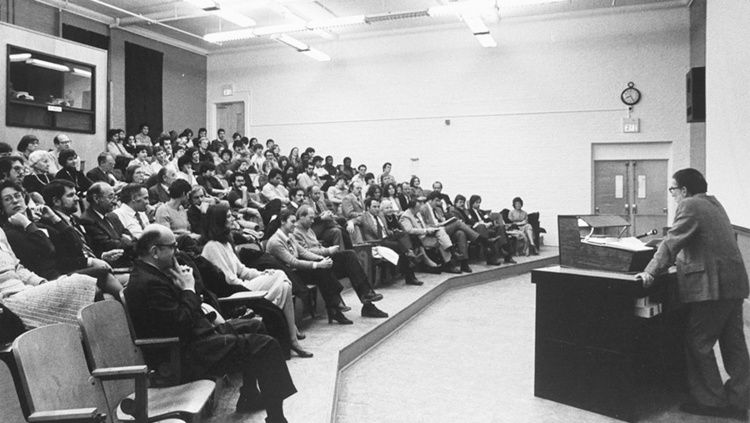
Please join us for a memorial lecture and panel discussion in memory of Professor Emeritus John W. Reps. Reps was a fixture in the Department of City and Regional Planning at Cornell University for over 70 years. After graduating as part of the first class of students to confer master's degrees in city and regional planning at Cornell in 1947, and several years of study in England both at the University of Liverpool and the London School of Economics, Reps returned to Ithaca in 1951 to join the planning department as a member of the faculty. His service to CRP took almost every form imaginable. Reps taught lecture courses and seminars and chaired the department for twelve years, acting simultaneously as the department secretary as well as director of admissions, commencement, and scheduling as he wrote books and papers, documented cities and towns, and collected historical city plans.
The memorial lecture titled "Planning in an Era of Rapid Urbanization: The Case of Indonesia" will be presented by Professor Christopher Silver, University of Florida. The lecture will be presented in person in the Abby and Howard Milstein Auditorium, Milstein Hall. The lecture is open to members of the Cornell community who are actively completing the Daily Check. The lecture will also be live-streamed. Please see The John Reps Memorial Lecture tab for more details.
Following a brief intermission, a panel of Cornell faculty and former students will present on the work and legacy of the late John Reps. This panel will be held online via Zoom. Please see the Panel Discussion tab for more details. After this panel, please join us for a virtual reception where we invite guests to share memories and stories of John.
Schedule of events
Lecture
12:25–2:20 p.m.
Milstein Auditorium/Livestream
Panel Discussion
3:00–4:00 p.m.
Available on Zoom
Virtual Reception
4:00–5:00 p.m.
Available on Zoom
This lecture is sponsored by the Russell Van Nest Black Lecture Fund and by a generous gift from Dr. Vukan Vuchic, Emeritus Professor of Transportation Systems Engineering and of City and Regional Planning at the University of Pennsylvania in Philadelphia.
Additional Information
Program
Southeast Asia Program
Movie Theaters Show Quiet Resistance to Thai Monarchy Is Growing
Tamara Loos, SEAP
Professor Tamara Loos, SEAP Core Faculty, is quoted here in a Bloomberg article.