
Southeast Asia Program
President Speaks Out on Atlanta Shootings
Condemns Anti-Asian Racism and Violence
Einaudi stands with our Asian and Asian American colleagues and students. Read the statement to find out how to report campus incidents of bias.
Additional Information
GETSEA Launches New Website

Visit to learn more about GETSEA
The consortium for Graduate Education and Training in Southeast Asian Studies has launched a new website, containing details about the consortium and its upcoming events, mini-courses, and more!
Additional Information
"Navigating Between the Law and a Distant Place: Judicial Procedures for non-Burmans and Legal Ethnography in the Late Eighteenth- and Early Nineteenth-Century Burma." A talk by Alexey Kirichenko (Moscow State University).
April 9, 2021
2:00 pm
Please join us for an invited talk by Prof. Alexey Kirichenko, generously co-sponsored by the Departments of Asian Studies, History and Philosophy; the South Asia, Southeast Asia, East Asia and Religious Studies Programs; and the Graduate and Professional Student Assembly. The event is open to all interested, and special accommodations can be made for access upon request.
Alexey Kirichenko is an Assistant Professor at Moscow State University, Russia where he teaches courses related to Burma, Southeast Asia, Buddhism, and Asian history. His PhD focused on Burmese royal historiography. Since 2009, he is engaged in field and archival work in Burma aimed at manuscript cataloguing and digitization, documentation of archival practices, monastic networks and Buddhist monuments, and research on the history of Buddhism. He has published extensively on various aspects of Burmese history and historiography. His current writing priorities address the issues of religious identity and knowledge production.
Due to COVID-era regulations, all attendees are required to register for this event here: http://cglink.me/2ee/r992619
Upon registration you should receive an automated email with the Zoom link. If for any reason you do not receive this email, please contact Bruno at bms297@cornell.edu.
Additional Information
Program
East Asia Program
Southeast Asia Program
South Asia Program
From Sarandib, via Lanka, to Ceylon: Exile and Memory in the Colonial Age

April 8, 2021
12:30 pm
Part of the Ronald and Janette Gatty Lecture Series
Ronit Ricci, Department of Asian Studies and Religion, Hebrew University of Jerusalem
The small, Indian Ocean island known as Sarandib, Lanka, and Ceylon was a site of banishment throughout the 18th century for members of royal families, convicts, servants and others sent there from across the Indonesian archipelago. Descendants of these exiles who remained on the island continued to speak and write in Malay, the archipelago's lingua franca, and to adhere to a collective Muslim identity for several centuries and into the present. The talkconsiders if and how earlier religious and literary traditions of banishment tied to the island -those of Adam's fall from paradise to Sarandib and Sita's abduction to Lanka in the Ramayana -played a role in shaping the experiences of the exiles and their descendants.
Additional Information
Program
Einaudi Center for International Studies
Southeast Asia Program
South Asia Program
Links and Fractures: The 23rd Cornell SEAP Graduate Student Conference
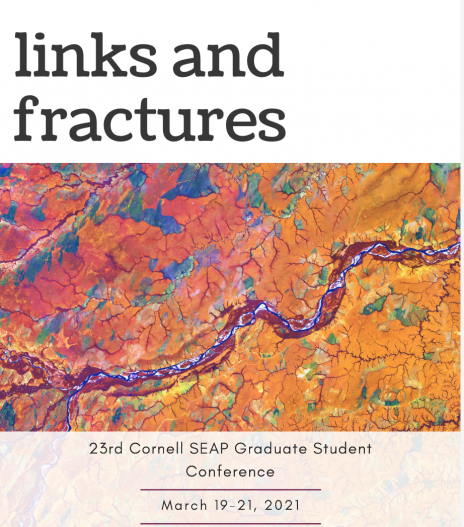
Happening this weekend, March 19-21!
Register now to attend the 23rd Cornell SEAP Graduate Student Conference, entitled Links and Fractures.
Additional Information
Authoritarianism and Democratic Backsliding in Southeast Asia: A Virtual Roundtable
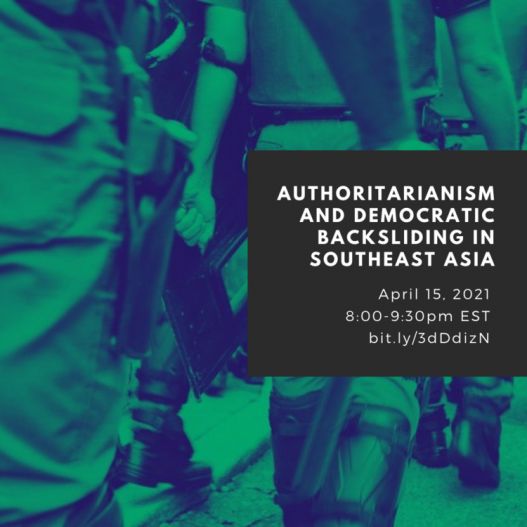
April 16, 2021
8:00 pm
The global trend of democratic backsliding has reshaped politics around the world, from the United States to Indonesia. Throughout Southeast Asia, a region long marked by contestation between authoritarian and democratic politics, contemporary authoritarian practices interact with local histories to generate distinctly new forms of politics—from penal populism in the Philippines to Burma’s most recent military coup. This virtual roundtable on authoritarianism brings together four experts on the politics of Myanmar, Indonesia, Thailand, and the Philippines to understand contemporary authoritarianism and democratic backsliding in the Southeast Asian context.
Introduction: Rebecca Slayton, Director of the Judith Reppy Institute for Peace and Conflict Studies (Associate Professor, Dept of Science and Technology Studies, Cornell)
Moderator: Tom Pepinsky (Tisch University Professor, Dept of Government, Cornell)
Panelists:
Pavin Chachavalpongpun (Associate Professor, Center for Southeast Asian Studies, Kyoto University)Mark R. Thompson (Professor of Politics and Head, Department of Asian & International Studies; Director of Southeast Asia Research Centre, City University of Hong Kong)Ardeth Thawnghmung (Chair of Political Science, Professor, Interim Director, Peace and Conflict Studies, University of Massachusetts Lowell)Eve Warburton (Postdoctoral Fellow, Asia Research Institute, National University of Singapore)
Co-organized by the Southeast Asia Program and the Judith Reppy Institute for Peace and Conflict Studies
Additional Information
Program
Einaudi Center for International Studies
Reppy Institute for Peace and Conflict Studies
Southeast Asia Program
A Conversation on the Plantationocene

April 15, 2021
11:00 am
This virtual conference, sponsored by the Mario Einaudi Center for International Studies and Migrations: A Global Grand Challenge, brings together a diverse group of scholars, activists, and practitioners to discuss the role that plantations and plantation agriculture have played in shaping the nature, structure, and dynamics of the modern era.
Although plantations have long been the subject of study, the Plantationocene as a concept emerged only in the past few years to describe the role of racialized, large-scale plantation agriculture in establishing a world system that to this day lives with the legacy and continuation of slavery, forced migration, dispossession, and mono-crop extractive agriculture intended for export production.
This article serves as a frame for the conversation: Wolford, Wendy, 2021 “The Plantationocene: A Lusotropical Contribution to the Theory,” Annals of the American Association of Geographers, early view online.
Over two days of roundtable discussions (April 15-16), scholars and activists from a variety of disciplines of critical social theory and practice, including agrarian studies, political ecology, development studies, black geographies and feminist theory, will discuss the Plantationocene and to what extent this conceptional framework may be useful—not just for analytical purposes, but also for activism and practice.
Explore the schedule and presentersRegister nowThe conference is available in Portuguese through simultaneous interpretation on the same Zoom channel. All sessions will be recorded.
Moderator:
Wendy Wolford, Robert A. and Ruth E. Polson Professor, Department of Global Development, Cornell University
Panelists:
Gerard Aching, Professor of Africana and Romance Studies, Cornell UniversityYasmine Ahmed, Postdoctoral teaching fellow, The American University in CairoSarah Besky, Associate Professor of Industrial and Labor Relations, Cornell UniversityRachel Bezner-Kerr, Professor of Global Development, Cornell UniversityJun Borras, Professor of Agrarian Studies, Institute of Social Studies, Erasmus University, the HagueNatacha Bruna, PhD candidate, International Institute of Social Studies (ISS), Erasmus University, the Hague Judith Carney, Professor of Geography, University of California, Los AngelesSophie Chao, Postdoctoral Research Associate, University of SydneySharad Chari, Associate Professor of Geography, University of California, BerkeleyYoujin Chung, Assistant Professor of Energy and Resources Group and Environmental Science, Policy, and Management, University of California, BerkeleyAndrew Curley, Assistant Professor of Geography, University of ArizonaMary Jo Dudley, Director of the Cornell Farmworker Program, Cornell UniversityChristopher Dunn, Elizabeth Newman Wilds Executive Director of Cornell Botanic Gardens, Cornell UniversityDivya Dutta, Researcher, Oxfam America and Oxfam Great BritainJennifer Franco, Activist and Researcher at the Transnational Institute (TNI), the HagueShannon Gleeson, Professor of Labor Relations, Law, and History, Cornell UniversityJenny Goldstein, Assistant Professor of Global Development, Cornell UniversityEuclides Gonçalves, Director and Researcher, Kaleidoscopio, Research in Public Policy, MozambiqueCarla Gras, Researcher and Professor of Sociology, University of Buenos AiresJulie Guthman, Professor of Social Sciences, University of California, Santa CruzShalmali Guttal, Executive Director, Focus on the Global South, BangkokTania Murray Li, Professor of Anthropology, University of TorontoJuliet Lu, Postdoctoral Research Fellow, Cornell Atkinson Center for SustainabilityFouad Makki, Associate Professor of Global Development, Cornell UniversityPriscilla McCutcheon, Assistant Professor of Geography, University of KentuckyPhilip McMichael, Professor of Global Development, Cornell UniversityGregg Mitman, Vilas Research and William Coleman Professor of History of Science, Medical History, and Environmental Studies, University of Wisconsin, MadisonSharlene Mollett, Distinguished Professor in Feminist Cultural Geography, Nature and Society and Associate Professor of Geography, University of TorontoJoão Mosca, Director, Observatório do Meio Rural, Maputo Andrew Ofstehage, Postdoctoral Associate, Cornell UniversityKasia Paprocki, Assistant Professor of Geography and Environment, London School of Economics and Political ScienceDeniz Pelek, Postdoctoral Researcher in the MIGRADEMO Project, Universitat Autònoma de BarcelonaNancy Peluso, Professor of Society and Environment and Chair of the Center for Southeast Asian Studies, University of California, BerkeleyPrabhu Pingali, Professor of Applied Economics and Policy, Cornell UniversityRachel Beatty Riedl, John S. Knight Professor of International Studies and Director of the Einaudi Center, Cornell UniversityCaitlin Rosenthal, Associate Professor, History, University of California, BerkeleySergio Sauer, Professor in the Center for Sustainable Development, University of BrasíliaJudite Stronzake, Activist in the Movement of Landless Workers (MST), Brazil and Professor of Education, Universidade Federal da Grande DouradosEric Tagliacozzo, John Stamburgh Professor, Department of History, Cornell UniversityAnna Tsing, Professor of Anthropology, University of California, Santa CruzMichael Watts, Chancellor’s Professor of Geography Emeritus, and Co-Director of Development Studies, University of California, BerkeleyWendy Wolford, Robert A. and Ruth E. Polson Professor of Global Development, Cornell UniversityYunan Xu, Post-doctoral researcher, International Institute of Social Studies (ISS), Erasmus University RotterdamJohn Aloysius Zinda, Assistant Professor, Global Development, Cornell University
Additional Information
Program
Einaudi Center for International Studies
Latin American and Caribbean Studies
Institute for African Development
Institute for European Studies
South Asia Program
Southeast Asia Program
Virtual Internships on Southeast Asia

Apply by March 31!
Global virtual internships for undergraduates are back in summer 2021, including opportunities with the Inya Institute and the Center for Khmer Studies!
Additional Information
"Hell as Metaphor in Early Buddhist Literature." A talk by Joseph A. Marino, III (University of Washington).

April 2, 2021
4:00 pm
Please join us for an invited talk by Prof. Joseph A. Marino, III, generously co-sponsored by the Departments of Asian Studies, History and Philosophy; the South Asia, Southeast Asia, East Asia and Religious Studies Programs; and the Graduate and Professional Student Assembly. The event is open to all interested, and special accommodations can be made for access upon request.
This talk examines the metaphor of hell as a place of burning in early Buddhist literature. Taking a Gandhari manuscript about the "Great Conflagration Hell” as our starting place, we explore foundational Buddhist hell texts and contemporaneous non-Buddhist Sanskrit literature to understand the Buddhist “hot hell” as a combination of two fire metaphors used widely elsewhere: the notion of desire as a fire that must be extinguished, and that of tapas as a purifying fire generated through austerity. Along the way, we see how “hot hell” descriptions develop from and build upon the volatile and violent depictions of a blacksmith’s forge.
Joe Marino is Assistant Professor of Buddhist Studies at the University of Washington, where he teaches Sanskrit and courses on Buddhist history and literature. His research specialty is Buddhist manuscripts from Gandhāra, which he edits, translates, and studies in the comparative context of early Buddhist literature in Indic and Chinese languages. He also writes about the pedagogical and literary functions of metaphor and simile in early Buddhist sutras. Joe received a BA and MA in Comparative Studies from Ohio State University, and an MA in Comparative Religion and PhD in Buddhist Studies from the University of Washington.
Due to COVID-era regulations, all attendees are required to register for this event here: http://cglink.me/2ee/r992968
Upon registration you should receive an automated email with the Zoom link. If for any reason you do not receive this email, please contact Bruno at bms297@cornell.edu.
Additional Information
Program
East Asia Program
Southeast Asia Program
South Asia Program
Links and Fractures - Southeast Asia Graduate Student Conference 2021

March 21, 2021
9:00 am
The time of global pandemic presented many obstacles for communities engaged with Southeast Asia to stay connected and thrive. At the same time, the limitations upon meeting in person or conducting fieldwork inspired new ways to forge dialogues, shake old conventions, and embrace creative, often technological, change. As graduate students, we witnessed a boom of new and revamped platforms that emerged to connect those separated geographically by COVID-19 and enable academic, social, and professional relations. On the other hand, physical limitations within our communities have produced severe economic and personal fractures that have not yet been remediated. These patterns of Links and Fractures have long existed before COVID-19 in Southeast Asia, arising out of historical processes of colonization and decolonization, religion, commodity and cultural exchanges, migration, language, information technology, economic expansion, social unrest, political upheaval, and more. Within these patterns are both opportunities and losses for a wide range of diverse Southeast Asian communities, creating “new normals” before the “new normal” instigated by COVID-19.
The Graduate Student Conference will be held March 19-21, 2021 online, catering to the opportunity to bring together participants and attendees from all over the world, and powered by SEAP web-platforms. PhD and Master students will present their research united by this common theme across all academic disciplines, presenting their work on how these Links and Fractures have shaped communities in Southeast Asia as part of a panel with faculty discussants. Over this immersive three-day period, the sharing of related research with Cornell SEAP faculty, academics and fellow peers within the graduate community will be facilitated.
- Keynote by Prof. Juno Salazar Parreñas (STS/FGSS), "Fracture or Linked? Southeast Asia after Area Studies Died"
- Full listing of Speakers and Abstracts
- Overview and registration links for each panel: Conference Schedule
Quick panel registration links:
SEA and the Indian Ocean: flows of ideas, goods, and labourState-making and resistancePolitics and gender in religion: entangled text and imageMemory: in poetics, battles, and campsEducating modernity, teaching nationalismMigrated Culture: politics of diaspora across generations This conference is organized by the Southeast Asia Graduate Student Committee
Additional Information
Program
Einaudi Center for International Studies
Southeast Asia Program
South Asia Program