
East Asia Program
Climate Change Has Come for the World’s Largest Greenhouse Gas Emitter

Jeremy Wallace, EAP
Jeremy Wallace, associate professor of government, says, “The climate story is a China story.”
Additional Information
2022 Korean Game Night
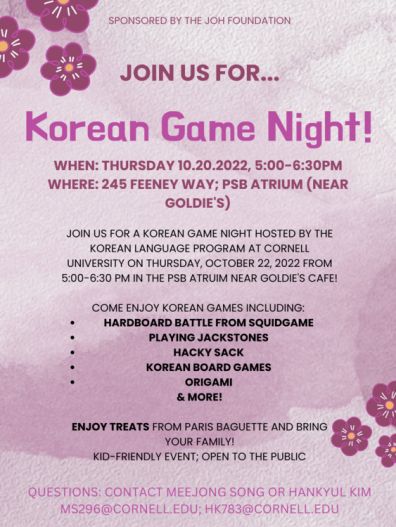
October 20, 2022
5:00 pm
PSB, Atrium (near Goldie's)
Come enjoy Korean games (hardboard battle from Squid Game, playing jackstones, hacky sack, Korean board game, origami, etc.) and baked food from Paris Baguette. Open to the public and kids-friendly.
Additional Information
Program
East Asia Program
Why African Nations Are Mostly Silent on China’s Rights Record

Magnus Fiskesjö, PACS/EAP/SEAP
“South Africa, with its proud tradition as a shining example for human rights, struggles now, saying nothing about China’s apartheid,” says Magnus Fiskesjo, associate professor of anthropology.
Additional Information
Migration, Ethnicity/Race, Gender, and Labor Market Inequality in Sub-Saharan Africa & the Asia-Pacific Region

October 7, 2022
9:00 am
ILR Conference Center
Scholars from Ghana, South Africa, Singapore, China, Japan, Australia, the Netherlands, the United Arab Emirates, Canada and the U.S. will present research on labor market inequality for global migrants in the Sub-Saharan Africa and Asia-Pacific regions.
Invited Conference to be held at the ILR Conference Center on Thursday October 6th (afternoon) and Friday October 7th (all day). Attendees are welcome, please register here.
Additional Information
Program
East Asia Program
Einaudi Center for International Studies
China Says Biden's Taiwan Remarks 'Severely Violate' US Policy Over Island

Jessica Chen Weiss, EAP
Biden's new comments are "dangerous, even if not an official change in policy", wrote Jessica Chen Weiss, professor of government, on Twitter. "More explicit here than in previous gaffes is the suggestion that the US would send troops to fight for Taiwan, regardless of what Taiwan does," she wrote, adding that it will "strengthen perceptions that the US is issuing Taiwan a blank check".
Additional Information
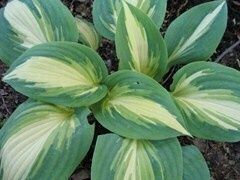
Cornell China Center Fall Field Trip: Cornell Botanic Gardens Tour of Chinese and Asian Plants
October 14, 2022
12:15 pm
Join this guided outdoor stroll exploring different areas of the garden to highlight several plants endemic to China and eastern Asia. Discover the importance of trees and garden plants in East Asian culture, and learn about plans to develop an Asian Summer Garden to showcase tree and herbaceous peonies and other plants native to China, Japan, and Korea. Led by garden staff and volunteer guides. The walk will take place rain or shine. It will be postponed to the next day, Fri 10/14, in the event of severe or hazardous weather, and registrants will emailed at least 45 minutes in advance if postponed. Limited to 20 participants.
***THIS TRIP IS NOW FULLY ENROLLED. Register here to add yourself to the wait list.***
DATE CHANGED to Fri 10/14 due to heavy rains on Thursday.
Additional Information
Program
Einaudi Center for International Studies
East Asia Program
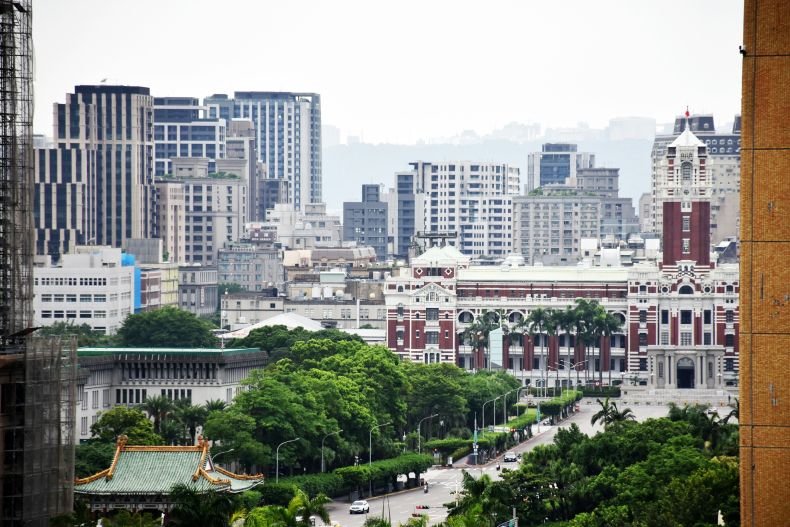
No More "Strategic Ambiguity" on Taiwan
Jessica Chen Weiss, EAP
Article about Biden’s strategy in China mentions comments by Jessica Chen Weiss, government professor at Cornell.
Additional Information
Career Info Session: U.S. Department of State and Public Service Careers

September 27, 2022
5:00 pm
Are you interested in a possible career in public service, and maybe specifically with the U.S. Department of State? Ever wondered what it's like to work in various capacities at State -- ranging from a Foreign Service Officer to policy analyst and intelligence officer -- or how to go about preparing yourself to be a successful applicant for jobs at State?
Please join the Einaudi Center for a virtual discussion about career paths and opportunities at the State Department and in public service, featuring three Cornell alumni who will share their insights:
Benjamin Brake, Director, Office of Cyber Affairs and Emerging Technology, Bureau of Intelligence and Research, U.S. Department of StateJason Oaks, Deputy National Intelligence Officer for East Asia, U.S. Department of StateEric Anderson, Foreign Service Office, Political Counselor in Islamabad, Pakistan, U.S. Department of StateThis career info session is presented by the Einaudi Center's International Studies Minor, and its outgoing director (Christopher Way) and incoming director (Oumar Ba). The International Relations Minor is open to all Cornell undergraduate students interested in learning about the politics, economics, history, languages, and cultures of the world.
Contact: irm@einaudi.cornell.edu
Additional Information
Program
Einaudi Center for International Studies
Reppy Institute for Peace and Conflict Studies
East Asia Program
Southeast Asia Program
Latin American and Caribbean Studies
Institute for African Development
Institute for European Studies
South Asia Program
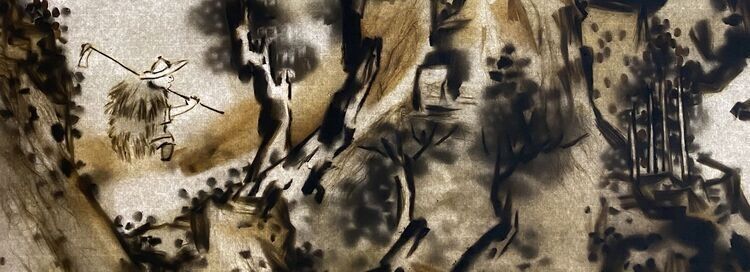
Cornell China Center Fall Field Trip: Herbert F. Johnson Museum of Art
October 13, 2022
10:00 am
You're invited to join this tour and conversation about the art museum's Chinese and East Asian collections. Come discuss opportunities to engage with the museum and how the museum can be a resource to Cornellians. Learn about Xu Bing, currently a Cornell A. D. White Professor-at-Large based in Beijing and New York, and his Background Story exhibition, and visit 5th floor Asian galleries. Led by Ellen Avril, Chief Curator and the Judith H. Stoikov Curator of Asian Art. Limited to 15 participants.
***THIS TRIP IS NOW FULLY ENROLLED. Register here to add yourself to the wait list.***
Additional Information
Program
Einaudi Center for International Studies
East Asia Program
Cornell Classical Chinese Colloquium

Welcome to Fall's Text Readings
The Cornell Classical Chinese Colloquium (CCCC) 古文品讀 is a reading group for scholars interested in premodern Sinographic (古文) text. The group typically meets monthly during the semester to explore a variety of classical Chinese texts and styles. Other premodern texts linked to classical Chinese in Japanese, Korean, and Vietnamese have been explored. Presentations include works from the earliest times to the 20th century. Workshop sessions are led by local, national, and international scholars.
For more information or to get on our list-serve, please email us.
|
|
||||||||||||
|
||||||||||||