
Einaudi Center for International Studies
China Should Focus on Financial System Reform to Increase Productivity: Professor

Eswar Prasad, SAP
Interview with Eswar Prasad, Cornell University economist, about China’s economic trajectory.
Additional Information
How Dairy Farms Manage Heat for Their Workers and Cows

Mary Jo Dudley, LACS
Mary Jo Dudley, director of the Cornell Farmworkers Program, states that New York state is developing an extreme heat action plan to improve conditions for workers during high temperatures. “We are considering initiatives such as creating cooling stations for farmworkers and emphasizing educational materials like posters and flyers,” Dudley says.
Additional Information
"Speculations on a Shirt":* The Photographic Ecology of the Working Classes in Bombay/Mumbai/Bambai, 1970s-1990s

November 18, 2024
12:15 pm
Uris Hall, G08
Talk by Ayesha Matthan (History of Art, Cornell University)
This talk looks at a photographic construction of the working classes in Bombay/Mumbai/Bambai between the 1970s and 1990s by a specific range of photographers. It will situate these images at a time when the city was witness to the steady decline of the Communist stronghold among the working classes after the death of the Communist Party of India (CPI) leader Krishna Desai in Bombay, moving to embrace the Shiv Sena Party with its anti-migrant rhetoric, and liberalization and deindustrialization after the Great Textile Mill Strike of 1982.
*Title taken from Namdeo Dhasal’s eponymously titled poem (trans. Dilip Chitre from the Marathi)
Ayesha Matthan is a PhD candidate in the Department of the History of Art and Visual Studies at Cornell University. She has degrees in Literature in English, Journalism, and Visual Studies from St Stephen’s College, Delhi; Asian College of Journalism in Chennai; and Jawaharlal Nehru University, New Delhi, respectively. She has worked with The Hindu as an arts journalist, The Alkazi Foundation for the Arts as a research scholar, and India Foundation for the Arts as a communications editor. Her PhD dissertation is tentatively titled “Looking for Bombay/Mumbai/Bambai: Photography, Identity, and the City, 1970s-1990s.” She also works now and then at the Johnson Museum as a Curatorial Assistant to preserve her sanity from the PhD madness.
Image: Sooni Taraporevala, “Streetside Services, Palmist”, Bombay 1977
Additional Information
Program
Einaudi Center for International Studies
South Asia Program
‘Gandhiji, I have no homeland’: Caste, Nation, and Decolonisation

November 11, 2024
12:15 pm
Uris Hall, G08
Talk by Priyamvada Gopal (English, University of Cambridge )
Partially in light of its recent currency for Hindu majoritarianism and the rhetoric of Hindutva, this talk will raise questions about the project of ‘decolonization’ in India through the work of Bhimrao Ambedkar. His famous polemic, What Congress and Gandhi Have Done to the Untouchables, written on the cusp of independence, raises questions relevant to our understanding of that period and present-day concerns. Ambedkar argues that the primary vehicle of anticolonialism, its ‘imagined community’ of the Indian nation, was, from the outset, compromised by a stratified and deep-rooted bedrock of exploitation, marginalization, and exclusion. What implications do the reality Ambedkar outlines have for how we think about decolonization in and of India? This paper argues that Ambedkar’s thought about what he saw as the ‘Hindu Raj’ following the British Raj is a vital contribution and corrective to regnant theories of decolonization not just because it offered a necessary challenge to caste Hindu anticolonialism but as an examination in itself, of what liberation is and what an actual end to colonialism might look like beyond a transfer of power. A strong engagement with Ambedkar’s critique has the potential to change our understanding of decolonization very profoundly.
Priyamvada Gopal was born in New Delhi, India, Schooling in Colombo, Sri Lanka; Thimpu, Bhutan; Delhi, India; and Vienna, Austria. Gopal’s subsequent education was at Delhi University, Jawaharlal Nehru University, Purdue University (USA), and Cornell University (USA, PhD 2000). Currently, Gopal is a professor of postcolonial studies at the Faculty of English, University of Cambridge, and a professorial fellow at Churchill College. Her interests are in the literature, politics, and cultures of empire, colonialism, and decolonization. Some of her related interests are in the novel, South Asian literature, and postcolonial cultures. Gopal’s published work includes Literary Radicalism in India: Gender, Nation and the Transition to Independence (Routledge, 2005), After Iraq: Reframing Postcolonial Studies (Special issue of New Formations co-edited with Neil Lazarus), The Indian English Novel: Nation, History and Narration (Oxford University Press, 2009) and, most recently, Insurgent Empire: Anticolonial Resistance and British Dissent (Verso, 2019) which was shortlisted for the British Academy Prize for Global Cultural Understanding and the Bread and Roses Prize. My writing has also appeared in The Hindu, Outlook India, India Today, The Independent, Prospect Magazine, The New Statesman, The Guardian, Al-Jazeera English (AJE) and The Nation (USA). I’ve contributed occasionally to the BBC’s Start the Week and Newsnight and programs on NDTV-India, Al-Jazeera, National Public Radio, and Canadian Broadcasting Corporation.
Additional Information
Program
Einaudi Center for International Studies
South Asia Program
Small Step Could Bring Big Relief to Young Undocumented Immigrants

Stephen Yale-Loehr, Migrations
“It is a small step within a complex immigration system that can smooth the way for many individuals to get a work visa more quickly,” says Stephen Yale-Loehr, professor of immigration law.
Additional Information
CANCELED - Individuating Identity in Postcolonial Pakistan

December 2, 2024
12:15 pm
Uris Hall, G08
Talk by Zehra Hashmi (History and Sociology of Science, University of Pennsylvania )
This talk examines how and why Pakistan’s national biometric-based identification regime came to use an individual’s blood relations to construct and track uniquely identified individuals. Through the concept of datafied kinship, it proposes that the uses of kin networks in Pakistan’s identity database, as information, can reconfigure our understanding of contemporary identification practices at large: individual identity is generated and tracked through relatedness, not unique bodily characteristics, or biometrics alone. To demonstrate this, it first examines how the database design works to construct identity through kin, and specifically how it excludes individuals on the basis of their kin through technological categories such as that of the “family intruder.” Second, it shows how this mode of individual identification differs and departs from the longstanding classificatory schemas that were so foundational to taxonomizing identity along the lines of caste, tribe, and religion in South Asia. It traces this diverging logic—between classification and individuation—to the emergence of individuating technologies in 1970s Pakistan, in the aftermath of the civil war between East Pakistan and West Pakistan, and during the escalating Cold War in the region. In so doing, it illustrates how the political stakes of Pakistan’s identification regime lie not only in its new possibilities for surveillance, a function of its individuating and tracking technology, or its classificatory refusal, but their interconnections.
Zehra Hashmi is an assistant professor in the History and Sociology of Science at the University of Pennsylvania. She is an anthropologist and historian who works on identification technologies in South Asia. Her research explores the everyday workings of securitization and surveillance in Pakistan through the intersection of identification, migration, kinship, and postcolonial and colonial governance. She received her PhD from the Interdepartmental Program in Anthropology and History at the University of Michigan.
Additional Information
Program
Einaudi Center for International Studies
South Asia Program
Asia’s Commercial Heft Helps Keep Russia’s War Economy Going

Nicholas Mulder, IES/PACS
Even if the West successfully uses secondary sanctions to coerce Asian countries, says Nicholas Mulder, a sanctions scholar at Cornell University, the long-term risk is that economic warfare undermines both the primacy of the dollar-based financial system and America’s influence in Asia.
Additional Information
NY Laws Often Do Little Good Because They’re Not Enforced

Alexandra Dufresne, GPV
Alexandra Dufresne is a professor of practice at the Brooks School of Public Policy at Cornell and director of the State Policy Advocacy Clinic.
Additional Information
Gift Supports Global Dissertations
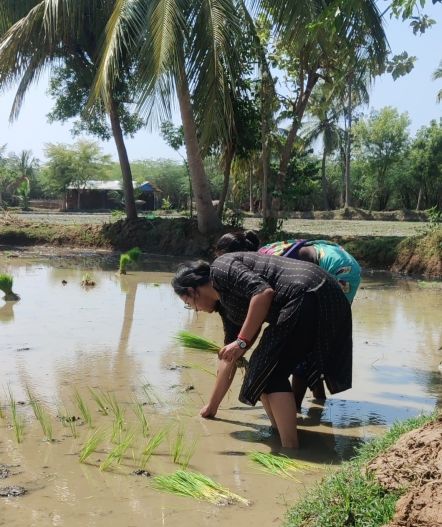
Global PhD Research Scholars Find Path to Finish Line
A generous gift from Amit Bhatia ’01 helps at least six Cornell students each year complete international fieldwork vital to their degrees.
Additional Information
In New Book, Professor Translates Ancient Advice for the Lovelorn

Michael Fontaine, IES
When it comes to romance, classics professor Michael Fontaine (IES) thinks some of the best tips come from looking back—way back.