
Einaudi Center for International Studies
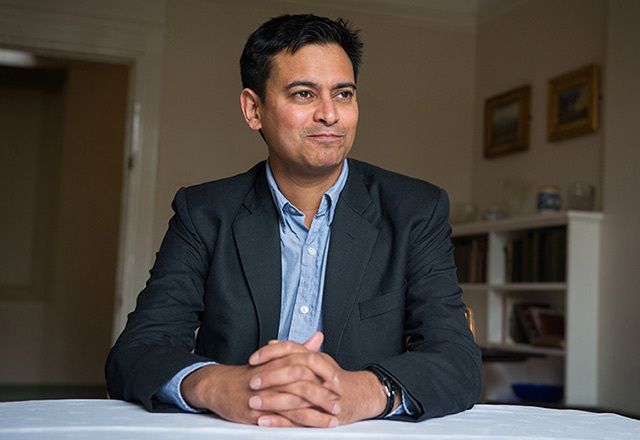
Unmasking the CCP Lecture Series "Money, Morale and Mayhem: Economic and Emotional Landscapes in the Formation of Revolutionary China, 1946-1949"
April 10, 2024
4:45 pm
Physical Sciences Building, 120
Did the Communists win or the Nationalists lose the Chinese civil war? This talk will reexamine this classic question with new evidence from diaries and memoirs of the period that examine how economic crisis and political disillusionment in the existing regime interacted with a new type of revolutionary identity. It will discuss the immensely complex and ambiguous political atmosphere in the period leading up to 1949 and suggest that while the forces behind revolution were powerful, they contained the seeds of their own contradictions too.
Register Now, to Join Remotely: https://ecornell.cornell.edu/keynotes/overview/K041024/
Speaker Bio: Professor Rana Mitter
Rana Mitter is ST Lee Chair in US-Asia Relations at the Harvard Kennedy School. He is the author of several books, including Forgotten Ally: China’s World War II (2013) which won the 2014 RUSI/Duke of Westminster’s Medal for Military Literature, and was named a Book of the Year in the Financial Times and Economist. His latest book is China’s Good War: How World War II is Shaping a New Nationalism (Harvard, 2020). His writing on contemporary China has appeared recently in Foreign Affairs, the Harvard Business Review, The Spectator, The Critic, and The Guardian. He has commented regularly on China in media and forums around the world, including at the World Economic Forum at Davos. His recent documentary on contemporary Chinese politics "Meanwhile in Beijing" is available on BBC Sounds. He is co-author, with Sophia Gaston, of the report “Conceptualizing a UK-China Engagement Strategy” (British Foreign Policy Group, 2020). He won the 2020 Medlicott Medal for Service to History, awarded by the UK Historical Association. He previously taught at Oxford, and is a Fellow of the British Academy.
This lecture series is kindly sponsored by the Einaudi Center, East Asia Program, Department of History, Charles H. Dyson School of Applied Economics and Management, Society for Humanities, Cornell External Education, eCornell, Cornell IT, Department of Government, and Department of Asian Studies.
Additional Information
Program
Einaudi Center for International Studies
East Asia Program
Pedro X. Molina’s Delicate Achievement

Series Features Scholars Under Threat Alumni
"My body is here, but my heart and my work are still entrenched in the struggles of my people," says Nicaraguan cartoonist Pedro X. Molina.
Additional Information
The Ants and the Grasshopper

March 6, 2024
7:00 pm
Willard Straight Hall Theatre
Anita Chitaya has a gift; she can help bring abundant food from dead soil, she can make men fight for gender equality, and she can end child hunger in her village. Now, to save her home from extreme weather, she faces her greatest challenge: persuading Americans that climate change is real.
Traveling from Malawi to California to the White House, Anita meets climate skeptics and despairing farmers. Her journey takes her across all the divisions shaping the US, from the rural-urban divide, to schisms of race, class and gender, to the thinking that allows Americans to believe we live on a different planet from everyone else. It will take all her skill and experience to persuade us that we’re all in this together.
This documentary, ten years in the making, weaves together the most urgent themes of our times: climate change, gender and racial inequality, the gaps between the rich and the poor, and the ideas that groups around the world have generated in order to save the planet.
Free admission. Sponsored by the Institute for African Development at the Mario Einaudi Center for International Studies.
Film website: https://www.antsandgrasshopper.org/
"I am blown away. You have found a hero of such grace and intelligence and power, and you had the good sense to get out of the way, center the narrative on her. The film is obviously not about agriculture in the way I expected to be-- it’s much bigger than that. We get to observe history. That’s what ten years on a movie gets you. I feel invested in the project... so wonderful to see it completed. I will be happy to spread the word." - Michael Pollan, Author & Director Of The Knight Program In Science And Environmental Journalism
Additional Information
Program
Einaudi Center for International Studies
Institute for African Development
Just Climate Futures

April 4, 2024
2:30 pm
Uris Hall, G08
Recent assessments of climate change impacts in Sub-Saharan Africa indicate that the continent is already experiencing impacts from rising temperatures, including water shortages, reduced food production, loss of lives and biodiversity loss. There are an increased number of extreme events, from drought, floods and tropical storms, and these events will worsen if global greenhouse gases are not significantly reduced. At the same time, Africa is one of the lowest contributors to greenhouse gas emissions, and many countries struggle to manage with the cost of climate change adaptation, while also paying high levels of debt. Alongside these climate challenges are ongoing extractive industries looking to Africa as a new or ongoing source of resources – including mining precious minerals to support renewable alternatives to fossil fuels. Despite this bleak picture, alternative models that are transformative and reparative are emerging as ways to imagine just climate futures in Africa. These alternatives include attention to multiple types of social inequities and building development strategies through dialogue and careful attention to power dynamics. Adaptation approaches that support decent livelihoods alongside biodiversity, ecosystems and indigenous knowledge are being tested and expanded. Recognition of power inequities at multiple scales and reparation of these inequities is part of such approaches.
Additional Information
Program
Einaudi Center for International Studies
Institute for African Development
Institute for African Development Seminar: The UN Global Compact Network Tanzania

March 7, 2024
2:30 pm
Uris Hall, G08
Recent assessments of climate change impacts in Sub-Saharan Africa indicate that the continent is already experiencing impacts from rising temperatures, including water shortages, reduced food production, loss of lives and biodiversity loss. There are an increased number of extreme events, from drought, floods and tropical storms, and these events will worsen if global greenhouse gases are not significantly reduced. At the same time, Africa is one of the lowest contributors to greenhouse gas emissions, and many countries struggle to manage with the cost of climate change adaptation, while also paying high levels of debt. Alongside these climate challenges are ongoing extractive industries looking to Africa as a new or ongoing source of resources – including mining precious minerals to support renewable alternatives to fossil fuels. Despite this bleak picture, alternative models that are transformative and reparative are emerging as ways to imagine just climate futures in Africa. These alternatives include attention to multiple types of social inequities and building development strategies through dialogue and careful attention to power dynamics. Adaptation approaches that support decent livelihoods alongside biodiversity, ecosystems and indigenous knowledge are being tested and expanded. Recognition of power inequities at multiple scales and reparation of these inequities is part of such approaches.
Additional Information
Program
Einaudi Center for International Studies
Institute for African Development
Trump and Biden May Be Ignoring America’s 130 Million Nonunion Workers– But These Voters Will Be Seeking a Champion to Elect in November

Desiree LeClercq, Einaudi
Nonunion workers and their role in the upcoming presidential elections are discussed in this opinion piece written by Desiree LeClercq, assistant professor of employment and labor law.
Additional Information
NY Must Address Urgent Need For Immigration Legal Aid

Stephen Yale-Loehr, Einaudi
Stephen Yale-Loehr, professor of immigration law, co-authors this opinion piece encouraging New York to address an urgent need for immigrant legal aid.
Additional Information
With Russian Economy Far From Collapse, U.S. Opts for Tougher Punishment

Nicholas Mulder, IES
“This is the first geopolitical crisis without all of the major Asian economies on board. The West does not have decisive economic power anymore. India and China are enough to keep Russia afloat,” says Nicholas Mulder, professor of history.
Additional Information
Beyond the “Nuclear Umbrella”: Rethinking European Defense After the Russia-Ukraine War

Matthew Evangelista, PACS
Matthew Evangelista, President White Professor of History and Political Science, examines the precedents and possibilities for postwar European security.
Additional Information
IAD Weekly Seminar Series: Adapting to and mitigating climate change in Tanzania: Report on use of the System of Rice Intensification

February 29, 2024
2:30 pm
G-08 Uris Hall
Dr. Primitiva Andrea Mboyerwa is a senior lecturer in the College of Agriculture’s Department of Soil and Geological Sciences at the Sokoine University of Agriculture. PhD in Climate-Smart Agriculture & Biodiversity Management from Haramaya University in Ethiopia as well as a M.Sc. in Soil Science and Land Management from Sokoine University of Agriculture. Over the past 14 years, she has studied and researched a wide range of farming systems in Tanzania as well as elsewhere in Africa, Australia and USA, addressing the System of Rice Intensification, crop productivity, soil health, mitigation of greenhouse gas emissions, soil conservation, fertilizer use efficiency, nutrient and water management, tillage practices, soil carbon sequestration, climate- smart agriculture, and biodiversity management. Her research interests have been framed by an understanding of the soil-water-plant-nutrients-environment interface emphasizing integrated approaches for devising crop production systems that have minimal to zero risks to the environment and human health.
Additional Information
Program
Einaudi Center for International Studies
Institute for African Development