
Einaudi Center for International Studies
Lessons from Democracies at Risk: A Global Perspective
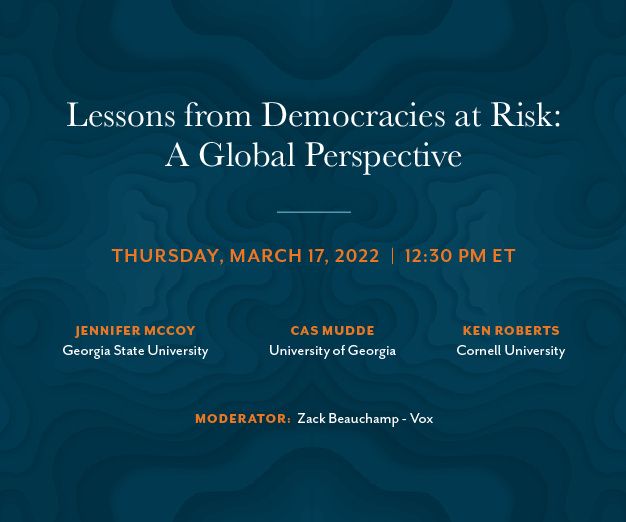
March 17, 2022
12:30 pm
The United States is not the only country where democracy is vulnerable. The forces of polarization, populism, and autocracy have provoked deep conflict and democratic backsliding across the globe in recent years. Countries such as Venezuela, Turkey, Hungary, and Russia that once seemed to be on the road to democratization have reversed course, with often tragic and devastating consequences. How does the United States fit into this global pattern? What lessons does a global perspective hold for the challenges of democratic vulnerability in the United States? And what have been the most effective sources of resilience in the global struggle for democracy?
Please join us for a discussion featuring some of the nation’s leading experts on global democratic vulnerability and resilience and what it might mean for American democracy.
Moderator:
Zack Beauchamp (Vox)
Panelists:
Jennifer McCoy (Georgia State University)
Cas Mudde (University of Georgia)
Ken Roberts (Cornell University)
This event is the second in our webinar series, Democracy in the Balance: Vulnerability, Resilience, and Reform, sponsored by the Mario Einaudi Center for International Studies, the American Academy of Political and Social Science, and the American Democracy Collaborative. These three panels will assess the state of American democracy and evaluate prospects for its reform and renewal, based on the latest evidence and insights from political and social science.
Additional Information
Program
Einaudi Center for International Studies
Ukrainian Invasion Adds to Chaos for Global Supply Chains

Eswar Prasad, SAP
“Even when trade flows may take place directly between Russia and its trading partners, the reality is that payments often have to go through a Western-dominated financial system, and usually have to go through a Western currency,” says Eswar Prasad, professor of economics and international trade policy.
Additional Information
Critics Call Out 'Racist' Western Coverage of Russia's Invasion of Ukraine
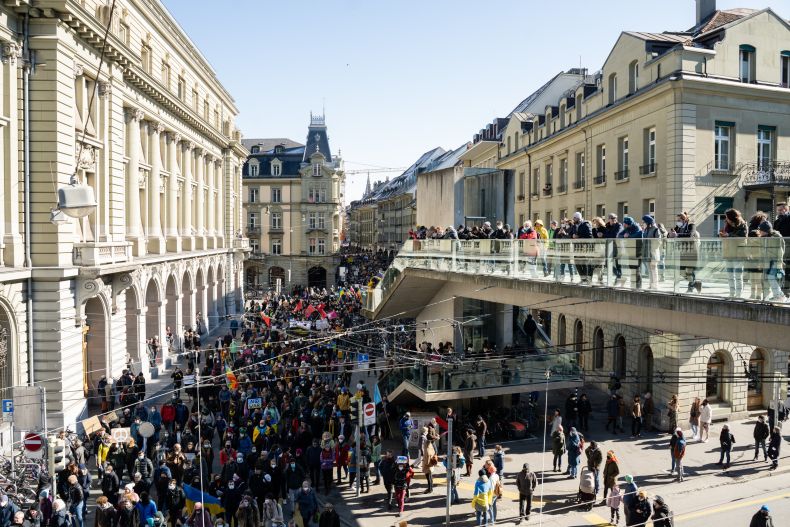
Mostafa Minawi, CO+POS and Global Public Voice Fellow
This piece notes that Mostafa Minawi commented on CBS News’ Charlie D’Agata comparing “the value of peoples’ lives and who qualifies as ‘civilized.’”
Additional Information
Russia is About to Plunge into Financial Crisis. How Will Citizens React?

Thomas Pepinsky, SEAP
SEAP director Thomas Pepinsky writes this opinion piece on Russia’s imminent financial crisis and how Russian citizens will react.
Additional Information
Einaudi, IES, and PACS Directors Condemn Russian Attack

Statement of Solidarity from the Einaudi Center
The invasion violates international law, the principles of national sovereignty, and basic human rights.
Cornell University's Mario Einaudi Center for International Studies and its programs, the Institute for European Studies (IES) and Judith Reppy Institute for Peace and Conflict Studies (PACS), stand in solidarity with the people of Ukraine as they resist Russia’s invasion of their sovereign nation.
The invasion violates international law, the principles of national sovereignty, and basic human rights. The indiscriminate air and missile attacks against Ukrainian cities constitute grave war crimes, and the flight of refugees portends a humanitarian crisis of enormous scale. We extend our sympathies to Ukrainian victims and defenders and to the brave Russians who have spoken out against Putin’s unjustified aggression.
Given the diversity of our intellectual community’s experiences and perspectives, it is even more striking that we are unanimous here: the Russian invasion of Ukraine must be condemned in the strongest terms. We stand for democratic values, tolerance, and human dignity. Our collective missions align to support rights and respect for humanity, as we work together with our students, colleagues, and partners across the world to move ever closer toward justice and peace.
- Rachel Beatty Riedl, Einaudi Center Director | John S. Knight Professor of International Studies | Professor, Government and Cornell Jeb E. Brooks School of Public Policy
- Mabel Berezin, IES Director | Professor of Sociology
- Rebecca Slayton, PACS Director | Associate Professor of Science and Technology Studies
Additional Information
Martín Caparrós (A.D. White Professor-at-Large): "Ñamérica"
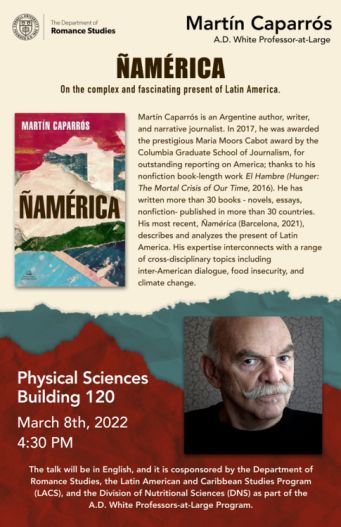
March 8, 2022
4:30 pm
PSB 120
MartÍn Caparrós is a distinguished Argentine author, writer, and narrative journalist, and one of the fundamental Latin American voices of our time. In 2017, he was awarded the prestigious Maria Moors Cabot award by the Columbia Graduate School of Journalism, for outstanding reporting on America; specifying work on his nonfiction book-length work El Hambre (Hunger: The Mortal Crisis of Our Time, 2016), in which the author visits both the richest and poorest people of the earth in order to explore why hunger is one of today’s big unresolved issues. The book has been translated into 14 languages.
He was the recipient of the prestigious Herralde Prize (2011) for his novel, Living; the Planeta Prize (2004) for his novel, Valfierno; and the Guggenheim Fellowship (1994). He also writes biweekly columns for The New York Times and Spain’s El País. His expertise interconnects with a range of cross-disciplinary topics including inter-American dialogue, food insecurity, and climate change.
This event is part of Caparrós’s first visit as an A.D. White Professor-at-Large (ADW-PAL) to Cornell. His on-campus residency runs March 7-11, 2022. He was elected as an ADW-PAL in 2019. His appointment runs through 2025.
The talk will be in English.
Additional Information
Program
Einaudi Center for International Studies
Latin American and Caribbean Studies
Russia’s War on Ukraine

Mar. 4 at 4:30: Register now!
Don't miss this virtual panel on the global consequences of the Russian invasion, featuring Einaudi faculty and IES visiting critic Dmitry Bykov.
Additional Information
Russia’s War on Ukraine: A New Attack on Peace, Rights, and Sovereignty

March 4, 2022
4:30 pm
The Russian invasion of Ukraine constitutes the first major land war in Europe in decades. It threatens lives across the region, the post–Cold War international order—and the stability of the global economy, as the United States, European allies, and countries around the world have imposed severe sanctions on Russia and supplied varying levels of aid to Ukraine.
In cooperation with the Cornell Jeb E. Brooks School of Public Policy and College of Arts and Sciences, the Mario Einaudi Center for International Studies has convened this expert panel to respond to the injustice and massive violation of sovereignty, human rights, and peace.
Join us for a wide-ranging discussion of Russian domestic and foreign policy, Ukrainian nationhood and security response, human rights and migration, economic sanctions’ impact, and international and European consequences of Russia’s invasion of Ukraine. The panel includes Dmitry Bykov, a Russian dissident and Open Society University Network threatened scholar sponsored by Global Cornell and hosted by the Einaudi Center's Institute for European Studies (IES), in partnership with Ithaca City of Asylum.
***
Panelists:
Mabel Berezin (IES Director; Professor, Department of Sociology/A&S)Dmitry Bykov (Russian writer and dissident; scholar at risk hosted by IES)Cristina Florea (Assistant Professor, Department of History/A&S)Nicholas Mulder (Assistant Professor, Department of History/A&S)Bryn Rosenfeld (Assistant Professor, Department of Government/A&S)Stephen Yale-Loehr (Migrations faculty fellow; Professor of Immigration Law Practice, Cornell Law School)Moderator:
Rachel Beatty Riedl (Einaudi Center Director; Professor, Department of Government/A&S and Cornell Brooks School)
Introduction:
Wendy Wolford (Vice Provost of International Affairs; Professor, Department of Global Development, College of Agriculture and Life Sciences)
***
Live Screening: Statler 196
Students: Join the campus community in Statler 196 at 4:30 to watch the panel live. Sponsored by the Einaudi Center, A&S, and Cornell Brooks School.
***
About the Series
The new Einaudi Center Critical Conversations Series brings together world-class regional, historical, and comparative experts to promote deeper understanding of global current events and emerging crises on the world stage. The stakes for our shared future have never been higher—so please join us for these critical conversations.
Additional Information
Program
Einaudi Center for International Studies
Reppy Institute for Peace and Conflict Studies
Institute for European Studies
Central Bank Digital Currencies Set to Eat into US Dollar Hegemony

Eswar Prasad, SAP
“We are soon going to be moving to a world where we will have global access to digital versions of the dollar or the Chinese renminbi and many of the other major currencies,” says Eswar Prasad, professor of international trade policy.
Additional Information
U.S. Allies Roll Out Fresh Sanctions on Russia Amid Debate Over How Hard to Hit

Eswar Prasad, SAP
Eswar Prasad talks about the effects major economic sanctions would have on the dollar-dominated global financial system.