
Einaudi Center for International Studies
Democratic Vulnerability and Resilience in the United States
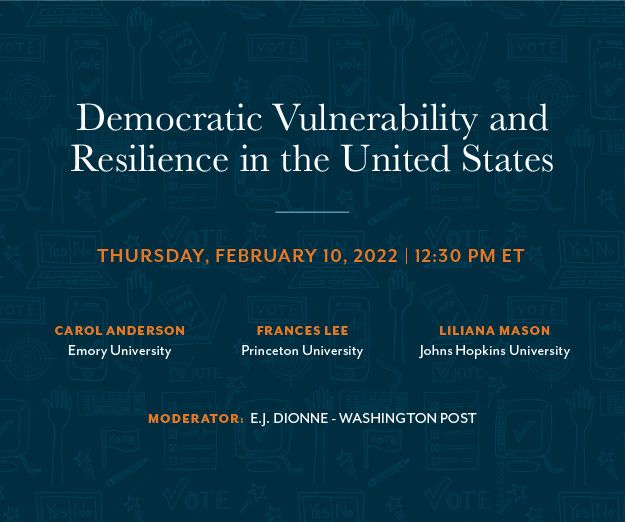
February 10, 2022
12:30 pm
The turbulence of the Trump administration and a chaotic 2020 presidential election revealed vulnerabilities in American democracy, and raised the possibility that it could be threatened directly. Many observers imagined that the election’s outcome might restore some sense of stability to a democratic system under stress, but 2021 was no tonic: we saw a violent assault on the U.S. Capitol provoked by fantastical claims of a stolen election; escalating conflict over voting rights, one of the basic pillars of a democratic society; and deepening partisanship and polarization over the basics of public health in a devastating global pandemic.
Recent polls indicate that a majority of Americans believe that democracy in the United States is in crisis. What aspects of our democracy remain under threat? Are there areas where the drift toward democratic backsliding has halted, or even reversed? We invite you to join us for a discussion that will focus on critical sources of both vulnerability and resilience for American democracy. Register now!
Moderator:
E. J. Dionne (The Washington Post)
Panelists:
Carol Anderson (Emory University)
Frances Lee (Princeton University)
Lilliana Mason (Johns Hopkins University)
This event is the first in our webinar series, Democracy in the Balance: Vulnerability, Resilience, and Reform, sponsored by the Mario Einaudi Center for International Studies, the American Academy of Political and Social Science, and the American Democracy Collaborative. These three panels will assess the state of American democracy and evaluate prospects for its reform and renewal, based on the latest evidence and insights from political and social science.
Additional Information
Program
Einaudi Center for International Studies
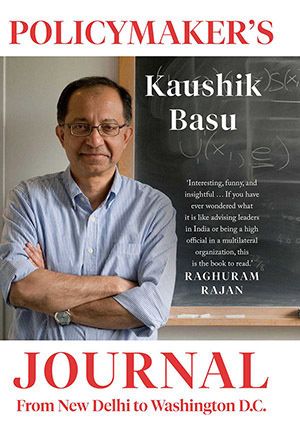
Policymaker's Journal: From New Delhi to Washington D.C.
March 31, 2022
4:00 pm
What is it like to move from the cloisters of academia to the high-profile sector of global markets and monetary policy? In his new book, Policymaker’s Journal: From New Delhi to Washington DC, (Simon & Schuster India, 2021)
Economist Kaushik Basu chronicles the years he spent working in the frenetic world of economic policymaking, first as chief economic advisor to the Indian government and later as the chief economist at the World Bank. In a live, virtual, Chats in the Stacks talk, Basu will discuss how he documented his day-to-day experiences over seven years of high-level, international economic policy work and share what he learned during that time.
Sponsored by Mann Library, the talk is followed by a live Q&A.
Basu is Cornell’s Carl Marks Professor of International Studies and a professor of economics. A former senior vice president and chief economist of the World Bank, from 2017 to 2021 he served as president of the International Economic Association and he was chief economic adviser to the Indian government from 2009 to 2012.
Dial-In Information
Please register through the following link:
https://cornell.zoom.us/webinar/register/WN_OOBc_FOKSravdzhWeK3k3A
Additional Information
Program
Einaudi Center for International Studies
South Asia Program
The Economic Costs of Closed Minds

Kaushik Basu, SAP
Kaushik Basu, professor of economics, writes this opinion piece about the uneven economic recovery of emerging market and developing economies (EMDEs) and advanced economies.
Additional Information
U.S. Could Utilize Rule to Stop High-Tech Exports to Russia

Eswar Prasad, SAP
“The U.S. is hoping Russia has learned the lesson through the Huawei example,” says Eswar Prasad, professor of economics and international trade policy.
Additional Information
Topic
- Development, Law, and Economics
Program
Expanded Options for Some Foreign Students
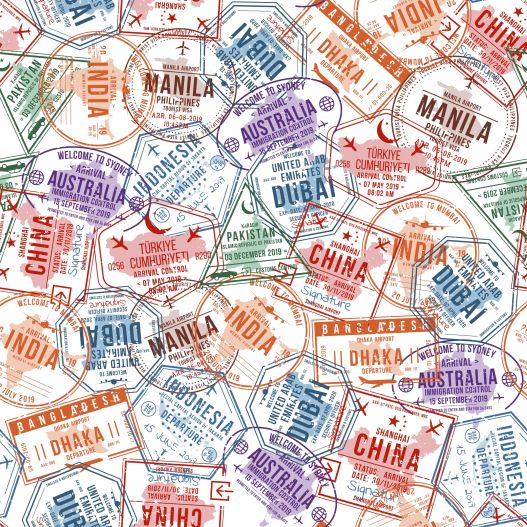
Steve Yale-Loehr
Steve Yale-Loehr, professor of immigration law, says administrative actions “provide a small but significant step to help keep U.S. companies competitive in a global economy and to address workforce shortages. Larger actions, such as increasing the number of employment-based green cards, will require congressional action.”
Additional Information
Biden’s "Worker-Centered" Trade Policy Fails U.S. Workers

Desirée LeClercq in Fortune
GPV fellow Desirée LeClercq argues that the Biden administration's trade policies are "not positive advancements for workers in the U.S., whose rights continued to be stymied by domestic laws and practices."
Additional Information
The Economic Weapon: The Interwar Rise of Sanctions
February 3, 2022
11:25 am
Prof. Nicholas Mulder provides a history of the interwar origins of economic sanctions, showing how they reconfigured international affairs by enabling distant coercion against civilian societies in peacetime. Based on wartime blockade practices, the instrument of sanctions offered a novel way to prevent war.
This presentation is based on his first book, The Economic Weapon: The Rise of Sanctions as a Tool of Modern War, recently published in January 2022 by Yale University Press.
About the speaker
Nicholas Mulder is an Assistant Professor of History at Cornell University. He works on European and international history from 1870 to the present. His research focuses on political, economic, and intellectual history, with particular attention to the era of the world wars between 1914 and 1945.
This seminar is part of the spring seminar series with the Reppy Institute for Peace and Conflict Studies (PACS).
Additional Information
Program
Einaudi Center for International Studies
Reppy Institute for Peace and Conflict Studies
Institute for African Development Seminar: Toward the Networked City? Translating models and ideals in water and sanitation of Dar es Salaam
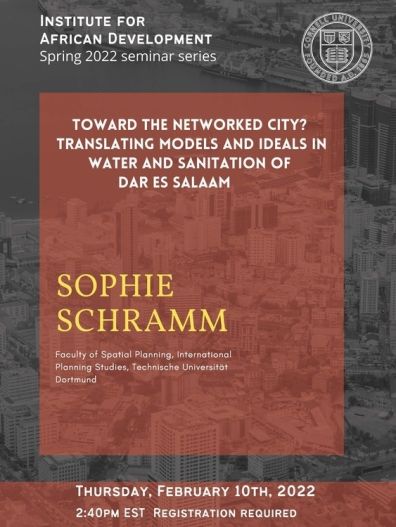
February 10, 2022
2:40 pm
Uris Hall, G-08
Issues in African Development Seminar Series examines critical concerns in contemporary Africa using a different theme each semester. The seminars provide a forum for participants to explore alternative perspectives and exchange ideas. They are also a focal activity for students and faculty interested in African development. In addition, prepares students for higher level courses on African economic, social and political development. The presentations are designed for students who are interested in development, Africa’s place in global studies, want to know about the peoples, cultures and societies that call Africa home, and explore development theories and alternate viewpoints on development.
Speaker details here
Zoom registration link here
Additional Information
Program
Einaudi Center for International Studies
Institute for African Development
Lingui, the Sacred Bonds

February 21, 2022
7:15 pm
Willard Straight Theatre
Ithaca Premiere. 2021 > Chad > Directed by Mahamat-Saleh Haroun
With Achouackh Abakar, Rihane Khalil Alio
Amina, a single mother and practicing Muslim, lives with her 15-year-old daughter, Maria. When Amina learns Maria is pregnant and wants to abort the child, they face an impossible situation in a country where abortion is legally and morally condemned. "A blistering attack on patriarchy and a warm reaffirmation of 'the sacred bonds' (the meaning of the film's title) among women, it's a bracing work... etched in fully felt performances and beautifully hued compositions." (Justin Chang, LA Times) Subtitled. More at mubi.com/films/lingui
1 hr 27 min
Additional Information
Program
Institute for African Development
Einaudi Center for International Studies
Borders, Captivity, and Memory in Transnational Italy and the Mediterranean: Day 2
April 8, 2022
9:45 am
Over two days, scholars, writers, practitioners, activists, and students across institutions are coming together virtually to explores the relationship between borders, captivity, and memory, and how it shapes the racialization of migration and the construction of national identity.
The first day of the symposium is March 18, 2022 and the second day is April 8, 2022.
Day 2 Schedule:
Welcome and Roundtable 1: Translation, Testimony, and Storytelling across Borders, 9:45–11:30 a.m. (ET)
Keynote: Language, Identity, and Representation in Transnational Italy, 12–1:30 p.m. (ET)
Speakers: Amara Lakhous and Ubah Cristina Ali FarahDiscussants: Ron Kubati and Loredana PolezziStudent Reflection Session, 1:30–2:15 p.m. (ET)
Open to undergraduate and graduate students at any institution
Roundtable 2: Readings and Discussion to Celebrate the Launch of Contemporary Italian Diversity in Critical and Fictional Narratives, 2:45–4:15 p.m. (ET)
This symposium is organized through the Central New York Humanities Corridor (LLC35), with co-sponsorship from Montclair State University Inserra Chair in Italian and Italian American Studies, the AAIS Critical Race Studies Caucus, Cornell's Migrations initiative, the Mario Einaudi Center for International Studies and its Institute for European Studies, the Cornell Department of Romance Studies, the University of Rochester's Humanities Center, and the Department of Humanities in the Eastman School of Music.
Additional Information
Program
Einaudi Center for International Studies
Institute for European Studies