
Einaudi Center for International Studies
The Allure of Scapegoating Return Migrants During a Pandemic

March 16, 2022
4:30 pm
Uris Hall, G-08
Ato Kwamena Onoma is a program officer at the Council for the Development of Social Science Research in Africa. He is the author of Anti-Refugee Violence and African Politics (Cambridge University Press, 2013) and The Politics of Property Rights Institutions in Africa (Cambridge University Press, 2009).
This event is part of the IAD Distinguished Africanist Scholar Lecture series.
Regist here for virtual access
Additional Information
Program
Einaudi Center for International Studies
Institute for African Development
Transcending Monolingual Worldviews: Magnifying the Impact of Knowledge in Academe and Society

April 29, 2022
11:30 am
Biotechnology Building, G10
All societies, and especially diverse ones like the US, are multilingual; translingual communication mediates life and professions and makes knowledge grow and work. Yet, myths about language set up barriers, inhibiting free exchange and application of knowledge. These myths include the ideas that knowledge must only be produced, can only be exchanged, and is applied best through dominant languages—damaging assumptions that adversely affect many domains, but particularly knowledge work by academics across the disciplines. Harm caused by this suppression of languages has been long documented in the literature in language, writing, and communication studies. Drawing on the research and his own efforts to counter language ideologies, Dr. Shyam Sharma will present a framework and share practical strategies, showing how transcending monolingual worldviews (and mobilizing all languages) helps academe and its scholars to magnify the impact of the knowledge they produce, both transnationally and within US academe and society.
About the speaker
Dr. Shyam Sharma is Associate Professor and Graduate Program Director in the Program in Writing and Rhetoric at the State University of New York in Stony Brook. His scholarship and teaching focus on issues of language and language policy/politics, cross-cultural rhetoric, international students and education, and writing in the disciplines. His works have appeared in a variety of venues, including College Composition and Communication, JAC, Across the Disciplines, Composition Studies, NCTE, Series in Writing and Rhetoric, Hybrid Pedagogy, Kairos, and Professional and Academic English (IELTS SIG). His last book (Routledge, 2018), based on data gathered by visiting 20 US universities plus data collected distantly from 15 more, offers theoretical and practical pathways for the advancement of Writing Studies at the graduate level, using writing support for international graduate students as a major intervention in graduate education. His next book analyzes the foundations of international education in the US in the decades after the Second World War, showing fault lines and potential futures by analyzing trajectories in the past few decades.
The event is free and open to the public. Campus visitors and members of the public must adhere to Cornell's public health requirements for events, which include wearing masks while indoors and providing proof of vaccination or a recent negative COVID-19 test.
Co-sponsored by the College of Arts & Sciences; the Graduate School Offices of Inclusion and Student Engagement, and Future Faculty and Academic Careers; the Office of Postdoctoral Studies; the Office of the Vice Provost for International Affairs; the English Language Support Office; the Language Resource Center; and the South Asia Program.
Registration is required: https://cornell.ca1.qualtrics.com/jfe/form/SV_1Li39my9DG4VrtY
Additional Information
Program
Einaudi Center for International Studies
South Asia Program
The Revolutionary City: Urbanization and the Global Transformation of Rebellion | Einaudi Center “Author Meets Critics”
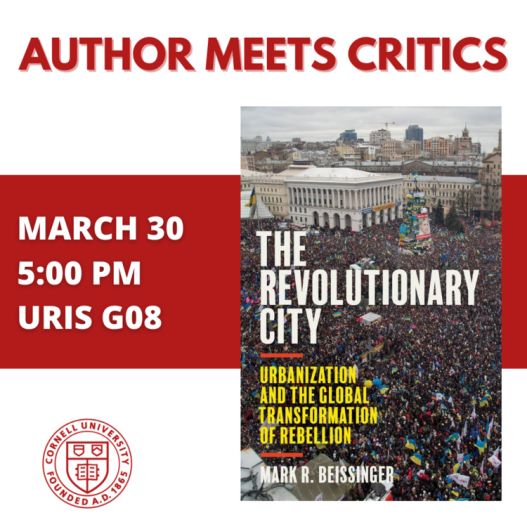
March 30, 2022
5:00 pm
Uris Hall, G08
Cities are changing sites of revolution and rebellion, contestations over forms of power and social relations. As historical and contemporary instances, revolutions present alternative views of world-making and contestations over the organization of society and relations of power. To better understand this phenomenon, the Mario Einaudi Center for International Studies has assembled a panel discussion of Professor Mark Beissinger’s book, The Revolutionary City: Urbanization and the Global Transformation of Rebellion (Princeton University Press, 2022). Join us for an exploration of how and why cities have become primary sites of revolutionary disruptions in the contemporary world.
Examining the changing character of revolution around the world, The Revolutionary City focuses on the impact that the concentration of people, power, and wealth in cities exercises on revolutionary processes and outcomes. Once predominantly an urban and armed affair, revolutions in the twentieth century migrated to the countryside, as revolutionaries searched for safety from government repression and discovered the peasantry as a revolutionary force. But at the end of the twentieth century, as urban centers grew, revolution returned to the city—accompanied by a new urban civic repertoire espousing the containment of predatory government and relying on visibility and the power of numbers rather than arms.
Using original data on revolutionary episodes since 1900, public opinion surveys, and engaging examples from around the world, Mark Beissinger explores the causes and consequences of the urbanization of revolution in the late twentieth and early twenty-first centuries. Beissinger examines the compact nature of urban revolutions, as well as their rampant information problems and heightened uncertainty. He investigates the struggle for control over public space, why revolutionary contention has grown more pacified over time, and how revolutions involving the rapid assembly of hundreds of thousands in central urban spaces lead to diverse, ad hoc coalitions that have difficulty producing substantive change.
Author of The Revolutionary City:
Mark R. Beissinger, Henry W. Putnam Professor of Politics, Princeton University
“Author Meets Critics” Expert Discussants:
Dina Bishara (Assistant Professor, School of Industrial and Labor Relations)Bryn Rosenfeld (Assistant Professor, Department of Government/A&S)Sidney Tarrow (Emeritus Maxwell Upson Professor, Department of Government/A&S; Adjunct Professor, Cornell Law School)
Moderator:
Rachel Beatty Riedl (Einaudi Center Director; Professor, Department of Government/A&S and Cornell Brooks School)
Co-Sponsors:
Institute for European Studies, Einaudi CenterSoutheast Asia Program, Einaudi CenterReppy Institute for Peace and Conflict Studies, Einaudi CenterInstitute of Politics and Global Affairs
About the Forum:
The “Author Meets Critics” forum stages scholarly conversations around the Einaudi Center’s research priority areas: Democratic Threats and Resilience, and Inequalities, Identities, and Justice.
Attendance Requirements:
In-person attendance is open to the Cornell community: Cornell ID and mask REQUIRED
Additional Information
Program
Einaudi Center for International Studies
Reppy Institute for Peace and Conflict Studies
Southeast Asia Program
Institute for European Studies
The Return of History: The War in Ukraine and the Future of Great Power Competition
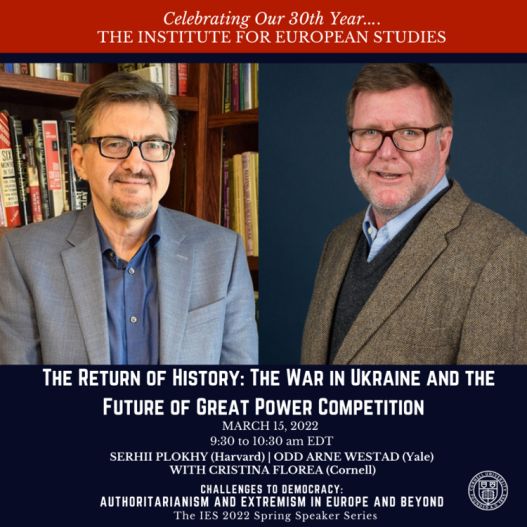
March 15, 2022
9:30 am
Register here.
Putin’s decision to invade Ukraine was largely informed by his notion of a shared Russian-Ukrainian history, which allegedly does not give Ukraine the right to a sovereign state. The current conflict in Ukraine is, in this sense, also a dispute about history. This panel brings together two leading historians of Eastern Europe, the Soviet Union, and the Cold War to discuss the war’s roots and significance from a historical perspective. The speakers will address key questions such as: What has Ukraine’s relationship with Russia been over the long term and how might the war change it? Does the war in Ukraine mark a break with the post-Cold War order, a return to the Cold War, or the beginning of something completely new? How should we think about China’s role in the conflict? Is the war a moment of opportunity or crisis for the West?
Serhii Plokhy is Mikhailo Hrushevsky professor of Ukrainian history at Harvard University and director of the Harvard Ukrainian Research Institute. He has written broadly on the history of Eastern Europe and Ukraine, on issues ranging from the premodern and early modern history of Eastern Slavs, to the Soviet Union’s collapse, nationalism and nationalist myth-making, and Chernobyl. His many publications include Yalta: The Price of Peace, The Last Empire: The Final Days of the Soviet Union, The Gates of Europe: A History of Ukraine, and Chernobyl: The History of a Tragedy. Professor Plokhy’s most recent work, Atoms and Ashes: A Global History of Nuclear Disaster, will be published later this year.
This event is co-sponsored by The Reppy Institute for Peace and Conflict Studies.
Odd Arne Westad is the Elihu Professor of History at Yale University, where he also teaches in the Jackson Institute for Global Affairs and serves as director of International Security Studies. Professor Westad specializes in modern international and global history, especially the history of eastern Asia since the 18th century. He has published widely on the history of the Cold War, China-Russia relations, and the Chinese civil war and Communist party, and is currently working on histories of empire and imperialism, above all in Asia. Through books such as Cold War and Revolution, Decisive Encounters, The Global Cold War, and The Cold War: A World History, Westad has revolutionized the field of Cold War history.
Additional Information
Program
Einaudi Center for International Studies
Reppy Institute for Peace and Conflict Studies
Institute for European Studies
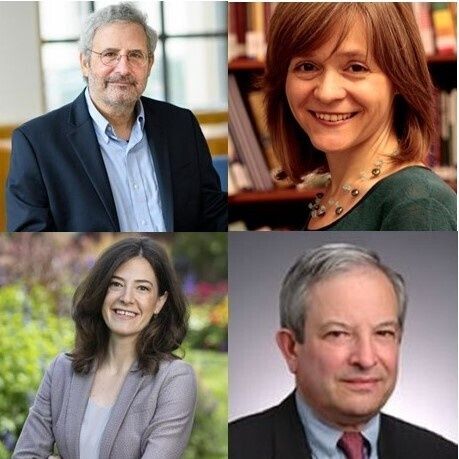
War in Europe: Russia’s Aggression and Ukraine’s Prospects
March 31, 2022
12:15 pm
Europe’s “Eastern Crisis” has witnessed the massing of military forces, armed intervention, and the forceful occupation of territory, combined with harsh rhetoric and outright falsehoods that hinder the pursuit of diplomatic solutions. The situation is eerily reminiscent of the 1930s, when another authoritarian state sought to reverse the consequences of what it perceived as an unfair peace settlement and mounted an aggressive campaign that engulfed the world in a disastrous war. An interdisciplinary panel of Russian, Ukrainian, and US experts will help us understand how we got to this point and what can be done.
Panelists
Mark R. Beissinger, Henry W. Putnam Professor of Politics, Princeton University
Bryn Rosenfeld, Assistant Professor, Department of Government, Cornell University
Kateryna Pishchikova, Associate Professor of Political Science and International Relations, eCampus University
Nicholas Rostow, Visiting Professor of Law, Cornell Law School
Moderator
Matthew Evangelista, President White Professor of History and Political Science, Department of Government, Cornell University
Presented by the Judith Reppy Institute for Peace and Conflict Studies, with co-sponsorship from the Institute of European Studies at the Mario Einaudi Center for International Studies, and the Institute of Politics and Global Affairs, Cornell University.
About the Series
The new Einaudi Center Critical Conversations Series brings together world-class regional, historical, and comparative experts to promote deeper understanding of global current events and emerging crises on the world stage. The stakes for our shared future have never been higher—so please join us for these critical conversations.
Register here
Additional Information
Program
Einaudi Center for International Studies
Reppy Institute for Peace and Conflict Studies
Institute for European Studies
Supporting Ukraine: Business Systems as Tools

March 10, 2022
4:30 pm
This webinar, hosted by the Cornell SC Johnson College of Business, features experts in finance, international policy, and labor economics discussing the unprecedented sanctions being levied at Russia in response to its invasion of Ukraine.
Additional Information
Program
Einaudi Center for International Studies
South Asia Program
Reppy Institute for Peace and Conflict Studies
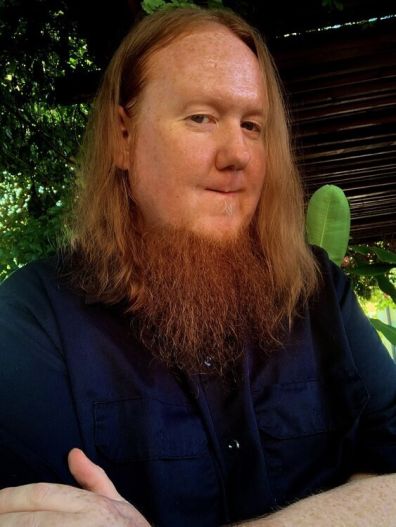
Freeze! The Grassroots Movement to Halt the Arms Race and End the Cold War
March 17, 2022
11:25 am
Uris Hall, G08
This is a hybrid event. Registration information is below.
Dr. Henry Maar argues for the significance of the often-overlooked Nuclear Weapons Freeze Campaign to the arms control talks at the end of the Cold War. Launched in 1979 based on the ideas of Randall Forsberg, the Freeze campaign rallied the public for a simple, yet radical proposal: bilaterally halt (or "freeze") the testing, deployment, and production of nuclear weapons between the United States and the Soviet Union. The Freeze campaign soon catapulted into the mainstream of political discussion, garnering bipartisan endorsements from the US Congress. The highest levels of the Reagan White House privately conceded the antinuclear backlash was potentially the most important national security challenge facing the administration. As the Freeze grew in popularity, the administration was left with a choice: reverse its nuclear saber-rattling or continue to face the ire of the public at the ballot box.
About the speaker
Henry Maar is a modern US Historian specializing in the relationship between domestic politics, peace activism, and US foreign relations. He is the author of FREEZE! The Grassroots Movement to Halt the Arms Race and End the Cold War, published by Cornell University Press. He received his Ph.D. in History from UC Santa Barbara in 2015 and was subsequently the Agnese N. Huary post-doctoral fellow at New York University's Center for the Study of the Cold War and the United States. He has previously taught at UC Santa Barbara and Shanghai Jiao Tong University and is currently a lecturer at California State University, Northridge.
Read his recently published article in the Washington Post.
This seminar is part of the spring seminar series with the Reppy Institute for Peace and Conflict Studies (PACS).
Register here
In accordance with university event guidance, all campus visitors who are 12 years old or older must also present a photo ID, as well as proof of vaccination for COVID-19 or results of a recent negative COVID-19 test. If you are not currently participating in the Cornell campus vaccination/testing program, please bring proof of vaccination or the results of a recent negative test.
Additional Information
Program
Einaudi Center for International Studies
Reppy Institute for Peace and Conflict Studies
Survivor of Chinese Concentration Camp Urges Solidarity with Uyghur Women
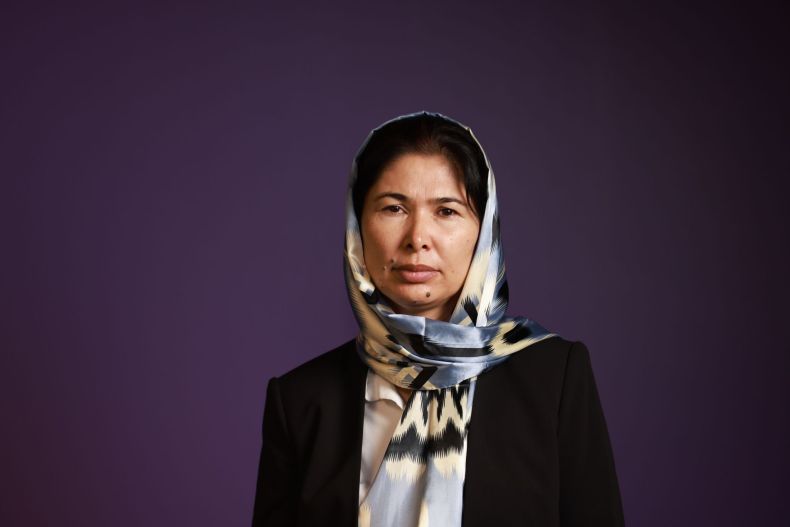
In honor of International Women’s Day
In a March 7 webinar, coinciding with International Women’s Day, Uyghur Muslim and Xinjiang concentration camp survivor Tursunay Ziyawudun spoke on the human rights violations against women she witnessed and survived during her two detentions. The event was hosted by the East Asia Program, moderated by Prof. Allen Carlson, Government and facilitated by Prof. Magnus Fiskesjö, Anthropology.
Additional Information
Shifting Crypto Landscape Threatens Crime Investigations and Sanctions

Sarah Kreps, PACS
Kreps and co-authors discuss the issues and concerns behind cryptocurrency and the potential for illicit activity online.
Additional Information
Topic
- Development, Law, and Economics
Program
Russia's Sanctions Won't Doom the U.S. Dollar

Eswar Prasad, SAP
Eswar Prasad, professor of economics and international trade policy, write this opinion piece arguing that sanctions on Russia won’t disrupt the fundamental structure of global finance. Prasad is also quoted in TIME and The New York Times on Russian sanctions.