
Einaudi Center for International Studies
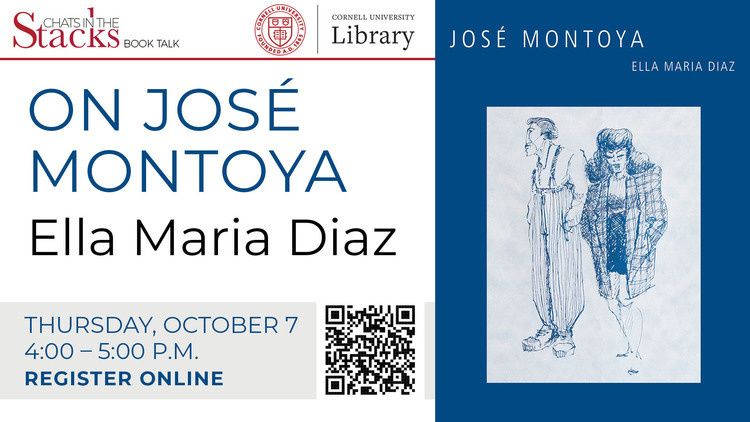
On José Montoya with Ella Maria Diaz
October 7, 2021
4:00 pm
Artist, poet, and musician José Montoya (1932–2013) was a leading figure of the Chicano movement, producing iconic works in many genres, cofounding the art collective Royal Chicano Air Force, and helping to organize for the United Farm Workers, while also teaching at California State University, Sacramento, and establishing the Barrio Art Program there.
In a live, virtual Chats in the Stacks book talk, Ella Maria Diaz, associate professor of Latina/o Studies and Literatures in English, will discuss her recently published book on the life and work of this prominent artist, educator, and activist: José Montoya (Volume 12 of the A Ver Series, UCLA Chicano Studies Research Center Press, 2020). Utilizing oral histories, archival, and digital humanities research, Diaz examines Montoya’s long and diverse career while proposing a new model for the study of Latina/o/x artists who transcend boundaries between art, education, and activism. José Montoya is also a visual delight, richly illustrated with reproductions of Montoya’s art from his collections at the California Ethnic and Multicultural Archives at UC Santa Barbara and other institutional collections.
A live Q&A will follow the talk. The audience is encouraged to submit their questions in the chat.
Additional Information
Program
Einaudi Center for International Studies
Latin American and Caribbean Studies
“Two Missionaries’ Orthographies in Conflict in Curaçao: Papiamentu’s 19th Century Case,” by Gabriel Antunes de Araujo, LACS Weekly Seminar Series, Co-sponsored by the Linguistics Department
November 15, 2021
1:00 pm
In this talk, we will present an orthographic and lexical analysis of three of the first printed documents in Papiamentu, a Portuguese-based Creole spoken in Curaçao: Prefecto Apostolico di Curacao na Cristian di su mision and Catecismo Corticu, both by M. J. Niewindt (1833, 1837, respectively), and Kamiena di Kroes, by J. J. Putman (1850). Our goal is to show that, even though two contemporary Dutch missionaries wrote them, the texts display significant variations, suggesting a quest for an orthographic standard in Papiamentu's earliest stages.
However, these orthographic standards were divergent. On the one hand, Niewdindt's Prefecto Apostolico and Catecismo contain a Hispanicized etymological orthography. On the other hand, Putman's Kamiena shows some influence from Dutch orthography. Consequently, we defend that both writers tried to establish unique orthographic systems for Papiamentu, forming the basis for the models that would end up as the official standardization of the language at the end of the twentieth century. Nevertheless, using a more Hispanicized orthography or one influenced by Dutch reflects its author's world view on Curaçao and the Netherlands as a political unit. At the same time, these two missionaries were able to propose innovations regarding methodology, objectives, recipients and pedagogical strategies that affected profoundly that society. To analyze the convergent and divergent characteristics of the Niewindt and Putman orthographies, we concentrate on the formal relationships between the graphemes in the texts. Our second objective is to study the lexicon of these documents and evaluate the degree of Iberian or Dutch influence on Papiamentu. From the socio-historical viewpoint, in the context of the nineteenth century Curaçao, Niewindt and Putman were living under an increasing influence from The Netherlands, as the influence from Iberia was fading away whilst Curaçao was also becoming more relevant to the Dutch state. However, Curaçao's society remained divided, marked by the scourge of slavery. It should be understood that within the segregated system in Curaçao in the eighteenth and nineteenth centuries, the Jews and the Calvinists neither obliged nor permitted slaves to follow any Jewish or Calvinist rites. Therefore, the Catholic religion practised by slaves was closely linked to their language, Papiamentu (Lampe 2002: 110-3). Thus, we consider that the lexicon of the three texts in Papiamentu is principally Iberian, with an irrelevant number of items of Dutch origin. Hence, the influence of Catholicism on Curaçao was also a linguistic one.
Zoom link: https://cornell.zoom.us/webinar/register/WN_k5ce9mxUS1uw2S5puZSfRg
References
Lampe, Armando. 2001. Mission or submission? Moravian and catholic missionaries in the Dutch Caribbean during the 19th century. Göttingen: Vandenhoeck und Ruprecht.
Niewindt, M. J. 1833 [2001]. Prefecto Apostolico di Curacao na Cristian di su mision. Fac-simile edition. Bloemendaal/Curaçao: Fundashon pa Planifikashon di Idioma/Stichting Libri Antilliani.
Niewindt, M. J. 1837 [2001]. Catecismo corticu pa uso di catolicanan di Curaçao, pa M.J. Niewindt. Curaçao. Fac-simile edition. Curaçao/Bloemendaal: Fundashon pa Planifikashon di Idioma/Stichting Libri Antilliani.
Putman, Jacobus Josephus. 1850 [2001]. Kamiena di kroes: ku historia, meditasjon i orasjon kortiekoe, pa J. J. Putman. Fac-simile edition. Bloemendaal: Stichting Libri Antilliani.
Additional Information
Program
Einaudi Center for International Studies
Latin American and Caribbean Studies
Biden To Tap Crypto, Big-Bank Critic To Run Wall Street Watchdog

Saule Omarova, Law
Saule Omarova, professor of law, is slated to be the nominee to run the Office of the Comptroller of the Currency.
Additional Information
What To Know About Evergande, the Chinese Property Developer Dragging Down Global Markets

Robert Hockett, CRADLE
“In opaque crises like the one now afflicting China’s Evergrande real estate conglomerate, it’s less ‘what you know’ than ‘what you know you don’t know’ that drives financial volatility,” says Robert Hockett, professor of law.
Additional Information
What Happens Now to U.S. Counterterrorism Efforts in Afghanistan?

Sarah Kreps, PACS
Sarah Kreps, professor of government, co-authors this analysis on counterterrorism efforts in Afghanistan with doctoral student Paul Lushenko.
Additional Information
Janet Yellen Faces Climate Test As Environmentalists Push For More Aggressive Financial Action

Eswar Prasad, SAP
Eswar Prasad, professor of economics, says, “If the insurance industry is very exposed to catastrophic events resulting from climate change — and if that was going to cause problems for the broader financial system — then FSOC might have some role to play. Barring that, it’s not obvious what role they should play because ultimately their job is about financial stability.”
Additional Information
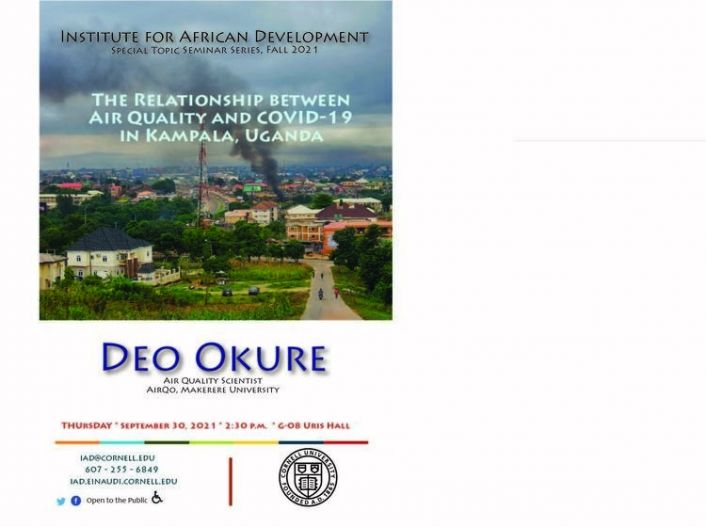
Institute for African Development Seminar Series: The Relationship between Air Quality and COVID-19 in Kampala, Uganda
September 30, 2021
2:40 pm
Issues in African Development Seminar Series examines critical concerns in contemporary Africa using a different theme each semester. The seminars provide a forum for participants to explore alternative perspectives and exchange ideas. They are also a focal activity for students and faculty interested in African development. In addition, prepares students for higher level courses on African economic, social and political development. The presentations are designed for students who are interested in development, Africa’s place in global studies, want to know about the peoples, cultures and societies that call Africa home, and explore development theories and alternate viewpoints on development. -
Additional Information
Program
Einaudi Center for International Studies
Institute for African Development
Impact: Global Public Voices in the Media

See how our Global Public Voices fellows and alumni are expanding the reach of Cornell’s expertise with their media appearances and op-eds.
Additional Information
Lingua Mater Student Competition Deadline
November 8, 2021
5:00 pm
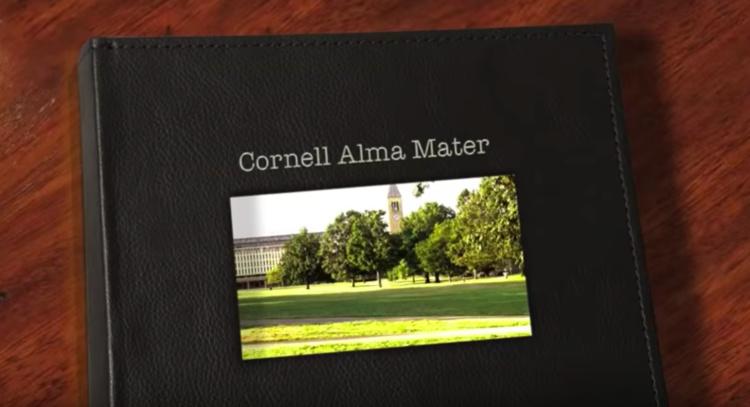
The Lingua Mater competition invites students to translate Cornell's Alma Mater into a different language and submit a video of the performed translation. The inaugural Lingua Mater student competition took place in 2018 as part of Cornell's Global Grand Challenges Symposium. The top three videos received cash prizes.
2021 competition details
Can you translate Cornell’s Alma Mater into your mother tongue (or a language you are learning/have learned at Cornell) and sing it? We invite you to translate “Far Above Cayuga’s Waters” and submit a video of you (and your friends!) performing it somewhere on any of Cornell’s campuses.
Translations do not need to be exact or perfectly in meter but should capture the feel and tune of our university’s Alma Mater. As is customary, include the first verse, refrain, second verse, and refrain in your video submission (for guidance, listen to a performance and read the lyrics).
Video submissions need to be MP4 files at 1920 x 1080 (1080p), in landscape mode with an aspect ratio of 16:9. Please ensure that you have copyright permission for any images/videos you use.
Entries will be reviewed by a panel of judges. Submissions will be judged equally on the translation, the musical quality, and the creativity in visual presentation.
The top three entries will win cash prizes.
Winners will be announced during International Education Week (November 15-19, 2021) and the top three videos will be posted online that week.
Entries may be submitted by any registered Cornell student or group of students.
Submission deadline: Monday, November 8, 2021 at 5 pm ET
SUBMIT YOUR VIDEO AND LYRICS HERE
Please contact Angelika Kraemer, Director of the Language Resource Center, if you have any questions.
The Lingua Mater competition is co-sponsored by the Language Resource Center and the Office of the Vice Provost for International Affairs.
Additional Information
Program
Einaudi Center for International Studies
East Asia Program
Southeast Asia Program
Latin American and Caribbean Studies
South Asia Program
Institute for African Development Seminar Series: The Design and Impact of a Largescale, Diaspora-driven Entrepreneurial Development Intervention: Experiences at the African Unionand Ghana
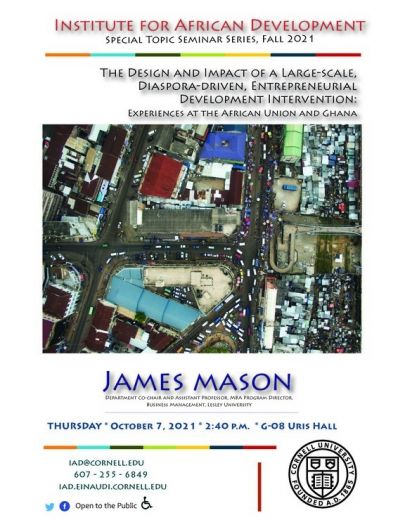
October 7, 2021
2:40 pm
Uris Hall, G-08
In 2019, during Ghana’s “Year of the Return”, a national program of Diaspora Engagement, bearing a letter of recommendation from the Deputy Chair of the African Union, endorsing my work on the “RMDI Project”, I obtained an appointment to meet with HE President Nana Addo Dankwa Akufo-Addo – with the objective of assessing how the RMDI might integrate into the “Year of the Return” framework and objectives.
The RMDI (Retirement Migration Development Intervention) is an Enterprise Systems Engineering construct designed to channel the knowledge, human, and social capital of inbound cohorts of retirees into an agenda of high-leverage development focused entrepreneurial network partnership.
This presentation will provide a high-level walkthrough of the RMDI Enterprise Architecture and provide an overview of my experiences and interactions at the African Union HQ and at the Jubilee House in Ghana. The intention is to share the challenges associated with communicating the design and nuances of a novel and complex development intervention architecture and to share lessons learned and future research.
Register in advance for this meeting:
https://cornell.zoom.us/meeting/register/tJMsd-GtqTwiE90v8J_jtnaK3bS9aN…
Additional Information
Program
Einaudi Center for International Studies
Institute for African Development