
Einaudi Center for International Studies
It's Time to End Vaccine Xenophobia

Migrations Faculty Fellows in The Hill
Gunisha Kaur and Stephen Yale-Loehr argue that to achieve herd immunity, vaccine access should be a basic right.
Additional Information
Investing in China Is Tough Bet To Make

Eswar Prasad, SAP
Eswar Prasad, professor of economics and trade policy, discusses the political risks involved in investing in China.
Additional Information
Is Mexico's Ban on Subcontracting Helping Workers?

Lance Compa, LACS
A new law in Mexico is banning labor subcontracting. Lance Compa, senior lecturer at the ILR School, calls the legislation a “very significant” step. Compa says the experience that Mexico learns from this will be an important lesson for other countries.
Additional Information
Protest Repression and the New Public/Private Federalism

Sidney Tarrow, Einaudi
This op-ed is written by Sidney Tarrow, professor of government and adjunct professor at the Cornell Law School. He argues many state “police protection” anti-protest bills are similar and show signs of having been drafted by a single source.
Additional Information
EMI Conference 2021 | Emerging Market Multinationals: Building the future on ESG excellence
November 5, 2021
8:00 am
Cornell Tech
The Emerging Markets Institute (EMI) was launched in 2010 to broaden global leadership horizons in business research and talent development. Every year, the EMI holds an Annual Conference to bring together business and opinion leaders, academics, and students to discuss emerging markets.
The conference’s key event is the launch of the annual Emerging Markets Multinationals Report, authored by Lourdes Casanova and Anne Miroux. The conference also holds panels discussing business in EMs, an annual case and pitch competition, and prompts thought leadership about the future of EMs.
Please visit the conference website to register and learn more about the event.
Additional Information
Program
Einaudi Center for International Studies
Latin American and Caribbean Studies
Deterritorializing Kashmir: Migration, History and the Literary Ecumene, by Asiya Zahoor
September 13, 2021
11:00 am
Uris Hall, G08
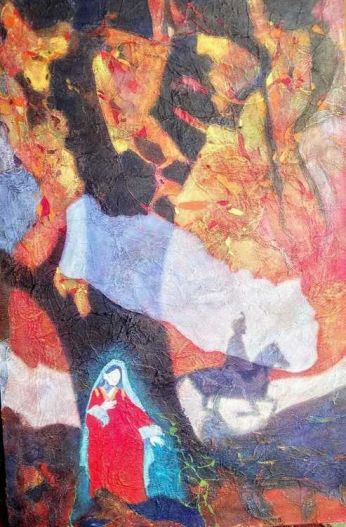
Since 1947, the valley of Kashmir has become synonymous with a territorial dispute. Such is the emphasis on “territorial integrity” in the mediatized discourse on Kashmir, both in the South Asian subcontinent and the west, that the territorializing of the region is hidden under the self-evident notions of nationalism and statecraft. The political narratives on the contestations of sovereignty in the region assume a nexus between territory, state, and sovereignty at the cost of literary imaginaries. These literary imaginaries offer a space for historical thought to begin re-telling and remaking the topography of Kashmir as an instance of multiple histories, temporalities and human geographies. As some of the Kashmiri writers are celebrated in the canon of global English literature, identified by their representativeness of regional territory, their writing reveals an enquiry into how territorialism happens. By focusing on the key Kashmiri writers of the present, I will argue against the forgetting of issues of migration, an alternative subaltern postcolonial history and the solidification of sub-national orientation. These three axes of my argument intersect at the current reality of the political fragments of Kashmir, drawn across subcontinental nationalisms, which require a new imaginary to even begin describing the immense loss of lives, aspirations, languages and cultures of contact that is the Kashmiri condition since the last century.
Asiya Zahoor hails from Baramulla, Kashmir. She studied Caribbean literature, Kashmiri Literature and Psycholinguistics, at the Universities of Kashmir, Jamia Millia Islmia (New Delhi) and Oxford University (UK). Her research explores the issues of migration, representation, identity and cognitive processes involving language learning. Asiya has translated short stories from Kashmiri to English. Her film, The Stitch, has won the Critics’ Award for the Best Short Film at the South Asian Film Festival and Best Short Film at Third Eye Film Festival, Mumbai. It has been an official selection at several international film festivals, including Roshd International festival in Tehran and Sharam Al Sheikh Festival, Egypt. Asiya has curated a website www.bolbosh.net that aims to document the literatures and languages of Kashmir. Her latest book, Serpents under my Veil (2019) is a collection of critically acclaimed poems. Currently, Asiya is a Sanford Taylor Fellow in the Department of Asian Studies at Cornell University.
Additional Information
Program
Einaudi Center for International Studies
South Asia Program
Beyond Borders

Migrations Students in Medium
Hear from Einaudi's undergraduate Migrations scholars as they reflect on questions driving student research at the spring symposium.
Additional Information
The Thespian Experience: Sanskrit Sources on the Emotional Life of Actors, by Daniele Cuneo
September 27, 2021
12:15 pm
Uris Hall, G08
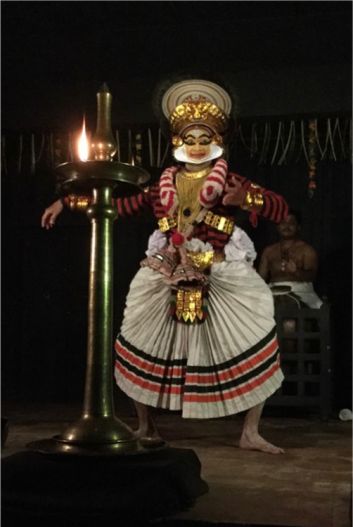
Actors across latitudes and cultures amaze their audiences by displaying at will the physical ‘symptoms’ of emotions such blushing, shivering, and weeping. Sanskrit sources offer almost two millennia of sophisticated reflections on the emotional life of actors, the hidden engine lying behind their almost eerie capacity to emote by exhibiting emotions that they might not even be feeling. In the most commonly known South Asian theory, it is the spectator who is the locus of rasa, the aesthetic experience of blissful savoring that even foreshadows the mystical experience of oneness with the absolute. However, an identical experience in the playwright and its indispensable transmission through the medium of the performer —be it an active or a passive recipient— are also vital aspects of the artistic process. The starting point of my presentation will be the seminal dramaturgical treatise by Bharata, the Nāṭyaśāstra, but the major protagonist will be Abhinavagupta (10th-11th c., Kaśmīr), a tantric master and philosopher who fashioned an innovative synthesis of earlier aesthetic theories. According to his vision, fictional detachment, emotional involvement and dynamic agency are integrated in the figure of the performer and in his liminal and all-encompassing nature of recipient, transmitter, and creator of the elixir of aesthetic experience. Such a mastery over one’s own emotional, mental and bodily sphere —the thespian experience— makes the actor a perfect metaphor and paradigm for the playful freedom of lordship, be it that of Śiva himself, the actor supreme, or of the nobleman, the supreme aesthetic connoisseur.
Daniele Cuneo is ‘maître de conférences' (lecturer) in Sanskrit and Indian Civilization at the Université Sorbonne nouvelle, Paris. After obtaining his PhD at the University of Rome "La Sapienza" under the direction of Raffaele Torella, he worked and taught in the three prestigious universities of Vienna, Cambridge and Leiden. His main areas of research are Sanskrit aesthetics, Philosophy of Language, Tamil Culture, and South Asian Manuscript Studies. Across multiples texts and traditions, it is the cultural imbrication of language and emotions that represents the core of Daniele Cuneo’s historical and philosophical investigation. His publications include several articles on Indian aesthetics and philosophy such as ‘Detonating or Defusing Desire. From Utpaladeva’s Ecstatic Aesthetics to Abhinavagupta’s Ecumenical Art Theory’, Italian translations of the Mānavadharmaśāstra, the seminal work on Sanskrit jurisprudence, and of the Muttoḷḷāyiram, a celebrated collection of Tamil poems from the mid-first millennium, and numerous contributions to the digital catalogue of the Sanskrit manuscript collections at the Cambridge University Library. His current projects focus on the edition, translation, interpretation and study of several Sanskrit texts from late medieval Kashmir (Mukula’s Abhidhāvṛttamātṛkā of Mukula, the unpublished commentary by Sahadeva on Vāmana’s work, and Mammaṭa’s Śabdavyāpāravicāra).
Additional Information
Program
Einaudi Center for International Studies
South Asia Program
International Research Key to Innovation

VP of International Affairs in The Hill
New R&D legislation undercuts innovation by limiting productive collaboration with China, says LASP faculty Wendy Wolford.
Additional Information
Celebration Conversations: Caribbean American Heritage
July 22, 2021
12:00 pm
Celebration Conversations are spaces to celebrate the stories, accomplishments, cultures, and heritages of Cornell staff, centering on historically marginalized voices. These conversations provide opportunities to bring us closer together and create a better understanding of our colleagues at Cornell. We encourage all staff to attend to connect with each other, support their colleagues, and deepen everyone's sense of belonging at Cornell.
All are invited to join us Thursday, July 22 at noon for a fun conversation on the rich culture and heritage of the Caribbean. Bring your dancing shoes!
Register in advance for this meeting:
https://cornell.zoom.us/meeting/register/tJYkcOqgrz0qGtcP_mfuurOMsICnse…
After registering, you will receive a confirmation email containing information about joining the meeting.
Additional Information
Program
Einaudi Center for International Studies
Latin American and Caribbean Studies