
Einaudi Center for International Studies
Amartya Sen: Attacks on Democracy (Bartels World Affairs Lecture)
May 5, 2021
4:30 pm
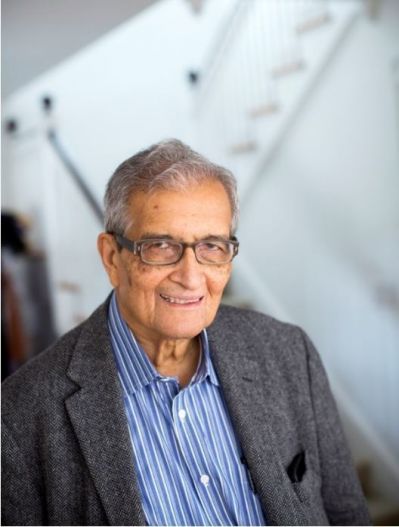
Nobel prize–winning economist Amartya Sen joins Cornell’s Kaushik Basu for the 2021 Bartels World Affairs Lecture, hosted by the Mario Einaudi Center for International Studies.
At the turn of the millennium, many would have said that understanding the need for democracy was the most important change in the world over the preceding century. Yet in the past 20 years, democracy has been treated with contempt and hostility in many parts of the world—including countries in the West (such as Hungary, Poland, and others), but also elsewhere.
It is important to ask why this is happening and how we should deal with it, Sen advises.
“Some countries seem to be undergoing a big transition in this respect, and my own country, India, may be a significant example—despite its being often described as the largest democracy in the world, which in some sense it still is,” Sen said. “As someone who is dismayed by recent developments, I would like to discuss the nature of the problems we may be facing and what can be done about them.”
Sen’s talk, “Attacks on Democracy,” will kick off a discussion with Cornell faculty and students moderated by Basu. Three faculty commentators and audience members, including several students, will join Sen for conversation and Q&A on democratic challenges—and ways forward. The event is part of the Einaudi Center’s democratic resilience global research theme.
Amartya Sen is Thomas W. Lamont University Professor and professor of economics and philosophy at Harvard University. He has served as president of the Econometric Society, American Economic Association, Indian Economic Association, and International Economic Association. Translated into more than 40 languages, Sen’s books include Collective Choice and Social Welfare (1970, 2017), Development as Freedom (1999), Identity and Violence (2006), and The Idea of Justice (2009). Sen’s awards include the Bharat Ratna (India); Commandeur de la Legion d'Honneur (France); National Humanities Medal, George Marshall Award, and Eisenhower Medal (USA); Bodley Medal and Edinburgh Medal (UK); Ordem do Merito Cientifico (Brazil); Aztec Eagle (Mexico); and the Nobel Prize in Economics.
Moderator:
Kaushik Basu is the Carl Marks Professor of International Studies, professor of economics in the College of Arts and Sciences, and former senior vice president and chief economist of the World Bank.
Faculty Commentators:
Robert Hockett, Edward Cornell Professor of Law, Cornell University
Marco Battaglini, Edward H. Meyer Professor of Economics, Cornell University
Rachana Kamtekar, Professor of Philosophy, Cornell University
The Bartels World Affairs Lecture was established in 1984 to foster a broadened worldview among Cornell students, especially undergraduates. The lecture and related events are made possible by the generosity of Henry E. Bartels ’48 and Nancy Horton Bartels ’48.
***
Our hearts are with Cornellians currently in India and South Asia, or with family or friends in the region, during the COVID-19 tragedy. Consider supporting this aid effort led by South Asian students, including Cornellians.
Additional Information
Program
Einaudi Center for International Studies
Southeast Asia Program
Reppy Institute for Peace and Conflict Studies
East Asia Program
Latin American and Caribbean Studies
Institute for African Development
Institute for European Studies
South Asia Program
Witnessing Emergency
Einaudi's Migrations Postdoc Wins ISA Award
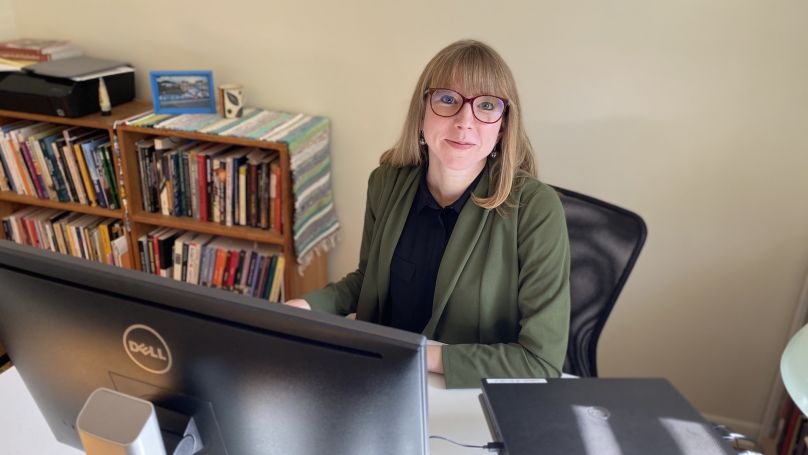
Eleanor Paynter received the International Studies Association’s 2021 Lynne Rienner Publishers Award for Best Dissertation in Human Rights.
Additional Information
April 15: Authoritarian Trends
Roundtable on Democratic Backsliding in Southeast Asia
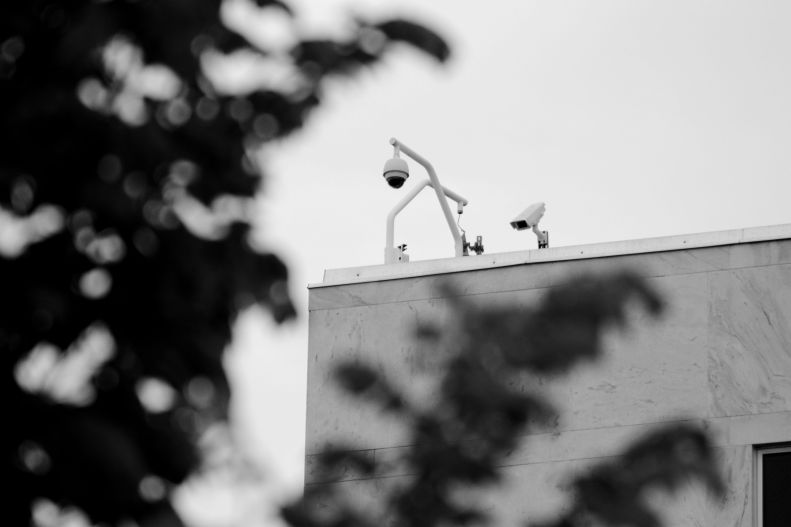
April 15 (8:00 p.m. ET): Experts on the politics of Myanmar, Indonesia, Thailand, and the Philippines discuss rising authoritarianism. Register now!
Additional Information
Musicology Colloquium: David Novak, "Cassette Cultures: Toward a Media Archeology of Popular Music"
April 22, 2021
5:00 pm
Abstract: In this talk, I trace the contemporary circulation of “golden era” 1960s and 1970s Cambodian popular music recordings as a global media archeology. I seek to contextualize and historicize revivals of pre-Khmer Rouge “Cambodian Rock” through the mediated movements of cassette tapes among North American independent labels and the activities of online archivists and heritage centers in present-day Cambodia, as well as in the documentary film Don’t Think I’ve Forgotten, the play Cambodian Rock Band, and the Los Angeles based group Dengue Fever. Drawing from ethnographic interviews with contemporary preservationists and reissue labels in Cambodia, California, Oregon, and Massachusetts, I consider the role of music in memories of genocide and war, the importance of physical materials in the global recognition of Southeast Asian history, and the ethical politics of media access in the transition to a digital archive.
Bio: David Novak is Associate Professor and Director of the Center for the Interdisciplinary Study of Music at the University of California, Santa Barbara. He is the author of Japanoise: Music at the Edge of Circulation (2103) and co-editor of Keywords in Sound (2015). His current book project, Diggers: A Media Archaeology of Global Popular Music, theorizes musical globalization through networks of record and cassette collectors, labels, archives, and digital preservation projects.
https://cornell.zoom.us/meeting/register/tJMqfuCgqjktGNxQYcYzNCDbVwr4pG…
Presented by Music Graduate Association and GPSFAC
Additional Information
Program
Southeast Asia Program
Einaudi Center for International Studies
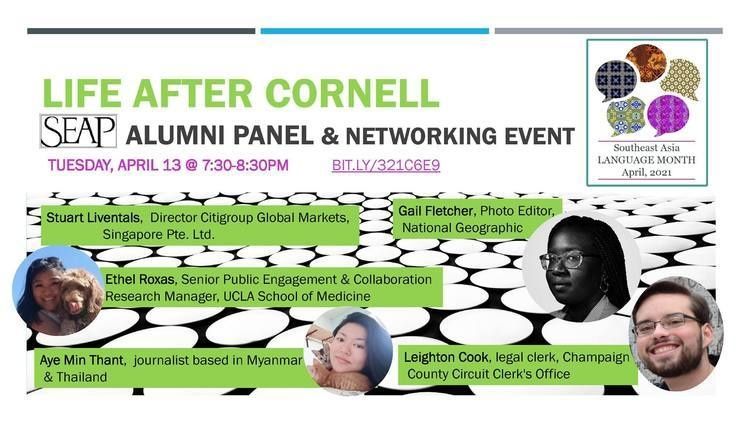
Life After Cornell Part 2 - Alumni Panel & Networking Event
April 13, 2021
7:30 pm
Join us for a panel discussion with SEAP alumni on Life After Cornell, and see where your study of Southeast Asia can take you!
Featured Guests:
Stuart Liventals, Director Citigroup Global Markets, Singapore Pte. Ltd.Gail Fletcher, Photo Editor, National GeographicEthel Roxas, Senior Public Engagement & Collaboration Research Manager, UCLA School of MedicineAye Min Thant, journalist based in Myanmar and ThailandLeighton Cook, legal clerk, Champaign County Circuit Clerk's OfficeThis event is a part of Southeast Asia Language Month! Current Cornell students can participate and compete for a $100 Amazon gift card and other prizes.
1. Download the GooseChase App
2. Enter code 3KX9D9
(or search for "Southeast Asia Language Month")
3. Complete missions and attend events to earn points
Additional Information
Program
Einaudi Center for International Studies
Southeast Asia Program
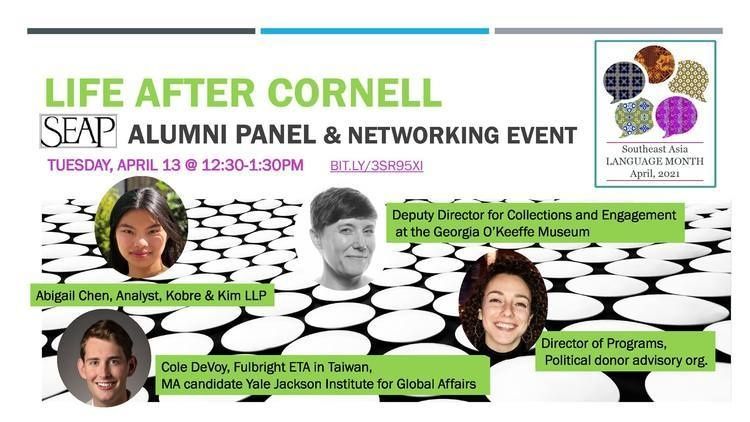
Life After Cornell Part 1 - Alumni Panel & Networking Event
April 13, 2021
12:30 pm
Join us for a panel discussion with SEAP alumni on Life After Cornell, and see where your study of Southeast Asia can take you!
Featured Guests:
Abigail Chen, Analyst, Kobre & Kim LLPJennifer Foley, Deputy Director for Collections and Engagement at teh Georgia O'Keeffe MusuemCole DeVoy, Fulbright ETA in Taiwan, MA candidate Yale Jackson Institute for Global AffairsHadar Sachs, Director of Programs, Mind the Gap 2020This event is a part of Southeast Asia Language Month! Current Cornell students can participate and compete for a $100 Amazon gift card and other prizes.
1. Download the GooseChase App
2. Enter code 3KX9D9
(or search for "Southeast Asia Language Month")
3. Complete missions and attend events to earn points
Additional Information
Program
Einaudi Center for International Studies
Southeast Asia Program
Global PhD Research Awards
Details
Conduct your international field research with a $10,000 award to support fieldwork expenses.
The Einaudi Center’s Amit Bhatia ’01 Global PhD Research Awards fund international fieldwork to help Cornell students complete their dissertations. Through a generous gift from Amit Bhatia, this funding opportunity annually supports at least six PhD students who have passed the A exam. Recipients hold the title of Amit Bhatia ’01 Global PhD Research Scholars. Meet the scholars.
All disciplines and research topics are welcome. Please indicate in your application if your project aligns with one of the Einaudi Center's global research priorities or one of our regional and thematic programs.
Eligibility
Cornell graduate students who have passed the A exam and been admitted to candidacy are eligible to apply. International fieldwork must be a critical component of your dissertation research. You must commit to travel abroad to conduct fieldwork for 9–12 months.
Please note that this award is meant to be supplementary to your primary funding source. This award does not provide tuition credit and requires students to be in absentia. A report is required upon completion.
Amount
$10,000, to be used before the end of the sixth PhD year. The award can cover the following expenses:
- International travel (economy airfare, visa fees)
- Domestic travel within the fieldwork country
- Accommodation and living expenses
- Research expenses (permits, translation costs, internet, archive access, survey costs, lab fees, etc.)
We encourage you to apply for other Cornell and external funding to complement this award, but please note that you are not eligible to apply for Einaudi’s travel grants. If you have already received a travel grant and wish to apply for a Global PhD Research Award, you may return your travel grant if you receive this award.
Please note that you may only bill for a research expense once. If an expense is already covered by this award or a Graduate School research travel grant, you may not use other Cornell or external grants to pay the same expense.
International Travel Approval
All international travel must be registered with the Cornell International Travel Registry. In line with Cornell’s international travel policy, selected students who plan to travel to a country flagged by the US Department of State as a "Level 4: Do not travel," or by the CDC as Level 4 "Special Circumstances," must get their travel plans reviewed and approved via a petition process by the International Travel Advisory & Response Team (ITART). ITART petitions are triggered by rules built into the Travel Registry, so if selected students’ travel requires a petition, the Travel Registry will prompt them for additional information about, and a rationale for, their elevated risk travel plans.
Please be aware that regardless of your destination, approval may be withdrawn if there is a change in the risk level of your destination or if we find that you have violated any contingencies of approval given. In such instances, you will be required to refund the award.
To receive the award, selected students must follow the university’s guidelines to petition for permission to travel internationally, to be submitted no earlier than six weeks and at least two weeks before the scheduled travel. In addition, students must participate in a short, online international travel predeparture orientation course designed by the university’s International Health & Safety team in order to receive travel approval.
Deadline
Applications, recommendation letters, and transcripts are due Friday, March 7, 2025 (11:59 p.m. ET).
How to Apply
Please order your official electronic transcript through the Office of the Registrar (see below); do not send your transcript directly. In the application, you will be asked to provide the following:
- Official electronic transcript (send to programs@einaudi.cornell.edu)
- Abstract of your dissertation project (maximum 150 words)
- Introduction to your dissertation project (maximum 400 words)
- Statement explaining the contribution of your research to existing literature and its relevance to advancing the human condition, planetary sustainability, or other impacts (maximum 400 words)
- Statement about publications that have most significantly informed your research (maximum 100 words)
- Statement explaining your plans for international field research (maximum 600 words)
- International field research budget information
- NetID email address of your recommender (your graduate thesis advisor)
FAQ
More Questions?
Join us for an upcoming information session.
Please email our academic programming staff if you have additional questions about the program or your application.
Additional Information
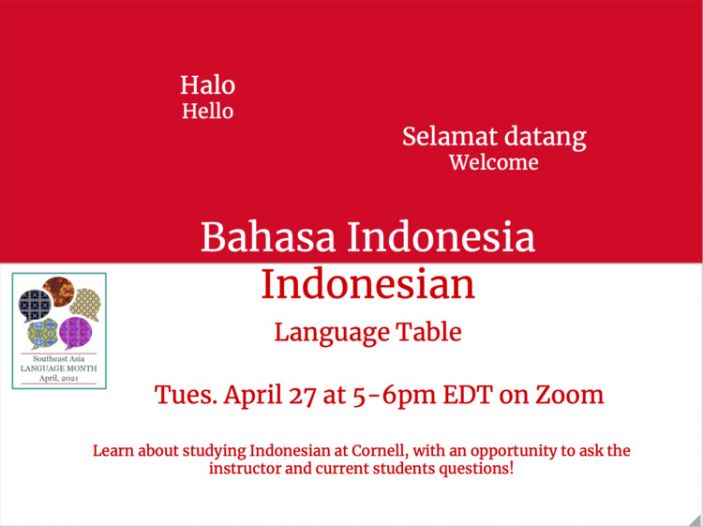
Indonesian Language Table
April 27, 2021
5:00 pm
Learn about studying Indonesian at Cornell, with an opportunity to ask the instructor and current students questions!
This event is a part of Southeast Asia Language Month! To participate and compete for a $100 Amazon gift card and other prizes:
1. Download the GooseChase App
2. Enter code 3KX9D9
(or search for "Southeast Asia Language Month")
3. Complete missions and attend events to earn points
Additional Information
Program
Einaudi Center for International Studies
Southeast Asia Program
Thai Language Table
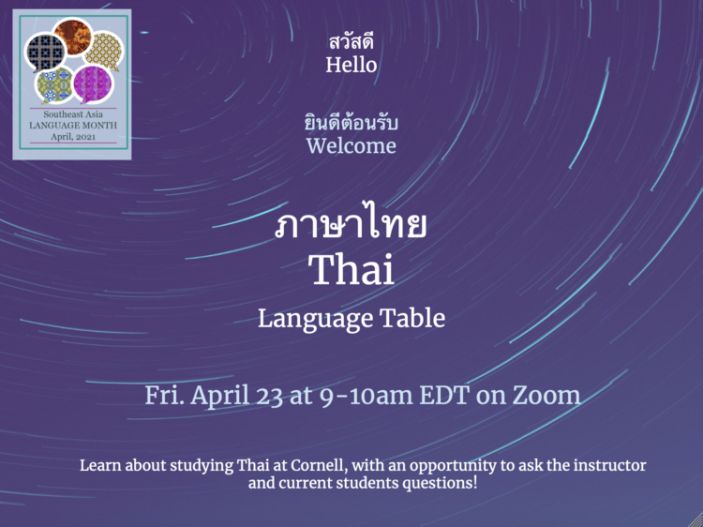
April 23, 2021
9:00 am
Learn about studying Thai at Cornell, with an opportunity to ask the instructor and current students questions!
This event is a part of Southeast Asia Language Month! To participate and compete for a $100 Amazon gift card and other prizes:
1. Download the GooseChase App
2. Enter code 3KX9D9
(or search for "Southeast Asia Language Month")
3. Complete missions and attend events to earn points
Additional Information
Program
Einaudi Center for International Studies
Southeast Asia Program
Vietnamese Language Table
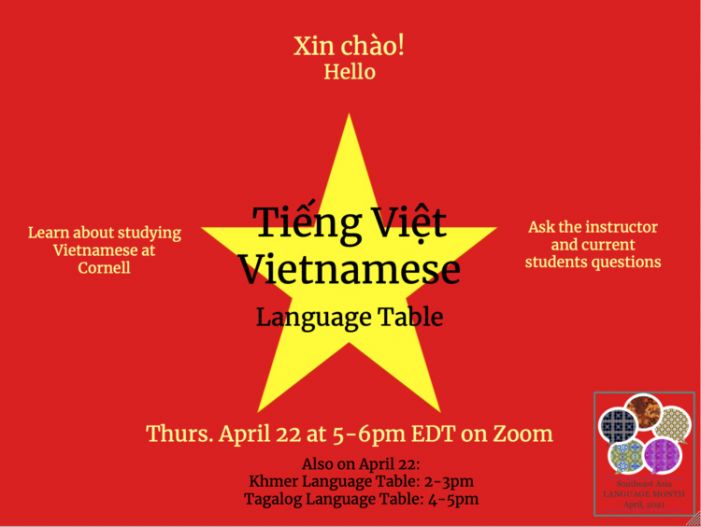
April 22, 2021
5:00 pm
Learn about studying Vietnamese at Cornell, with an opportunity to ask the instructor and current students questions!
Also on April 22:
Khmer Language Table: 2-3pm EDT
Tagalog Language Table: 4-5pm EDT
This event is a part of Southeast Asia Language Month! To participate and compete for a $100 Amazon gift card and other prizes:
1. Download the GooseChase App
2. Enter code 3KX9D9
(or search for "Southeast Asia Language Month")
3. Complete missions and attend events to earn points
Additional Information
Program
Einaudi Center for International Studies
Southeast Asia Program