
Einaudi Center for International Studies
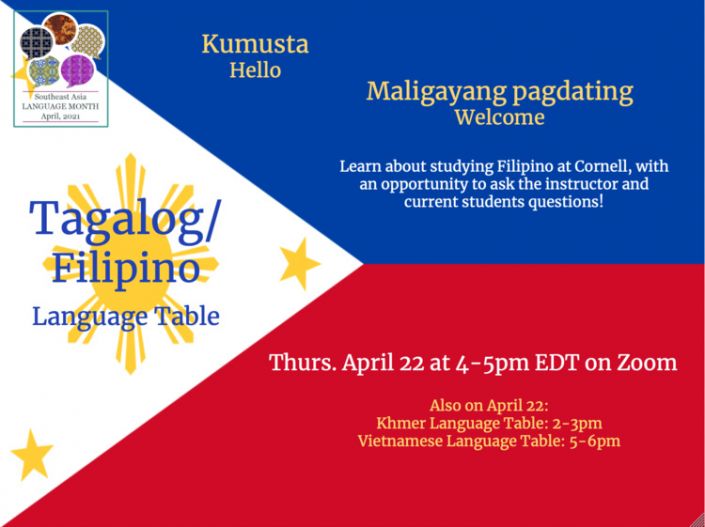
Tagalog/Filipino Language Table
April 22, 2021
4:00 pm
Learn about studying Tagalog at Cornell, with an opportunity to ask the instructor and current students questions!
Also on April 22:
Khmer Language Table: 2-3pm EDT
Vietnamese Language Table: 5-6pm EDT
This event is a part of Southeast Asia Language Month! To participate and compete for a $100 Amazon gift card and other prizes:
1. Download the GooseChase App
2. Enter code 3KX9D9
(or search for "Southeast Asia Language Month")
3. Complete missions and attend events to earn points
Additional Information
Program
Einaudi Center for International Studies
Southeast Asia Program
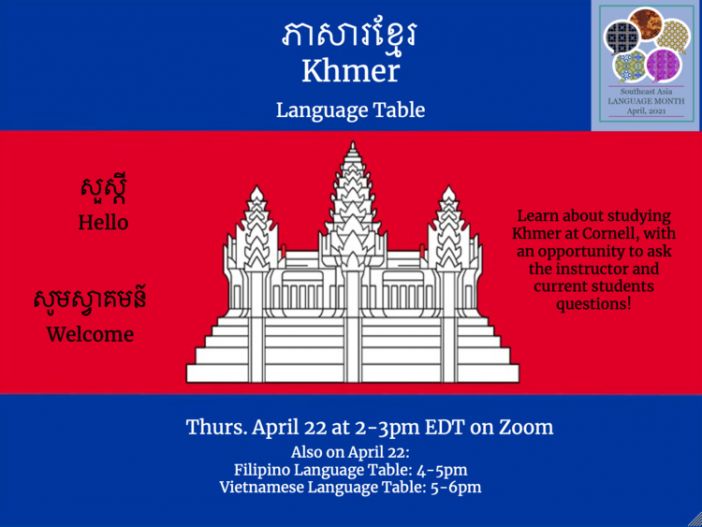
Khmer Language Table
April 22, 2021
2:00 pm
Learn about studying Khmer at Cornell, with an opportunity to ask the instructor and current students questions!
Also on April 22:
Tagalog Language Table: 4-5pm EDT
Vietnamese Language Table: 5-6pm EDT
This event is a part of Southeast Asia Language Month! To participate and compete for a $100 Amazon gift card and other prizes:
1. Download the GooseChase App
2. Enter code 3KX9D9
(or search for "Southeast Asia Language Month")
3. Complete missions and attend events to earn points
Additional Information
Program
Einaudi Center for International Studies
Southeast Asia Program
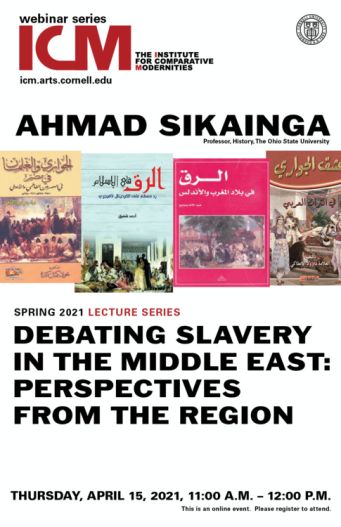
Ahmad Sikainga, Debating Slavery in the Middle East: Perspectives from the Region
April 15, 2021
11:00 am
Scholars interested in the study of slavery in the Middle East have often lamented that the subject has received little attention within the region itself, particularly in the Arab world. Indeed, slavery has remained a sensitive subject in many Middle Eastern societies. However, during the past few decades, a significant body of literature in Arabic language has emerged. A few local academics, public intellectuals, writers, artists, and activists have written about various aspects of slavery and its legacy in the region, including the attitude of Islam towards slavery, abolition, and the experiences of certain categories of enslaved people such as eunuchs, enslaved women, slave soldiers, singers, and performers. The subject has also figured prominently in several literary and artistic works such as novels, film, and theatre. This presentation will shed light on some of these writings, the way in which academics and non-academics from the region have approached and engaged the subject, and the extent to which their perspectives would enhance and contribute to the current debate on slavery and its legacy in Middle Eastern societies.
Additional Information
Program
Einaudi Center for International Studies
The Future of Tech in India: Leveraging Digitalization for Inclusive Growth
April 22, 2021
12:00 pm
Over the last decade, India has become the fifth-biggest economy in the world, taking an innovative approach to digitalization with the unique combination of large-scale diffusion of bank accounts for the unbanked, a nationwide biometric database for 1.3 billion citizens, and the widespread adoption of mobile technology — now second largest in the world with over 600 million subscribers.
Despite being hit hard by the pandemic, India’s digital success is now enabling the economy to rebound sharply while also ushering in new business models across a range of sectors, such as financial payments and healthcare.
The Emerging Market Webinar Series, organised by Cornell's Emerging Markets Institute, invites a distinguished panel of experts to discuss how digital transformation is a key enabler for sustainable and inclusive growth in India.
Speakers
Lourdes Casanova, Senior Lecturer, Cornell SC Johnson College of BusinessSaurabh Agrawal, Executive Director and Group CFO, Tata SonsShobana Kamenini, Executive Vice Chairperson, Apollo Hospitals Enterprises Ltd.Soumitra Dutta, Professor of Management and Former Founding Dean, Cornell SC Johnson College of BusinessModerator: Vinit KR Khicha, EMI Fellow and FT MBA '21
Additional Information
Program
Einaudi Center for International Studies
Latin American and Caribbean Studies
South Asia Program
Migrations Summer Institute
Apply by May 14
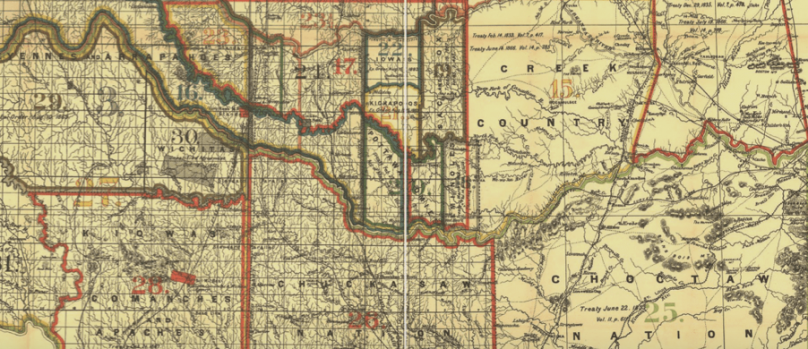
Early career? Apply to join our inaugural summer institute on July 12–23: Cartographies of Racial Justice Beyond Borders. $2,000 stipend.
Additional Information
Inequality and Dispossession

Plantationocene Conference Examined Plantations’ Legacies
Watch conference videos featuring 40 panelists from around the world.
Additional Information
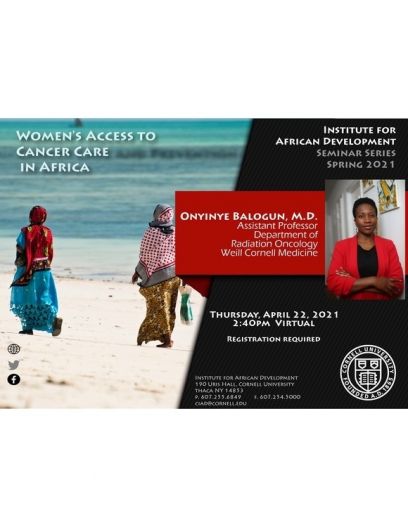
Institute for African Development Seminar: Women's Access to Cancer Care in Africa
April 22, 2021
2:40 pm
Issues in African Development Seminar Series examines critical concerns in contemporary Africa using a different theme each semester. The seminars provide a forum for participants to explore alternative perspectives and exchange ideas. They are also a focal activity for students and faculty interested in African development. In addition, prepares students for higher level courses on African economic, social and political development. The presentations are designed for students who are interested in development, Africa’s place in global studies, want to know about the peoples, cultures and societies that call Africa home, and explore development theories and alternate viewpoints on development.
Additional Information
Program
Einaudi Center for International Studies
Institute for African Development
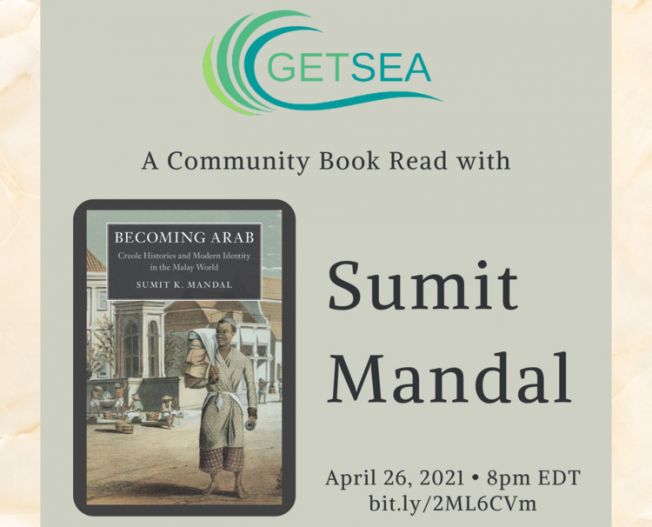
Becoming Arab: A Community Book Read with Sumit Mandal
April 27, 2021
8:00 pm
A community book read with Sumit Mandal, author of Becoming Arab: Creole Histories and Modern Identity in the Malay World and winner of the 2020 Benda Prize. This read is organized by the consortium for Graduate Education and Training in Southeast Asian Studies (GETSEA).
Sumit Mandal is a historian at the University of Nottingham Malaysia. He is currently doing research on Muslim shrines as inscriptions in the landscape of transregional histories of the Malay world. He is working towards a book from this research that is tentatively titled “Saints of the Southern Indian Ocean: Sacred Geographies, Popular Faith Practices, and the Politics of Islam from Jakarta to Cape Town.”
As the AAS Southeast Asia Council (SEAC) describes it: Sumit Mandal’s Becoming Arab: Creole Histories and Modern Identity in the Malay World (2018) is a powerful and important work of history, the result of prodigious archival research. Beyond its importance in challenging conventional understandings of the category ‘Arab’ in the Malay world, it suggests new ways of thinking about the project of colonial racial categorization more broadly. Mandal importantly argues that most scholarship assumes that racial categorizations deployed in postcolonial nations stemmed from colonial practices aimed at dividing populations in order to rule them. He upends this argument by breaking down what the category, Arab, meant in historical contexts prior to, during, and after Dutch colonial rule. In particular, Mandal’s argument that colonial racial categories are not ‘totalizing’ but are subject to reinterpretation and subversion, encourages the reader to think hard about the historical processes through which such racial categories come to exist, and shift over time. Working from Malay, Dutch, French, and English language sources, this is a book whose importance will center the field of Southeast Asian studies in broader conversations about creole histories and racializing area studies.
Additional Information
Program
Einaudi Center for International Studies
Southeast Asia Program
A Critical Exploration of Language Access and Equity with Fatema Sumar and Angelika Kraemer
April 7, 2021
3:00 pm
Register here:
https://cornell.zoom.us/webinar/register/WN_40g5rX84SNK4QwQSch1jbg
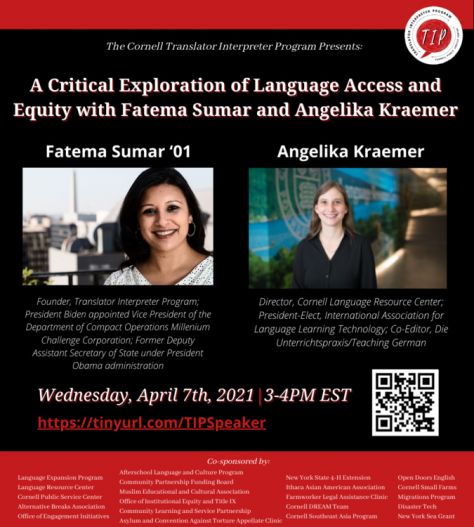
The Translator Interpreter Program (TIP) is facilitating an online discussion, “A Critical Exploration of Language Access and Equity with Fatema Sumar and Angelika Kraemer,” featuring Fatema Sumar ‘01, the founder of TIP and President Biden-appointed Vice President of the Department of Compact Operations at the Millennium Challenge Corporation, and Angelika Kraemer, the faculty advisor of TIP and Director of the Language Resource Center at Cornell. The Translator Interpreter Program is a student-run program of the Cornell University Public Service Center, providing free translation and interpretation services in a wide range of languages for the community agencies in emergency and non-emergency situations.
Additional Information
Program
Einaudi Center for International Studies
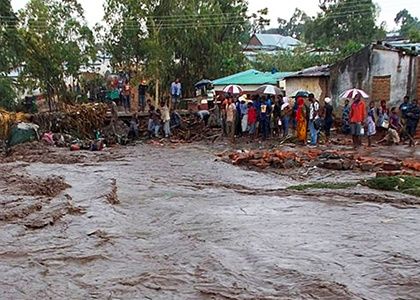
Verdant Views: Global Climate Stories
April 22, 2021
3:00 pm
Our changing climate poses great challenges for humanity around the world: extreme weather events, sea level rise, flooding, drought, wildfires and more. How are countries in areas most affected by climate change responding to these and other challenges? In honor of Earth Day 2021, this special edition of Verdant Views will feature current Fellows in Cornell’s Hubert H. Humphrey Fellowship Program, sharing stories of the challenges and choices they face in their home countries, and actions being taken in response to this global crisis. Presented in partnership with the Hubert H. Humphrey Fellowship Program and the CALS Department of Global Development.
Participating Humphrey Fellows:
Husnain Afzal, Executive Engineer (Civil) at Pakistan Water & Power Development Authority (WAPDA)
Saukira Banda, Former Communication and Knowledge Management Officer for 'Pilot Program for Climate Resilience Project' in Environmental Affairs Department, Ministry of Forestry and Natural Resources, Malawi
Natalya Minchenko, Sustainable Development Goals advisor, UNDP/UNICEF/UNFPA project on 2030 Agenda, Minsk, Belarus
Alma Perez, Agricultural Production Manager, La Paz Department, Project ACS USAID at FINTRAC, Honduras
This live webinar is free but pre-registration is required. Please register through the "Register" button on this page, or the following link: https://cornell.zoom.us/webinar/register/WN_qPWPrfsYRHuT34O4o5rCDw
After registering, you will receive a confirmation email containing information about joining the webinar. The webinar will be recorded and available for viewing online after the live broadcast. Participants in the live presentation will have the opportunity to pose questions.
Verdant Views is a monthly webinar series hosted by Kevin Moss of Cornell Botanic Gardens. Each episode focuses on a different topic related to plants, gardens, conservation, sustainability, and the vital connections between plants and peoples around the world.
Earth Day is an international event held annually on April 22 to raise awareness and demonstrate support for environmental protection, with a major focus on climate action. First held on April 22, 1970, it now includes a wide range of events coordinated globally by EARTHDAY.ORG (formerly Earth Day Network).
Additional Information
Program
Einaudi Center for International Studies
Latin American and Caribbean Studies
Institute for African Development
Institute for European Studies
South Asia Program