
Einaudi Center for International Studies
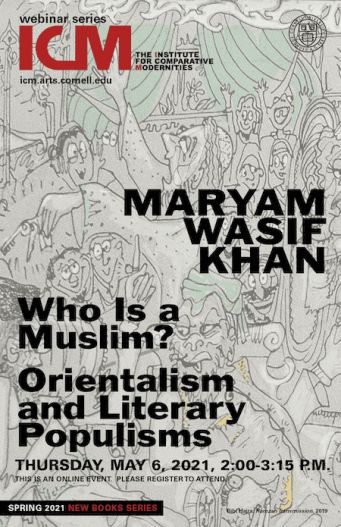
Maryam Wasif Khan, "Who Is a Muslim: Orientalism and Literary Populisms"
May 6, 2021
2:00 pm
This conversation with Maryam Wasif Khan is part of ICM's Spring 2021 New Books Series. Who Is a Muslim? argues that modern Urdu literature, from its inception in colonial institutions such as Fort William College, Calcutta, to its dominant iterations in contemporary Pakistan—popular novels, short stories, television serials—is formed around a question that is and historically has been at the core of early modern and modern Western literatures. The question “Who is a Muslim?,” a constant concern within eighteenth-century literary and scholarly orientalist texts, the English oriental tale chief among them, takes on new and dangerous meanings once it travels to the North-Indian colony, and later to the newly formed Pakistan. A literary-historical study spanning some three centuries, this book argues that the idea of an Urdu canon, far from secular or progressive, has been shaped as the authority designate around the intertwined questions of piety, national identity, and citizenship.
Additional Information
Program
Einaudi Center for International Studies
South Asia Program
Digital Enclosure and Unfreedom in Northwest China

May 6, 2021
11:25 am
Darren Byler, University of Washington, discusses the working paper "Digital Enclosure and Unfreedom in Northwest China."
The author will join for a conversation about their work. No formal presentation will be given; please read in advance. A link to the reading will be sent with the registration confirmation.
Part of the Reppy Institute for Peace and Conflict Studies (PACS) seminar series.
Co-sponsored by the Departments of Anthropology and Science & Technology Studies (STS).
About the author
Darren Byler is a postdoctoral researcher in the ChinaMade project at the University of Colorado, Boulder. He received his PhD from the Department of Anthropology at the University of Washington in 2018. His research focuses on Uyghur dispossession, infrastructural power and "terror capitalism" in the city of Ürümchi, the capital of Chinese Central Asia (Xinjiang). He has published research articles in the Asia-Pacific Journal, Contemporary Islam, Central Asian Survey, the Journal of Chinese Contemporary Art and contributed essays to volumes on ethnography of Islam in China, transnational Chinese cinema and travel and representation. He has provided expert testimony on Uyghur human rights issues before the Canadian House of Commons and writes a regular column on these issues for SupChina. In addition, he has published Uyghur-English literary translations (with Mutellip Enwer) in Guernica and Paper Republic. He also writes and curates the digital humanities art and politics repository The Art of Life in Chinese Central Asia, which is hosted at livingotherwise.com.
About the working paper
The author explains: "In my work I use the conceptual framing of a digital enclosure to consider the way Uyghur and Kazakh societies in Northwest China have been enveloped by a surveillance system over the past decade. I show how novel enclosures are produced and, in turn, construct new frontiers in capital accumulation and state power. The Turkic Muslim digital enclosure system gives technology companies and state authorities abilities to watch and control the movements and behavior of Muslims in increasingly intimate ways, turning them into an unfree proletariat--a docile yet productive permanent underclass."
Artwork by the artist Badiucao. Used with permission.
Additional Information
Program
Einaudi Center for International Studies
Reppy Institute for Peace and Conflict Studies
East Asia Program
Migration at the US-Mexico Border During the Biden Era with Journalist Alice Driver
May 3, 2021
4:30 pm
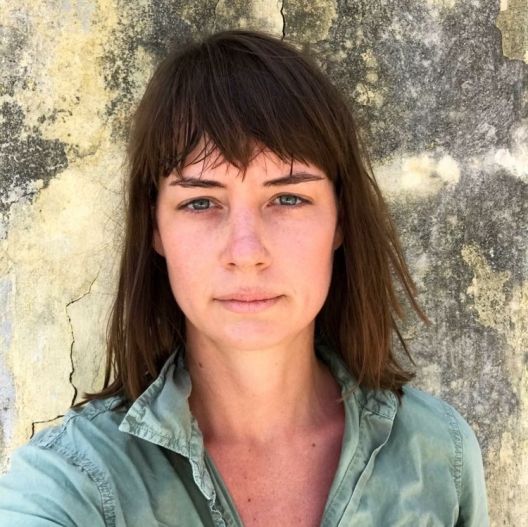
Journalist and translator Alice Driver is joining the Latin American Studies Program seminar series to share her work on migration, human rights, and gender equality.
Alice Driver is a writer and investigative journalist who covers immigration and labor rights. She is based in Mexico City, and she is the author of More or Less Dead (University of Arizona Press, 2015). Her journalism has been published by National Geographic, Time, CNN, and Oxford American. She has recently collaborated on migration projects with Chinese neorealist painter Liu Xiaodong, National Geographic photographer John Stanmeyer, and Noble laureates Jody Williams, Shirin Ebadi, Tawakkol Karman, and Rigoberta Menchú.
Currently based in Mexico City, Driver is the author of More or Less Dead: Feminicide, Haunting, and the Ethics of Representation in Mexico (University of Arizona 2015). She received a 2017 Images and Voices of Hope Restorative Narrative Fellowship and 2017 Foreign Policy Interrupted Fellowship and also participated in the Women's Media Center Progressive Women’s Voices 2017 media and leadership training program.
Driver has received first aid training for combat and wilderness wounds through Reporters Instructed in Saving Colleagues (RISC) and from the DART Center and Columbia Journalism School course on Reporting Safely in Crisis Zones. She is currently partnering with Longreads Originals to produce a series of articles on migration in Central America. Buzzfeed recently included her work in "8 Visual Stories That Will Challenge Your View of the World."
This Latin American Studies Program (LASP) event is co-sponsored by the Migrations initiative.
Additional Information
Program
Einaudi Center for International Studies
Latin American and Caribbean Studies
Race and Racism Across Borders
Nyabola, Students, Reflect on Border Crossings
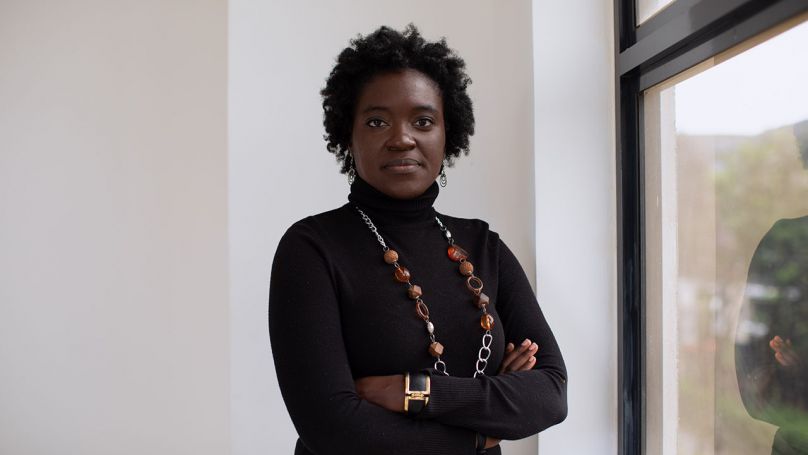
April 12: Writer and activist Nanjala Nyabola joins Einaudi/Migrations panel. Cornell students share original writing and visual art. Register now!
Additional Information
Burmese Language Table
April 20, 2021
12:00 pm
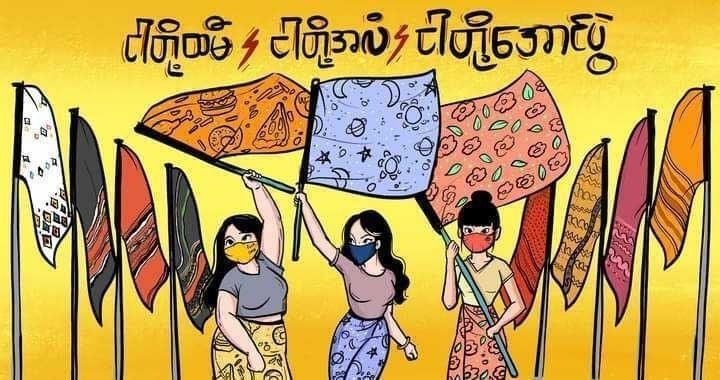
Learn about studying Burmese at Cornell, with an opportunity to ask the instructor and current students questions!
This event is a part of Southeast Asia Language Month! To participate and compete for a $100 Amazon gift card and other prizes, follow the steps below. This competition is only for current Cornell students.
1. Download the GooseChase App
2. Enter code 3KX9D9
(or search for "Southeast Asia Language Month")
3. Complete missions and attend events to earn points
Additional Information
Program
Einaudi Center for International Studies
Southeast Asia Program
DJs, Linnaeus, and Plantations
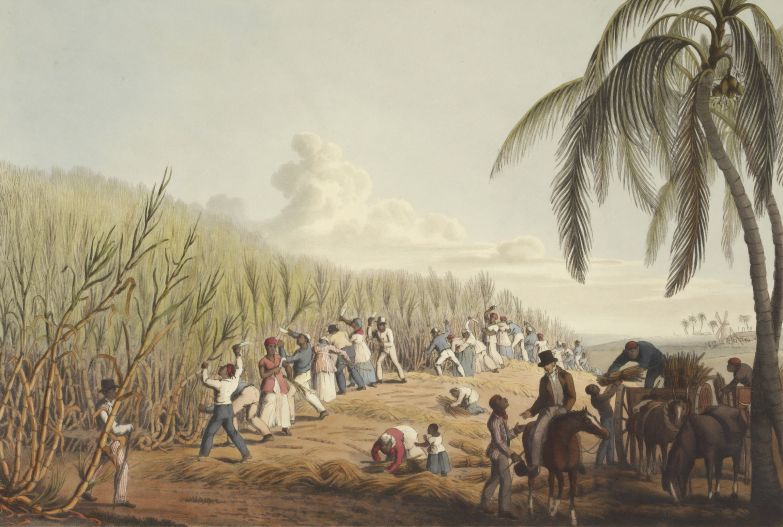
Goffe Studies Afterlives of European Colonialism
Global Public Voices fellow Tao Leigh Goffe: "You can’t understand ecological crisis without understanding racial crisis.”
Additional Information
Institute for African Development Seminar: Public health and its others: Exploring the politics and culture of AIDS and Ebola in West Africa
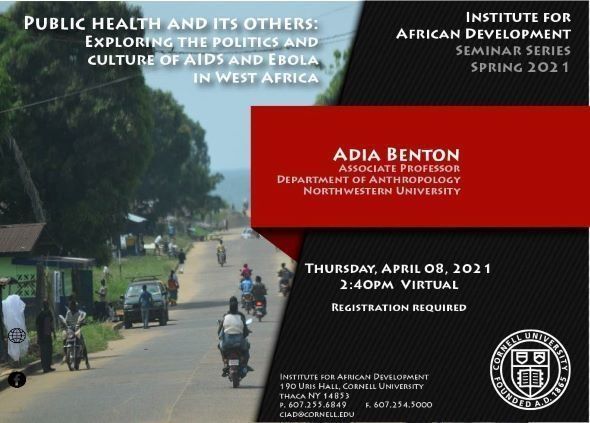
April 8, 2021
2:40 pm
Issues in African Development Seminar Series examines critical concerns in contemporary Africa using a different theme each semester. The seminars provide a forum for participants to explore alternative perspectives and exchange ideas. They are also a focal activity for students and faculty interested in African development. In addition, prepares students for higher level courses on African economic, social and political development. The presentations are designed for students who are interested in development, Africa’s place in global studies, want to know about the peoples, cultures and societies that call Africa home, and explore development theories and alternate viewpoints on development.
Additional Information
Program
Einaudi Center for International Studies
Institute for African Development
A Conversation on the Plantationocene

April 16, 2021
9:00 am
This virtual conference, sponsored by the Mario Einaudi Center for International Studies and Migrations: A Global Grand Challenge, brings together a diverse group of scholars, activists, and practitioners to discuss the role that plantations and plantation agriculture have played in shaping the nature, structure, and dynamics of the modern era.
Although plantations have long been the subject of study, the Plantationocene as a concept emerged only in the past few years to describe the role of racialized, large-scale plantation agriculture in establishing a world system that to this day lives with the legacy and continuation of slavery, forced migration, dispossession and mono-crop extractive agriculture intended for export production. The article below serves as a frame for the conversation:
Wolford, Wendy, 2021 “The Plantationocene: A Lusotropical Contribution to the Theory,” Annals of the American Association of Geographers, early view online.
Over two days of roundtable discussions (April 15-16), scholars and activists from a variety of disciplines of critical social theory and practice, including agrarian studies, political ecology, development studies, black geographies and feminist theory, will discuss the Plantationocene and to what extent this conceptional framework may be useful—not just for analytical purposes, but also for activism and practice.
Explore the schedule and presentersRegister nowThe conference is available in Portuguese through simultaneous interpretation on the same Zoom channel. All sessions will be recorded.
Moderator:
Wendy Wolford, Robert A. and Ruth E. Polson Professor, Department of Global Development, Cornell University
Panelists:
Gerard Aching, Professor of Africana and Romance Studies, Cornell UniversityYasmine Ahmed, Postdoctoral teaching fellow, The American University in CairoSarah Besky, Associate Professor of Industrial and Labor Relations, Cornell UniversityRachel Bezner-Kerr, Professor of Global Development, Cornell UniversityJun Borras, Professor of Agrarian Studies, Institute of Social Studies, Erasmus University, the HagueNatacha Bruna, PhD candidate, International Institute of Social Studies (ISS), Erasmus University, the Hague Judith Carney, Professor of Geography, University of California, Los AngelesSophie Chao, Postdoctoral Research Associate, University of SydneySharad Chari, Associate Professor of Geography, University of California, BerkeleyYoujin Chung, Assistant Professor of Energy and Resources Group and Environmental Science, Policy, and Management, University of California, BerkeleyAndrew Curley, Assistant Professor of Geography, University of ArizonaMary Jo Dudley, Director of the Cornell Farmworker Program, Cornell UniversityChristopher Dunn, Elizabeth Newman Wilds Executive Director of Cornell Botanic Gardens, Cornell UniversityDivya Dutta, Researcher, Oxfam America and Oxfam Great BritainJennifer Franco, Activist and Researcher at the Transnational Institute (TNI), the HagueShannon Gleeson, Professor of Labor Relations, Law, and History, Cornell UniversityJenny Goldstein, Assistant Professor of Global Development, Cornell UniversityEuclides Gonçalves, Director and Researcher, Kaleidoscopio, Research in Public Policy, MozambiqueCarla Gras, Researcher and Professor of Sociology, University of Buenos AiresJulie Guthman, Professor of Social Sciences, University of California, Santa CruzShalmali Guttal, Executive Director, Focus on the Global South, BangkokTania Murray Li, Professor of Anthropology, University of TorontoJuliet Lu, Postdoctoral Research Fellow, Cornell Atkinson Center for SustainabilityFouad Makki, Associate Professor of Global Development, Cornell UniversityPriscilla McCutcheon, Assistant Professor of Geography, University of KentuckyPhilip McMichael, Professor of Global Development, Cornell UniversityGregg Mitman, Vilas Research and William Coleman Professor of History of Science, Medical History, and Environmental Studies, University of Wisconsin, MadisonSharlene Mollett, Distinguished Professor in Feminist Cultural Geography, Nature and Society and Associate Professor of Geography, University of TorontoJoão Mosca, Director, Observatório do Meio Rural, Maputo Andrew Ofstehage, Postdoctoral Associate, Cornell UniversityKasia Paprocki, Assistant Professor of Geography and Environment, London School of Economics and Political ScienceDeniz Pelek, Postdoctoral Researcher in the MIGRADEMO Project, Universitat Autònoma de BarcelonaNancy Peluso, Professor of Society and Environment and Chair of the Center for Southeast Asian Studies, University of California, BerkeleyPrabhu Pingali, Professor of Applied Economics and Policy, Cornell UniversityRachel Beatty Riedl, John S. Knight Professor of International Studies and Director of the Einaudi Center, Cornell UniversityCaitlin Rosenthal, Associate Professor, History, University of California, BerkeleySergio Sauer, Professor in the Center for Sustainable Development, University of BrasíliaJudite Stronzake, Activist in the Movement of Landless Workers (MST), Brazil and Professor of Education, Universidade Federal da Grande DouradosEric Tagliacozzo, John Stamburgh Professor, Department of History, Cornell UniversityAnna Tsing, Professor of Anthropology, University of California, Santa CruzMichael Watts, Chancellor’s Professor of Geography Emeritus, and Co-Director of Development Studies, University of California, BerkeleyWendy Wolford, Robert A. and Ruth E. Polson Professor of Global Development, Cornell UniversityYunan Xu, Post-doctoral researcher, International Institute of Social Studies (ISS), Erasmus University RotterdamJohn Aloysius Zinda, Assistant Professor, Global Development, Cornell University
Additional Information
Program
Einaudi Center for International Studies
Latin American and Caribbean Studies
Institute for African Development
Institute for European Studies
South Asia Program
Race and Racism Across Borders
April 12, 2021
11:00 am
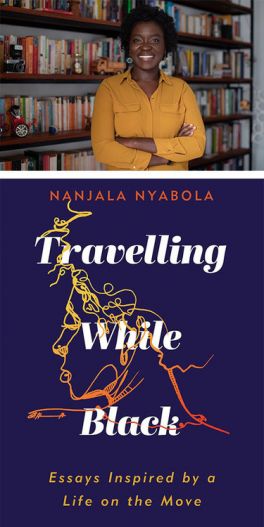
Keynote Speaker: Nanjala Nyabola
Cornell Students: Critical Reflections
Nanjala Nyabola, author of Travelling While Black-Essays Inspired by a Life on the Move, will be in conversation with professors Rachel Beatty Riedl, Kim Yi Dionne, and postdoc Eleanor Paynter.
Nanjala Nyabola is a writer, political analyst, and activist based in Nairobi, Kenya. Nyabola writes extensively about African society and politics, technology, international law, and feminism for academic and non-academic publications. Her first book, Digital Democracy, Analogue Politics: How the Internet Era is Transforming Politics in Kenya (Zed Books, 2018), was described as "a must-read for all researchers and journalists writing about Kenya today." Nyabola's ground-breaking work opens up new ways of understanding the current global online era, reframing digital democracy from the African perspective.
Nyabola’s latest book, the critically acclaimed Travelling While Black; Essays Inspired by a Life on the Move, (available electronically from the Cornell Library) is a stark reminder that the world needs to be seen through the lens of others. Her work has featured in publications including African Arguments, Al Jazeera, Financial Times, Foreign Affairs, Foreign Policy (magazine), The Guardian, New African, The New Humanitarian, The New Inquiry, New Internationalist, and World Policy Journal.
Nyabola holds a BA in African studies and political science from the University of Birmingham, an MSc in forced migration and an MSc in African studies from the University of Oxford, which she attended as a Rhodes Scholar, and a JD from Harvard Law School.
Following the dialogue, students will present select prose, poems, and visual art published as part of Global Cornell's Race and Racism Across Borders, a call that asked students and alumni to reflect on the new knowledge gained about racial dynamics when they crossed a literal or figurative border.
Register Now
Additional Information
Program
Einaudi Center for International Studies
Reppy Institute for Peace and Conflict Studies
East Asia Program
Southeast Asia Program
Latin American and Caribbean Studies
Institute for African Development
Institute for European Studies
South Asia Program
Predictive Policing and Everyday Police Work
April 29, 2021
11:25 am
Simon Egbert and Matthias Leese discuss their book Criminal Futures: Predictive Policing and Everyday Police Work, out via Routledge in 2020.
The authors will join for a conversation about their work. No formal presentation will be given; please read in advance. A link to the reading will be sent with the registration confirmation and the book is also available open access.
Part of the Reppy Institute for Peace and Conflict Studies (PACS) seminar series.
Co-sponsored by the Department of Science & Technology Studies (STS).
Additional Information
Program
Einaudi Center for International Studies
Reppy Institute for Peace and Conflict Studies